What happens when head and neck cancer continues to progress despite chemotherapy and immunotherapy?
For patients with recurrent or metastatic head and neck squamous cell carcinoma (HNSCC), that question has often come with few encouraging answers. Once standard treatments stop working, the remaining options are limited, and the disease can threaten some of the most fundamental aspects of daily life: speaking, swallowing, eating, and even breathing.
Now, after a decade without a newly approved drug in this post-platinum setting, there is a new option.
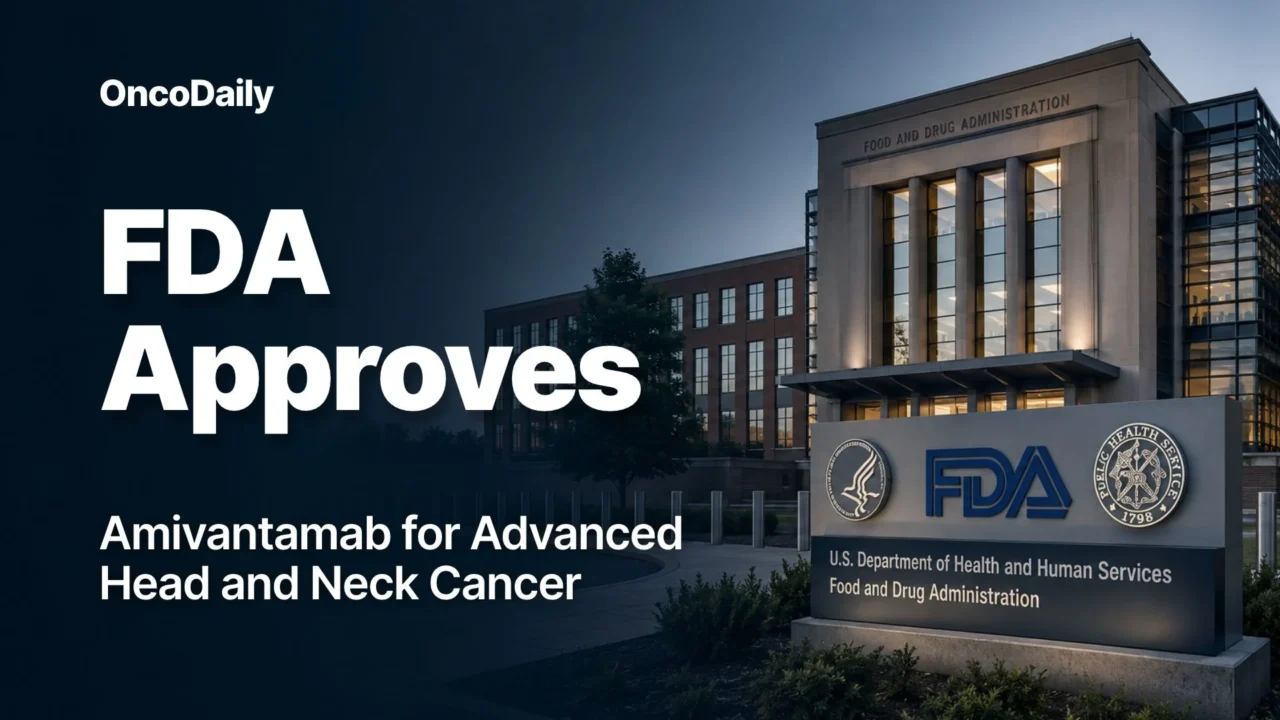
On November 5, 2026, the U.S. Food and Drug Administration (FDA) granted accelerated approval to amivantamab and hyaluronidase-lpuj (Rybrevant Faspro), developed by Johnson & Johnson’s Janssen Biotech, for certain adults with recurrent or metastatic HNSCC whose disease has progressed following platinum-based chemotherapy and PD-1/PD-L1 immunotherapy.
The decision was driven by results from the Phase 1b/2 OrigAMI-4 trial, in which 42% of patients experienced tumor shrinkage or disappearance, including complete responses in 15%.
For a population in which available therapies have historically produced response rates of approximately 20% or less, the findings offer an encouraging signal, although a direct comparative benefit has not yet been established.
Why This FDA Approval Matters
Head and neck squamous cell carcinoma is a biologically complex disease that can arise in several anatomical sites, including the oral cavity, pharynx, and larynx.
While immune checkpoint inhibitors have changed the treatment landscape for recurrent or metastatic HNSCC, many patients eventually experience disease progression.
After platinum-based chemotherapy and immunotherapy, oncologists have often relied on treatments such as taxanes or cetuximab, with modest response rates and limited survival outcomes.
The newly approved treatment offers something different: simultaneous targeting of two signaling pathways implicated in tumor growth and treatment resistance.
Angelo De Claro, MD, Director of the FDA’s Oncology Center of Excellence, described the approval as a meaningful advance for patients with limited treatment options, adding that the therapy offers:
“This therapy offers patients and their physicians a new option with the potential to make a real difference in people’s lives.”
Importantly, the approval is restricted to patients previously treated with platinum-based chemotherapy and an anti-PD-1 or anti-PD-L1 antibody. It does not include patients with HPV-associated oropharyngeal squamous cell carcinoma, as determined by p16 testing.
OrigAMI-4: What Did the Trial Actually Show?
The approval is supported by the OrigAMI-4 trial (NCT06385080), an open-label, multicenter Phase 1b/2 study evaluating subcutaneous amivantamab in previously treated recurrent or metastatic HNSCC.
The pivotal cohort enrolled 102 patients who had already received platinum-based chemotherapy and immunotherapy.
Results, published in the Journal of Clinical Oncology, demonstrated:
- 42% overall response rate, assessed by blinded independent central review.
- 15% complete response rate, indicating the disappearance of measurable target lesions.
- 56% of responders maintained their response for at least six months.
- 6.8 months median progression-free survival.
- 12.5 months median overall survival.
One particularly notable finding was the complete response rate. Among 102 heavily pretreated patients, 15 achieved a complete response, an encouraging result in a setting where durable disease control remains difficult.
However, the findings require careful interpretation.
OrigAMI-4 was a single-arm study. Although the response rate compares favorably with historical results for available therapies, this was not a head-to-head comparison, and the study does not establish that amivantamab improves survival over existing options.
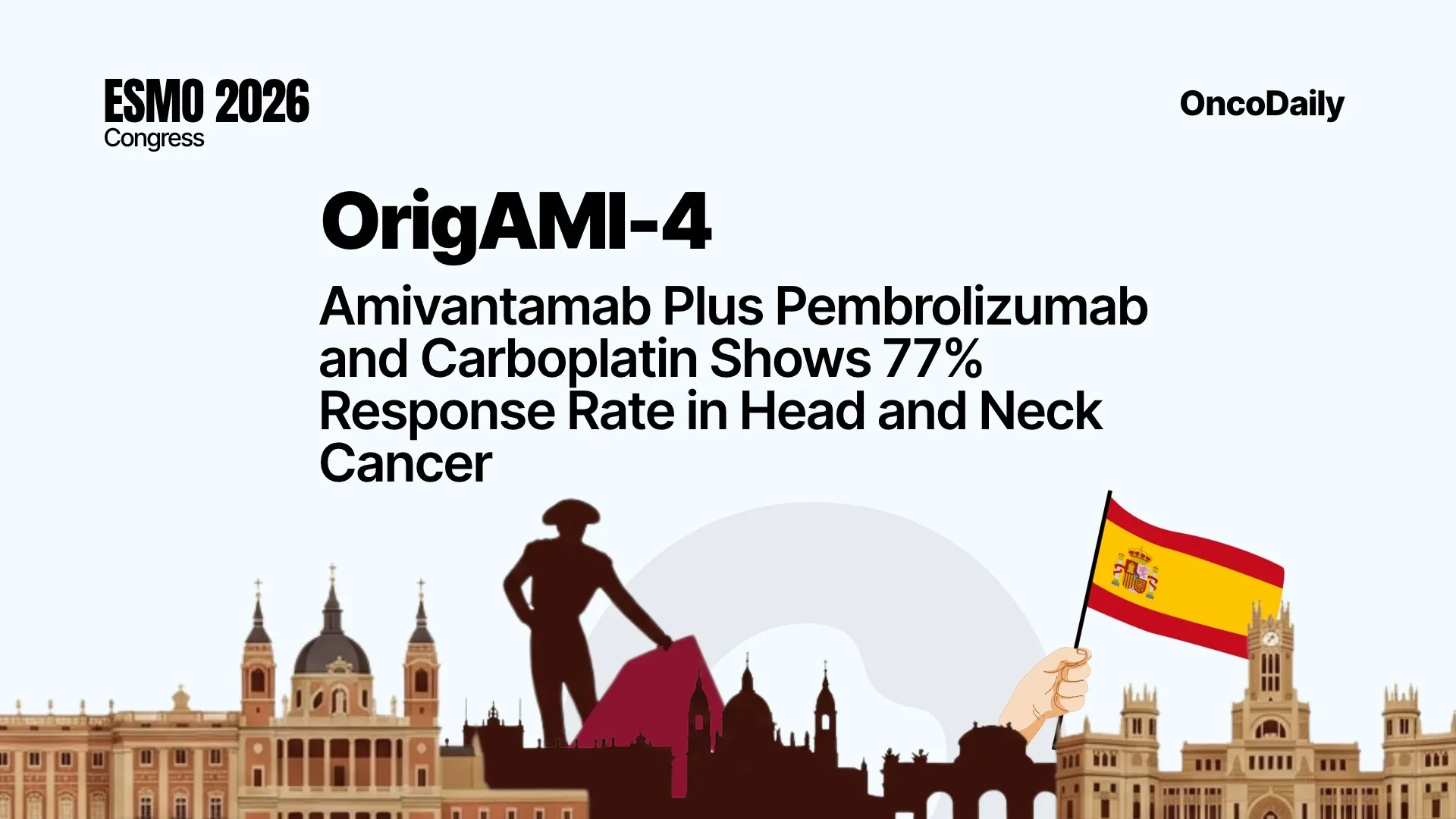
Read the latest updates on the OrigAMI-4 trial at ESMO 2026.
Two Targets, One Antibody: What Makes Amivantamab Different?
Amivantamab is not a conventional chemotherapy drug or an immune checkpoint inhibitor.
It is a bispecific antibody designed to target two proteins involved in cancer progression:
- EGFR (epidermal growth factor receptor): A signaling receptor frequently overexpressed in head and neck cancer that promotes tumor growth and survival.
- MET (mesenchymal-epithelial transition factor): Another receptor involved in cellular proliferation, invasion, and potentially resistance to EGFR-directed therapies.
Targeting EGFR alone has been an established strategy in HNSCC, but resistance remains a substantial challenge.
Amivantamab takes a different approach by simultaneously binding EGFR and MET, potentially disrupting complementary signaling mechanisms while recruiting immune effector cells against tumor cells.
The therapy has already established a role in certain forms of EGFR-mutated non-small cell lung cancer. Its latest approval brings this dual-targeting strategy into head and neck oncology.
There is also a practical difference in administration: the new formulation is delivered through a subcutaneous injection lasting approximately five minutes, rather than a prolonged intravenous infusion.
What About Safety?
Promising efficacy must be weighed against toxicity, particularly in patients with advanced disease who may already have substantial treatment-related complications.
In OrigAMI-4, the most frequently reported adverse reactions included rash (79%), fatigue (39%), nail toxicity (35%), stomatitis (32%), and edema (28%).
Serious adverse reactions occurred in 39% of patients, while fatal adverse reactions were reported in 6%.
Important warnings include interstitial lung disease/pneumonitis, severe dermatologic reactions, administration-related hypersensitivity, ocular toxicity, and embryo-fetal toxicity.
These findings highlight the importance of toxicity monitoring and individualized treatment decisions.
Accelerated Approval Is Not the End of the Story
The FDA’s decision was based on overall response rate and duration of response, endpoints considered reasonably likely to predict clinical benefit.
However, whether the observed tumor responses ultimately translate into longer survival or improved quality of life remains to be confirmed.
The Phase 3 OrigAMI-5 trial (NCT07276399) is investigating amivantamab in combination with carboplatin and pembrolizumab in the first-line setting for recurrent or metastatic HNSCC.
The study will provide additional evidence on the clinical value of EGFR/MET dual-targeting, including survival outcomes.
A New Chapter in Head and Neck Cancer Treatment?
For a decade, patients whose head and neck cancer progressed after platinum-based treatment have seen few new FDA-approved options.
Amivantamab changes that landscape, introducing a dual-targeted therapy with encouraging tumor responses in a difficult-to-treat population.
But the distinction between tumor response and improved survival remains essential.
The FDA approval is an important step, not the final answer. The next challenge is determining whether the encouraging responses seen in OrigAMI-4 can translate into longer-lasting clinical benefits and meaningful improvements in patients’ lives.
For now, the approval expands the treatment possibilities for eligible patients and opens another avenue for investigating EGFR/MET-targeted therapy in head and neck cancer.
Read further on OncoDaily: FDA Approves Pirtobrutinib for First-Line CLL/SLL Without 17p Deletion, a First for Non-Covalent BTK Inhibitors