





Vincristine: Understanding Its Mechanism, Dosing, and Clinical Role in Cancer
Key takeaways
- Vincristine is a vinca alkaloid that inhibits microtubule formation.
- It disrupts the mitotic spindle and arrests dividing cells in metaphase.
- The usual adult label dose is 1.4 mg/m² IV once weekly.
- Pediatric dosing is generally 1.5–2 mg/m² once weekly, with weight-based dosing for very small children.
- Many adult protocols cap individual vincristine doses at 2 mg, but this is regimen-specific.
- Vincristine must only be administered intravenously. Intrathecal administration is usually fatal.
- Peripheral and autonomic neuropathy are its principal dose-limiting toxicities.
- Strong CYP3A inhibitors can markedly increase neurotoxicity.
- - Vincristine remains a major component of ALL, lymphoma, rhabdomyosarcoma, Wilms tumor, and neuroblastoma treatment.
Vincristine is a vinca alkaloid chemotherapy and antimitotic agent that has remained a cornerstone of cancer treatment for more than six decades. It is particularly important in acute leukemia, lymphomas, rhabdomyosarcoma, neuroblastoma, and Wilms tumor, where it is usually incorporated into multi-agent chemotherapy regimens. The current US prescribing information specifically indicates vincristine for acute leukemia and describes its established combination use in Hodgkin lymphoma, non-Hodgkin lymphoma, rhabdomyosarcoma, neuroblastoma, and Wilms tumor.
Unlike taxanes such as paclitaxel and docetaxel, which stabilize microtubules, vincristine inhibits microtubule formation. This disrupts the mitotic spindle and arrests dividing cells in metaphase. Its major dose-limiting toxicity is neurotoxicity rather than myelosuppression.
Key Facts
- Generic name: Vincristine sulfate
- Former/common brand names: Oncovin, Vincasar PFS
- Drug class: Vinca alkaloid; antimitotic chemotherapy
- Route: Intravenous only
- FDA approval: 1963
- Adult label dose: 1.4 mg/m² IV once weekly
- Pediatric label dose: 1.5–2 mg/m² IV once weekly
- Children ≤10 kg: Starting dose 0.05 mg/kg IV once weekly
- Available concentration: 1 mg/mL
- Major mechanism: Inhibition of microtubule formation and mitotic spindle function
- Major toxicity: Peripheral and autonomic neurotoxicity
- Premedication: Not routinely required
- Major safety warning: Intrathecal administration is usually fatal
- Important interaction: Strong CYP3A inhibitors can markedly increase vincristine toxicity.
What Is Vincristine?
Vincristine is a naturally derived vinca alkaloid originally isolated from the Madagascar periwinkle, Catharanthus roseus.
Its development followed observations that extracts from the plant produced profound effects on white blood cells. Vincristine subsequently became one of the foundational agents of combination chemotherapy and received FDA approval in 1963.
Unlike many cytotoxic drugs, vincristine causes relatively little bone-marrow suppression at conventional doses. This characteristic has made it particularly useful in multidrug regimens containing other strongly myelosuppressive agents.
What Is the Mechanism of Action of Vincristine?
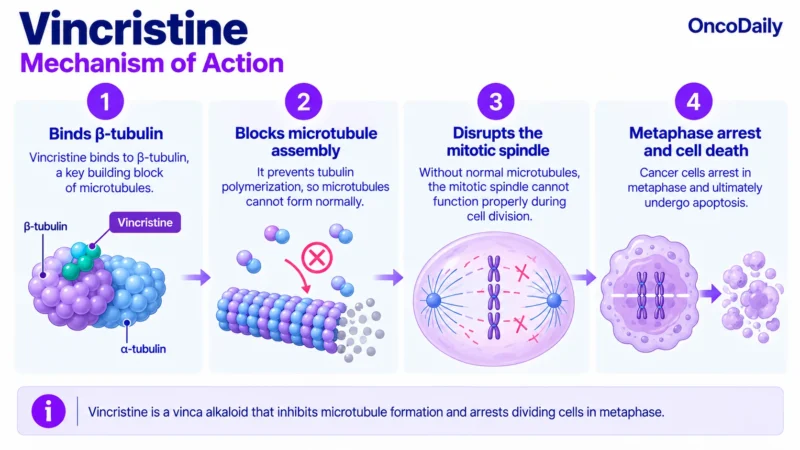
1. Binding to β-Tubulin
Vincristine binds to β-tubulin, an essential structural component of microtubules.
2. Inhibition of Microtubule Polymerization
Vincristine prevents tubulin molecules from assembling normally into microtubules.
This distinguishes it from taxanes such as paclitaxel and docetaxel, which stabilize existing microtubules.
3. Mitotic Spindle Disruption
Microtubules are required for formation of the mitotic spindle.
When microtubule assembly is inhibited, the spindle cannot function properly and chromosomes cannot segregate normally.
4. Metaphase Arrest
The resulting mitotic disruption causes dividing cells to arrest primarily during metaphase.
5. Cancer-Cell Death
Persistent mitotic dysfunction activates cellular stress and death pathways, eventually leading to apoptosis.
The mechanism can be summarized as:
Vincristine → β-tubulin binding → inhibition of microtubule assembly → mitotic spindle disruption → metaphase arrest → cancer-cell death.
Watch more: Vincristine & Vinblastine: Mechanism of Action
What Is the Dose of Vincristine?
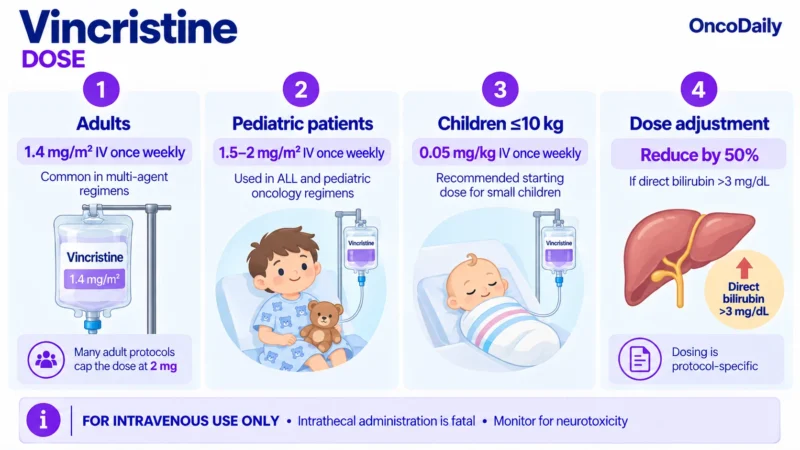
Vincristine dosing is highly protocol-specific.
Adults
The current US prescribing information gives a usual adult dose of:
1.4 mg/m² IV once weekly.
Many adult oncology protocols use a maximum individual dose of 2 mg, particularly CHOP-based lymphoma regimens, but the dose cap is protocol-specific rather than a universal statement in the current generic US label.
Pediatric Patients
The labeled pediatric dose is:
1.5–2 mg/m² IV once weekly.
For children weighing 10 kg or less, the recommended starting dose is:
0.05 mg/kg IV once weekly.
DLBCL and Other CHOP-Based Lymphoma Regimens
A commonly used CHOP/R-CHOP schedule includes:
Vincristine 1.4 mg/m² IV on Day 1, usually capped at 2 mg, repeated every 21 days as part of combination therapy.
Acute Lymphoblastic Leukemia
Vincristine is incorporated into induction, consolidation/intensification, and maintenance components of many ALL protocols.
Typical protocol doses are around:
1.5 mg/m² IV, often with a protocol-defined maximum dose.
Exact scheduling differs considerably between pediatric and adult ALL protocols and should follow the specific treatment regimen.
Rhabdomyosarcoma
Vincristine is a core component of VAC chemotherapy:
Vincristine + dactinomycin + cyclophosphamide.
Vincristine-containing regimens have been central to cooperative-group rhabdomyosarcoma studies for decades.
How Is Vincristine Administered?
Vincristine must be administered intravenously only.
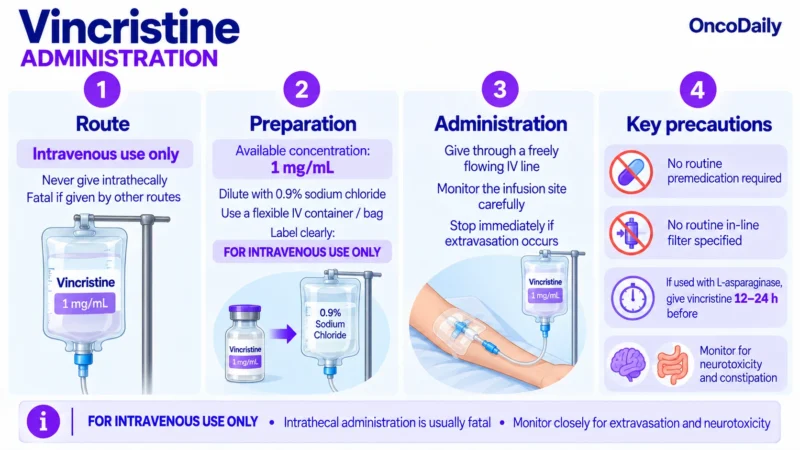
The most important administration rule is:
FOR INTRAVENOUS USE ONLY — FATAL IF GIVEN BY OTHER ROUTES.
Intrathecal administration of vincristine usually results in fatal ascending neurotoxicity. The current US label therefore requires vincristine to be diluted in a flexible plastic container and prominently labeled to reduce wrong-route medication errors.
Available Formulation
Vincristine sulfate injection is supplied as a sterile, preservative-free solution at:
1 mg/mL
including 1 mg/1 mL and 2 mg/2 mL single-dose vials.
Preparation
The current US label specifies dilution with:
0.9% sodium chloride injection.
Diluted concentrations between approximately 0.0015 and 0.08 mg/mL are stable for up to 24 hours when protected from light at 25°C under the conditions described in the prescribing information.
IV Administration
Vincristine should be administered through an intact, freely flowing IV catheter.
The infusion site must be monitored carefully because vincristine can cause substantial tissue injury after extravasation.
If extravasation occurs, administration should be stopped immediately and the remaining dose administered through another vein. The label describes local hyaluronidase and moderate heat as measures that may help disperse extravasated drug.
Does Vincristine Require an In-Line Filter?
No routine in-line filter is specified in the current US prescribing information.
Administration should follow the specific institutional policy and product formulation being used.
Does Vincristine Require Premedication?
No routine corticosteroid or antihistamine premedication is required.
This differs from solvent-based paclitaxel and several other infusion therapies.
Supportive medication may nevertheless be required according to the chemotherapy regimen and individual patient risk.
Because autonomic neuropathy commonly causes constipation, bowel function should be monitored carefully throughout therapy.
How Should Vincristine Be Given With Asparaginase?
When vincristine is used with L-asparaginase, the US prescribing information recommends giving vincristine:
12–24 hours before L-asparaginase.
Administering L-asparaginase before vincristine can reduce hepatic clearance of vincristine and increase toxicity.
Does Vincristine Require Renal or Hepatic Dose Adjustment?
Renal Impairment
Vincristine is predominantly cleared through hepatic metabolism and biliary excretion.
The current US label does not provide a standard renal dose-reduction schedule.
Renal function remains clinically relevant in patients receiving multi-agent chemotherapy or experiencing tumor lysis syndrome.
Hepatic Impairment
Because vincristine is eliminated predominantly through the hepatobiliary system, impaired biliary clearance can significantly increase exposure and neurotoxicity.
The US prescribing information recommends:
Direct bilirubin >3 mg/dL: reduce the vincristine dose by 50%.
What Is the Pharmacokinetic Profile of Vincristine?
Distribution
Vincristine distributes rapidly and extensively into tissues.
Within approximately 15–30 minutes after injection, more than 90% of the drug has distributed from the blood into tissues, where it is strongly but reversibly bound.
Vincristine penetrates the central nervous system poorly, which is why it cannot substitute for CNS-directed therapy in leukemia.
Metabolism
Vincristine is extensively metabolized by hepatic CYP3A enzymes, particularly:
CYP3A4 and CYP3A5.
Elimination
Vincristine is eliminated mainly through the biliary and fecal routes.
Approximately 80% of an injected dose appears in feces, while approximately 10–20% can be recovered in urine.
Half-Life
Vincristine demonstrates multiphasic pharmacokinetics and extensive tissue binding.
Reported terminal half-lives vary considerably between studies, with values ranging roughly from 23 to 85 hours or longer, reflecting substantial interpatient pharmacokinetic variability.
What Are the Important Drug Interactions?
CYP3A Inhibitors
Vincristine is a CYP3A substrate.
Strong CYP3A inhibitors can increase exposure and substantially worsen neurotoxicity.
Important interacting drugs include certain azole antifungals, particularly:
- Itraconazole
- Voriconazole
- Posaconazole.
The current label recommends avoiding strong CYP3A inhibitors whenever possible.
CYP3A Inducers
Strong CYP3A inducers may reduce vincristine exposure and should also generally be avoided.
P-Glycoprotein Interactions
Vincristine is also a substrate of P-glycoprotein, so strong P-gp inhibitors or inducers can alter drug exposure.
What Are the Clinical Uses of Vincristine?
Acute Leukemia
Acute leukemia is the principal indication stated in the US vincristine label.
Vincristine is especially important in acute lymphoblastic leukemia, where it forms part of multidrug induction and subsequent treatment phases.
Non-Hodgkin Lymphoma
Vincristine has been one of the defining components of CHOP chemotherapy:
Cyclophosphamide + doxorubicin + vincristine + prednisone.
Rituximab combined with CHOP subsequently established R-CHOP as a major treatment regimen for DLBCL.
Hodgkin Lymphoma
Vincristine is incorporated into selected Hodgkin lymphoma regimens, particularly pediatric and historical multidrug protocols.
Rhabdomyosarcoma
Vincristine remains a core drug in pediatric rhabdomyosarcoma chemotherapy.
The classic VAC regimen consists of:
Vincristine + dactinomycin + cyclophosphamide.
Wilms Tumor
Vincristine and dactinomycin have formed the chemotherapy backbone for many patients with favorable-histology Wilms tumor.
Higher-risk disease may require additional agents according to disease stage and biology.
Neuroblastoma
Vincristine is also incorporated into selected multi-agent neuroblastoma treatment protocols.
Vincristine is frequently combined with dactinomycin in pediatric solid tumors such as Wilms tumor and rhabdomyosarcoma. Learn more about Dactinomycin on OncoDaily.
What Did Vincristine Clinical Trials Show?
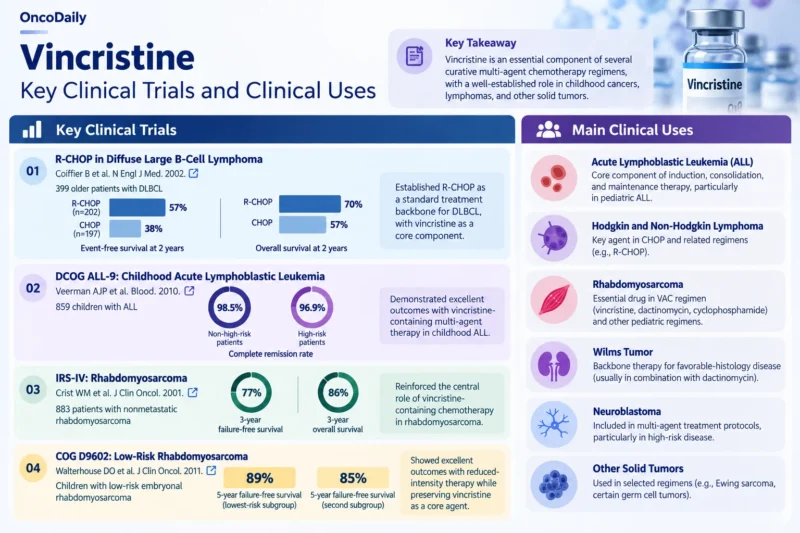
Because vincristine was developed before the modern era of single-drug registration trials, much of its clinical evidence comes from multi-agent cooperative-group regimens rather than trials designed to isolate the effect of vincristine alone.
R-CHOP in Diffuse Large B-Cell Lymphoma
A landmark randomized trial enrolled 399 patients older than 60 years with DLBCL and compared CHOP with rituximab plus CHOP.
Vincristine was part of both chemotherapy backbones.
At two years:
- Event-free survival: 57% with R-CHOP vs 38% with CHOP
- Overall survival: 70% vs 57%.
At long-term follow-up, overall survival remained superior with R-CHOP.
The study established R-CHOP as a major DLBCL treatment backbone while retaining vincristine as one of the central chemotherapy components.
DCOG ALL-9: Childhood ALL
The prospective DCOG ALL-9 study enrolled 859 children with ALL.
Vincristine was incorporated into dexamethasone- and asparaginase-based induction and was also included during maintenance treatment.
Complete remission was achieved in:
- 98.5% of non-high-risk patients
- 96.9% of high-risk patients.
The study illustrates the longstanding role of vincristine within curative multidrug ALL therapy rather than as an isolated single agent.
IRS-IV: Rhabdomyosarcoma
The Intergroup Rhabdomyosarcoma Study IV included 883 patients with nonmetastatic rhabdomyosarcoma.
Vincristine-containing chemotherapy was incorporated across the major treatment arms.
Overall:
- 3-year failure-free survival: 77%
- 3-year overall survival: 86%.
The study reinforced vincristine’s central role in risk-adapted rhabdomyosarcoma therapy.
COG D9602: Low-Risk Rhabdomyosarcoma
In Children’s Oncology Group D9602, low-risk embryonal rhabdomyosarcoma patients received vincristine/dactinomycin with or without cyclophosphamide depending on risk subgroup.
Estimated 5-year failure-free survival was:
- 89% in the lowest-risk subgroup
- 85% in the second subgroup.
The study demonstrated that selected children could maintain excellent outcomes with reduced treatment intensity while retaining vincristine-based therapy.
Is Vincristine FDA Approved?
Yes.
Vincristine received FDA approval in 1963, making it one of the longest-established anticancer medicines still routinely used in modern oncology.
The current US label indicates vincristine for acute leukemia and describes established combination use in Hodgkin lymphoma, non-Hodgkin lymphoma, rhabdomyosarcoma, neuroblastoma, and Wilms tumor.
What Is the Current Clinical Role of Vincristine?
Despite the rapid development of targeted therapy, immunotherapy, antibody-drug conjugates, and cellular therapies, vincristine remains an important component of curative multidrug chemotherapy.
Its continued importance is particularly evident in:
- Childhood ALL
- Adult ALL
- DLBCL and other lymphomas
- Rhabdomyosarcoma
- Wilms tumor
- Neuroblastoma.
A major advantage is its relatively limited myelosuppression compared with many other cytotoxic drugs. The major clinical limitation is cumulative neurotoxicity.
For more about its unusual discovery from the Madagascar periwinkle, read The Flower Behind Vincristine on OncoDaily.
What Are the Major Side Effects of Vincristine?
The dominant toxicity of vincristine is neurologic.
Major adverse effects include:
- Peripheral sensory neuropathy
- Motor neuropathy
- Autonomic neuropathy
- Constipation
- Paralytic ileus
- Jaw pain
- Cranial neuropathies
- Muscle weakness
- Loss of deep tendon reflexes
- Neuropathic pain
- SIADH and hyponatremia
- Alopecia
- Extravasation injury.
Unlike many cytotoxic agents, clinically significant bone-marrow suppression is generally less prominent with vincristine when used at recommended doses.
Peripheral Neuropathy
Vincristine-induced peripheral neuropathy is the principal dose-limiting toxicity.
Symptoms may include:
- Tingling
- Numbness
- Neuropathic pain
- Reduced reflexes
- Distal weakness
- Foot drop
- Difficulty walking
- Fine-motor impairment.
Neuropathy is usually cumulative and dose related.
Some neurologic effects can persist after treatment has ended.
Autonomic Neuropathy
Autonomic nerve injury may cause:
- Constipation
- Abdominal distension
- Paralytic ileus
- Urinary retention.
Constipation should be actively monitored rather than treated only after severe symptoms develop.
Cranial Neuropathy
Vincristine may affect cranial nerves, producing manifestations such as:
- Ptosis
- Diplopia
- Facial weakness
- Hoarseness
- Jaw pain.
SIADH
Vincristine can rarely cause inappropriate antidiuretic hormone secretion, resulting in:
- Hyponatremia
- Confusion
- Seizures in severe cases.
Extravasation
Vincristine can cause considerable local irritation and tissue injury if it escapes from the vein.
Correct catheter position should be confirmed before administration and the infusion site monitored throughout treatment.
Charcot-Marie-Tooth Disease
Vincristine is contraindicated in patients with the demyelinating form of Charcot-Marie-Tooth syndrome because of the risk of profound neurotoxicity.
Fatal Intrathecal Administration
The most important safety issue with vincristine is accidental intrathecal administration.
Intrathecal vincristine is usually fatal.
This is why modern medication-safety procedures require preparation in an IV infusion bag rather than a syringe intended for direct administration.
What Monitoring Is Required?
Monitoring should include:
- Neurologic examination
- Peripheral sensory symptoms
- Motor strength
- Deep tendon reflexes
- Bowel function
- Abdominal symptoms
- CBC
- Liver function and bilirubin
- Serum electrolytes when clinically indicated
- IV infusion site
- Concomitant CYP3A-interacting medications.
The current label specifically emphasizes clinical assessment for neurotoxicity before repeated dosing.