





Tegafur/Gimeracil/Oteracil: Understanding Its Mechanism, Dosing, and Clinical Role
Key takeaways
- Tegafur/gimeracil/oteracil (S-1) is an oral fluoropyrimidine combination containing tegafur, gimeracil, and oteracil.
- Tegafur is converted to 5-FU, providing the antitumor activity.
- Gimeracil inhibits DPD, increasing and prolonging systemic 5-FU exposure.
- Oteracil reduces gastrointestinal activation of 5-FU, helping limit GI toxicity.
- S-1 is administered orally, usually twice daily after meals.
- A commonly used schedule is 28 days of treatment followed by 14 days off, although schedules vary by indication.
- S-1 has major clinical importance in gastric and pancreatic cancer, particularly in Japan and other Asian countries.
- The ACTS-GC trial established S-1 as an important adjuvant treatment after gastric cancer surgery.
- The JASPAC-01 trial demonstrated a major survival benefit with adjuvant S-1 after pancreatic cancer resection.
- Renal function is particularly important because reduced clearance of gimeracil can increase 5-FU exposure and toxicity.
- S-1 is not FDA approved in the United States, despite extensive clinical use in Asia.
Tegafur/gimeracil/oteracil is an oral fluoropyrimidine combination consisting of tegafur, gimeracil, and oteracil. It is designed to provide systemic exposure to 5-fluorouracil (5-FU) through tegafur while gimeracil inhibits 5-FU degradation and oteracil reduces gastrointestinal toxicity. The combination is known as S-1 and is widely used in Japan and other Asian countries for several gastrointestinal cancers.
This article aims to review tegafur/gimeracil/oteracil’s mechanism of action, dose, administration, clinical uses, clinical-trial evidence, pharmacokinetics, safety profile, and current approval status, with particular focus on its role in gastric, colorectal, pancreatic, and other gastrointestinal malignancies.
Key Facts
- Generic name: Tegafur/gimeracil/oteracil
- Common name: S-1
- Drug class: Oral fluoropyrimidine combination
- Route: Oral
- Components: Tegafur + gimeracil + oteracil
- Active fluoropyrimidine: Tegafur → 5-FU
- Gimeracil: Inhibits dihydropyrimidine dehydrogenase (DPD), reducing 5-FU degradation
- Oteracil: Reduces phosphorylation of 5-FU in the gastrointestinal tract
- Major cancers: Gastric, colorectal, pancreatic, biliary tract, and other gastrointestinal cancers
- Typical administration: Twice daily after meals
- Common schedule: 28 consecutive days followed by a 14-day rest period, depending on regimen
- Major toxicities: Neutropenia, anemia, thrombocytopenia, diarrhea, nausea, stomatitis, and fatigue
- Important consideration: Dose selection depends on body-surface area and renal function
- Major clinical role: Fluoropyrimidine-based treatment of gastrointestinal malignancies
What Is Tegafur/Gimeracil/Oteracil?
Tegafur/gimeracil/oteracil, commonly called S-1, is an oral fluoropyrimidine formulation containing three pharmacologically active components.
Tegafur
Tegafur is a prodrug that is gradually converted to 5-FU in the body.
5-FU subsequently generates active metabolites that interfere with DNA and RNA synthesis.
Gimeracil
Gimeracil, also called CDHP, is a potent inhibitor of dihydropyrimidine dehydrogenase (DPD).
DPD is the major enzyme responsible for degradation of 5-FU.
By inhibiting DPD, gimeracil increases and prolongs systemic exposure to 5-FU, allowing tegafur to be administered orally at relatively tolerable doses.
Oteracil
Oteracil, also known as oxonate, preferentially inhibits phosphorylation of 5-FU within the gastrointestinal tract.
This reduces local gastrointestinal exposure to active 5-FU metabolites and is intended to decrease gastrointestinal toxicity.
The combination therefore uses a coordinated pharmacologic strategy:
Tegafur → supplies 5-FU
Gimeracil → slows 5-FU degradation
Oteracil → reduces gastrointestinal 5-FU activation
What Is the Mechanism of Action of Tegafur/Gimeracil/Oteracil?
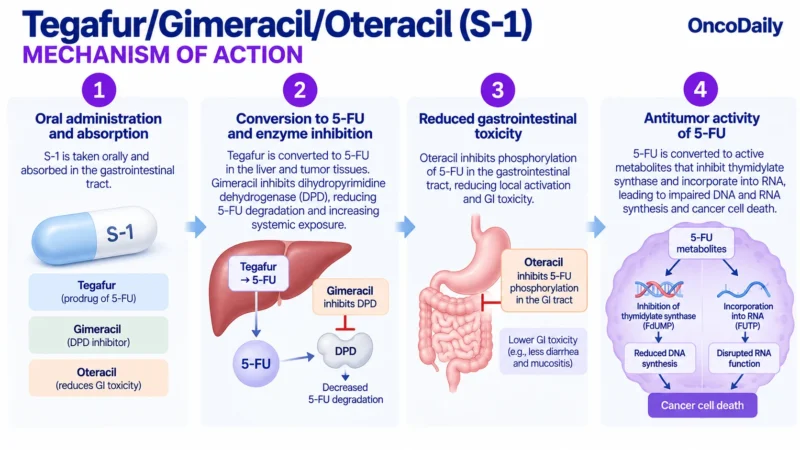
The antitumor effect of S-1 ultimately comes from 5-FU generated from tegafur.
1. Tegafur Conversion to 5-FU
After oral administration, tegafur undergoes hepatic and tissue metabolism to generate 5-FU.
2. Gimeracil Inhibits DPD
Gimeracil inhibits DPD, the major enzyme responsible for catabolism of 5-FU.
This increases the amount and duration of systemic 5-FU exposure.
3. Oteracil Protects the GI Tract
Oteracil inhibits 5-FU phosphorylation in the gastrointestinal tract, helping reduce local gastrointestinal toxicity.
4. 5-FU Disrupts Nucleic Acid Synthesis
5-FU is converted into several active metabolites.
FdUMP inhibits thymidylate synthase, reducing thymidine production and impairing DNA synthesis.
Other metabolites such as FUTP are incorporated into RNA, disrupting RNA processing and function.
The overall pathway can be summarized as:
Tegafur → 5-FU → active fluoropyrimidine metabolites → thymidylate synthase inhibition + RNA disruption → impaired DNA/RNA synthesis → cancer-cell death
What Is the Dose of Tegafur/Gimeracil/Oteracil?
The dose of S-1 varies according to the specific indication, body-surface area, treatment regimen, and renal function.
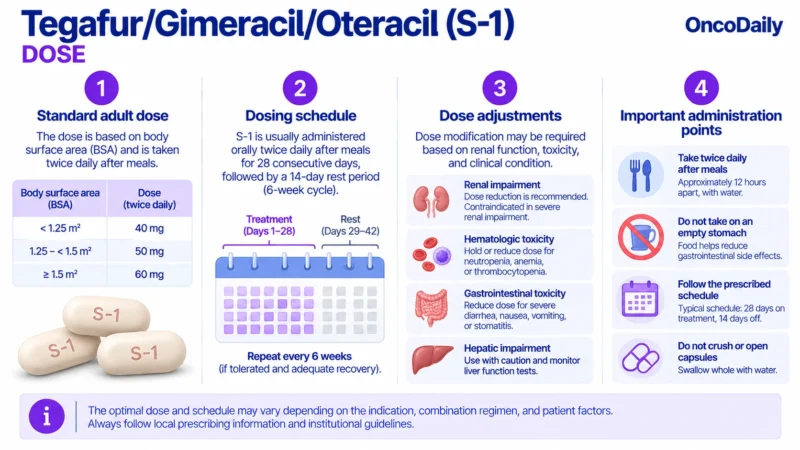
For adults receiving S-1 in commonly used regimens, dosing is frequently administered twice daily after meals.
A commonly used schedule is:
28 days of treatment followed by 14 days of rest
for a 6-week cycle.
The exact dose depends on body-surface area. Common dosing categories include:
- BSA <1.25 m²: 40 mg twice daily
- BSA 1.25–<1.5 m²: 50 mg twice daily
- BSA ≥1.5 m²: 60 mg twice daily
These doses may vary according to the specific national product label and treatment regimen.
Dose modification may be required for:
- Renal impairment
- Neutropenia
- Thrombocytopenia
- Diarrhea
- Stomatitis
- Other significant toxicity.
How Is Tegafur/Gimeracil/Oteracil Administered?
S-1 is administered orally.
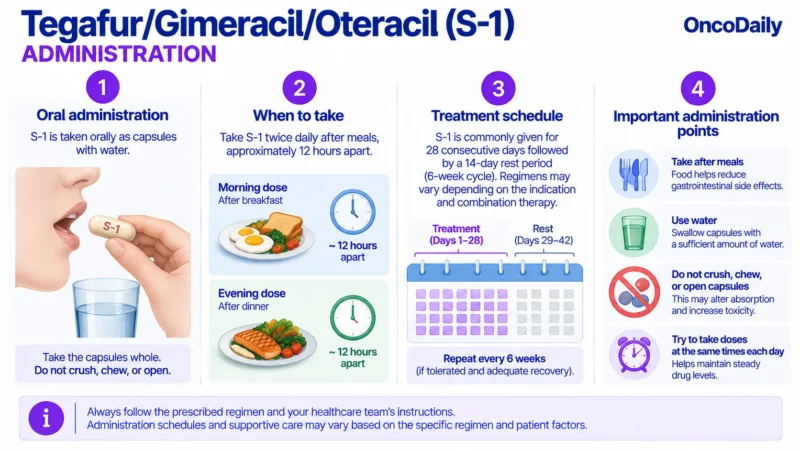
The capsules or tablets should generally be taken:
- Twice daily
- After meals
- Approximately 12 hours apart
- With water.
Treatment schedules vary according to disease and combination regimen.
A commonly used schedule is:
Days 1–28: Treatment
Days 29–42: Rest
The next cycle begins after the treatment-free interval if the patient has adequately recovered.
When S-1 is combined with other anticancer agents, the schedule can differ substantially.
Does S-1 Require an In-Line Filter?
No.
Tegafur/gimeracil/oteracil is an oral medication, so there is no IV administration and no requirement for an in-line filter.
Does Tegafur/Gimeracil/Oteracil Require Premedication?
There is no routine mandatory premedication specifically required for S-1.
Supportive treatment is individualized according to the patient’s symptoms and combination regimen.
Antiemetics may be used when clinically appropriate, while diarrhea, mucositis, and other gastrointestinal toxicities should be treated promptly.
Are Dose Reductions Used?
Yes.
Dose interruption and reduction may be necessary for clinically significant toxicity.
Important reasons for modification include:
- Neutropenia
- Thrombocytopenia
- Anemia
- Diarrhea
- Stomatitis
- Severe nausea or vomiting
- Hepatic abnormalities
- Renal impairment
- Other grade 3–4 toxicities.
Treatment is generally withheld until toxicity improves and then resumed according to the specific treatment protocol.
What Is the Pharmacokinetic Profile of S-1?
The pharmacokinetics of S-1 reflect the interaction between its three components.
Tegafur
Tegafur is converted to 5-FU and provides the systemic fluoropyrimidine exposure.
Gimeracil
Gimeracil inhibits DPD, substantially reducing degradation of 5-FU and increasing systemic exposure.
Oteracil
Oteracil is preferentially distributed to the gastrointestinal tract and inhibits local phosphorylation of 5-FU.
Renal function is particularly important because gimeracil is predominantly eliminated through the kidneys.
As renal function declines, gimeracil exposure increases, which can increase 5-FU exposure and toxicity.
Does S-1 Require Renal or Hepatic Dose Adjustment?
Renal Impairment
Yes.
Renal function is an important determinant of S-1 dosing.
Patients with reduced creatinine clearance generally require dose reduction, while severe renal impairment may represent a contraindication depending on the specific product label.
This is particularly important because accumulation of gimeracil can substantially increase 5-FU exposure.
Hepatic Impairment
Patients with hepatic dysfunction should be monitored carefully.
Although S-1 does not rely exclusively on hepatic elimination, liver dysfunction can affect fluoropyrimidine metabolism and treatment tolerance.
Dose modifications may be necessary depending on the severity of hepatic dysfunction and the specific regimen.
What Are the Clinical Uses of Tegafur/Gimeracil/Oteracil?
Gastric Cancer
S-1 has a particularly important role in gastric cancer, especially in Japan and other Asian countries.
It can be used:
- As postoperative adjuvant therapy
- In advanced or metastatic disease
- In combination with platinum chemotherapy
- In selected perioperative treatment strategies.
The ACTS-GC trial established postoperative S-1 as an important adjuvant treatment for patients with stage II or III gastric cancer after curative surgery.
Pancreatic Cancer
S-1 has become an important fluoropyrimidine option in pancreatic cancer, particularly in Japan.
It has been evaluated as:
- Adjuvant therapy
- Treatment for advanced disease
- A component of combination chemotherapy.
The JASPAC-01 trial demonstrated superior overall survival with adjuvant S-1 compared with gemcitabine after resection of pancreatic cancer in a Japanese population.
Read more: Gemcitabine: Mechanism of Action, Dose, Administration, Clinical Uses, and Side Effects on OncoDaily.
Colorectal Cancer
S-1 has also been studied extensively in colorectal cancer.
It may be used alone or combined with oxaliplatin or irinotecan.
Combination regimens include:
SOX: S-1 + oxaliplatin
IRIS: irinotecan + S-1
These regimens have demonstrated activity in advanced colorectal cancer.
Biliary Tract Cancer
S-1 has been investigated in biliary tract cancers, including combinations with platinum chemotherapy.
Its role varies geographically and is less established globally than its role in gastric or pancreatic cancer.
Other Gastrointestinal Malignancies
S-1 has also been studied in:
- Esophageal cancer
- Head and neck cancers
- Non-small cell lung cancer
- Other solid tumors.
Its strongest clinical footprint remains within gastrointestinal oncology.
What Did Clinical Trials Show?
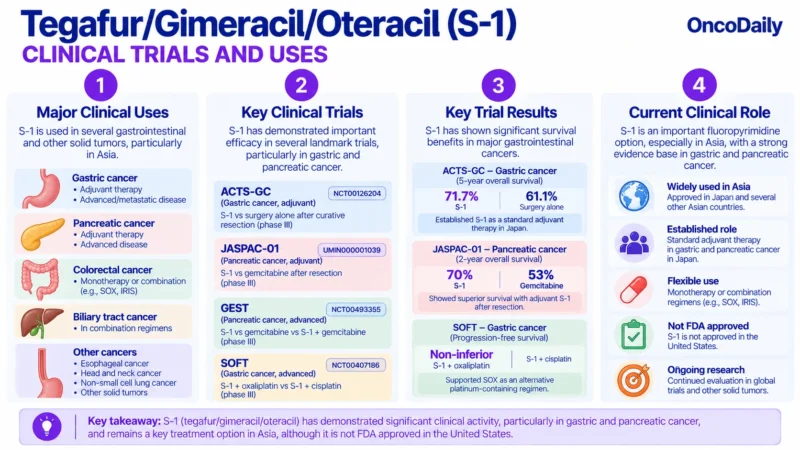
ACTS-GC Trial — Gastric Cancer
The landmark ACTS-GC phase III trial randomized patients with stage II or III gastric cancer after curative surgery to receive postoperative S-1 or surgery alone.
The study demonstrated a significant survival benefit with one year of postoperative S-1 therapy.
Five-year overall survival was approximately:
71.7% with S-1 vs 61.1% with surgery alone.
The results established S-1 as a major adjuvant treatment for gastric cancer in Japan.
JASPAC-01 — Pancreatic Cancer
The phase III JASPAC-01 trial compared postoperative S-1 with gemcitabine in patients with resected pancreatic cancer.
S-1 demonstrated a significant survival advantage.
Two-year overall survival was approximately:
70% with S-1 vs 53% with gemcitabine.
The results established adjuvant S-1 as a standard treatment option after pancreatic cancer resection in Japan.
GEST Trial — Advanced Pancreatic Cancer
The GEST phase III trial evaluated S-1, gemcitabine, and gemcitabine plus S-1 in patients with advanced pancreatic cancer.
S-1 demonstrated non-inferior overall survival compared with gemcitabine, while combination therapy did not demonstrate a statistically significant superiority over gemcitabine.
The study supported S-1 as an alternative fluoropyrimidine-based treatment strategy in advanced pancreatic cancer.
SOFT Trial — Advanced Gastric Cancer
The SOFT phase III trial evaluated S-1 plus oxaliplatin compared with S-1 plus cisplatin in patients with advanced gastric cancer.
S-1 plus oxaliplatin demonstrated non-inferior progression-free survival and overall survival compared with S-1 plus cisplatin, supporting SOX as an alternative platinum-containing regimen.
CLASSIC and Other Global Fluoropyrimidine Studies
S-1 has also been incorporated into international studies evaluating postoperative and advanced gastrointestinal cancer treatment.
However, geographic differences in treatment standards, pharmacogenetics, and tolerability mean that evidence generated in Asian populations cannot always be directly extrapolated to Western populations.
Is Tegafur/Gimeracil/Oteracil FDA Approved?
S-1 is not FDA approved in the United States as of 2026.
It is approved and widely used in Japan and several other Asian countries for multiple gastrointestinal malignancies.
The regulatory status differs substantially between regions.
Therefore, when discussing S-1, it is important to distinguish between:
- International clinical use
- Japanese regulatory approval
- U.S. FDA approval.
What Is the Current Clinical Role of S-1?
S-1 remains an important fluoropyrimidine-based therapy, particularly in Japan and other Asian countries.
Its three-component design allows:
Tegafur → 5-FU production
Gimeracil → prolonged 5-FU exposure
Oteracil → reduced gastrointestinal toxicity
Its strongest clinical roles are in gastric and pancreatic cancer, with additional use in colorectal and other gastrointestinal cancers.
However, S-1 has not achieved the same global adoption as capecitabine or infusional 5-FU, particularly in North America and many European countries.
Its continued importance reflects the substantial clinical evidence supporting its use in Asian oncology practice.
What Are the Major Side Effects of S-1?
Myelosuppression
Important hematologic toxicities include:
Neutropenia
Anemia
Thrombocytopenia
Febrile neutropenia.
Gastrointestinal Toxicity
Patients may develop:
- Diarrhea
- Nausea
- Vomiting
- Anorexia
- Abdominal discomfort
- Stomatitis.
Oteracil was specifically incorporated to reduce gastrointestinal toxicity associated with 5-FU.
Fatigue
Fatigue is commonly reported and can become more prominent during prolonged treatment.
Hand-Foot Syndrome
Hand-foot syndrome can occur with S-1 but may differ in frequency and severity from conventional capecitabine therapy.
Hepatotoxicity
Liver enzyme abnormalities can occur and should be monitored during treatment.
Hyperbilirubinemia
Changes in bilirubin levels may occur during therapy and can require treatment interruption or modification.
What Monitoring Is Required?
Monitoring should include:
- CBC with differential
- Platelet count
- Renal function
- Liver function
- Bilirubin
- Assessment for diarrhea
- Assessment for stomatitis
- Assessment for nausea/vomiting
- Assessment for dehydration
- Assessment of treatment adherence.
Because renal function influences gimeracil exposure, creatinine clearance should be assessed regularly.