





Gemcitabine: Mechanism of Action, Dose, Administration, Clinical Uses, and Side Effects
Key takeaways
- Gemcitabine is a nucleoside antimetabolite that disrupts DNA synthesis in dividing cancer cells.
- The drug is administered by intravenous infusion, usually over approximately 30 minutes.
- Standard doses commonly range from 1,000 to 1,250 mg/m², but schedules vary substantially by cancer type.
- Gemcitabine is a major chemotherapy backbone in pancreatic cancer, particularly with nab-paclitaxel.
- It is also used with cisplatin in NSCLC and other gemcitabine-sensitive cancers, and with carboplatin in platinum-sensitive ovarian cancer.
- The principal dose-limiting toxicity is myelosuppression, particularly neutropenia and thrombocytopenia.
- Gemcitabine remains clinically important despite the emergence of targeted and immune-based therapies.
Gemcitabine is a pyrimidine nucleoside analog and antimetabolite chemotherapy used in several solid tumors, including pancreatic, non-small cell lung, ovarian, and breast cancers. It is administered intravenously and may be used alone or in combination with agents such as cisplatin, carboplatin, paclitaxel, or nab-paclitaxel. Gemcitabine is FDA approved for several cancer indications.
This article aims to review gemcitabine mechanism of action, dose, administration, clinical-trial findings, safety profile, and current role in cancer treatment.
Gemcitabine Key Facts
- Generic name: Gemcitabine
- Brand names: Gemzar, Infugem
- Drug class: Pyrimidine nucleoside analog; antimetabolite
- Administration: Intravenous infusion
- Main approved uses: Pancreatic cancer, non-small cell lung cancer, ovarian cancer, and breast cancer
- Common dose: 1,000–1,250 mg/m² IV over 30 minutes, depending on indication and regimen
- Major combinations: Gemcitabine + nab-paclitaxel, cisplatin, carboplatin, or paclitaxel
- Approval status: FDA approved
- Major toxicities: Myelosuppression, infection, nausea, fatigue, elevated liver enzymes, pulmonary toxicity, and rarely hemolytic uremic syndrome.
What Is Gemcitabine?
Gemcitabine is a synthetic deoxycytidine analog that inhibits DNA synthesis and thereby slows or stops proliferation of cancer cells.
Systemic gemcitabine has established roles in:
- Pancreatic cancer
- Non-small cell lung cancer
- Ovarian cancer
- Breast cancer.
Gemcitabine-containing combinations are also widely used in other malignancies, including biliary tract and bladder cancers, depending on disease setting and treatment protocol.
Gemcitabine Mechanism of Action
Gemcitabine is a pyrimidine nucleoside analog that becomes active after intracellular phosphorylation.
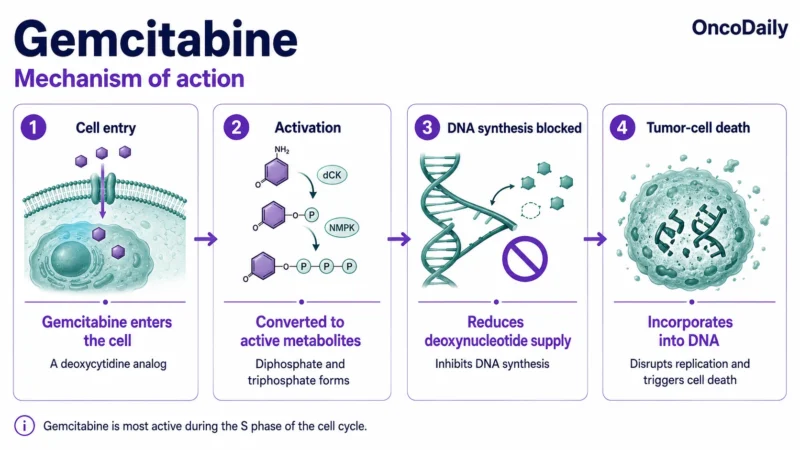
Its mechanism can be summarized in four steps:
- Gemcitabine enters the cancer cell.
- It is phosphorylated to active metabolites, particularly gemcitabine diphosphate and triphosphate.
- Gemcitabine diphosphate reduces the supply of normal deoxynucleotides needed for DNA synthesis.
- Gemcitabine triphosphate is incorporated into DNA, disrupting DNA elongation and replication.
The result is inhibition of DNA synthesis and death of proliferating cancer cells.
Gemcitabine is particularly active during the S phase of the cell cycle.
Watch more: Explore gemcitabine’s mechanism of action, pharmacokinetics, clinical uses, and toxicities in Medicine of the Week: Gemcitabine.
What Is the Dose of Gemcitabine?
Gemcitabine dosing depends heavily on the cancer type and combination regimen.
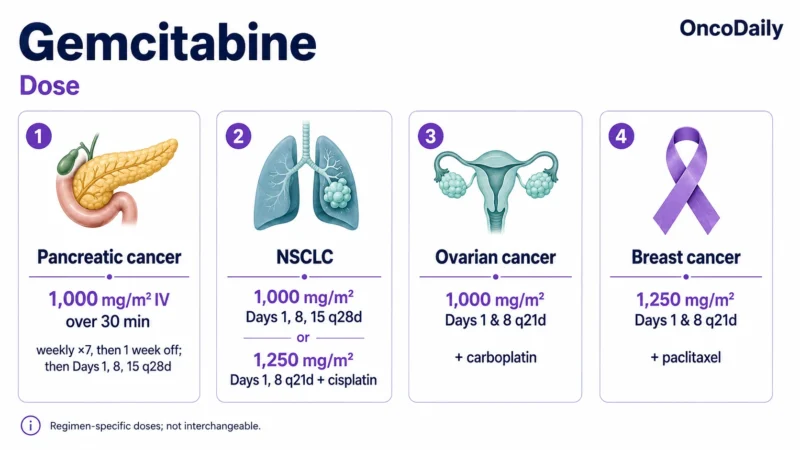
Pancreatic Cancer
The FDA-labeled dose is:
Gemcitabine 1,000 mg/m² IV over 30 minutes.
The labeled schedule is:
- Weekly for the first 7 weeks, followed by 1 week off
- Thereafter, Days 1, 8, and 15 of each 28-day cycle.
In modern pancreatic cancer treatment, gemcitabine is frequently given with nab-paclitaxel using a protocol-defined schedule.
Non-Small Cell Lung Cancer
Two labeled gemcitabine/cisplatin schedules are available.
28-day schedule:
Gemcitabine 1,000 mg/m² IV over 30 minutes on Days 1, 8, and 15
with cisplatin given on Day 1.
21-day schedule:
Gemcitabine 1,250 mg/m² IV over 30 minutes on Days 1 and 8
with cisplatin administered on Day 1.
Ovarian Cancer
For platinum-sensitive recurrent ovarian cancer:
Gemcitabine 1,000 mg/m² IV over 30 minutes on Days 1 and 8 of a 21-day cycle, combined with carboplatin.
Breast Cancer
The labeled regimen is:
Gemcitabine 1,250 mg/m² IV over 30 minutes on Days 1 and 8 every 21 days, in combination with paclitaxel.
Paclitaxel is given on Day 1 before gemcitabine.
These doses are regimen-specific and should not be interchanged.
How Is Gemcitabine Administered?
Gemcitabine is administered by intravenous infusion.
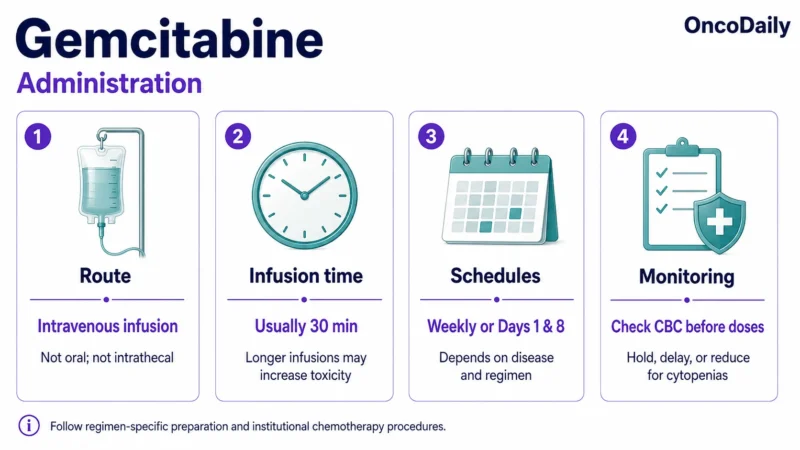
The usual infusion duration is approximately:
30 minutes.
Administration generally involves:
- Calculating the dose according to body-surface area
- Diluting or preparing the product according to the specific formulation
- Administering it intravenously
- Monitoring blood counts before subsequent doses
- Adjusting or withholding treatment according to hematologic toxicity.
Longer infusion times or administration more frequently than recommended can increase toxicity and are generally avoided unless specifically required by a clinical protocol.
Does Gemcitabine Require an In-Line Filter?
There is no universal gemcitabine-specific in-line filter requirement across all formulations.
Administration should follow:
- The specific gemcitabine product label
- Institutional chemotherapy procedures
- Pharmacy preparation instructions
- Any requirements associated with other drugs in the combination regimen.
A filter required for a partner drug should not automatically be assumed to apply to gemcitabine.
Is Premedication Required?
Gemcitabine does not require a universal drug-specific premedication regimen.
However, antiemetic prophylaxis may be given according to:
- The complete chemotherapy regimen
- Patient-specific nausea risk
- Combination partners such as cisplatin.
For example, cisplatin-containing regimens generally require substantially more intensive antiemetic prophylaxis than gemcitabine alone.
Are Dose Reductions Used?
Yes.
Gemcitabine doses may be reduced, delayed, or withheld for:
- Neutropenia
- Thrombocytopenia
- Febrile neutropenia
- Severe nonhematologic toxicity
- Significant hepatic toxicity
- Pulmonary toxicity
- Hemolytic uremic syndrome or renal toxicity.
Blood counts are generally assessed before each scheduled treatment, and dose modification is based on the degree of myelosuppression and the specific regimen.
What Is Known About Gemcitabine Pharmacokinetics?
Gemcitabine is rapidly distributed and metabolized following IV administration.
Inside cells, it undergoes phosphorylation to active nucleotides responsible for its cytotoxic effects.
Most circulating gemcitabine is rapidly inactivated by cytidine deaminase to the metabolite 2′,2′-difluorodeoxyuridine, which is subsequently eliminated predominantly through the kidneys.
The intracellular active metabolites can persist longer than plasma gemcitabine itself, helping explain why antitumor activity continues after plasma concentrations decline.
Are Renal or Hepatic Dose Adjustments Required?
No single universally accepted starting-dose reduction is established for all patients with renal or hepatic impairment.
However, patients should have:
- Renal function monitored
- Hepatic function monitored
- CBC assessed before dosing
- Treatment modified when clinically important toxicity develops.
Particular caution is appropriate if there is significant liver dysfunction, renal impairment, or evidence of gemcitabine-associated hemolytic uremic syndrome.
What Did Gemcitabine Clinical Trials Show?
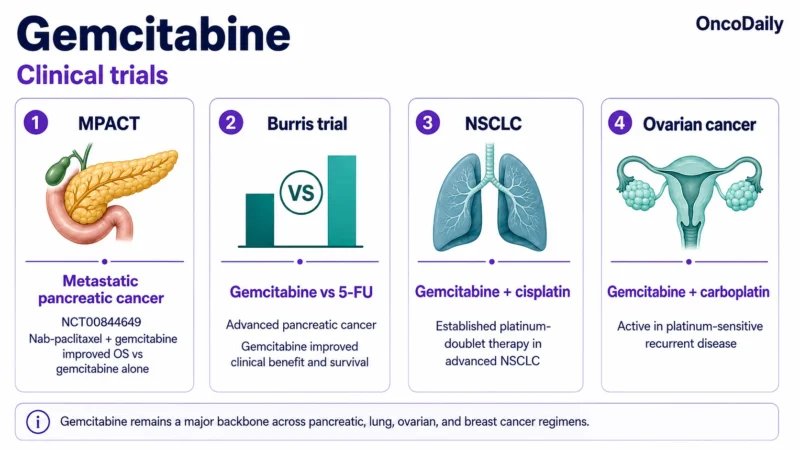
MPACT — Metastatic Pancreatic Cancer
The Phase 3 MPACT trial (NCT00844649) compared nab-paclitaxel plus gemcitabine with gemcitabine alone in 861 patients with previously untreated metastatic pancreatic adenocarcinoma.
Median overall survival was:
- 8.5 months with nab-paclitaxel + gemcitabine
- 6.7 months with gemcitabine alone.
Median progression-free survival was:
- 5.5 months
- versus 3.7 months, respectively.
These findings established gemcitabine plus nab-paclitaxel as an important systemic-treatment option for metastatic pancreatic cancer.
Gemcitabine Versus Fluorouracil in Pancreatic Cancer
An earlier randomized study comparing gemcitabine with fluorouracil helped establish gemcitabine as a treatment for advanced pancreatic cancer.
Median survival was approximately:
- 5.65 months with gemcitabine
- 4.41 months with fluorouracil.
The 12-month survival rates were approximately 18% versus 2%, respectively.
Gemcitabine Plus Erlotinib
The NCT00026338 study compared gemcitabine plus erlotinib with gemcitabine alone in advanced pancreatic cancer.
Median survival was approximately 6.2 months versus 5.9 months, showing a modest survival improvement with the addition of erlotinib.
Non-Small Cell Lung Cancer
Gemcitabine plus cisplatin became an established platinum-doublet chemotherapy approach in advanced NSCLC, with approved schedules using either 1,000 mg/m² on Days 1, 8, and 15 or 1,250 mg/m² on Days 1 and 8 depending on cycle length.
Ovarian Cancer
Gemcitabine plus carboplatin is FDA approved for advanced ovarian cancer recurring at least six months after completion of platinum-based therapy, supporting its role in platinum-sensitive recurrent disease.
Is Gemcitabine FDA Approved?
Yes.
Systemic gemcitabine is FDA approved for:
- Advanced ovarian cancer, with carboplatin
- Metastatic breast cancer, with paclitaxel
- Non-small cell lung cancer, with cisplatin
- Pancreatic cancer, including locally advanced and metastatic disease.
What Is the Current Role of Gemcitabine?
Gemcitabine remains a major chemotherapy backbone across several cancers.
Current uses include:
- Gemcitabine + nab-paclitaxel in pancreatic cancer
- Gemcitabine + cisplatin in selected lung, biliary tract, and urothelial cancer settings
- Gemcitabine + carboplatin in recurrent ovarian cancer
- Gemcitabine + paclitaxel in metastatic breast cancer
- Gemcitabine-based combinations in selected bladder and other solid tumors.
Its role increasingly involves combination with targeted therapy or immunotherapy rather than use as a stand-alone cytotoxic agent.
Read more: Explore current approaches to pancreatic cancer treatment on OncoDaily.
What Are the Side Effects of Gemcitabine?
Important adverse effects include:
- Neutropenia
- Thrombocytopenia
- Anemia
- Infection
- Fever
- Fatigue
- Nausea and vomiting
- Elevated liver enzymes
- Rash
- Edema
- Dyspnea
- Pulmonary toxicity
- Renal toxicity
- Rare hemolytic uremic syndrome.
Myelosuppression
Myelosuppression is one of the most important gemcitabine toxicities.
Neutropenia, thrombocytopenia, and anemia may require dose delay or reduction. Blood counts should therefore be monitored before treatment.
Pulmonary Toxicity
Gemcitabine can rarely cause serious pulmonary toxicity, including interstitial pneumonitis, pulmonary edema, or acute respiratory distress syndrome.
New or worsening respiratory symptoms warrant prompt clinical evaluation.
Hemolytic Uremic Syndrome
A rare but potentially serious complication is hemolytic uremic syndrome, characterized by hemolysis, thrombocytopenia, and renal dysfunction.
Gemcitabine should be discontinued if clinically significant HUS develops.
Hepatic Toxicity
Transient elevations in liver enzymes are common. Severe hepatic injury is uncommon but may occur, particularly in patients with pre-existing liver disease or hepatic metastases.
Written by Mirna Antabian, MD