


Sunitinib (Sutent): Understanding Its Mechanism, Dosing, Clinical Uses, and Role in RCC, GIST, and Pancreatic Neuroendocrine Tumors
Key takeaways
- Sunitinib is an oral multitargeted receptor tyrosine kinase inhibitor.
- Major targets include VEGFR1–3, PDGFR-α/β, KIT, FLT3, RET, and CSF-1R. DailyMed
- Standard GIST and advanced RCC dosing is 50 mg once daily for 4 weeks followed by 2 weeks off.
- pNET dosing is 37.5 mg once daily continuously.
- In metastatic RCC, sunitinib improved median PFS to 11 vs 5 months compared with interferon alfa.
- In imatinib-resistant/intolerant GIST, median time to progression was 27.3 vs 6.4 weeks compared with placebo.
- In advanced pNET, median PFS was 11.4 vs 5.5 months, HR 0.42.
- S-TRAC showed DFS 6.8 vs 5.6 years in high-risk RCC after nephrectomy.
- The major boxed warning is hepatotoxicity.
- Other major risks include hypertension, cardiomyopathy, QT prolongation, hemorrhage, proteinuria, thyroid dysfunction, and hand-foot syndrome.
- In 2026, sunitinib remains highly relevant in GIST and pNET, while its role in RCC is more selective because modern immunotherapy-based strategies have reshaped treatment.
Sunitinib (Sutent) is an oral, multitargeted receptor tyrosine kinase inhibitor with both antiangiogenic and direct antitumor activity. It inhibits several clinically relevant kinases, including VEGFR1–3, PDGFR-α/β, KIT, FLT3, CSF-1R, and RET, thereby suppressing tumor angiogenesis, proliferation, and metastatic progression.
In the United States, sunitinib remains FDA approved for advanced renal cell carcinoma (RCC), adjuvant treatment of high-risk RCC after nephrectomy, gastrointestinal stromal tumor (GIST) after progression on or intolerance to imatinib, and progressive, well-differentiated pancreatic neuroendocrine tumors (pNETs) that are unresectable, locally advanced, or metastatic.
Key Facts
- Generic name: Sunitinib
- Brand name: Sutent
- Drug class: Multitargeted receptor tyrosine kinase inhibitor
- Major targets: VEGFR1, VEGFR2, VEGFR3, PDGFR-α, PDGFR-β, KIT, FLT3, CSF-1R, RET
- Route: Oral
- Initial US approval: 2006
- Available strengths: 12.5 mg, 25 mg, 37.5 mg, 50 mg
- GIST / advanced RCC dose: 50 mg once daily, 4 weeks on followed by 2 weeks off
- pNET dose: 37.5 mg once daily continuously
- Adjuvant RCC: 50 mg once daily, Schedule 4/2, for 9 cycles
- Food: With or without food
- Major interaction pathway: CYP3A4
- Boxed warning: Hepatotoxicity
- Important toxicities: Hypertension, cardiotoxicity, QT prolongation, hemorrhage, proteinuria, hand-foot syndrome, thyroid dysfunction, cytopenias, hepatotoxicity.
What Is Sunitinib?
Sunitinib is a small-molecule inhibitor of multiple receptor tyrosine kinases involved in:
- Tumor angiogenesis
- Tumor-cell proliferation
- Stromal support
- Metastatic progression
Its key molecular targets include:
VEGFR1, VEGFR2, VEGFR3
These receptors regulate angiogenesis and vascular permeability.
PDGFR-α and PDGFR-β
These contribute to tumor stroma and pericyte support.
KIT
Particularly important in gastrointestinal stromal tumors.
RET, FLT3, and CSF-1R
These can contribute to oncogenic signaling in selected tumor types.
What Is the Mechanism of Action of Sunitinib?
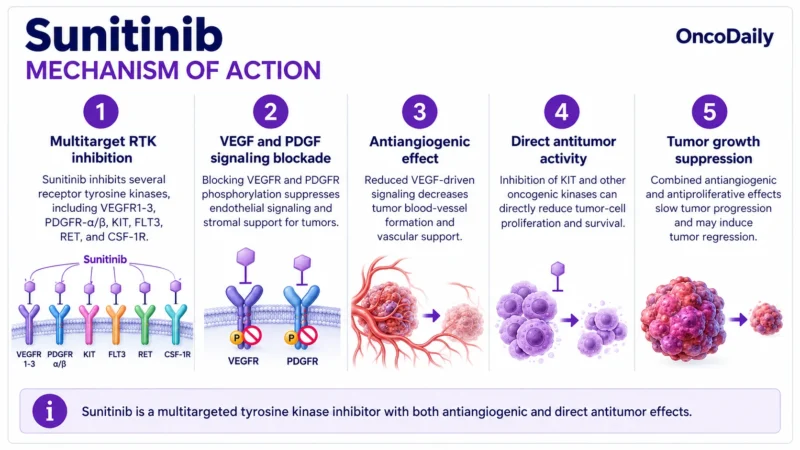
1. Tumors Activate Angiogenic and Growth Pathways
Many tumors depend on receptor tyrosine kinases such as:
- VEGFR
- PDGFR
- KIT
- RET
for blood-vessel formation, proliferation, and survival.
2. VEGF Signaling Promotes Angiogenesis
VEGF binds VEGFR on endothelial cells and activates pathways that promote:
- Endothelial-cell proliferation
- New-vessel formation
- Tumor vascularization
- Tumor growth
3. Sunitinib Blocks Multiple RTKs
Sunitinib inhibits:
- VEGFR1–3
- PDGFR-α/β
- KIT
- FLT3
- RET
- CSF-1R
and reduces receptor phosphorylation.
4. Angiogenesis Is Suppressed
Inhibition of VEGFR and PDGFR signaling reduces:
- Endothelial-cell proliferation
- Tumor blood-vessel formation
- Pericyte support of tumor vasculature
5. Direct Tumor Signaling Is Also Reduced
In tumors dependent on abnormal KIT, RET, or PDGFR signaling, sunitinib can directly inhibit malignant-cell proliferation.
6. Antitumor Effects Follow
The overall result is:
- Reduced angiogenesis
- Reduced proliferation
- Reduced tumor growth
- Reduced metastatic potential
- Tumor regression in some settings
The mechanism can be summarized as:
Sunitinib → inhibition of VEGFR/PDGFR/KIT and other RTKs → reduced phosphorylation and angiogenesis → reduced tumor growth and survival.
What Is the Dose of Sunitinib?
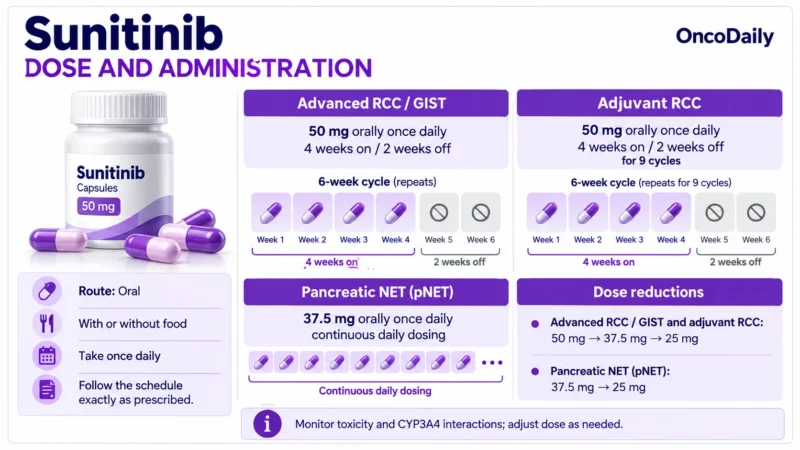
GIST and Advanced RCC
The standard dose is:
50 mg orally once daily
using:
Schedule 4/2
meaning:
- 4 weeks on treatment
- 2 weeks off treatment
Each complete cycle therefore lasts:
6 weeks.
Treatment continues until:
- Disease progression
- Unacceptable toxicity.
Adjuvant RCC
For adults at high risk of RCC recurrence after nephrectomy:
50 mg orally once daily
on:
4 weeks on / 2 weeks off
for:
Nine 6-week cycles.
Pancreatic Neuroendocrine Tumors
For progressive, well-differentiated advanced pNET:
37.5 mg orally once daily
given:
Continuously without a scheduled treatment break.
Treatment continues until progression or unacceptable toxicity.
How Should Sunitinib Be Taken?
Sunitinib can be taken:
With or without food.
It should generally be taken:
- Once daily
- At approximately the same time each day
Patients should follow the prescribed schedule carefully because RCC/GIST and pNET use different dosing schedules.
What If a Dose Is Missed?
A missed dose should not generally be compensated for by taking extra capsules.
The patient should resume the prescribed schedule rather than doubling the next dose.
Because sunitinib has a long half-life, maintaining the established daily regimen is more important than trying to replace a missed administration.
How Are Sunitinib Dose Reductions Made?
For GIST and advanced RCC, the recommended dose reductions are:
- Starting dose: 50 mg once daily
- First reduction: 37.5 mg once daily
- Second reduction: 25 mg once daily
The Schedule 4/2 pattern is maintained.
For adjuvant RCC:
- Starting dose: 50 mg once daily
- First reduction: 37.5 mg once daily
For pNET:
- Starting dose: 37.5 mg once daily
- First reduction: 25 mg once daily.
Dose Modification for Hepatotoxicity
Grade 3
- Withhold sunitinib
- Wait for recovery to Grade 0–1 or baseline
- Resume at a reduced dose
If Grade 3 hepatotoxicity recurs:
Permanently discontinue.
Grade 4
Permanently discontinue sunitinib.
Dose Modification for Cardiovascular Toxicity
For asymptomatic clinically important decline in LVEF:
- Withhold treatment
- Allow recovery
- Resume at a reduced dose if appropriate
For clinically manifest:
Congestive heart failure
sunitinib should be:
Permanently discontinued.
Dose Modification for Hypertension
For Grade 3 hypertension:
- Hold treatment
- Control blood pressure
- Resume at reduced dose after recovery
For Grade 4 hypertension:
Permanently discontinue.
What Are the Important Drug Interactions With Sunitinib?
Sunitinib is metabolized predominantly by:
CYP3A4.
Strong CYP3A4 Inhibitors
Strong inhibitors increase sunitinib exposure.
Examples include:
- Ketoconazole
- Itraconazole
- Clarithromycin
- Ritonavir
Ketoconazole increased combined exposure to sunitinib and its active metabolite by approximately:
51% for AUC.
If a strong CYP3A4 inhibitor cannot be avoided, the label suggests reducing sunitinib to:
- 37.5 mg once daily for RCC/GIST
- 25 mg once daily for pNET.
Strong CYP3A4 Inducers
Strong inducers can decrease sunitinib exposure.
Examples include:
- Rifampin
- Carbamazepine
- Phenytoin
- St. John’s wort
Alternative medications are preferred.
If unavoidable, cautious dose escalation may be considered with close toxicity monitoring.
QT-Prolonging Drugs
Because sunitinib can prolong QT, caution is required with medications that also prolong the QT interval.
More frequent:
ECG monitoring
should be considered when these drugs are used concomitantly.
Does Sunitinib Require Renal or Hepatic Dose Adjustment?
Renal Impairment
No clinically important pharmacokinetic differences were seen in patients with:
- Mild renal impairment
- Moderate renal impairment
- Severe renal impairment not requiring dialysis. DailyMed
Therefore routine starting-dose adjustment is generally:
Not required.
End-Stage Renal Disease on Hemodialysis
No starting-dose adjustment is required.
However, systemic exposure is approximately:
47% lower
than in patients with normal renal function.
The dose may therefore be increased gradually, up to approximately:
Two-fold
based on safety and tolerability.
Hepatic Impairment
For:
- Child-Pugh A
- Child-Pugh B
no clinically meaningful pharmacokinetic difference has been demonstrated, and routine starting-dose modification is generally not required.
Data in severe hepatic impairment are limited.
What Is the Pharmacokinetic Profile of Sunitinib?
Absorption
After oral administration:
Tmax is approximately 6–12 hours.
Food Effect
A high-fat, high-calorie meal does not produce a clinically significant change in exposure.
Therefore sunitinib may be taken:
With or without food.
Steady State
Steady-state concentrations are generally reached within:
10–14 days.
With repeated dosing:
- Sunitinib accumulates approximately 3–4-fold
- Its active metabolite accumulates approximately 7–10-fold.
Protein Binding
Sunitinib is approximately:
95% protein bound
while its active metabolite is approximately:
90% protein bound.
Half-Life
Terminal half-life:
Sunitinib
40–60 hours
Active metabolite
80–110 hours.
Metabolism
Sunitinib is primarily metabolized by:
CYP3A4
to an active metabolite.
The active metabolite contributes approximately:
23%–37%
of total systemic exposure.
Elimination
After a radiolabeled dose:
- Approximately 61% is recovered in feces
- Approximately 16% is recovered in urine.
What Are the Clinical Uses of Sunitinib?
1. Advanced Renal Cell Carcinoma
Sunitinib is FDA approved for:
Advanced RCC.
It became one of the defining VEGFR-targeted therapies in metastatic clear-cell RCC and established the modern antiangiogenic treatment era.
2. Adjuvant High-Risk RCC
Sunitinib is also FDA approved for:
Adults at high risk of RCC recurrence following nephrectomy.
However, its practical role in the adjuvant setting has become limited because newer immune-based strategies have changed contemporary RCC management.
3. Gastrointestinal Stromal Tumor
Sunitinib is FDA approved for:
GIST after progression on or intolerance to imatinib.
This remains an important molecularly targeted use because sunitinib inhibits:
KIT and PDGFR
among other kinases.
4. Pancreatic Neuroendocrine Tumors
Sunitinib is FDA approved for:
Progressive, well-differentiated pancreatic neuroendocrine tumors
that are:
- Unresectable
- Locally advanced
- Metastatic.
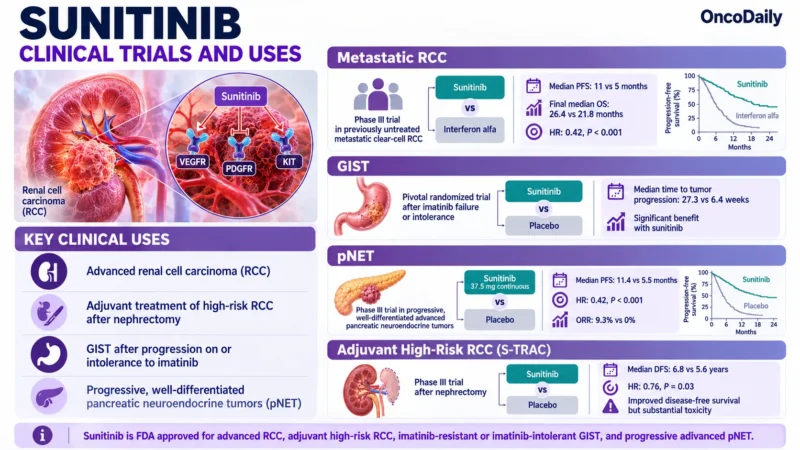
What Did the Pivotal RCC Trial Show?
The phase III trial comparing:
Sunitinib
with:
Interferon alfa
included:
750 previously untreated patients with metastatic clear-cell RCC.
Patients received sunitinib:
50 mg once daily on Schedule 4/2.
Progression-Free Survival
Median PFS:
- 11 months with sunitinib
- 5 months with interferon alfa
Hazard ratio:
0.42
95% CI:
0.32–0.54
P < 0.001.
Overall Survival in RCC
Final median overall survival was:
- 26.4 months with sunitinib
- 21.8 months with interferon alfa
HR:
0.821.
These results established sunitinib as a foundational targeted therapy for metastatic RCC.
What Did the GIST Trial Show?
The pivotal randomized trial evaluated sunitinib in patients with:
Advanced GIST after imatinib failure or intolerance.
Sunitinib was compared with placebo.
Median time to tumor progression was:
- 27.3 weeks with sunitinib
- 6.4 weeks with placebo
P < 0.0001.
This led to the FDA approval of sunitinib in:
Imatinib-resistant or imatinib-intolerant GIST.
What Did the pNET Trial Show?
The pivotal phase III trial enrolled:
171 patients
with progressive, well-differentiated pancreatic neuroendocrine tumors.
Patients received:
- Sunitinib 37.5 mg continuously
- Placebo.
Progression-Free Survival
Median PFS:
- 11.4 months
- 5.5 months
Hazard ratio:
0.42
P < 0.001.
Objective Response Rate
- Sunitinib: 9.3%
- Placebo: 0%.
Updated pNET Results
Blinded independent central review later reported:
- Median PFS: 12.6 months with sunitinib
- 5.8 months with placebo
- HR 0.32
- 38.6 months
- 29.1 months
HR:
0.73
although the OS difference was not statistically significant, partly in the context of substantial crossover.
What Did the S-TRAC Trial Show?
The phase III S-TRAC trial evaluated adjuvant sunitinib after nephrectomy in patients with:
High-risk locoregional clear-cell RCC.
Median disease-free survival was:
- 6.8 years with sunitinib
- 5.6 years with placebo
Hazard ratio:
0.76
P = 0.03.
However, toxicity was substantial:
- Dose reductions: 34.3%
- Dose interruptions: 46.4%
- Treatment discontinuation: 28.1%.
Is Sunitinib FDA Approved?
Yes.
FDA-approved indications include:
Advanced RCC
For adults with advanced renal cell carcinoma.
Adjuvant RCC
For adults at high risk of recurrence after nephrectomy.
GIST
After:
Progression on or intolerance to imatinib.
pNET
For:
Progressive, well-differentiated unresectable locally advanced or metastatic pancreatic neuroendocrine tumors.
What Is the Current Clinical Role of Sunitinib in 2026?
Sunitinib remains an important FDA-approved targeted therapy, but its role differs substantially by disease.
Advanced RCC
Sunitinib was once a dominant first-line therapy.
In 2026, the RCC treatment landscape is centered much more heavily around:
- Immune-checkpoint inhibitor combinations
- ICI + VEGF-TKI regimens
- Newer targeted strategies
Therefore, sunitinib monotherapy has a more selective role than it historically did.
Adjuvant RCC
Although still FDA approved, adjuvant sunitinib is rarely the preferred modern strategy because the field has moved toward immune-based adjuvant therapy and newer combinations. The rapidly evolving 2026 adjuvant landscape now includes newer immune-targeted approaches.
GIST
Sunitinib remains an important targeted treatment after:
Imatinib progression or intolerance
and retains a well-established role in sequential GIST therapy.
pNET
Sunitinib remains an established targeted option in:
Progressive advanced pancreatic neuroendocrine tumors
because of its proven antiangiogenic efficacy and phase III PFS benefit.
Read more: Metastatic Renal Cell Carcinoma in 2026: Frontline Combinations, Post-IO Sequencing, and the Emergence of HIF-2α Inhibition — OncoDaily discusses how sunitinib helped establish VEGFR-targeted therapy in RCC and how newer IO-based combinations have changed its place in treatment.
Watch more: OncoDaily discussion on targeted therapies and kinase inhibition, relevant to multitargeted TKIs such as sunitinib.
What Are the Major Side Effects of Sunitinib?
Common adverse reactions include:
- Fatigue
- Asthenia
- Diarrhea
- Mucositis/stomatitis
- Nausea
- Reduced appetite
- Vomiting
- Abdominal pain
- Hand-foot syndrome
- Hypertension
- Bleeding
- Dysgeusia
- Dyspepsia
- Thrombocytopenia.
Important serious toxicities include:
- Hepatotoxicity
- Cardiomyopathy
- QT prolongation
- Hypertension
- Hemorrhage
- Thrombotic microangiopathy
- Proteinuria
- Thyroid dysfunction
- Severe dermatologic toxicity
- Reversible posterior leukoencephalopathy syndrome
- Osteonecrosis of the jaw
- Impaired wound healing.
Hepatotoxicity
Sunitinib carries an FDA:
Boxed warning for hepatotoxicity.
Severe liver injury, liver failure, and fatal events have occurred.
Monitor:
- ALT
- AST
- Bilirubin
at:
- Baseline
- During each treatment cycle
- As clinically indicated.
Grade 4 hepatotoxicity requires:
Permanent discontinuation.
Cardiovascular Toxicity
Sunitinib can cause:
- Heart failure
- Cardiomyopathy
- Myocardial ischemia
- Myocardial infarction
In the pooled safety population:
Approximately 3%
experienced heart failure. DailyMed
Consider:
- Baseline LVEF
- Periodic LVEF monitoring
- Clinical assessment for heart-failure symptoms.
QT Prolongation
Sunitinib can cause:
Dose-dependent QT prolongation
and, rarely:
Torsade de Pointes.
Risk is greater in patients with:
- QT-prolonging drugs
- Bradycardia
- Cardiac disease
- Hypokalemia
- Hypomagnesemia.
Consider monitoring:
- ECG
- Potassium
- Magnesium
in higher-risk patients.
Hypertension
Hypertension is a characteristic VEGF-pathway toxicity.
Blood pressure should be monitored:
- Before treatment
- Regularly during treatment
Severe hypertension may require:
- Treatment interruption
- Antihypertensive therapy
- Dose reduction.
Proteinuria
Sunitinib can cause clinically significant proteinuria.
Monitor:
Urinary protein.
For:
≥3 g protein in 24 hours
treatment should generally be interrupted until improvement.
Nephrotic syndrome or recurrent severe proteinuria despite dose reduction requires:
Permanent discontinuation.
Thyroid Dysfunction
Sunitinib can cause:
- Hypothyroidism
- Hyperthyroidism
Monitor thyroid function:
- At baseline
- Periodically
- As clinically indicated.
Hand-Foot Syndrome and Skin Toxicity
Palmar-plantar erythrodysesthesia is a common toxicity.
Rare severe dermatologic events include:
- Stevens-Johnson syndrome
- Toxic epidermal necrolysis
- Erythema multiforme
- Necrotizing fasciitis
These severe events require:
Permanent discontinuation.
Hemorrhage
Sunitinib can increase the risk of:
- Epistaxis
- GI bleeding
- Pulmonary bleeding
- Other hemorrhagic events
Severe Grade 3–4 bleeding may require treatment interruption, dose reduction, or discontinuation depending on severity.
Wound Healing
Sunitinib should be withheld:
At least 3 weeks before elective surgery.
It should not be restarted for at least:
2 weeks after major surgery
and until:
Adequate wound healing has occurred.
Embryo-Fetal Toxicity
Sunitinib can cause fetal harm.
Females of reproductive potential should use effective contraception:
During treatment and for 4 weeks after the final dose.
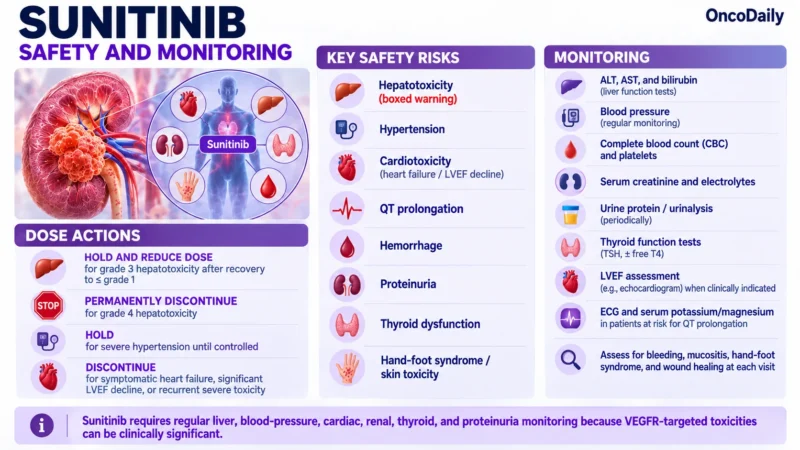
What Monitoring Is Required?
Monitoring during sunitinib treatment should include:
- ALT
- AST
- Bilirubin
- Blood pressure
- CBC
- Platelet count
- Electrolytes
- Potassium
- Magnesium
- Serum creatinine
- Urinalysis / urine protein
- Thyroid function
- LVEF when clinically indicated
- ECG in patients at increased QT risk
- Signs of heart failure
- Bleeding
- Hand-foot syndrome
- Oral mucositis
- Weight and nutritional status
- Blood glucose, particularly in patients using glucose-lowering therapy
- Wound healing before and after surgery
- Dental health / osteonecrosis risk
- CYP3A4 drug interactions.
FAQ
What Is Sunitinib Used For?
- Advanced RCC
- High-risk RCC after nephrectomy
- GIST after imatinib progression or intolerance
- Progressive advanced pancreatic neuroendocrine tumors.
What Is the Standard Sunitinib Dose for RCC and GIST?
What Is the pNET Dose?
Can Sunitinib Be Taken With Food?
It can be taken:
With or without food.
How Does Sunitinib Work?
VEGFR, PDGFR, KIT, RET, and FLT3
thereby reducing angiogenesis and tumor growth.
What Did the RCC Trial Show?
- 11 months with sunitinib
- 5 months with interferon alfa
HR 0.42.
What Did the GIST Trial Show?
- 27.3 weeks
- 6.4 weeks
with sunitinib versus placebo.
What Did the pNET Trial Show?
- 11.4 months
- 5.5 months
HR 0.42.