The treatment of metastatic clear-cell renal cell carcinoma (RCC) has been transformed by the integration of immune checkpoint inhibitors with VEGFR-targeted tyrosine kinase inhibitors, and most recently by the emergence of belzutifan, the first approved inhibitor of HIF-2α, a transcription factor constitutively activated by near-universal VHL loss in clear-cell RCC. IO-based combinations now hold regulatory approval for the frontline setting, none compared head-to-head, while the post-IO landscape is being reshaped by mechanistically complementary combinations that move beyond the limits of IO rechallenge.
Validated predictive biomarkers to guide individual treatment selection do not yet exist, leaving sequencing decisions across an expanding evidence base to clinical judgment.
These challenges will be among the topics discussed at VIRO 2026 – Global Voices in Renal Oncology, a virtual international congress organized by OncoDaily, taking place September 10–11, 2026.
Redefining the First Line: The End of Monotherapy
Sunitinib and pazopanib were the unchallenged first-line standards for metastatic clear-cell RCC for more than a decade. That era closed with a succession of randomized phase 3 trials, each demonstrating OS superiority over sunitinib, that resulted in four IO-based combinations receiving regulatory approval. These trials divided broadly along two mechanistic strategies: dual immune checkpoint blockade with nivolumab plus ipilimumab, and the combination of a PD-1 or PD-L1 inhibitor with a VEGFR-directed TKI.

Nivolumab plus Ipilimumab: Long-Term Survival and the Sarcomatoid Signal
The combination of nivolumab and ipilimumab (CheckMate 214) was the first regimen to demonstrate an overall survival advantage over sunitinib in intermediate- and poor-risk metastatic RCC (Motzer RJ et al., NEJM, 2018). The final 9-year analysis, presented at ASCO 2025 and published in Annals of Oncology, documented a 9-year OS rate of 31% versus 20% with sunitinib (HR 0.71) in the intention-to-treat population, representing the longest phase 3 follow-up of a first-line checkpoint inhibitor combination in RCC to date, confirming that a meaningful fraction of patients achieves sustained, long-term disease control that is not seen with VEGFR-TKI monotherapy (Choueiri et al., Annals of Oncology, 2026).
Sarcomatoid differentiation, present in 10–15% of clear-cell RCC cases and historically associated with aggressive disease and short survival, has emerged as a particularly responsive histologic subtype. In the CheckMate 214 sarcomatoid exploratory analysis, nivolumab plus ipilimumab achieved a confirmed ORR of 60.8% versus 23.1% with sunitinib, with a complete response rate of 18.9%, an unprecedented outcome in this population (Tannir NM et al., Clinical Cancer Research, 2021). Most experienced oncologists now regard sarcomatoid features as a clinical enrichment factor for this regimen.
The combination’s limitations are equally important. In favorable-risk disease, the OS advantage over sunitinib was not statistically significant in the primary analysis (Motzer RJ et al., NEJM, 2018). ORRs are lower than those achieved with IO+TKI regimens, which matters in patients with high disease burden requiring rapid tumor shrinkage. Immune-related adverse events, particularly colitis, hepatitis, and endocrinopathies, require active monitoring and often corticosteroid management.
IO plus TKI Combinations: Approved Regimens
Cabozantinib plus nivolumab (CheckMate 9ER) achieved a PFS HR of 0.51 and an OS HR of 0.60 versus sunitinib, with an ORR of 55.7% (Choueiri TK et al., New England Journal of Medicine, 2021). Cabozantinib’s multi-target kinase profile, encompassing VEGFR, MET, and AXL, provides specific rationale for its activity in bone-metastatic disease and in tumors with MET-driven resistance. The combination dose of 40 mg daily offers improved tolerability relative to the 60 mg monotherapy dose.
At ASCO 2026, Darren R. Feldman (Memorial Sloan Kettering Cancer Center) presented final results from a phase 2 trial of cabozantinib plus nivolumab in non-clear cell RCC, a population that accounts for approximately 25% of metastatic kidney tumors and has historically had inferior outcomes with single-agent VEGFR TKIs. In 53 patients with papillary, FH-deficient, unclassified, or translocation-associated RCC, the combination achieved an ORR of 43%, a median PFS of 11 months, and a median OS of 28 months at approximately 50 months of follow-up.
Responses were observed in both treatment-naive and previously treated patients. Response rates were particularly notable in FH-deficient RCC, where 7 of 8 patients achieved an objective response. A separate chromophobe cohort was closed early due to lack of activity. These results, with no new safety signals at extended follow-up, support cabozantinib plus nivolumab as a relevant treatment option across non-clear cell histologies (Feldman DR et al., ASCO Annual Meeting, 2026).

Lenvatinib plus pembrolizumab (CLEAR/KEYNOTE-581) reported the highest ORR of any frontline phase 3 mRCC trial at 71%, with a median PFS of 23.9 months versus sunitinib (Motzer R et al., NEJM, 2021). The final overall survival analysis confirmed a sustained survival benefit over sunitinib (HR 0.79) (Motzer RJ et al., JCO, 2024). However, lenvatinib’s toxicity profile, including hypertension, diarrhea, and fatigue, requires structured dose-reduction planning from treatment initiation. Dose adjustments to 14 mg daily are not infrequent and should be framed as appropriate dose optimization rather than treatment compromise.
Axitinib plus pembrolizumab (KEYNOTE-426) demonstrated significant OS and PFS benefits across all IMDC risk groups versus sunitinib (Rini BI et al., NEJM, 2019). The 5-year final analysis, published in Nature Medicine in 2025, confirmed sustained benefit with a median OS of 47.2 versus 40.8 months (HR 0.84), an ORR of 60.6% versus 39.6%, and for the first time identified an 18-gene T-cell-inflamed gene expression profile as a potentially predictive biomarker of response, a preliminary but meaningful step toward molecular stratification in this disease (Rini BI et al., Nature Medicine, 2025).
Axitinib’s more selective VEGFR inhibition generates a distinct and generally manageable toxicity profile, making it a practical option in patients for whom the broader kinase activity of cabozantinib or lenvatinib raises comorbidity concerns.
Choosing Between Frontline Combinations
With multiple approved combinations and no head-to-head comparative trial, first-line selection in 2026 depends on clinical judgment rather than algorithmic assignment. IMDC risk stratification remains valuable for prognosis and for calibrating treatment expectations with patients, but it does not cleanly direct regimen choice. Several practical axes inform the decision.
Disease pace and bulk is often the most decisive factor. High-burden, rapidly progressive disease favors the higher-ORR IO+TKI combinations, where the need for fast tumor control cannot wait for a delayed immunologic response. In low-volume, indolent disease where durability is the priority, the long-term survival tail of nivolumab plus ipilimumab remains a reasonable argument, particularly in patients who can tolerate a period of limited early response in exchange for the possibility of prolonged disease control.
Sarcomatoid differentiation tilts the decision further toward dual IO, supported by the most robust histology-specific efficacy data available (Tannir NM et al., Clinical Cancer Research, 2021). Comorbidities and tolerability ultimately determine which TKI partner is most appropriate, with cardiovascular status, renal function, and baseline performance capacity all weighing on that choice.
A principle underappreciated in frontline decision-making is that the TKI chosen in the first line directly constrains second-line options. A patient exposed to cabozantinib frontline cannot rely on it as a second-line rescue with the same efficacy rationale. Sequencing intent, not just the first-line choice, should frame the initial treatment decision.
After Frontline IO Progression
When patients progress on frontline IO-based therapy, the question of IO rechallenge has been directly addressed. CONTACT-03 randomized patients who had progressed after prior IO to atezolizumab plus cabozantinib versus cabozantinib monotherapy. Adding atezolizumab did not improve PFS or OS and increased toxicity (Pal SK et al., Lancet, 2023). This result effectively closed the door on routine IO rechallenge after IO progression and redirected the field toward TKI-based and novel-mechanism combinations as the post-IO backbone.
Find more videos on OncoDaily YouTube TV.
VEGFR-TKI as the Post-IO Standard
VEGFR-targeted kinase inhibition remains the foundation of second-line therapy following IO-based frontline treatment. The evidence base draws on the METEOR trial, which established cabozantinib’s superiority over everolimus in VEGFR-pretreated patients (Choueiri TK et al., NEJM, 2015), and AXIS, which demonstrated axitinib’s superiority over sorafenib in the second-line setting (Rini BI et al., Lancet, 2011). Although both trials predate the IO-first paradigm, their mechanistic underpinning remains applicable in the IO-pretreated population. Cabozantinib and lenvatinib are the most widely used agents in this context, with the choice shaped by prior TKI exposure and individual comorbidity profile.
The LenCabo trial, presented at ESMO 2025, provided the first randomized head-to-head comparison between two of the most commonly used second-line strategies in IO-pretreated clear-cell RCC. The phase 2 trial randomized 90 patients who had progressed on prior PD-1-based therapy to lenvatinib plus everolimus or cabozantinib monotherapy. Lenvatinib plus everolimus demonstrated superior PFS (15.7 versus 10.2 months; HR 0.51; p=0.02) and a numerically higher ORR (52.6% versus 38.6%), with OS data immature at the time of data cutoff. Grade 3–4 adverse events were more frequent with the combination (67.5% versus 50%), and treatment discontinuation due to toxicity occurred in 20% versus 10.9% (Hahn AW et al., Annals of Oncology, 2025).
As a phase 2 trial in which 86 patients received treatment, LenCabo is not practice-changing on its own, but it represents the first prospective comparative data between two widely used post-IO approaches and provides meaningful support for lenvatinib-based combination therapy in this context.
HIF-2α Inhibition: Belzutifan and a Mechanistically New Axis
Belzutifan, the first approved oral HIF-2α inhibitor, introduced the most mechanistically distinct therapeutic option in RCC since the advent of checkpoint inhibition. In the vast majority of clear-cell RCC tumors, biallelic VHL loss leads to constitutive accumulation of HIF-2α, which drives transcription of VEGF, PDGF, and cyclin D1, the oncogenic programs defining clear-cell RCC biology. Inhibiting HIF-2α upstream of these targets provides a non-cross-resistant mechanism active after both IO and VEGFR-TKI exposure.
LITESPARK-005 compared belzutifan to everolimus in patients previously treated with both IO therapy and a VEGFR-TKI. Belzutifan demonstrated superior PFS (HR 0.75) and a substantially higher ORR (22.7% versus 3.5%), the first time any agent had shown superiority over everolimus in this population, securing FDA approval for belzutifan in previously treated clear-cell RCC (Choueiri TK et al., NEJM, 2024).
Belzutifan’s two signature toxicities are mechanistically predictable. Anemia results from reduced erythropoietin production as HIF-2α is suppressed in renal peritubular cells. Hypoxia reflects impairment of oxygen-sensing homeostasis in a proportion of patients. Management requires baseline and interval hemoglobin monitoring, aggressive iron repletion, early initiation of erythropoiesis-stimulating agents, and home pulse oximetry with clearly defined thresholds for dose interruption. A downward trend in oxygen saturation readings is itself the signal to hold the drug; waiting for symptoms is insufficient.
LITESPARK-011: Belzutifan in Combination After IO-Based Frontline Therapy
LITESPARK-011, presented at ASCO GU 2026, is the first randomized phase 3 trial to evaluate a belzutifan-containing combination of lenvatinib plus belzutifan against an active TKI comparator, cabozantinib monotherapy, in patients who had progressed after prior anti–PD-(L)1 therapy administered in the first-line, second-line, or adjuvant setting. In 747 randomized patients, the combination demonstrated superior PFS (14.8 versus 10.7 months; HR 0.70; 95% CI 0.59–0.84; p<0.001) and a higher ORR (52.6% versus 40.2%), with complete responses in 20 patients on the combination arm versus 4 on cabozantinib.
Median duration of response nearly doubled at 23.0 versus 12.3 months. OS trended in favor of the combination (34.9 versus 27.6 months; HR 0.85) but did not reach statistical significance at the interim analysis and will be assessed at the final analysis. Patient-reported quality-of-life measures were similar between arms. Grade 3 or higher treatment-emergent adverse events were comparable between the two arms (84.1% with the combination versus 82.7% with cabozantinib), with hypoxia — belzutifan’s mechanism-specific toxicity — among the events more characteristic of the combination (Motzer RJ et al., JCO, 2026).
Lenvatinib inhibits VEGFR, FGFR, and PDGF receptor signaling in the tumor vasculature and stroma, while belzutifan blocks HIF-2α upstream, suppressing the transcriptional program that drives those same oncogenic pathways. The combination targets the two dominant signaling axes of clear-cell RCC through complementary, non-overlapping mechanisms, providing a biologically coherent basis for the activity observed, and a notable contrast to the CONTACT-03 result, where adding a second IO agent to a TKI conferred no benefit.
The Role of mTOR Inhibition
Everolimus and temsirolimus have been progressively displaced from the second-line setting by more efficacious TKI and belzutifan-based regimens. Both retain a role in later lines, particularly for patients with documented mTOR pathway alterations or those unable to tolerate VEGFR-directed therapy due to comorbidities or cumulative toxicity.
Emerging Directions
Recent reports signal where the field is heading. In the phase 1 ARC-20 study, casdatifan, a next-generation oral HIF-2α inhibitor, achieved a confirmed ORR of 35% in the recommended 100 mg once-daily cohort (n=32) and 31% in the total monotherapy population (n=127), with a median PFS of 12.2 months, in patients refractory to prior anti–PD-(L)1 and VEGFR-TKI therapy. Greater serum erythropoietin suppression correlated with clinical benefit, offering a mechanistically grounded candidate biomarker. A phase 3 trial (PEAK-1) of casdatifan plus cabozantinib in previously treated clear-cell RCC is ongoing (Choueiri TK et al., Nature, 2026).
Long-term follow-up of the phase 2 OMNIVORE trial found that among 12 patients who discontinued nivolumab after an early objective response, half remained treatment-free at 1 year, with several sustaining disease control beyond 4 years. Salvage ipilimumab in non-responders produced only a 4% response-conversion rate, reinforcing that sequential dual blockade does not reproduce the benefit of upfront concurrent nivolumab plus ipilimumab (McKay RR et al., Journal for ImmunoTherapy of Cancer, 2026).

Cellular therapy is also entering the RCC landscape. In the phase 1 TRAVERSE trial, a single infusion of ALLO-316, an allogeneic CD70-targeted CAR T-cell product, achieved a confirmed ORR of 25% in the phase Ib cohort (n=20), rising to 31.3% among patients with high tumor CD70 expression (TPS ≥50%). All responders remained progression-free at the time of analysis. Safety improved after phase Ia protocol amendments, with no grade 5 treatment-related events in phase Ib (Srour SA et al., Journal of Clinical Oncology, 2026).
Where the NCCN Guidelines Stand
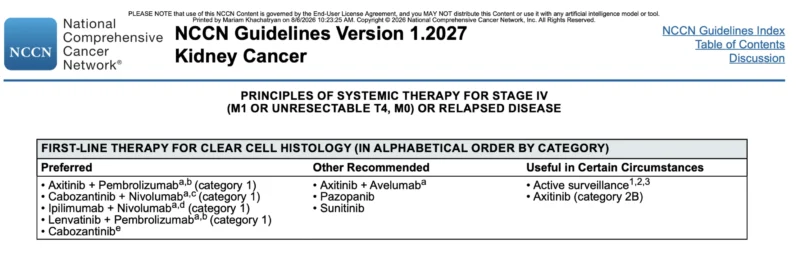
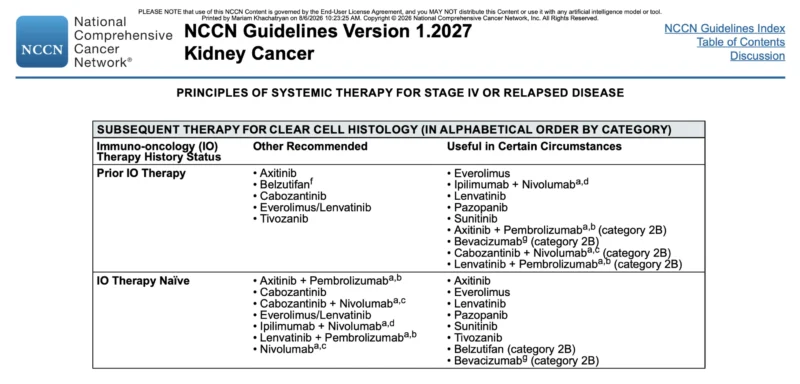
The current NCCN Guidelines for Kidney Cancer (Version 1.2027) reflect much of the evidence discussed above. For first-line clear-cell disease, the preferred category 1 options are the same IO-based combinations covered here, axitinib plus pembrolizumab, cabozantinib plus nivolumab, ipilimumab plus nivolumab, and lenvatinib plus pembrolizumab, with cabozantinib monotherapy also listed as a preferred option and older single-agent TKIs positioned as other recommended or situational choices.
For subsequent therapy, the guidelines now stratify recommendations by prior IO exposure. In patients with prior IO therapy, belzutifan appears among the recommended options alongside VEGFR-TKI monotherapy and everolimus-based regimens, consistent with the post-IO framework outlined in this review. For IO-naive patients progressing after non-IO frontline treatment, the full range of IO-based combinations remains available. This histology- and exposure-based structure underscores the central theme of contemporary RCC management: sequencing decisions increasingly depend on what a patient has already received.
Translating Evidence to Practice: Where the Gaps Remain
The proliferation of effective options has created a new kind of clinical problem: not a shortage of treatment, but a lack of data to discriminate between options at the individual patient level. No head-to-head trial has compared frontline IO+TKI combinations, and no prospective data address optimal sequencing from frontline IO-based therapy through second and third lines. Oncologists choosing between first-line regimens, and then navigating what remains available after the TKI used frontline, are doing so without a comparative evidence scaffold.
The biomarker problem is equally acute. Metastatic RCC has no validated predictive marker for IO response, TKI sensitivity, or belzutifan activity. The 5-year KEYNOTE-426 analysis identified an 18-gene T-cell-inflamed gene expression profile as significantly associated with OS, PFS, and ORR within the pembrolizumab plus axitinib arm, a meaningful signal, but not yet a test ready for routine clinical use (Rini BI et al., Nature Medicine, 2025). PD-L1 expression and tumor mutational burden remain exploratory. Until validated biomarkers arrive, clinicians are making high-stakes treatment choices on clinicopathologic features and judgment alone.
Translating belzutifan-based regimens to community practice adds a further layer of complexity. The dense monitoring infrastructure of clinical trials, including frequent lab draws, structured dose-interruption protocols, and rapid clinical access, does not automatically exist outside academic centers. Building proactive protocols for hemoglobin monitoring, ESA initiation, and home pulse oximetry before the first patient starts treatment is an organizational requirement, not an afterthought.
How to navigate these decisions across diverse healthcare systems, where access to combination biologics, monitoring infrastructure, and supportive care vary considerably, will be at the center of the discussion at VIRO 2026 – Global Voices in Renal Oncology, taking place virtually September 10–11, 2026. Register here and stay informed.