


Ruxolitinib (Jakafi): Understanding Its Mechanism, Dosing, Clinical Uses, and Role in Myelofibrosis, Polycythemia Vera, and Graft-Versus-Host Disease
Key takeaways
- Ruxolitinib is a JAK1/JAK2 inhibitor with major roles in MF, PV, aGVHD, and cGVHD.
- It suppresses JAK-STAT signaling and inflammatory cytokine pathways.
- MF dosing is based on platelet count: 5, 15, or 20 mg BID for conventional Jakafi depending on baseline platelets.
- PV starts at 10 mg BID.
- Steroid-refractory aGVHD starts at 5 mg BID.
- cGVHD starts at 10 mg BID.
- Jakafi can be taken with or without food.
- Jakafi XR, introduced in 2026, provides once-daily extended-release dosing.
- COMFORT-I showed 41.9% spleen response vs 0.7% with placebo at week 24.
- RESPONSE established ruxolitinib after hydroxyurea failure in PV.
- REACH2 showed 62% vs 39% ORR in steroid-refractory acute GVHD.
- REACH3 showed 49.7% vs 25.6% week-24 ORR in chronic GVHD.
- Major practical toxicities are anemia, thrombocytopenia, neutropenia, and infection risk.
- Abrupt discontinuation should generally be avoided because symptoms may rebound rapidly.
- CBC, lipid monitoring, infection surveillance, skin examination, and cardiovascular risk assessment are central to safe therapy.
Ruxolitinib (Jakafi) is an oral JAK1/JAK2 inhibitor used across several hematologic diseases characterized by dysregulated JAK-STAT signaling or excessive cytokine activation. In 2026, its FDA-approved indications include intermediate- or high-risk myelofibrosis (MF), polycythemia vera (PV) after inadequate response or intolerance to hydroxyurea, steroid-refractory acute graft-versus-host disease (aGVHD), and chronic GVHD after failure of one or two lines of systemic therapy in patients aged 12 years and older. The U.S. label was updated in July 2026 and now includes both conventional Jakafi twice-daily tablets and Jakafi XR once-daily extended-release tablets.
Key Facts
- Generic name: Ruxolitinib
- Brand: Jakafi
- Extended-release formulation: Jakafi XR
- Drug class: JAK1/JAK2 inhibitor
- Route: Oral
- Initial U.S. approval: 2011
- Major indications: Myelofibrosis, polycythemia vera, acute GVHD, chronic GVHD
- MF starting dose: Based on baseline platelet count
- PV starting dose: 10 mg twice daily
- aGVHD starting dose: 5 mg twice daily
- cGVHD starting dose: 10 mg twice daily
- Food: With or without food
- Major characteristic toxicities: Anemia, thrombocytopenia, neutropenia
- Other important risks: Serious infections, herpes zoster, tuberculosis/reactivation risk, non-melanoma skin cancer, lipid elevation, MACE, thrombosis, secondary malignancies, symptom rebound after abrupt discontinuation
- Major interaction pathway: CYP3A4; CYP2C9 contributes to metabolism
- Important 2026 update: Once-daily Jakafi XR is now available in 11, 22, 33, 44, and 55 mg strengths.
What Is Ruxolitinib?
Ruxolitinib is a small-molecule inhibitor of:
JAK1 and JAK2
These kinases transmit signals from cytokine and growth-factor receptors to intracellular STAT proteins.
JAK-STAT signaling regulates:
- Hematopoiesis
- Immune-cell activation
- Cytokine production
- Cell proliferation
- Survival
In myeloproliferative neoplasms such as MF and PV, this pathway is frequently dysregulated, often through:
- JAK2 V617F
- CALR mutations
- MPL mutations
- Other alterations converging on JAK-STAT signaling
Importantly, ruxolitinib works by suppressing downstream JAK signaling and does not require the patient to have a JAK2 mutation.
In GVHD, JAK1/JAK2 signaling contributes to inflammatory cytokine signaling and activation of alloreactive immune cells.
What Is the Mechanism of Action of Ruxolitinib?
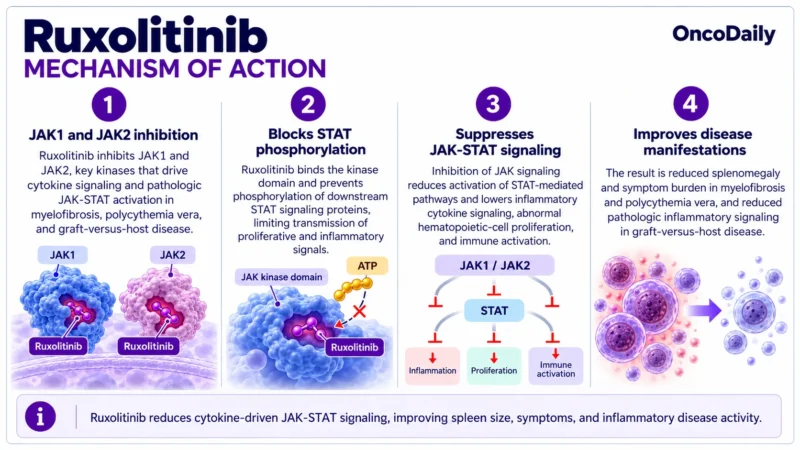
1. Cytokine Receptors Activate JAK1 and JAK2
Cytokine and growth-factor binding activates receptor-associated Janus kinases.
This leads to phosphorylation of intracellular signaling proteins.
2. STAT Proteins Become Activated
Activated JAK1/JAK2 recruit and phosphorylate:
STAT proteins
which then move into the nucleus and regulate transcription of genes involved in:
- Proliferation
- Survival
- Inflammation
- Immune activation
3. Ruxolitinib Inhibits JAK1 and JAK2
Ruxolitinib directly inhibits the kinase activity of:
JAK1 and JAK2.
4. STAT Phosphorylation Is Suppressed
Inhibition of JAK activity reduces activation of downstream STAT proteins.
In patients with MF and PV, ruxolitinib produces rapid inhibition of cytokine-induced STAT3 phosphorylation.
5. Clinical Effects Depend on the Disease
In myelofibrosis, this leads to:
- Reduced inflammatory cytokine signaling
- Reduced splenomegaly
- Improved constitutional symptoms
In polycythemia vera, it helps control:
- Hematocrit
- Splenomegaly
- Disease-related symptoms
In GVHD, JAK1/JAK2 blockade reduces:
- Pro-inflammatory cytokine signaling
- Pathologic immune activation
- Immune-cell tissue infiltration.
Overall:
Ruxolitinib → JAK1/JAK2 inhibition → ↓ STAT activation → ↓ inflammatory and proliferative signaling → disease-specific clinical benefit
What Is the Recommended Dose of Ruxolitinib?
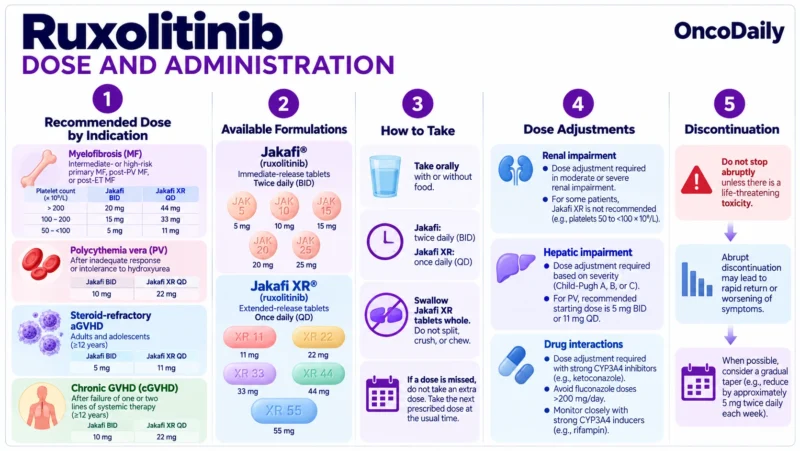
Myelofibrosis
The starting dose depends on baseline platelet count.
Platelets >200 × 10⁹/L
Jakafi: 20 mg orally twice daily
or:
Jakafi XR: 44 mg once daily
Platelets 100–200 × 10⁹/L
Jakafi: 15 mg twice daily
or:
Jakafi XR: 33 mg once daily
Platelets 50 to <100 × 10⁹/L
Jakafi: 5 mg twice daily
or:
Jakafi XR: 11 mg once daily.
Dose titration is guided by:
- Platelet count
- ANC
- Spleen response
- Symptom response
- Toxicity
For selected patients with inadequate response and adequate counts, Jakafi can be increased in:
5 mg twice-daily increments
up to:
25 mg twice daily.
Polycythemia Vera
Recommended starting dose:
Jakafi 10 mg twice daily
or:
Jakafi XR 22 mg once daily.
Steroid-Refractory Acute GVHD
For adults and adolescents aged ≥12 years:
Jakafi 5 mg twice daily
or:
Jakafi XR 11 mg once daily.
Dose escalation to 10 mg twice daily may be considered after at least 3 days if blood counts remain adequate and additional response is needed, according to the full prescribing information.
Chronic GVHD
Recommended starting dose:
Jakafi 10 mg twice daily
or:
Jakafi XR 22 mg once daily.
How Should Ruxolitinib Be Taken?
Jakafi can be taken:
With or without food.
If a dose is missed:
- Do not take an extra dose
- Take the next prescribed dose at the usual time.
For patients unable to swallow conventional Jakafi tablets, the tablets can be dispersed in water and administered through an appropriate nasogastric tube under label instructions.
Jakafi XR should be:
Swallowed whole.
Do not:
- Split
- Crush
- Chew
extended-release tablets.
How Should Ruxolitinib Be Discontinued?
Ruxolitinib should generally not be stopped abruptly unless there is a potentially life-threatening toxicity.
After interruption or discontinuation, patients may experience recurrence or rapid worsening of:
- Fever
- Fatigue
- Bone pain
- Splenomegaly
- Respiratory symptoms
- Hemodynamic instability in rare severe cases
When treatment is discontinued for non-emergency reasons, gradual tapering may be considered.
An example provided in the label is:
reduce Jakafi by approximately 5 mg twice daily each week.
How Are Ruxolitinib Dose Reductions Managed?
Dose modification is primarily driven by:
- Platelet count
- Hemoglobin
- ANC
- Renal/hepatic function
- Drug interactions
- Clinical indication
- Treatment response
Cytopenias
Management may include:
- Dose reduction
- Temporary interruption
- Transfusion support
particularly for:
- Thrombocytopenia
- Anemia
- Neutropenia.
The exact reduction sequence differs substantially between MF, PV, aGVHD, and cGVHD, so dose adjustments should follow the indication-specific label.
What Drug Interactions Are Important With Ruxolitinib?
Ruxolitinib is metabolized primarily by:
CYP3A4
and to a lesser extent by:
CYP2C9.
Strong CYP3A4 Inhibitors
Strong CYP3A4 inhibitors increase ruxolitinib exposure.
Ketoconazole increased:
- Cmax by 33%
- AUC by 91%
and prolonged the half-life.
For MF and PV, dose reduction is generally required.
For example, patients on stable doses ≥10 mg twice daily typically require approximately:
50% dose reduction.
Fluconazole
Fluconazole inhibits both CYP3A4 and CYP2C9 and can substantially increase ruxolitinib exposure.
Avoid:
fluconazole doses >200 mg/day.
Dose modification is required with doses ≤200 mg/day.
Strong CYP3A4 Inducers
Rifampin reduced ruxolitinib:
- Cmax by 32%
- AUC by 61%
although exposure to active metabolites increased.
Patients receiving strong inducers should be monitored closely for reduced clinical activity.
Does Ruxolitinib Require Dose Adjustment in Renal or Hepatic Impairment?
Yes. Dose adjustment is indication- and platelet-dependent.
Renal Impairment
For MF with moderate or severe renal impairment:
Platelets >150 × 10⁹/L
No starting-dose adjustment is required.
Platelets 100–150 × 10⁹/L
10 mg twice daily
or:
Jakafi XR 22 mg once daily
Platelets 50 to <100 × 10⁹/L
5 mg once daily
and Jakafi XR should not be used.
For PV with moderate or severe renal impairment:
5 mg twice daily
or:
Jakafi XR 11 mg once daily.
Different reductions apply in GVHD and ESRD on dialysis. DailyMed
Hepatic Impairment
For MF, dose depends on platelet count.
For PV with Child-Pugh A, B, or C impairment:
Jakafi 5 mg twice daily
or:
Jakafi XR 11 mg once daily.
In GVHD, hepatic dose modifications depend on the severity of liver involvement from GVHD itself.
What Is the Pharmacokinetic Profile of Ruxolitinib?
Absorption
Conventional Jakafi reaches peak plasma concentration approximately:
1–2 hours after dosing.
Oral absorption is at least:
95%.
Jakafi XR reaches peak concentration at approximately:
3 hours.
Food Effect
A high-fat, high-calorie meal does not cause a clinically meaningful change in exposure.
Therefore, ruxolitinib can be taken:
with or without food.
Protein Binding
Ruxolitinib is approximately:
97% protein bound, primarily to albumin.
Half-Life
For conventional Jakafi:
approximately 3 hours
for ruxolitinib itself.
The half-life of ruxolitinib plus its metabolites is approximately:
5.8 hours.
For Jakafi XR:
approximately 5 hours.
Metabolism
Primarily:
CYP3A4
and secondarily:
CYP2C9.
Excretion
Approximately:
- 74% of radiolabeled drug-related material is recovered in urine
- 22% in feces
with <1% excreted as unchanged drug.
What Are the Clinical Uses of Ruxolitinib?
Myelofibrosis
Ruxolitinib is approved for adults with:
- Intermediate-risk MF
- High-risk MF
- Primary MF
- Post-PV MF
- Post-ET MF.
Polycythemia Vera
Ruxolitinib is approved for adults with PV who have:
- Inadequate response to hydroxyurea
- Intolerance to hydroxyurea.
Acute GVHD
Ruxolitinib is approved for:
steroid-refractory acute GVHD
in patients aged:
12 years and older.
Chronic GVHD
Ruxolitinib is approved for:
chronic GVHD after failure of one or two lines of systemic therapy
in patients aged:
12 years and older.
What Did the Pivotal Clinical Trials Show?
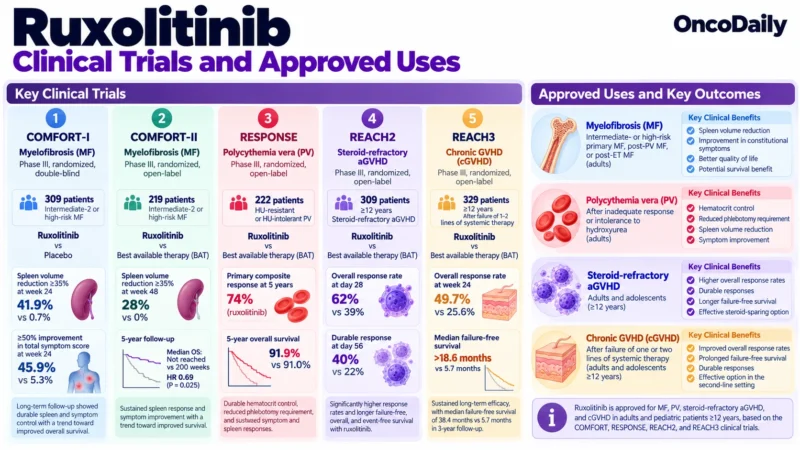
COMFORT-I
The phase III COMFORT-I trial enrolled:
309 patients
with intermediate-2 or high-risk myelofibrosis and compared:
- Ruxolitinib
- Placebo
At week 24:
Spleen Volume Reduction ≥35%
- Ruxolitinib: 41.9%
- Placebo: 0.7%
≥50% Improvement in Total Symptom Score
- Ruxolitinib: 45.9%
- Placebo: 5.3%
Both differences were highly significant.
Long-term follow-up showed:
- Median spleen-response duration: 168.3 weeks
- Median OS: not reached with ruxolitinib vs 200 weeks with placebo
- HR for death: 0.69, P = 0.025.
COMFORT-II
The phase III COMFORT-II trial compared:
- Ruxolitinib
- Best available therapy
in myelofibrosis.
At week 48:
≥35% Spleen Volume Reduction
- Ruxolitinib: 28%
- Best available therapy: 0%
P < 0.001.
At 5 years, the probability of maintaining a spleen response among responders was approximately:
48%.
The long-term analysis also showed a trend toward improved overall survival with ruxolitinib.
RESPONSE
The phase III RESPONSE trial evaluated ruxolitinib in PV patients resistant or intolerant to hydroxyurea.
Patients received:
- Ruxolitinib 10 mg twice daily
- Best available therapy
The primary endpoint combined:
- Hematocrit control without phlebotomy
- ≥35% reduction in spleen volume
Long-term follow-up showed that at 5 years, the probability of maintaining the primary composite response was:
74%.
Five-year overall survival was:
- 91.9% with ruxolitinib
- 91.0% with best available therapy, although substantial crossover occurred.
REACH2
The phase III REACH2 study established ruxolitinib for steroid-refractory acute GVHD.
At day 28:
Overall Response Rate
- Ruxolitinib: 62%
- Best available therapy: 39%
P < 0.001
Durable Response at Day 56
- 40%
- 22%
respectively.
Median failure-free survival was:
- 5.0 months
- 1.0 month
respectively.
The final analysis continued to show longer failure-free, overall, and event-free survival with ruxolitinib.
REACH3
The phase III REACH3 trial evaluated ruxolitinib in glucocorticoid-refractory or glucocorticoid-dependent chronic GVHD.
At week 24:
Overall Response
- Ruxolitinib: 49.7%
- Best available therapy: 25.6%
P < 0.001
Median failure-free survival was:
- >18.6 months
- 5.7 months, respectively.
At 3-year follow-up:
- Median failure-free survival was 38.4 months with ruxolitinib vs 5.7 months with BAT
- 36-month FFS probability was 56.5% vs 18.2%
- Median duration of response was not reached with ruxolitinib vs 6.4 months with BAT.
Is Ruxolitinib FDA Approved?
Yes.
Current U.S. indications include:
- Intermediate- or high-risk myelofibrosis in adults
- Polycythemia vera after inadequate response or intolerance to hydroxyurea
- Steroid-refractory acute GVHD in adults and pediatric patients ≥12 years
- Chronic GVHD after failure of one or two systemic therapies in adults and pediatric patients ≥12 years.
What Is the Current Clinical Role of Ruxolitinib in 2026?
Myelofibrosis
Ruxolitinib remains a foundational JAK inhibitor for symptomatic MF, particularly when treatment goals include:
- Spleen-volume reduction
- Symptom control
- Improvement in constitutional symptoms
- Quality-of-life improvement
Its use is strongly influenced by:
- Platelet count
- Baseline anemia
- Transfusion dependence
- Spleen size
- Symptom burden
- Comorbidities
- Prior JAK-inhibitor exposure
- Patients with significant anemia or thrombocytopenia may require alternative JAK-inhibitor strategies or careful dose adjustment.
Read more: Myelofibrosis (MF) in 2026: Matching Therapy to the Dominant Clinical Problem by OncoDaily.
Watch more: COMFORT: Five-Year Outcomes of Ruxolitinib in Patients With Myelofibrosis — Ruben A. Mesa, MD, discusses the durable efficacy and long-term safety of ruxolitinib in myelofibrosis.
Polycythemia Vera
Ruxolitinib remains an established second-line option after:
hydroxyurea resistance or intolerance.
Its principal benefits include:
- Hematocrit control
- Reduced phlebotomy requirement
- Spleen reduction
- Symptom improvement.
Acute GVHD
Ruxolitinib remains a standard systemic option for:
steroid-refractory aGVHD
based on the response advantage demonstrated in REACH2.
Chronic GVHD
Ruxolitinib is a major second- or later-line therapy after failure of systemic treatment, with sustained long-term efficacy demonstrated in REACH3.
Once-Daily Jakafi XR
A major practical development in 2026 is the availability of Jakafi XR, allowing once-daily administration across the labeled indications using equivalent extended-release dose strengths.
For example:
- 5 mg BID → 11 mg XR QD
- 10 mg BID → 22 mg XR QD
- 15 mg BID → 33 mg XR QD
- 20 mg BID → 44 mg XR QD
- 25 mg BID → 55 mg XR QD.
What Are the Major Side Effects of Ruxolitinib?
Myelosuppression
The most important hematologic toxicities are:
- Anemia
- Thrombocytopenia
- Neutropenia
These are often dose related.
In MF and PV, the most common hematologic adverse reactions occurring in >20% of patients are:
thrombocytopenia and anemia.
CBC monitoring is therefore central to safe use.
Serious Infections
Ruxolitinib can increase the risk of bacterial, viral, fungal, and opportunistic infections.
Clinicians should assess for prior infection history, including:
- Tuberculosis
- Herpes simplex
- Herpes zoster
- Hepatitis B
before treatment.
Serious active infections should be controlled before therapy is initiated.
Herpes Zoster
Herpes zoster reactivation can occur.
Patients should be monitored for:
- Dermatomal pain
- Vesicular rash
- Disseminated infection
and vaccination status should be considered according to applicable recommendations.
Symptom Exacerbation After Discontinuation
Abrupt withdrawal may lead to rapid return of MF symptoms and, rarely, severe inflammatory deterioration.
Gradual tapering should be considered when clinically feasible.
Non-Melanoma Skin Cancer
Ruxolitinib is associated with increased risk of:
- Basal-cell carcinoma
- Squamous-cell carcinoma
- Other non-melanoma skin cancers
Periodic skin examinations are recommended.
Lipid Elevations
Ruxolitinib can increase:
- Total cholesterol
- LDL cholesterol
- Triglycerides
Lipid assessment is recommended approximately:
8–12 weeks after treatment initiation.
Cardiovascular Events and Thrombosis
The current label includes warnings regarding:
- Major adverse cardiovascular events
- Arterial thrombosis
- Venous thrombosis
particularly in patients with relevant cardiovascular risk factors.
Secondary Malignancies
Secondary malignancies, including certain lymphoid malignancies, have been reported.
Risk assessment is especially important in:
- Current smokers
- Former smokers
- Patients with other malignancy risk factors.
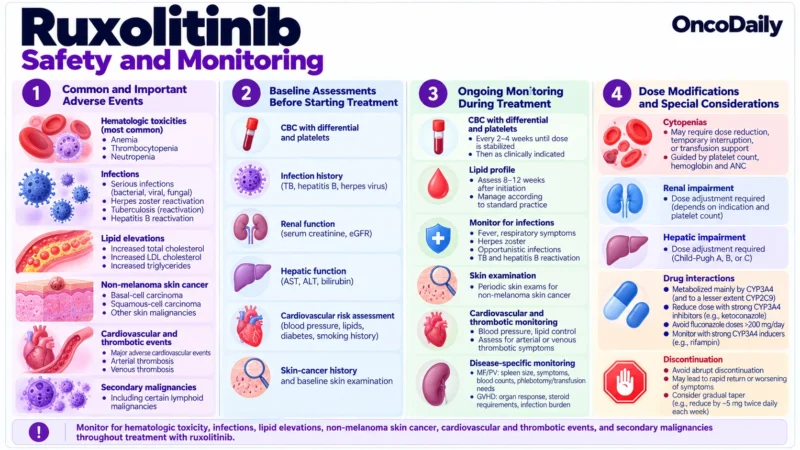
What Monitoring Is Required During Ruxolitinib Treatment?
Before starting treatment:
- CBC with differential and platelets
- Infection history
- Tuberculosis risk
- Hepatitis B history
- Herpesvirus history
- Renal function
- Hepatic function
- Cardiovascular risk
- Skin-cancer history
During therapy:
CBC
Perform:
every 2–4 weeks until the dose is stabilized
then:
as clinically indicated.
Monitor for:
- Anemia
- Thrombocytopenia
- Neutropenia
Lipid Profile
Assess:
8–12 weeks after initiation
and treat abnormalities according to standard practice.
Infection Monitoring
Monitor for:
- Fever
- Respiratory symptoms
- Herpes zoster
- Opportunistic infection
- Tuberculosis
- Hepatitis B reactivation
Skin Examination
Perform periodic skin examinations for:
non-melanoma skin cancer.
Cardiovascular and Thrombotic Monitoring
Assess:
- Blood pressure
- Smoking history
- Diabetes
- Lipids
- Arterial symptoms
- Venous thromboembolic symptoms
Disease-Specific Monitoring
For MF:
- Spleen size
- Symptom burden
- Blood counts
- Transfusion requirements
For PV:
- Hematocrit
- Phlebotomy requirement
- Splenomegaly
- Symptoms
For GVHD:
- Organ-specific response
- Infection burden
- Steroid requirements
- Cytopenias
FAQ
What is ruxolitinib used for?
- Myelofibrosis
- Polycythemia vera after hydroxyurea failure/intolerance
- Steroid-refractory acute GVHD
- Chronic GVHD after failure of systemic treatment
What is the standard dose for myelofibrosis?
- 200 × 10⁹/L: 20 mg BID
- 100–200 × 10⁹/L: 15 mg BID
- 50 to <100 × 10⁹/L: 5 mg BID
What is the starting dose for polycythemia vera?
What is the dose for acute GVHD?
What is the dose for chronic GVHD?
Can ruxolitinib be taken with food?
It may be taken:
with or without food.
What is Jakafi XR?
What are the most important side effects?
- Anemia
- Thrombocytopenia
- Neutropenia
- Infection risk