


Regorafenib (Stivarga): Understanding Its Mechanism, Dosing, Clinical Uses, and Role in Colorectal Cancer, GIST, and Hepatocellular Carcinoma
Key takeaways
- Regorafenib is an oral multikinase inhibitor targeting angiogenic, stromal, and oncogenic pathways.
- Important targets include VEGFR-1/2/3, TIE2, PDGFR-β, FGFR, KIT, RET, RAF-1, and BRAF.
- Standard dosing is 160 mg once daily on Days 1–21 of each 28-day cycle.
- CORRECT demonstrated median OS 6.4 vs 5.0 months in refractory mCRC, HR 0.77.
- CONCUR demonstrated median OS 8.8 vs 6.3 months, HR 0.55, in Asian patients with refractory mCRC.
- GRID demonstrated median PFS 4.8 vs 0.9 months after imatinib and sunitinib failure in GIST, HR 0.27.
- RESORCE demonstrated median OS 10.6 vs 7.8 months after sorafenib in HCC, HR 0.63.
- Characteristic toxicities include hand-foot skin reaction, hypertension, diarrhea, fatigue, and hepatotoxicity.
- Early dose modification and proactive toxicity management are central to successful treatment.
- In 2026, regorafenib remains relevant in later-line mCRC, sequential GIST therapy, and selected post-sorafenib HCC.
Regorafenib (Stivarga) is an oral multikinase inhibitor with antiangiogenic, antiproliferative, and stromal effects. It inhibits several kinases involved in tumor angiogenesis and oncogenic signaling, including VEGFR-1/2/3, TIE2, PDGFR-β, FGFR, KIT, RET, RAF-1, and BRAF. Through these actions, regorafenib suppresses tumor vascularization, stromal support, and malignant-cell signaling.
In the United States, regorafenib is FDA approved for metastatic colorectal cancer (mCRC) after standard therapies, unresectable or metastatic GIST after prior imatinib and sunitinib, and hepatocellular carcinoma (HCC) previously treated with sorafenib. Its pivotal evidence comes from the CORRECT, GRID, and RESORCE phase III trials.
Key Facts
- Generic name: Regorafenib
- Brand name: Stivarga
- Drug class: Oral multikinase inhibitor
- Major targets: VEGFR-1/2/3, TIE2, PDGFR-β, FGFR, KIT, RET, RAF-1, BRAF
- Route: Oral
- Standard dose: 160 mg once daily
- Schedule: Days 1–21 of each 28-day cycle
- Main FDA-approved uses: mCRC, GIST, HCC
- Major toxicities: Hand-foot skin reaction, hypertension, hepatotoxicity, diarrhea, fatigue, hemorrhage, cardiac ischemia/infarction
- Important monitoring: Liver function, blood pressure, skin toxicity, bleeding, electrolytes, cardiac symptoms
What Is Regorafenib?
Regorafenib is a small-molecule inhibitor of multiple tyrosine and serine/threonine kinases.
Its targets can be grouped into several biologic functions:
Angiogenic targets
- VEGFR-1
- VEGFR-2
- VEGFR-3
- TIE2
Stromal targets
- PDGFR-β
- FGFR
Oncogenic targets
- KIT
- RET
- RAF-1
- BRAF
This broad activity allows regorafenib to interfere with:
- Tumor angiogenesis
- Tumor-cell proliferation
- Stromal support
- Oncogenic signaling
- Tumor progression.
What Is the Mechanism of Action of Regorafenib?
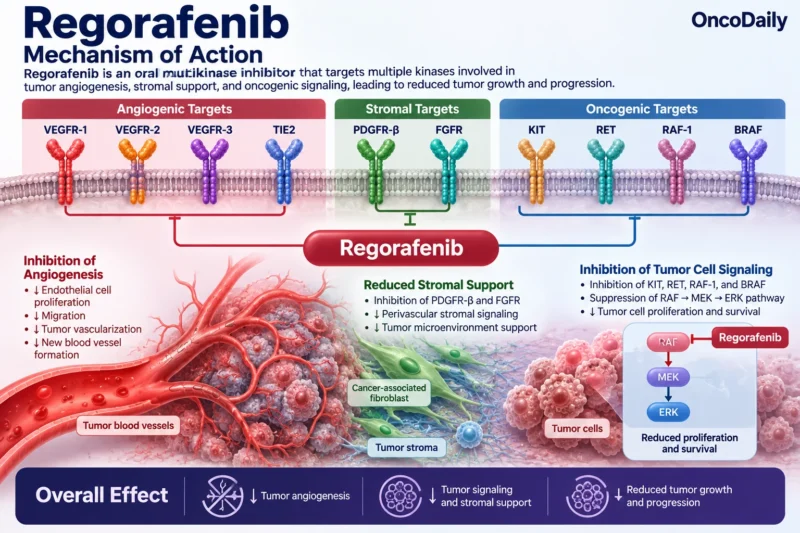
1. Tumors Depend on Angiogenesis
VEGF signaling through VEGFR-1/2/3 promotes:
- Endothelial-cell proliferation
- Migration
- Tumor vascularization
- New blood-vessel formation
2. Regorafenib Blocks VEGFR and TIE2
Regorafenib inhibits key angiogenic kinases, reducing:
- Endothelial proliferation
- Tumor blood-vessel formation
- Tumor vascular support
3. Stromal Signaling Is Suppressed
Inhibition of:
- PDGFR-β
- FGFR
reduces stromal and perivascular support of the tumor.
4. Oncogenic Signaling Is Also Inhibited
Regorafenib inhibits:
- KIT
- RET
- RAF-1
- BRAF
and thereby interferes with oncogenic pathways including the:
RAF → MEK → ERK pathway.
5. Tumor Growth and Progression Are Reduced
The overall effect is:
Regorafenib → inhibition of angiogenic + stromal + oncogenic kinases → ↓angiogenesis + ↓tumor signaling → reduced tumor growth and progression.
What Is the Dose of Regorafenib?
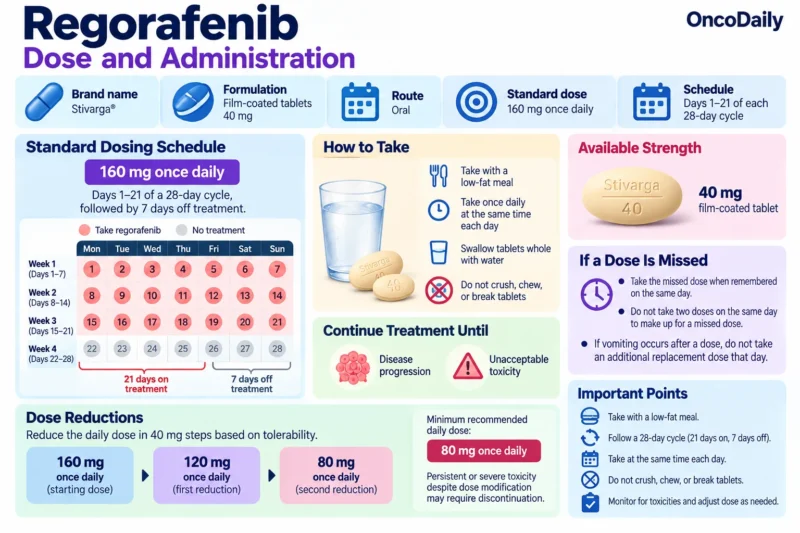
The standard recommended dose is:
160 mg orally once daily
for:
Days 1–21 of each 28-day cycle.
This is followed by:
7 days off treatment.
The same schedule was used in the major phase III trials in:
- mCRC
- GIST
- HCC.
How Should Regorafenib Be Taken?
Regorafenib is taken:
- Once daily
- At approximately the same time each day
- For 21 consecutive days
- Followed by 7 treatment-free days
It should be taken with a:
Low-fat meal.
Treatment generally continues until:
- Disease progression
- Unacceptable toxicity
What If a Dose Is Missed?
If a dose is missed:
- Take it when remembered on the same day
- Do not take two doses on the same day to compensate
- Resume the regular schedule afterward
If vomiting occurs after a dose:
- Do not take an additional replacement dose that day
How Are Regorafenib Dose Reductions Made?
Dose reductions are generally made in 40 mg steps.
- Starting dose: 160 mg once daily
- First reduction: 120 mg once daily
- Second reduction: 80 mg once daily
The minimum recommended daily dose is generally:
80 mg once daily.
Persistent or severe toxicity despite dose modification may require permanent discontinuation.
What Are the Important Drug Interactions With Regorafenib?
Regorafenib metabolism involves:
- CYP3A4
- UGT1A9
Clinically important interactions therefore include strong enzyme inhibitors and inducers.
Strong CYP3A4 Inducers
These may reduce regorafenib exposure.
Examples include:
- Rifampin
- Carbamazepine
- Phenytoin
- St. John’s wort
These combinations should generally be avoided.
Strong CYP3A4 Inhibitors
These may increase exposure to regorafenib or active metabolites.
Examples include:
- Clarithromycin
- Itraconazole
- Ketoconazole
- Ritonavir
Medication review is important before and during treatment.
Does Regorafenib Require Renal Dose Adjustment?
Routine starting-dose adjustment is generally not required for mild or moderate renal impairment.
Clinical experience is more limited in severe renal impairment and end-stage renal disease, so additional caution is appropriate.
Does Regorafenib Require Hepatic Dose Adjustment?
Because regorafenib can cause serious hepatotoxicity, baseline hepatic function is particularly important.
Patients with:
- Mild hepatic impairment
- Moderate hepatic impairment
require close monitoring.
Use in severe hepatic impairment is generally not recommended because of limited safety data and the potential for significant hepatic toxicity.
What Is the Pharmacokinetic Profile of Regorafenib?
Regorafenib is orally administered and extensively metabolized.
Its active metabolites also contribute to pharmacologic activity.
Key metabolic pathways include:
- CYP3A4
- UGT1A9
Regorafenib and active metabolites have relatively long half-lives, which support once-daily dosing during each treatment cycle.
What Are the Clinical Uses of Regorafenib?
1. Metastatic Colorectal Cancer
Regorafenib is used in patients with:
Treatment-refractory metastatic colorectal cancer
after progression on standard therapies.
This indication was established through the:
CORRECT trial, with confirmatory evidence from CONCUR.
2. Gastrointestinal Stromal Tumor
Regorafenib is used for:
Unresectable or metastatic GIST
after failure of:
- Imatinib
- Sunitinib
This indication was established in the:
GRID trial.
3. Hepatocellular Carcinoma
Regorafenib is used for:
HCC after prior sorafenib
in patients who previously tolerated sorafenib.
This role was established in:
RESORCE.
What Did the CORRECT Trial Show?
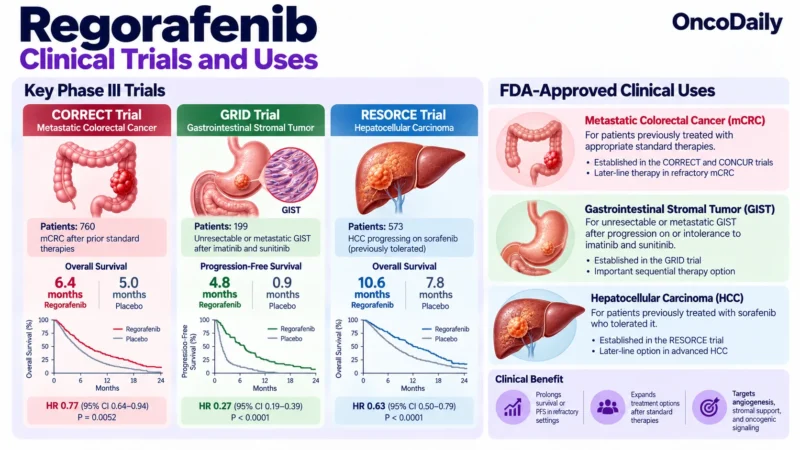
The phase III CORRECT trial enrolled:
760 patients
with metastatic colorectal cancer that had progressed after standard treatment.
Patients received:
- Regorafenib
- Placebo
Regorafenib was given at:
160 mg once daily for the first 3 weeks of each 4-week cycle.
Median Overall Survival
- 6.4 months with regorafenib
- 5.0 months with placebo
Hazard ratio:
0.77
95% CI:
0.64–0.94
P = 0.0052.
CORRECT established regorafenib as a later-line systemic therapy in refractory mCRC.
What Did the CONCUR Trial Show?
The phase III CONCUR trial evaluated regorafenib in:
Asian patients with refractory metastatic colorectal cancer.
A total of:
204 patients
were randomized.
Median Overall Survival
- 8.8 months with regorafenib
- 6.3 months with placebo
Hazard ratio:
0.55
P = 0.00016.
CONCUR reinforced the survival benefit of regorafenib in heavily pretreated mCRC.
What Did the GRID Trial Show?
The phase III GRID trial evaluated regorafenib in patients with:
Metastatic or unresectable GIST after failure of imatinib and sunitinib.
A total of:
199 patients
were randomized.
Median Progression-Free Survival
- 4.8 months with regorafenib
- 0.9 months with placebo
Hazard ratio:
0.27
95% CI:
0.19–0.39
P < 0.0001.
The marked improvement in PFS established regorafenib as an important later-line GIST therapy.
What Did the RESORCE Trial Show?
The phase III RESORCE trial enrolled patients with:
HCC progressing on sorafenib
who had previously tolerated sorafenib.
A total of:
573 patients
were randomized.
Median Overall Survival
- 10.6 months with regorafenib
- 7.8 months with placebo
Hazard ratio:
0.63
95% CI:
0.50–0.79
P < 0.0001.
RESORCE established sequential:
Sorafenib → regorafenib
as an effective strategy in appropriately selected patients with advanced HCC.
Is Regorafenib FDA Approved?
Yes.
FDA-approved indications include:
Metastatic Colorectal Cancer
For patients previously treated with appropriate standard therapies.
GIST
For patients with unresectable or metastatic disease after progression on or intolerance to:
- Imatinib
- Sunitinib
Hepatocellular Carcinoma
For patients previously treated with:
Sorafenib.
What Is the Current Clinical Role of Regorafenib in 2026?
Metastatic Colorectal Cancer
Regorafenib remains an established later-line oral therapy in heavily pretreated mCRC.
Its role is increasingly individualized because other later-line strategies are also available, but it remains particularly relevant when:
- Standard chemotherapy options have been exhausted
- Molecularly targeted options are unavailable
- An oral multikinase inhibitor is appropriate
A practical issue in mCRC is tolerability, and contemporary practice frequently emphasizes careful dose modification and early toxicity management.
Read more: PARERE Study by GONO: ctDNA-Guided Panitumumab Re-Treatment vs Regorafenib Sequencing in Chemorefractory Metastatic Colorectal Cancer on OncoDaily.
Watch more: Second Line and Later Therapies – mCRC — Dr. Ben Weinberg discusses later-line treatment strategies in metastatic colorectal cancer, including regorafenib.
GIST
Regorafenib remains a key sequential therapy after:
Imatinib → sunitinib
failure.
The GRID trial established its strong PFS benefit in this refractory population.
Hepatocellular Carcinoma
Regorafenib remains an approved later-line option after sorafenib.
Its modern use is more selective because the HCC treatment landscape has expanded substantially, but RESORCE remains important evidence for patients who:
- Tolerated sorafenib
- Subsequently developed disease progression.
What Are the Major Side Effects of Regorafenib?
Important adverse effects include:
- Hand-foot skin reaction
- Fatigue
- Diarrhea
- Hypertension
- Rash
- Hepatotoxicity
- Reduced appetite
- Weight loss
- Mucositis
- Bleeding
- Infection
- Electrolyte abnormalities
The toxicity profile often requires:
- Treatment interruption
- Dose reduction
- Supportive care.
Hand-Foot Skin Reaction
Hand-foot skin reaction is one of the most characteristic regorafenib toxicities.
In CORRECT, Grade ≥3 treatment-related HFSR occurred in approximately:
17%.
In GRID, Grade ≥3 HFSR occurred in approximately:
20%.
Management includes:
- Early skin assessment
- Moisturizers
- Removal of calluses
- Avoidance of friction
- Dose interruption or reduction when needed.
Hypertension
Hypertension is common and can be severe.
In RESORCE, Grade 3–4 hypertension occurred in:
15%
of regorafenib-treated patients.
Blood pressure should be:
- Controlled before treatment
- Monitored regularly during therapy
and significant hypertension may require:
- Interruption
- Dose reduction.
Hepatotoxicity
Regorafenib can cause:
Severe and potentially fatal liver injury.
Liver-function testing should include:
- ALT
- AST
- Bilirubin
at baseline and frequently during the initial treatment period, then periodically thereafter.
The large CONSIGN study reinforced the importance of liver monitoring and dose modification during treatment.
Diarrhea
Diarrhea is common and may become clinically significant.
Management includes:
- Hydration
- Antidiarrheal therapy
- Electrolyte monitoring
- Treatment interruption or reduction for severe toxicity.
Fatigue
Fatigue is frequent and may limit treatment tolerance.
Grade ≥3 fatigue occurred in:
- 10% in CORRECT
- 9% in RESORCE.
Clinical evaluation should consider:
- Anemia
- Dehydration
- Infection
- Thyroid dysfunction
- Nutritional status
- Disease progression.
Hemorrhage
Regorafenib may increase bleeding risk.
Patients should be monitored for:
- GI bleeding
- Hematuria
- Epistaxis
- Hemoptysis
- Other clinically significant hemorrhage.
Severe bleeding may require permanent discontinuation.
Cardiac Ischemia and Infarction
Regorafenib can increase the risk of:
- Myocardial ischemia
- Myocardial infarction
Patients with new:
- Chest pain
- Dyspnea
- Ischemic symptoms
require prompt assessment.
Gastrointestinal Perforation and Fistula
Although uncommon, regorafenib can cause:
- GI perforation
- GI fistula
These are serious complications and generally require permanent discontinuation.
What Monitoring Is Required?
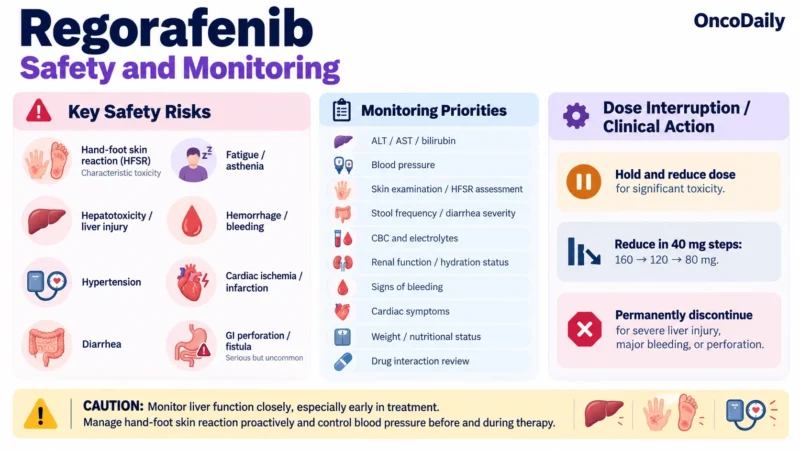
Monitoring during regorafenib therapy should include:
- ALT
- AST
- Bilirubin
- Blood pressure
- CBC
- Electrolytes
- Phosphate
- Renal function
- Skin examination
- Signs of hand-foot skin reaction
- Stool frequency
- Hydration status
- Signs of bleeding
- Cardiac symptoms
- GI symptoms suggesting perforation or fistula
- Weight and nutritional status
- Medication review for CYP3A4/UGT1A9 interactions
FAQ
What Is Regorafenib Used For?
- Previously treated metastatic colorectal cancer
- GIST after imatinib and sunitinib
- HCC after sorafenib.
What Is the Standard Dose?
on:
Days 1–21 of each 28-day cycle.
What Are the Dose Reductions?
How Does Regorafenib Work?
- Angiogenesis
- Stromal signaling
- Tumor-cell proliferation
including VEGFR, TIE2, PDGFR, FGFR, KIT, RET, and RAF-family kinases. PubMed
What Did CORRECT Show?
5.0 to 6.4 months
with regorafenib.
HR:
0.77.
What Did GRID Show?
0.9 to 4.8 months
with regorafenib.
HR:
0.27.
What Did RESORCE Show?
7.8 to 10.6 months
with regorafenib.
HR:
0.63.