


Quizartinib (Vanflyta): Understanding Its Mechanism, Dosing, Clinical Uses, and Role in FLT3-ITD–Positive Acute Myeloid Leukemia
Key takeaways
- Quizartinib is a selective FLT3 inhibitor used specifically for newly diagnosed FLT3-ITD–positive AML.
- It is incorporated throughout induction, consolidation, and maintenance.
- Induction: 35.4 mg once daily, Days 8–21.
- Consolidation: 35.4 mg once daily, Days 6–19.
- Maintenance starts at 26.5 mg daily, increasing to 53 mg daily if QTcF permits.
- Maintenance can continue for up to 36 cycles.
- QuANTUM-First showed median OS of 31.9 vs 15.1 months, HR 0.78.
- 2026 analyses demonstrate deeper FLT3-ITD MRD responses and provide additional evidence supporting continuation therapy.
- Quizartinib's role is specifically FLT3-ITD, unlike gilteritinib, which also has established FLT3-TKD activity.
- The major boxed warning is QT prolongation, torsades de pointes, and cardiac arrest.
- Vanflyta is available only through a REMS program because of cardiac risk.
- ECG and electrolyte monitoring are essential.
- Strong CYP3A inhibitors require dose reduction; strong or moderate CYP3A inducers should be avoided.
- Quizartinib should be stopped 7 days before HSCT conditioning.
- It is not FDA indicated as maintenance monotherapy after allogeneic HSCT.
Quizartinib (Vanflyta) is an oral, potent, selective FLT3 tyrosine kinase inhibitor approved for adults with newly diagnosed FLT3 internal tandem duplication (FLT3-ITD)–positive acute myeloid leukemia (AML). It is used with standard cytarabine/anthracycline induction, followed by cytarabine consolidation, and then as single-agent maintenance after consolidation chemotherapy. It is not FDA approved for FLT3-TKD–only AML and is not indicated as maintenance monotherapy after allogeneic hematopoietic stem-cell transplantation (HSCT).
The pivotal phase III QuANTUM-First trial demonstrated a significant overall-survival benefit from adding quizartinib to intensive chemotherapy and continuing it after consolidation, establishing quizartinib as a major frontline FLT3-directed option specifically for FLT3-ITD–positive AML.
Key Facts
- Generic name: Quizartinib
- Brand name: Vanflyta
- Drug class: Selective FLT3 tyrosine kinase inhibitor
- FLT3 inhibitor type: Type II
- Primary clinical target: FLT3-ITD
- Route: Oral
- Initial U.S. approval: 2023
- FDA-approved setting: Newly diagnosed adult FLT3-ITD–positive AML
- Induction dose: 35.4 mg once daily on Days 8–21
- Consolidation dose: 35.4 mg once daily on Days 6–19
- Maintenance: 26.5 mg once daily Days 1–14 of Cycle 1 → 53 mg once daily from Day 15 if QTcF ≤450 ms
- Maintenance duration: Up to 36 cycles
- Available tablet strengths: 17.7 mg and 26.5 mg
- Food: With or without food
- Major active metabolite: AC886
- Boxed warning: QT prolongation, torsades de pointes, and cardiac arrest
- Restricted distribution: Vanflyta REMS
- Major metabolic pathway: CYP3A4/5.
What Is Quizartinib?
Quizartinib is a small-molecule inhibitor of the receptor tyrosine kinase:
FLT3
FLT3 is expressed on hematopoietic progenitor cells and participates in normal proliferation and differentiation.
In AML, an internal tandem duplication within FLT3 (FLT3-ITD) causes constitutive receptor activation.
This results in continuous downstream signaling that promotes:
- Leukemic blast proliferation
- Survival
- Reduced apoptosis
- Expansion of the malignant clone
Quizartinib and its active metabolite AC886 bind the ATP-binding domain of FLT3 and inhibit FLT3 kinase activity.
A critical distinction from gilteritinib is that quizartinib’s established approved role is specifically FLT3-ITD–positive AML; it should not be presented as a broadly active FLT3-TKD agent.
What Is the Mechanism of Action of Quizartinib?
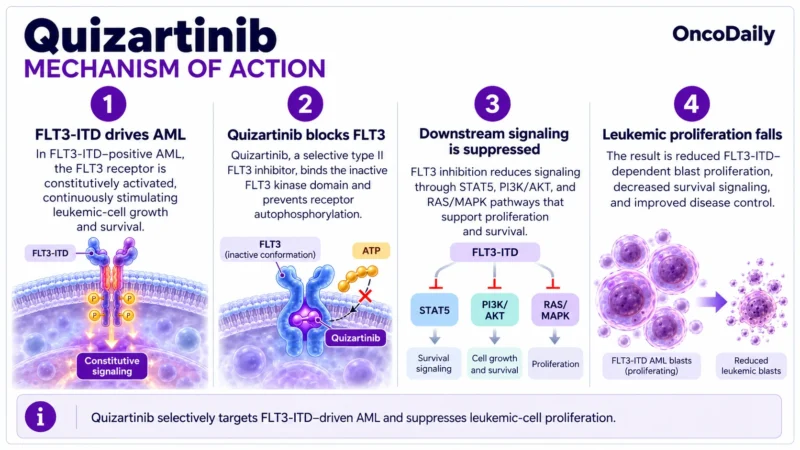
1. FLT3-ITD Constitutively Activates FLT3
Normally, FLT3 signaling is tightly regulated.
In FLT3-ITD AML, internal tandem duplication causes persistent activation of the receptor without normal ligand-dependent control.
This drives signaling through pathways including:
- STAT5
- PI3K–AKT
- RAS–RAF–MEK–ERK
leading to leukemic-cell proliferation and survival.
2. Quizartinib Binds the FLT3 Kinase Domain
Quizartinib is a type II FLT3 inhibitor that binds the inactive conformation of the FLT3 kinase.
Its active metabolite:
AC886
also contributes to FLT3 inhibition.
3. FLT3 Autophosphorylation Is Blocked
Quizartinib inhibits FLT3 kinase activity and prevents:
FLT3 receptor autophosphorylation.
4. Downstream Oncogenic Signaling Falls
As FLT3 phosphorylation decreases, signaling through:
- STAT5
- PI3K/AKT
- RAS/MAPK
is suppressed.
5. FLT3-ITD–Dependent Leukemic Proliferation Is Reduced
The overall effect is:
Quizartinib → FLT3 inhibition → ↓ FLT3 phosphorylation → ↓ downstream survival/proliferative signaling → ↓ FLT3-ITD–dependent AML-cell growth
Preclinical models demonstrated inhibition of FLT3-ITD–dependent proliferation and antitumor activity.
What Is the Recommended Dose of Quizartinib?
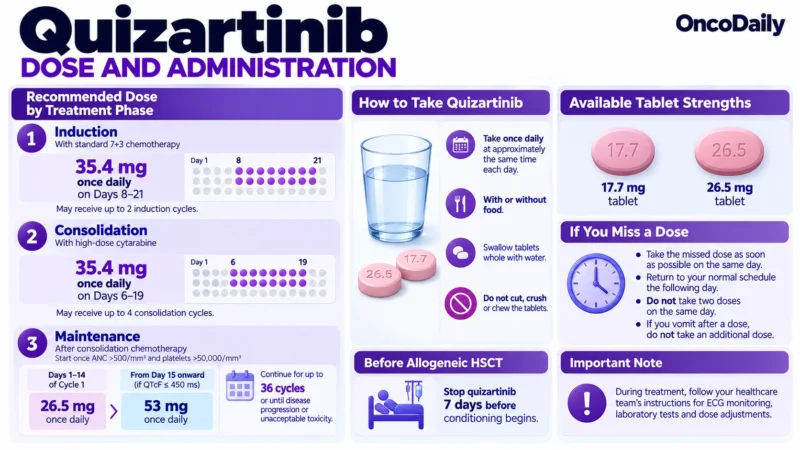
Quizartinib dosing varies according to the phase of AML treatment.
Induction
With standard 7+3 induction chemotherapy:
35.4 mg orally once daily on Days 8–21.
Patients may receive up to:
2 induction cycles.
If a second induction uses a 5+2 regimen, quizartinib is given on:
Days 6–19.
Consolidation
With high-dose cytarabine consolidation:
35.4 mg orally once daily on Days 6–19.
Patients may receive up to:
4 consolidation cycles.
Maintenance
Maintenance should begin after consolidation chemotherapy once blood counts have recovered to:
- ANC >500/mm³
- Platelets >50,000/mm³
During the first maintenance cycle:
26.5 mg once daily on Days 1–14.
If:
QTcF ≤450 ms
increase on Day 15 to:
53 mg once daily.
The 53 mg dose is then administered continuously, without a scheduled break between cycles, for up to:
36 cycles
or until progression or unacceptable toxicity.
If QTcF >500 ms occurred during induction or consolidation, the label directs maintenance at:
26.5 mg once daily rather than escalating to 53 mg.
Before Allogeneic HSCT
For patients proceeding to HSCT:
Stop quizartinib 7 days before conditioning begins.
How Should Quizartinib Be Taken?
Vanflyta should be taken:
- Once daily
- At approximately the same time each day
- With or without food
Tablets should be swallowed whole.
Do not:
- Cut
- Crush
- Chew
the tablets.
A high-fat, high-calorie meal does not cause a clinically meaningful alteration in quizartinib pharmacokinetics.
What Should You Do If You Miss a Dose of Quizartinib?
If a dose is missed or not taken at the usual time:
- Take it as soon as possible on the same day
- Return to the usual schedule the following day
- Do not take two doses on the same day
If vomiting occurs after a dose:
- Do not replace the dose
- Wait until the next scheduled dose.
How Are Quizartinib Dose Reductions Managed?
Quizartinib has structured dose-reduction levels.
Standard reduction sequence
53 mg → 35.4 mg → 26.5 mg → interruption
For patients receiving 17.7 mg:
17.7 mg → interruption.
QTcF 450–480 ms
Continue the current dose with close monitoring.
QTcF 481–500 ms
Reduce quizartinib by one dose level without interruption.
If QTcF falls below 450 ms, the previous dose may be resumed during the next cycle with close ECG monitoring.
QTcF >500 ms
- Interrupt quizartinib
- Correct reversible causes
- Resume at a reduced dose after QTcF falls below 450 ms
If QTcF >500 ms recurs despite dose reduction and correction of risk factors:
Permanently discontinue quizartinib.
Torsades de pointes, polymorphic ventricular tachycardia, or life-threatening arrhythmia requires:
Permanent discontinuation.
Grade 3–4 Nonhematologic Toxicity
- Interrupt quizartinib
- Resume at the previous dose if toxicity improves to Grade ≤1
- Resume at a reduced dose if it improves only to Grade 2
- Discontinue if Grade 3–4 toxicity persists >28 days.
Severe Hypokalemia or Hypomagnesemia
For Grade 3–4 electrolyte abnormalities:
- Interrupt quizartinib
- Correct potassium and magnesium
- Restart when toxicity improves to Grade ≤2 without symptoms.
What Drug Interactions Are Important With Quizartinib?
Quizartinib is predominantly metabolized by:
CYP3A4/5.
Strong CYP3A Inhibitors
Strong CYP3A inhibitors increase quizartinib exposure and therefore can increase QT and other toxicities.
Ketoconazole increased quizartinib:
- AUC by 94%
- Cmax by 17%.
Dose reductions are required:
- 53 mg → 26.5 mg
- 35.4 mg → 17.7 mg
- 26.5 mg → 17.7 mg
If the patient is receiving:
17.7 mg
quizartinib should be interrupted during strong CYP3A inhibitor treatment.
After the inhibitor has been discontinued for approximately 5 half-lives, resume the prior quizartinib dose.
This interaction is particularly relevant in AML because potent azole antifungal therapy may be required.
Strong or Moderate CYP3A Inducers
Avoid these combinations.
Efavirenz, a moderate CYP3A inducer, reduced quizartinib:
- AUC by approximately 90%
- Cmax by approximately 45%.
Examples include:
- Rifampin
- Carbamazepine
- Phenytoin
- Phenobarbital
- St. John’s wort
QT-Prolonging Drugs
Combining quizartinib with other QT-prolonging agents increases risk.
Relevant medications can include:
- Azole antifungals
- Ondansetron
- Granisetron
- Azithromycin
- Moxifloxacin
- Pentamidine
- Prochlorperazine
- Tacrolimus
If combination therapy is necessary:
increase ECG monitoring.
BCRP Substrates
Quizartinib can inhibit BCRP.
Avoid concomitant BCRP substrates where possible, or monitor carefully and adjust the substrate according to its prescribing information.
Does Quizartinib Require Dose Adjustment in Renal or Hepatic Impairment?
Renal Impairment
No routine dose adjustment is required for:
CrCl 30–89 mL/min.
Quizartinib has not been adequately studied in:
CrCl <30 mL/min.
Hepatic Impairment
No routine dose adjustment is recommended for:
- Mild hepatic impairment
- Moderate hepatic impairment
Quizartinib has not been adequately studied in:
severe hepatic impairment / Child-Pugh C.
What Is the Pharmacokinetic Profile of Quizartinib?
Absorption
Absolute oral bioavailability is approximately:
71%.
Median Tmax is approximately:
4 hours.
Food Effect
No clinically significant pharmacokinetic difference occurs with a high-fat, high-calorie meal.
Therefore, Vanflyta may be administered:
with or without food.
Protein Binding
Quizartinib and AC886 are:
≥99% protein bound.
Half-Life
Mean effective half-lives during maintenance are approximately:
- Quizartinib: 81 hours
- AC886: 136 hours.
Steady State
Steady state is reached at approximately:
Day 15
with once-daily administration.
Metabolism
Quizartinib is metabolized primarily by:
CYP3A4/5
to its major active metabolite:
AC886.
Excretion
After radiolabeled administration:
- Approximately 76.3% was recovered in feces
- Approximately 1.64% in urine.
What Are the Clinical Uses of Quizartinib?
Newly Diagnosed FLT3-ITD–Positive AML
Quizartinib is FDA approved for adults with:
newly diagnosed FLT3-ITD–positive AML
confirmed by an:
FDA-approved diagnostic test.
It is given:
- With cytarabine + anthracycline induction
- With high-dose cytarabine consolidation
- As maintenance monotherapy after consolidation chemotherapy.
FLT3-TKD AML
Quizartinib’s FDA indication is not for isolated FLT3-TKD disease.
This distinction is important when comparing quizartinib with broader FLT3 inhibitors such as gilteritinib.
Post-Transplant Maintenance
Vanflyta is not FDA indicated as maintenance monotherapy after allogeneic HSCT, because an improvement in overall survival in this specific setting has not been established.
What Did the Pivotal Clinical Trials Show?
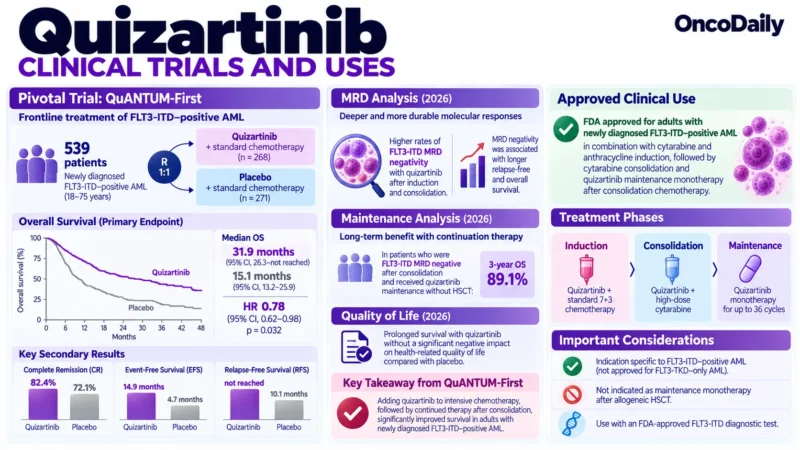
QuANTUM-First
The pivotal phase III QuANTUM-First trial enrolled adults aged 18–75 years with newly diagnosed FLT3-ITD–positive AML.
A total of:
539 patients
were randomized 1:1 to:
- Quizartinib + standard chemotherapy
- Placebo + standard chemotherapy
followed by consolidation, possible allogeneic transplantation, and continuation therapy.
Overall Survival
At a median follow-up of:
39.2 months
median overall survival was:
- Quizartinib: 31.9 months
- Placebo: 15.1 months
Hazard ratio:
0.78
95% CI:
0.62–0.98
P = 0.032.
This represents the key finding that established quizartinib as a frontline treatment for FLT3-ITD–positive AML.
Treatment Strategy
Quizartinib was integrated throughout treatment:
- Induction chemotherapy
- Consolidation chemotherapy
- Allogeneic HCT when appropriate
- Continuation/maintenance therapy for up to 3 years.
QuANTUM-First MRD Analysis
A 2026 analysis evaluated FLT3-ITD measurable residual disease.
Quizartinib produced:
- Deeper FLT3-ITD molecular responses
- Higher MRD-negativity rates at the end of induction
- Benefit regardless of FLT3-ITD insertion length
- Benefit regardless of NPM1 comutation status
MRD level after induction was strongly associated with subsequent relapse and survival.
QuANTUM-First Maintenance Analysis
A 2026 maintenance analysis further explored patients continuing quizartinib after consolidation.
Among patients who were FLT3-ITD MRD negative after consolidation and received quizartinib maintenance without allogeneic transplantation, estimated:
3-year survival was 89.1%.
These findings strengthen the rationale for continuation therapy after consolidation, although decisions regarding transplantation must remain individualized.
Quality-of-Life Analysis
A 2026 QuANTUM-First patient-reported outcome analysis found that adding quizartinib prolonged survival without a substantial adverse effect on overall health-related quality of life compared with placebo. PubMed
Is Quizartinib FDA Approved?
Yes.
Quizartinib is FDA approved for adults with:
newly diagnosed FLT3-ITD–positive AML
in combination with:
- Standard cytarabine + anthracycline induction
- Cytarabine consolidation
followed by:
quizartinib maintenance monotherapy after consolidation chemotherapy.
Initial U.S. approval occurred in:
2023.
It is not indicated as maintenance monotherapy following allogeneic HSCT.
What Is the Current Clinical Role of Quizartinib in 2026?
Frontline FLT3-ITD–Positive AML
Quizartinib is an established frontline targeted option for fit adults with newly diagnosed FLT3-ITD–positive AML receiving intensive chemotherapy.
Its defining evidence comes from QuANTUM-First, where:
median OS nearly doubled from 15.1 to 31.9 months.
Unlike midostaurin, which has activity across FLT3 mutation classes, quizartinib’s approved role is specifically centered on:
FLT3-ITD disease.
This makes rapid molecular characterization at AML diagnosis essential.
Read more: Integrating Targeted Therapies into HMA-Venetoclax in AML: Perspectives from ASCO 2026 by OncoDaily.
Watch more: Quizartinib for frontline FLT3-ITD+ AML: updated results from the QuANTUM-First trial — Harry Erba, MD, PhD, discusses the role of quizartinib in newly diagnosed FLT3-ITD–positive AML, including deeper responses and the survival benefit seen with quizartinib plus intensive chemotherapy.
Integration Across the Treatment Course
Quizartinib is unusual because the FDA-approved strategy spans:
induction → consolidation → maintenance.
The drug therefore functions not simply as an induction adjunct but as a longitudinal component of FLT3-ITD AML treatment.
Molecular Response and MRD
The 2026 QuANTUM-First analyses add an increasingly important molecular dimension to treatment.
Quizartinib improves the depth of FLT3-ITD MRD response, and MRD status after induction and consolidation provides prognostic information regarding:
- Relapse
- Survival
- Potential value of continuation therapy.
Maintenance After Consolidation
Continuation for up to:
36 cycles
is part of the FDA-approved regimen for patients who do not proceed into the post-allogeneic-HSCT maintenance setting.
Importantly, maintenance after HSCT should not be conflated with standard post-consolidation maintenance because the U.S. label specifically states that post-HSCT maintenance is not an approved indication.
What Are the Major Side Effects of Quizartinib?
QT Prolongation and Cardiac Arrhythmias
The defining safety concern is:
QT prolongation.
Vanflyta carries a boxed warning for:
- QT prolongation
- Torsades de pointes
- Cardiac arrest.
Among 1,081 AML patients exposed to quizartinib in clinical trials:
- Torsades de pointes occurred in approximately 0.2%
- Cardiac arrest in approximately 0.6%
- Ventricular fibrillation in approximately 0.1%.
In QuANTUM-First:
- 2.3% developed QTcF >500 ms
- 10% had a QTcF increase >60 ms from baseline.
Do not initiate or escalate quizartinib if:
QTcF >450 ms.
Electrolyte Abnormalities
Hypokalemia and hypomagnesemia substantially increase arrhythmic risk.
Before and during therapy:
- Monitor potassium
- Monitor magnesium
- Correct deficiencies promptly.
Myelosuppression
Common hematologic adverse reactions include:
- Febrile neutropenia
- Neutropenia
- Thrombocytopenia
- Anemia
In QuANTUM-First, febrile neutropenia occurred in approximately:
44% of quizartinib-treated patients.
Gastrointestinal Toxicity
Common events included:
- Diarrhea: 42%
- Mucositis: 38%
- Nausea: 34%
- Abdominal pain: 30%
- Vomiting: 25%.
Diarrhea and vomiting require particular attention because they can worsen:
- Hypokalemia
- Hypomagnesemia
- QT risk.
Infection
Because quizartinib is administered with intensive AML chemotherapy, clinically important infections are common.
Reported events included:
- Sepsis
- Upper respiratory infections
- Fungal infections
- Herpesvirus infections.
Hepatic Abnormalities
Hypertransaminasemia was observed and liver-function tests should be monitored during therapy.
Embryo-Fetal Toxicity
Quizartinib may cause fetal harm.
Effective contraception is recommended:
- Females: during therapy and for 7 months after the last dose
- Males with female partners: during therapy and for 4 months after the last dose
Breastfeeding should be avoided during therapy and for:
1 month after the final dose.
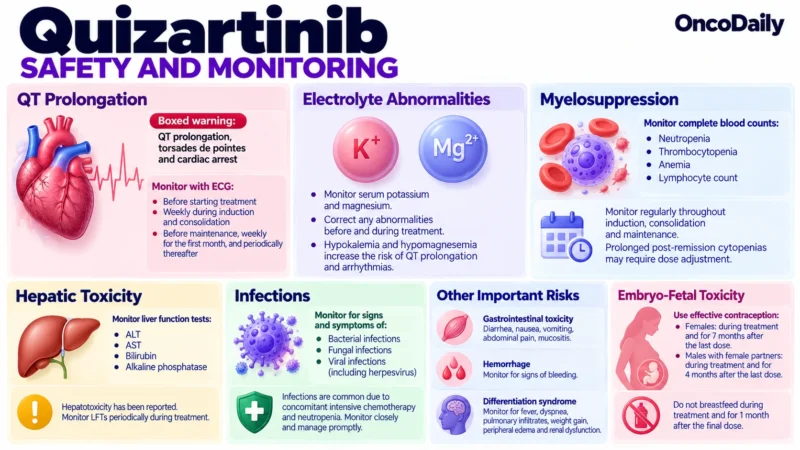
What Monitoring Is Required During Quizartinib Treatment?
ECG Monitoring
Before starting quizartinib:
Obtain an ECG and confirm QTcF ≤450 ms.
Induction and Consolidation
Perform ECG:
- Before initiation
- Weekly during quizartinib treatment
- More frequently if clinically indicated
Maintenance
Perform ECG:
- Before starting maintenance
- Weekly for at least the first month
- Weekly after dose escalation
- Periodically thereafter.
Electrolytes
Monitor:
- Potassium
- Magnesium
and keep both within the normal range.
More frequent assessment is appropriate with:
- Diarrhea
- Vomiting
- Concomitant QT-prolonging therapy.
CBC
Monitor:
- ANC
- Platelets
- Hemoglobin
- Lymphocyte count
throughout intensive therapy and maintenance.
Prolonged post-remission neutropenia or thrombocytopenia may require dose reduction.
Infection Surveillance
Monitor closely for:
- Fever
- Sepsis
- Fungal infection
- Respiratory infection
- Herpesvirus infection
- particularly during neutropenic phases.
Liver Function
Monitor:
- ALT
- AST
- Bilirubin
- Alkaline phosphatase
as part of routine AML treatment surveillance.
Medication Review
At every treatment phase, review for:
- Strong CYP3A inhibitors
- CYP3A inducers
- QT-prolonging medications
- BCRP substrates
because supportive-care drugs used in AML frequently interact with quizartinib.
FAQ
What is quizartinib used for?
What is the induction dose?
What is the consolidation dose?
What is the maintenance dose?
26.5 mg once daily for Days 1–14 of Cycle 1
then increase to:
53 mg once daily
if QTcF is ≤450 ms.
Can quizartinib be taken with food?
It can be taken:
with or without food.
Is quizartinib used for FLT3-TKD AML?
What is the most important toxicity?
What QTc is required before starting treatment?
QTcF >450 ms.
Does quizartinib require ECG monitoring?
ECGs are required at baseline and repeatedly during induction, consolidation, and maintenance.