


Ponatinib (Iclusig): Understanding Its Mechanism, Dosing, Clinical Uses, and Role in CML and Philadelphia Chromosome-Positive ALL
Key takeaways
- Ponatinib is a third-generation BCR::ABL1 TKI with potent activity against T315I.
- It is used mainly in resistant CML, T315I-positive disease, and Ph+ ALL.
- In CP-CML, the recommended strategy is 45 mg once daily → 15 mg once daily after achieving ≤1% BCR::ABL1IS.
- OPTIC validated this response-based dosing strategy and showed 5-year ≤1% BCR::ABL1IS rates of 60% in the 45-mg starting cohort.
- PACE demonstrated durable efficacy in heavily pretreated patients, including T315I-positive disease.
- Newly diagnosed Ph+ ALL is treated with 30 mg once daily with chemotherapy → 15 mg once daily after MRD-negative CR.
- PhALLCON showed MRD-negative CR of 34.4% with ponatinib vs 16.7% with imatinib.
- Ponatinib carries boxed warnings for arterial occlusive events, VTE, heart failure, and hepatotoxicity.
- Vascular risk is dose dependent, making dose optimization critical.
- Ponatinib is not recommended for newly diagnosed CP-CML.
- Monitoring must include CBC, BCR::ABL1 PCR, blood pressure, cardiovascular risk, liver tests, lipase, vascular symptoms, and drug interactions.
Ponatinib (Iclusig) is an oral third-generation BCR::ABL1 tyrosine kinase inhibitor (TKI) designed to retain activity against native BCR::ABL1 and a broad spectrum of resistant kinase-domain mutations, including the highly resistant T315I mutation. It has an established role in heavily pretreated chronic myeloid leukemia (CML), T315I-positive disease, and Philadelphia chromosome-positive acute lymphoblastic leukemia (Ph+ ALL).
The current U.S. label also includes newly diagnosed adult Ph+ ALL in combination with chemotherapy, an indication granted under accelerated approval based on the phase III PhALLCON trial. Ponatinib carries a major safety burden, with a boxed warning for arterial occlusive events, venous thromboembolic events, heart failure, and hepatotoxicity, making response-based dosing and cardiovascular risk management central to its use.
Key Facts
- Generic name: Ponatinib
- Brand name: Iclusig
- Drug class: Third-generation BCR::ABL1 TKI
- Primary target: BCR::ABL1
- Key mutation activity: T315I
- Route: Oral
- Initial U.S. approval: 2012
- Available strengths: 10 mg, 15 mg, 30 mg, 45 mg
- CP-CML starting dose: 45 mg once daily
- CP-CML response-based reduction: 15 mg once daily after achieving ≤1% BCR::ABL1IS
- AP/BP-CML: 45 mg once daily
- Newly diagnosed Ph+ ALL + chemotherapy: 30 mg once daily → 15 mg once daily after MRD-negative CR
- Ph+ ALL monotherapy: 45 mg once daily when no other kinase inhibitor is indicated or in T315I-positive disease
- Food: With or without food
- Major boxed warnings: Arterial occlusive events, venous thromboembolic events, heart failure, hepatotoxicity
- Other important risks: Hypertension, pancreatitis, myelosuppression, hemorrhage, neuropathy, ocular toxicity, fluid retention, arrhythmias
- Major interaction pathway: CYP3A4.
What Is Ponatinib?
Ponatinib is a potent small-molecule kinase inhibitor developed to overcome resistance to earlier-generation BCR::ABL1inhibitors.
In Philadelphia chromosome-positive leukemia:
t(9;22) → BCR::ABL1
creates a constitutively active tyrosine kinase that promotes:
- Leukemic-cell proliferation
- Survival
- Resistance to apoptosis
- Progression of the malignant clone
Ponatinib is particularly important because it was structurally designed to retain activity against the T315I gatekeeper mutation, which causes resistance to several earlier TKIs.
Ponatinib also inhibits other kinases, including:
- VEGFR
- FGFR
- PDGFR
- SRC-family kinases
- KIT
- RET
but its main therapeutic role is inhibition of BCR::ABL1.
What Is the Mechanism of Action of Ponatinib?
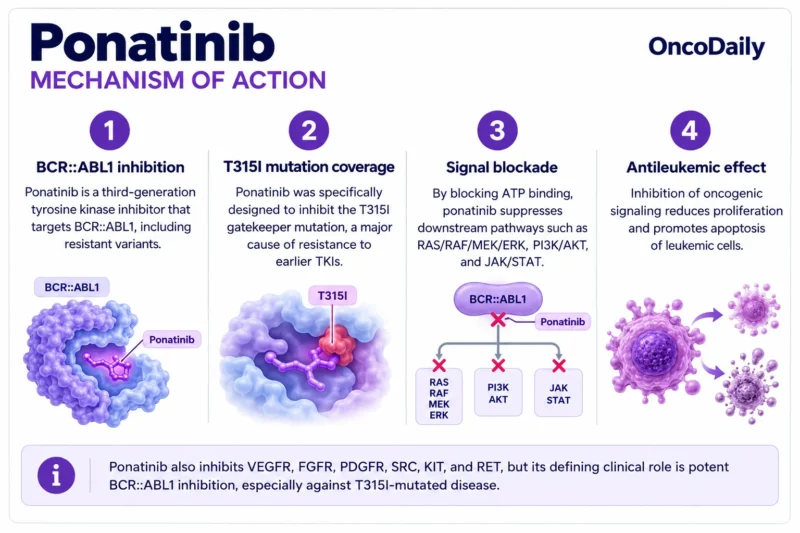
1. BCR::ABL1 Drives Leukemic Signaling
The BCR::ABL1 fusion kinase continuously activates downstream signaling pathways, including:
- RAS–RAF–MEK–ERK
- PI3K–AKT
- JAK/STAT
This promotes uncontrolled leukemic-cell growth and survival.
2. Resistance Mutations Can Prevent Earlier TKIs From Binding
Mutations within the BCR::ABL1 kinase domain can reduce the effectiveness of earlier TKIs.
The most clinically important example is:
T315I
which interferes with binding of several first- and second-generation TKIs.
3. Ponatinib Binds the ATP-Binding Region of BCR::ABL1
Ponatinib was designed with a structure capable of accommodating the altered kinase pocket created by T315I.
It inhibits:
- Native BCR::ABL1
- T315I-mutated BCR::ABL1
- Numerous other resistant BCR::ABL1 variants
4. ATP-Dependent Phosphorylation Is Suppressed
Ponatinib blocks kinase activation and phosphorylation of downstream substrates.
5. Leukemic Signaling Falls
This results in:
- ↓ RAS/MAPK signaling
- ↓ PI3K/AKT signaling
- ↓ JAK/STAT signaling
- ↓ proliferation
- ↓ survival
- ↑ apoptosis
Overall:
Ponatinib → broad BCR::ABL1 inhibition including T315I → ↓ phosphorylation → ↓ oncogenic signaling → suppression of resistant leukemic clones
What Is the Recommended Dose of Ponatinib?
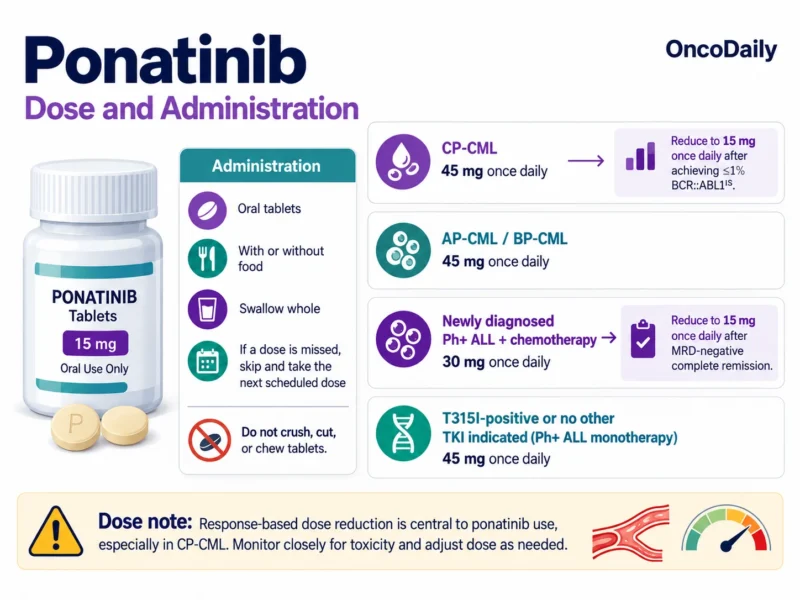
Chronic-Phase CML
For adults with CP-CML resistant or intolerant to at least two prior kinase inhibitors, or with T315I-positive CP-CML:
45 mg orally once daily
followed by reduction to:
15 mg once daily
after achievement of:
≤1% BCR::ABL1IS.
If response is subsequently lost, re-escalation to a previously tolerated dose of:
- 30 mg daily
- or 45 mg daily
may be considered.
This response-based dose reduction strategy is central to modern ponatinib use because efficacy and arterial toxicity are both dose related.
Accelerated-Phase or Blast-Phase CML
Recommended starting dose:
45 mg orally once daily.
The optimal dose has not been definitively established.
Dose reduction may be considered in AP-CML after achievement of a major cytogenetic response.
Newly Diagnosed Ph+ ALL
When used with chemotherapy:
30 mg orally once daily
with reduction to:
15 mg once daily
after achieving:
MRD-negative complete remission, defined as ≤0.01% BCR::ABL1/ABL1 at the end of induction.
Treatment may continue with chemotherapy for up to 20 cycles, until loss of response or unacceptable toxicity.
Ph+ ALL Monotherapy
For adults with:
- T315I-positive Ph+ ALL
- or Ph+ ALL for whom no other kinase inhibitor is indicated
the recommended starting dose is:
45 mg orally once daily.
How Should Ponatinib Be Taken?
Ponatinib should be taken:
- Once daily
- With or without food
- At approximately the same time each day
Tablets should be:
Swallowed whole.
Do not:
- Crush
- Break
- Cut
- Chew.
What Should You Do If You Miss a Dose of Ponatinib?
If a dose is missed:
- Do not take the missed dose later
- Take the next dose at the regularly scheduled time the following day
- Do not double the dose.
How Are Ponatinib Dose Reductions Managed?
Dose modification is particularly important with ponatinib because toxicity is strongly dose dependent.
Standard Dose-Reduction Steps
CP-CML
Typical sequence:
45 mg → 30 mg → 15 mg → 10 mg once daily
depending on toxicity.
AP-CML, BP-CML, and Ph+ ALL Monotherapy
Typical sequence:
45 mg → 30 mg → 15 mg
Patients unable to tolerate 15 mg should generally discontinue treatment.
Newly Diagnosed Ph+ ALL
Typical reductions:
30 mg → 15 mg → 10 mg once daily
with discontinuation if 10 mg cannot be tolerated. Access Data
Arterial Occlusive Events
Management depends on severity.
Grade 3–4 cardiovascular or cerebrovascular arterial occlusive events generally require:
Permanent discontinuation.
Lower-grade events require interruption, reassessment, and sometimes dose reduction.
Hepatotoxicity
For significant ALT/AST elevation:
- Interrupt treatment
- Allow recovery
- Resume at a lower dose when appropriate
Ponatinib should be permanently discontinued if substantial transaminase elevation occurs with:
bilirubin >2× ULN
and relatively normal alkaline phosphatase, consistent with serious drug-induced liver injury.
Pancreatitis or Lipase Elevation
Management may include:
- Temporary interruption
- Dose reduction
- Permanent discontinuation for severe symptomatic pancreatitis
depending on severity and recurrence.
Myelosuppression
If:
ANC <1 × 10⁹/L
or:
platelets <50 × 10⁹/L
interrupt ponatinib until recovery to:
- ANC ≥1.5 × 10⁹/L
- Platelets ≥75 × 10⁹/L
then resume at the same or a reduced dose depending on recurrence.
What Drug Interactions Are Important With Ponatinib?
Ponatinib is predominantly metabolized through:
CYP3A4.
Strong CYP3A Inhibitors
Strong CYP3A inhibitors can increase ponatinib exposure.
These should preferably be avoided.
If unavoidable, the label recommends reducing:
- 45 mg → 30 mg
- 30 mg → 15 mg
- 15 mg → 10 mg
Avoid coadministration in patients already receiving 10 mg.
Examples include:
- Ketoconazole
- Itraconazole
- Clarithromycin
- Ritonavir
Strong CYP3A Inducers
Strong CYP3A inducers can reduce ponatinib exposure and should generally be avoided.
Examples include:
- Rifampin
- Carbamazepine
- Phenytoin
- Phenobarbital
- St. John’s wort.
Does Ponatinib Require Dose Adjustment in Renal or Hepatic Impairment?
Renal Impairment
No dedicated renal starting-dose adjustment is specified in the current FDA label based solely on renal impairment.
However, clinical judgment is required in patients with substantial renal dysfunction because:
- Comorbid cardiovascular risk may be increased
- Hypertension may worsen renal disease
- Treatment-related complications may affect renal function
Hepatic Impairment
For patients receiving ponatinib as monotherapy for:
- CP-CML
- AP-CML
- BP-CML
- Ph+ ALL
and who have pre-existing:
- Child-Pugh A
- Child-Pugh B
- Child-Pugh C
hepatic impairment, reduce the starting dose from:
45 mg → 30 mg once daily.
What Is the Pharmacokinetic Profile of Ponatinib?
Ponatinib is administered orally and has a long enough effective half-life to support:
Once-daily dosing.
It is:
- Extensively protein bound
- Primarily metabolized through CYP3A4
- Metabolized to multiple inactive metabolites
Administration with food is permitted because clinically meaningful exposure differences do not require fasting administration.
What Are the Clinical Uses of Ponatinib?
Chronic-Phase CML After Multiple Prior TKIs
Ponatinib is indicated for adults with:
CP-CML resistant or intolerant to at least two prior kinase inhibitors.
It is particularly valuable after failure of agents such as:
- Imatinib
- Dasatinib
- Nilotinib
- Bosutinib
T315I-Positive CML
Ponatinib has a particularly important role in:
T315I-positive CML
in:
- Chronic phase
- Accelerated phase
- Blast phase.
Advanced-Phase CML
It is approved for:
- AP-CML
- BP-CML
when no other kinase inhibitor is indicated.
Newly Diagnosed Ph+ ALL
Ponatinib is approved:
in combination with chemotherapy
for adults with newly diagnosed Ph+ ALL.
Resistant or T315I-Positive Ph+ ALL
Ponatinib monotherapy is also approved for:
- T315I-positive Ph+ ALL
- Ph+ ALL when no other kinase inhibitor is indicated.
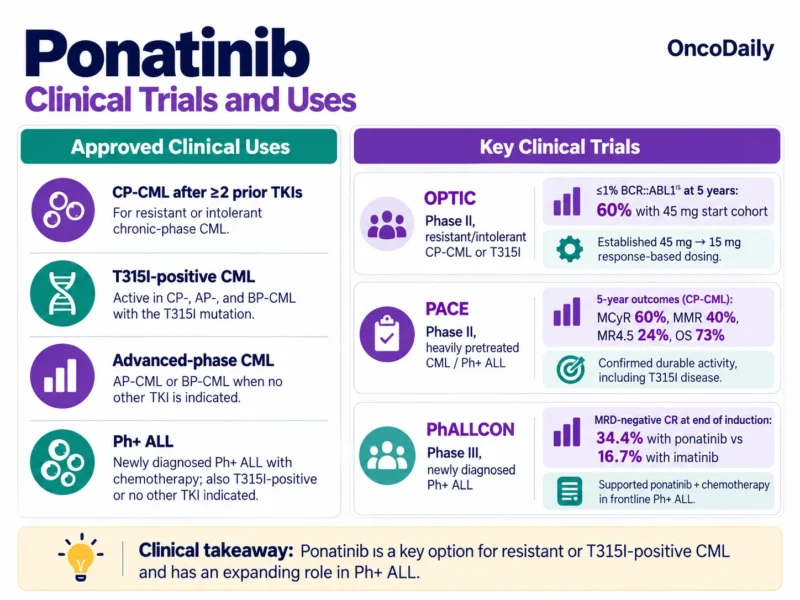
What Did the Pivotal Clinical Trials Show?
OPTIC
The randomized phase II OPTIC trial was designed to optimize the benefit-risk balance of ponatinib in CP-CML resistant or intolerant to at least two prior TKIs or with a T315I mutation.
A total of:
283 patients
were randomized to starting doses of:
- 45 mg once daily
- 30 mg once daily
- 15 mg once daily
Patients receiving 45 mg or 30 mg reduced to:
15 mg once daily
once they achieved:
≤1% BCR::ABL1IS.
Primary Analysis
At 12 months, ≤1% BCR::ABL1IS was achieved in approximately:
- 42% with 45 mg
- 28% with 30 mg
- 24% with 15 mg.
This established:
45 mg → 15 mg response-based dosing
as the preferred CP-CML strategy.
Five-Year OPTIC Follow-Up
At 5 years, ≤1% BCR::ABL1IS had been achieved in:
- 60% of the 45-mg cohort
- 41% of the 30-mg cohort
- 40% of the 15-mg cohort
Five-year PFS was:
- 63%
- 57%
- 60%, respectively
and overall survival exceeded:
80% in all three cohorts.
The 45-mg starting cohort produced the strongest results in patients with T315I-positive disease.
PACE
The pivotal phase II PACE trial enrolled:
449 heavily pretreated patients
with CML or Ph+ ALL who were resistant or intolerant to dasatinib or nilotinib or who had the T315I mutation.
Ponatinib was initially administered at:
45 mg once daily.
Among chronic-phase CML patients in the mature 5-year analysis:
- Major cytogenetic response: 60%
- Major molecular response: 40%
- MR4.5: 24%
- Estimated 5-year OS: 73%
Among patients achieving MCyR, the probability of maintaining the response for 5 years was:
82%.
Importantly, the cumulative incidence of arterial occlusive events increased over long follow-up, which contributed directly to development of the modern response-based dosing strategy.
PhALLCON
The global phase III PhALLCON trial compared frontline:
- Ponatinib 30 mg once daily
- Imatinib 600 mg once daily
each combined with reduced-intensity chemotherapy in adults with newly diagnosed Ph+ ALL.
A total of:
245 patients
were randomized.
The primary endpoint was MRD-negative complete remission at the end of induction.
Results:
- Ponatinib: 34.4%
- Imatinib: 16.7%
P = 0.002.
Arterial occlusive events were infrequent:
- Ponatinib: 2.5%
- Imatinib: 1.2%
These results supported FDA accelerated approval of ponatinib plus chemotherapy for newly diagnosed adult Ph+ ALL. \
Is Ponatinib FDA Approved?
Yes.
Current FDA-approved indications include adult patients with:
CML
- CP-CML resistant or intolerant to at least two prior kinase inhibitors
- AP-CML when no other kinase inhibitor is indicated
- BP-CML when no other kinase inhibitor is indicated
- T315I-positive CP-CML
- T315I-positive AP-CML
- T315I-positive BP-CML
Ph+ ALL
- Newly diagnosed Ph+ ALL in combination with chemotherapy
- T315I-positive Ph+ ALL
- Ph+ ALL when no other kinase inhibitor is indicated.
Importantly:
Ponatinib is not indicated or recommended for newly diagnosed chronic-phase CML.
What Is the Current Clinical Role of Ponatinib in 2026?
Resistant Chronic-Phase CML
Ponatinib is a key later-line option for patients with resistant CP-CML after multiple prior TKIs.
Modern use emphasizes:
45 mg → 15 mg response-based dosing
to maintain efficacy while reducing exposure-related vascular toxicity.
Watch more: New OPTIC Trial Analysis Shows Ponatinib Is Effective in Chronic Myeloid Leukemia Patients — discussion of ponatinib efficacy, response-based dosing, and safety in resistant CP-CML.
T315I-Positive Disease
Ponatinib remains one of the most important treatment options when:
BCR::ABL1 T315I
is detected.
OPTIC confirmed particularly strong long-term outcomes in T315I-positive patients treated with the 45-mg starting strategy.
Read more: Hagop Kantarjian: A Comprehensive Review of Ponatinib in CML and Ph+ ALL on OncoDaily.
Ph+ ALL
Ponatinib now has an expanding role in frontline Ph+ ALL.
PhALLCON established superiority over imatinib for achieving MRD-negative remission with reduced-intensity chemotherapy.
More recent evidence has also strengthened the role of ponatinib + blinatumomab as a chemotherapy-free frontline strategy. In a 2026 randomized trial, estimated 24-month event-free survival was:
- 86% with ponatinib + blinatumomab
- 67% with imatinib + chemotherapy
with a lower cumulative incidence of relapse in the ponatinib/blinatumomab group.
This represents an important evolution in contemporary Ph+ ALL management, although the exact regulatory status of specific chemotherapy-free combinations should be distinguished from the FDA-approved ponatinib-plus-chemotherapy indication.
Cardiovascular Risk and Dose Selection
The major challenge with ponatinib is balancing:
potent antileukemic activity
against:
dose-dependent vascular toxicity.
Before treatment, clinicians should evaluate:
- Coronary artery disease
- Cerebrovascular disease
- Peripheral arterial disease
- Hypertension
- Diabetes
- Dyslipidemia
- Smoking
- Age
- Other vascular risk factors
The response-based dosing strategy from OPTIC is therefore central to modern ponatinib treatment.
What Are the Major Side Effects of Ponatinib?
Common adverse reactions include:
- Rash
- Arthralgia
- Abdominal pain
- Fatigue
- Headache
- Constipation
- Hypertensio
- Dry skin
- Hepatotoxicity
- Fluid retention
- Pancreatitis/lipase elevation
- Nausea
- Hemorrhage
- Anemia
- Arterial occlusive events
- Cardiac arrhythmias.
Major serious risks include:
- Arterial occlusive events
- Venous thromboembolic events
- Heart failure
- Hepatotoxicity
- Severe hypertension
- Pancreatitis
- Myelosuppression
- Hemorrhage
- Neuropathy
- Ocular toxicity
- Fluid retention
- Arrhythmias
- Tumor lysis syndrome
- RPLS
- Gastrointestinal perforation
- Impaired wound healing.
Arterial Occlusive Events
This is one of the defining toxicities of ponatinib.
Events can include:
- Myocardial infarction
- Stroke
- Cerebral arterial stenosis
- Peripheral arterial occlusion
- Need for urgent revascularization
Importantly, these events have occurred in patients:
- With cardiovascular risk factors
- Without known risk factors
- Including patients aged ≤50 years.
In long-term PACE follow-up, cumulative AOE incidence in CP-CML reached approximately:
31%.
Modern response-based dosing substantially improves the benefit-risk profile.
Venous Thromboembolic Events
Ponatinib may also cause:
- Deep venous thrombosis
- Pulmonary embolism
- Other venous thromboses
Patients should be monitored for clinical signs of VTE.
Heart Failure
Ponatinib can cause:
- New heart failure
- Worsening heart failure
- Left ventricular dysfunction
Treatment interruption or discontinuation may be necessary.
Hypertension
Blood pressure should be controlled before and during therapy.
Uncontrolled hypertension may require:
- Treatment interruption
- Dose reduction
- Discontinuation.
Hepatotoxicity
Ponatinib carries a boxed warning for hepatotoxicity.
Liver injury can include:
- ALT elevation
- AST elevation
- Hyperbilirubinemia
- Liver failure
- Rare fatal hepatic injury
Liver-function monitoring is essential.
Pancreatitis and Lipase Elevation
Ponatinib can cause:
- Asymptomatic lipase elevation
- Clinical pancreatitis
Serum lipase should be monitored.
Abdominal pain with elevated lipase should prompt evaluation for pancreatitis.
Myelosuppression
Ponatinib can cause:
- Thrombocytopenia
- Neutropenia
- Anemia
- Leukopenia
CBC should be obtained:
- Every 2 weeks for the first 3 months
- Then monthly
- Or as clinically indicated.
Ocular Toxicity
Ponatinib can cause significant ocular adverse effects.
A comprehensive eye examination
should be performed:
- At baseline
- Periodically during treatment.
Surgery and Wound Healing
Ponatinib can impair wound healing.
It should generally be withheld:
at least 1 week before elective surgery
and not administered for at least:
2 weeks after major surgery
and until adequate wound healing has occurred.
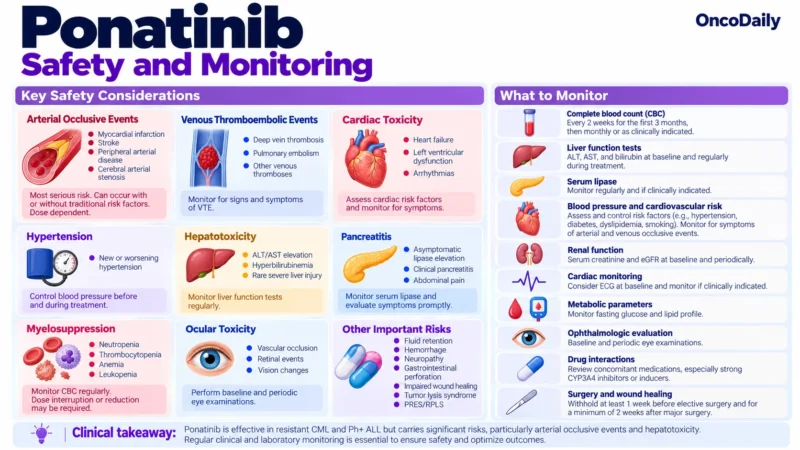
What Monitoring Is Required During Ponatinib Treatment?
Monitoring should include:
- CBC
- BCR::ABL1 quantitative PCR
- Blood pressure
- Cardiovascular risk assessment
- Symptoms/signs of arterial occlusion
- Symptoms/signs of venous thromboembolism
- Cardiac symptoms
- ALT
- AST
- Bilirubin
- Serum lipase
- Electrolytes
- Glucose
- Lipid profile
- Neurologic symptoms
- Peripheral neuropathy
- Ocular examinations
- Signs of hemorrhage
- Fluid retention
- Medication interactions
- CYP3A inhibitors/inducers
- Pregnancy status when relevant
CBC
Every 2 weeks for the first 3 months, then monthly or as clinically indicated.
Liver Function
Monitor:
- ALT
- AST
- Bilirubin
at baseline and regularly throughout treatment.
Pancreatic Monitoring
Monitor:
Serum lipase
and investigate abdominal symptoms promptly.
Cardiovascular Monitoring
Regularly assess:
- Blood pressure
- Symptoms of myocardial ischemia
- Neurologic symptoms
- Peripheral arterial symptoms
- Heart-failure symptoms
- Vascular risk factors
Molecular Monitoring
In CP-CML:
BCR::ABL1 quantitative PCR
is essential because reaching:
≤1% BCR::ABL1IS
triggers the recommended reduction from:
45 mg → 15 mg daily.
FAQ
What is ponatinib used for?
Is ponatinib active against T315I?
This is one of its most important clinical advantages.
What is the standard dose for resistant chronic-phase CML?
What is the dose for newly diagnosed Ph+ ALL?
Can ponatinib be taken with food?
It may be taken:
with or without food.
What is the most important toxicity?
arterial occlusive events.
Ponatinib also carries boxed warnings for VTE, heart failure, and hepatotoxicity.
Why is the ponatinib dose reduced after response?
Does ponatinib cause pancreatitis?
Lipase elevation and pancreatitis are recognized toxicities.
Is ponatinib used as first-line treatment for chronic-phase CML?
The FDA label specifically states that it is not indicated or recommended for newly diagnosed CP-CML.