


Panitumumab (Vectibix): Mechanism of Action, Dosing, Clinical Uses, Trials, and Side Effects
Panitumumab (Vectibix) is a fully human IgG2 monoclonal antibody targeting the epidermal growth factor receptor (EGFR/HER1/ERBB1). By binding the extracellular domain of EGFR, panitumumab blocks ligand-mediated receptor activation and suppresses downstream signaling pathways involved in tumor-cell proliferation, survival, and progression.
First approved by the FDA in September 2006, panitumumab became an important targeted treatment for metastatic colorectal cancer (mCRC). Its efficacy depends strongly on molecular selection, particularly the absence of activating KRAS and NRAS mutations when used in conventional anti-EGFR treatment.
In January 2025, panitumumab gained an additional role in KRAS G12C-mutated metastatic colorectal cancer, when the FDA approved its combination with sotorasib following prior fluoropyrimidine-, oxaliplatin-, and irinotecan-based chemotherapy.
Panitumumab is administered intravenously at 6 mg/kg every 14 days. Its clinical efficacy has been established in trials including PRIME, ASPECCT, PARADIGM, and CodeBreaK 300.
Key Facts
- Generic name: Panitumumab
- Brand name: Vectibix
- Drug class: EGFR-directed monoclonal antibody
- Antibody type: Fully human IgG2
- Molecular target: EGFR (HER1/ERBB1)
- Mechanism: Inhibition of EGFR activation and downstream RAS–RAF–MEK–ERK and PI3K–AKT signaling
- Initial FDA approval: September 2006
- Administration: Intravenous infusion
- Recommended dose: 6 mg/kg every 14 days
- Available vial strengths: 100 mg/5 mL and 400 mg/20 mL
- Main indication: Metastatic colorectal cancer
- Key biomarkers: KRAS/NRAS wild-type status or KRAS G12C mutation for the sotorasib combination
- Approved combinations: FOLFOX in first-line RAS wild-type mCRC; sotorasib in previously treated KRAS G12C-mutated mCRC
- Monotherapy indication: Previously treated RAS wild-type mCRC
- Pivotal trials: PRIME, ASPECCT, PARADIGM, CodeBreaK 300
- Major adverse reactions: Acneiform rash, dry skin, diarrhea, paronychia, hypomagnesemia
- Boxed warning: Dermatologic toxicity
- Serious risks: Severe skin reactions, electrolyte depletion, infusion reactions, ILD, renal complications, and ocular toxicity
- Important monitoring: Skin toxicity, magnesium, calcium, potassium, hydration, and respiratory symptoms
- Elimination: Antibody catabolism and target-mediated clearance
What Is Panitumumab?
Panitumumab is a recombinant fully human monoclonal antibody that selectively binds EGFR.
EGFR belongs to the ERBB family of receptor tyrosine kinases and is expressed on normal epithelial tissues and many colorectal cancer cells.
Activation of EGFR by ligands such as epidermal growth factor and transforming growth factor-alpha promotes receptor dimerization and signaling through:
- RAS–RAF–MEK–ERK
- PI3K–AKT–mTOR
These pathways regulate proliferation, survival, angiogenesis, and tumor progression.
Panitumumab prevents ligand binding and EGFR activation.
However, activating mutations in KRAS or NRAS can maintain downstream signaling independently of EGFR, producing resistance to conventional anti-EGFR treatment.
The combination of panitumumab with sotorasib is a specific exception because sotorasib directly inhibits KRAS G12C while panitumumab blocks compensatory EGFR signaling.
What Is the Mechanism of Action of Panitumumab?
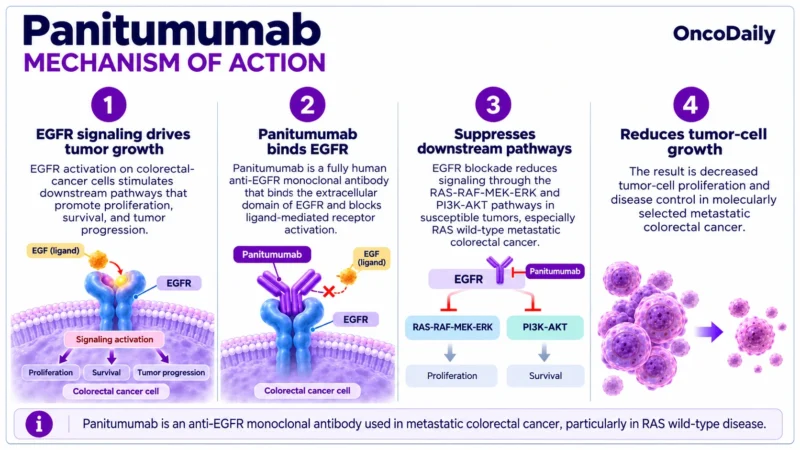
1. EGFR Activation Promotes Tumor Growth
EGFR ligands bind the extracellular receptor domain, promoting receptor dimerization and tyrosine kinase activation.
This activates intracellular growth and survival pathways.
2. Panitumumab Binds EGFR
Panitumumab binds the extracellular ligand-binding region of EGFR.
This prevents ligand activation and interferes with receptor signaling.
3. Downstream Oncogenic Signaling Is Suppressed
EGFR inhibition reduces activation of:
- RAS–RAF–MEK–ERK
- PI3K–AKT
These effects suppress proliferation and survival signaling in susceptible tumor cells.
4. Tumor Growth Is Inhibited
In tumors dependent on EGFR signaling, receptor blockade can reduce tumor-cell proliferation and promote growth arrest.
Unlike cetuximab, panitumumab is an IgG2 antibody, and classical natural killer cell-mediated ADCC is not considered a major established mechanism of its clinical activity.
5. KRAS G12C Inhibition Enhances Activity in Selected Tumors
In KRAS G12C-mutated colorectal cancer, KRAS inhibition alone can trigger compensatory EGFR signaling.
Combining panitumumab with sotorasib blocks EGFR-mediated adaptive signaling while inhibiting mutant KRAS.
Overall mechanism:
Panitumumab → EGFR binding → reduced receptor activation → suppression of MAPK and PI3K–AKT signaling → reduced tumor-cell proliferation.
In KRAS G12C-mutated mCRC:
Sotorasib + panitumumab → mutant KRAS G12C inhibition + EGFR feedback blockade → enhanced antitumor activity.
What Is the Recommended Dose of Panitumumab?
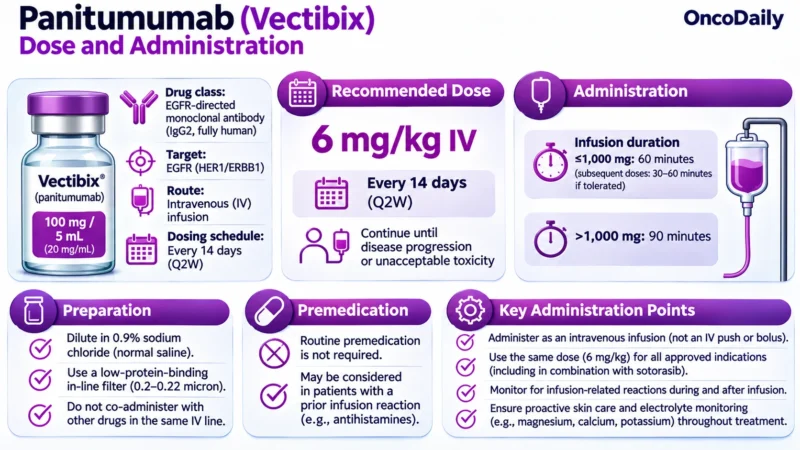
Standard Intravenous Dose
6 mg/kg intravenously every 14 days.
Treatment generally continues until:
- Disease progression
- Unacceptable toxicity
The dose is the same across the currently approved colorectal cancer indications.
First-Line RAS Wild-Type Metastatic Colorectal Cancer
Panitumumab is administered with:
FOLFOX chemotherapy.
Recommended dose:
6 mg/kg IV every two weeks.
This regimen is appropriate for molecularly eligible patients, with the greatest clinical relevance generally in left-sided primary tumors.
Previously Treated RAS Wild-Type Metastatic Colorectal Cancer
Panitumumab may be administered as monotherapy after progression following fluoropyrimidine-, oxaliplatin-, and irinotecan-containing chemotherapy.
Dose:
6 mg/kg IV every 14 days.
KRAS G12C-Mutated Metastatic Colorectal Cancer
For eligible patients previously treated with fluoropyrimidine-, oxaliplatin-, and irinotecan-based chemotherapy:
Panitumumab: 6 mg/kg IV every 14 days
combined with:
Sotorasib: 960 mg orally once daily.
The combination continues until disease progression or unacceptable toxicity.
How Should Panitumumab Be Administered?
Intravenous Administration
Panitumumab must be administered as a diluted intravenous infusion.
It should not be administered as:
- An intravenous push
- An intravenous bolus
Use an infusion pump and a low-protein-binding 0.2- or 0.22-micron in-line filter, according to product instructions.
Infusion Duration
Doses of 1,000 mg or Less
Infuse over 60 minutes.
If the first infusion is tolerated, subsequent doses may be administered over 30–60 minutes.
Doses Greater Than 1,000 mg
Infuse over 90 minutes.
Premedication
Routine corticosteroid or antihistamine premedication is not universally required.
However, premedication may be considered in patients with a previous infusion reaction, based on clinical assessment.
Skin Toxicity Prevention
Preemptive dermatologic management is strongly encouraged.
Common approaches include:
- Regular skin moisturization
- Sunscreen and ultraviolet protection
- Low-potency topical corticosteroids
- Oral doxycycline or minocycline when appropriate
The STEPP study demonstrated reduced clinically significant skin toxicity with preemptive supportive treatment.
What Should You Do If a Panitumumab Dose Is Missed?
Panitumumab is administered by healthcare professionals every two weeks.
If a scheduled infusion is missed:
- Contact the treating team.
- Administer the delayed dose when clinically appropriate.
- Adjust subsequent treatment dates to maintain the intended schedule.
- Assess for toxicity that may require a treatment delay.
There is no universal recommendation to double the next infusion.
How Are Panitumumab Dose Modifications Managed?
Grade 3 Dermatologic Toxicity
The FDA label provides a specific approach for recurrent Grade 3 skin toxicity.
First Occurrence
Withhold 1–2 doses.
If toxicity improves below Grade 3:
Resume at 100% of the original dose.
Second Occurrence
Withhold 1–2 doses.
After recovery:
Resume at 80% of the original dose.
Third Occurrence
Withhold 1–2 doses.
After recovery:
Resume at 60% of the original dose.
Fourth Occurrence
Permanently discontinue panitumumab.
Grade 4 skin toxicity or Grade 3 toxicity that does not recover after withholding 1–2 doses also requires permanent discontinuation.
Infusion-Related Reactions
For Grade 1–2 reactions:
Reduce the infusion rate by 50%.
For severe infusion reactions:
Stop the infusion and consider permanent discontinuation according to reaction severity.
Interstitial Lung Disease
If ILD is suspected, interrupt treatment and investigate.
If ILD is confirmed:
Permanently discontinue panitumumab.
Combination With Sotorasib
When sotorasib is temporarily withheld or permanently discontinued, panitumumab should also be withheld or discontinued, respectively, according to the combination labeling.
What Drug Interactions Are Important With Panitumumab?
Bevacizumab and Chemotherapy
Combining panitumumab with bevacizumab-containing chemotherapy regimens is not recommended.
Clinical studies demonstrated increased toxicity and inferior outcomes with certain combinations.
Oxaliplatin-Based Chemotherapy in RAS-Mutant Disease
Panitumumab should not be used with FOLFOX in RAS-mutant colorectal cancer.
In this setting, anti-EGFR therapy may worsen outcomes.
The FDA-approved sotorasib combination for KRAS G12C-mutated disease is a separate, specifically defined indication.
Sotorasib
Panitumumab is intentionally combined with sotorasib in eligible KRAS G12C-mutated mCRC.
Monitor for additive:
- Dermatologic toxicity
- Diarrhea
- Electrolyte disturbances
- Other treatment-related adverse reactions
CYP450 Interactions
Panitumumab is not primarily metabolized through CYP450 enzymes.
Conventional CYP-mediated interactions are not generally expected.
Does Panitumumab Require Dose Adjustment in Renal or Hepatic Impairment?
Renal Impairment
Panitumumab is not primarily eliminated through renal excretion.
Routine dose adjustments are generally not specified for renal impairment.
However, severe diarrhea and dehydration may cause acute kidney injury.
Hepatic Impairment
Panitumumab is cleared through antibody catabolism and target-mediated pathways.
No established hepatic dose-adjustment algorithm is available.
Clinical data in severe hepatic impairment are limited.
What Is the Pharmacokinetic Profile of Panitumumab?
Half-Life
At the recommended dose, panitumumab has an elimination half-life of approximately:
7.5 days.
Distribution
Panitumumab distributes mainly within vascular and extracellular compartments.
Metabolism
Panitumumab undergoes proteolytic catabolism and target-mediated elimination.
Clearance
Elimination includes:
- Saturable EGFR-mediated pathways
- Nonspecific antibody clearance
Steady State
With 6 mg/kg every two weeks, steady-state concentrations are reached after repeated administration.
What Are the Clinical Uses of Panitumumab?
First-Line RAS Wild-Type Metastatic Colorectal Cancer
Panitumumab is approved with FOLFOX for first-line treatment of RAS wild-type mCRC.
Clinical selection should consider:
- Extended KRAS/NRAS status
- Primary tumor sidedness
- Disease burden
- Treatment goals
- Patient comorbidities
Left-sided RAS wild-type tumors generally derive the clearest benefit from first-line anti-EGFR treatment.
Previously Treated RAS Wild-Type Metastatic Colorectal Cancer
Panitumumab may be used as monotherapy after progression on standard cytotoxic chemotherapy.
This provides an option for patients who have not previously received appropriate anti-EGFR treatment.
KRAS G12C-Mutated Metastatic Colorectal Cancer
Panitumumab is approved with sotorasib following prior fluoropyrimidine-, oxaliplatin-, and irinotecan-based chemotherapy.
This combination addresses adaptive EGFR signaling that limits the activity of KRAS G12C inhibition alone.
Other Investigational Uses
Panitumumab has been studied in additional combinations and treatment settings, including rechallenge strategies and perioperative approaches.
These should not be assumed to be FDA-approved indications.
What Molecular Testing Is Required Before Panitumumab?
Extended RAS Testing
Before conventional panitumumab treatment, test:
- KRAS exons 2, 3, and 4
- NRAS exons 2, 3, and 4
Patients with activating RAS mutations generally should not receive panitumumab monotherapy or conventional panitumumab–FOLFOX treatment.
KRAS G12C Testing
The sotorasib combination requires confirmed:
KRAS G12C mutation
using an FDA-approved test.
This is a specific molecular exception to the usual RAS wild-type requirement.
Additional Biomarkers
Comprehensive molecular assessment in mCRC should also consider:
- BRAF V600E
- MSI/MMR status
- HER2 amplification when relevant
- Other actionable alterations
These biomarkers help determine the optimal treatment sequence.
What Did the Pivotal Clinical Trials Show?
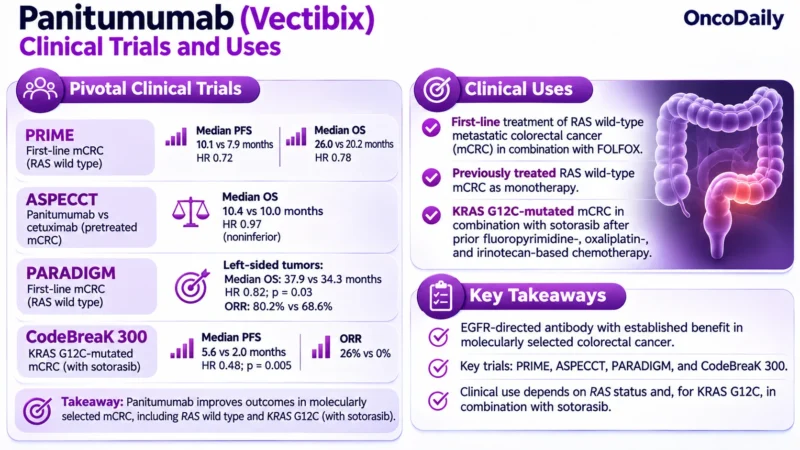
PRIME — First-Line Metastatic Colorectal Cancer
The randomized phase III PRIME trial compared:
- Panitumumab + FOLFOX4
- FOLFOX4 alone
The trial randomized 1,183 patients with previously untreated metastatic colorectal cancer.
An extended RAS analysis demonstrated that the benefit was concentrated in RAS wild-type disease.
Median Progression-Free Survival — Extended RAS Wild-Type Population
- Panitumumab + FOLFOX4: 10.1 months
- FOLFOX4: 7.9 months
HR: 0.72
Median Overall Survival
- Panitumumab + FOLFOX4: 26.0 months
- FOLFOX4: 20.2 months
HR: 0.78
These results established the importance of comprehensive RAS testing before anti-EGFR treatment.
ASPECCT — Panitumumab Versus Cetuximab
The randomized phase III ASPECCT study compared panitumumab with cetuximab in previously treated metastatic colorectal cancer with wild-type KRAS exon 2.
The trial randomized 1,010 patients.
Median Overall Survival
- Panitumumab: 10.4 months
- Cetuximab: 10.0 months
HR: 0.97
Panitumumab met the prespecified criterion for noninferiority.
Important Safety Differences
- Grade 3–4 infusion reactions: less frequent with panitumumab
- Grade 3–4 hypomagnesemia: more frequent with panitumumab
The trial established comparable overall survival between these anti-EGFR antibodies in its selected study population.
PARADIGM — Panitumumab Versus Bevacizumab
The phase III PARADIGM study compared:
- Panitumumab + mFOLFOX6
- Bevacizumab + mFOLFOX6
in previously untreated RAS wild-type metastatic colorectal cancer.
The trial enrolled 823 patients, with 802 included in the as-treated analysis.
Median Overall Survival — Left-Sided Primary Tumors
- Panitumumab: 37.9 months
- Bevacizumab: 34.3 months
HR: 0.82
p = 0.03
Objective Response Rate — Left-Sided Tumors
- Panitumumab: 80.2%
- Bevacizumab: 68.6%
PARADIGM reinforced the importance of primary tumor sidedness when selecting first-line biological therapy.
CodeBreaK 300 — KRAS G12C-Mutated Metastatic Colorectal Cancer
The randomized phase III CodeBreaK 300 trial evaluated sotorasib plus panitumumab against standard later-line therapy in previously treated KRAS G12C-mutated mCRC.
The FDA-approved comparison included:
- Sotorasib 960 mg daily + panitumumab
- Standard care with trifluridine/tipiracil or regorafenib
Median Progression-Free Survival
- Sotorasib + panitumumab: 5.6 months
- Standard care: 2.0 months
HR: 0.48
p = 0.005
Objective Response Rate
- Sotorasib + panitumumab: 26%
- Standard care: 0%
The initial analysis did not establish a statistically significant overall survival advantage.
These findings supported FDA approval of the combination in January 2025.
Read More: CodeBreaK 300 Trial Demonstrates Promising Efficacy of Sotorasib Plus Panitumumab in KRAS G12C-Mutated Colorectal Cancer by OncoDaily.
Watch More: CodeBreaK 300: Sotorasib + Panitumumab vs. Standard of Care in KRAS G12C-Mutated mCRC.
Does Panitumumab Have CNS Activity?
Panitumumab is a large monoclonal antibody with limited penetration across an intact blood–brain barrier.
It does not have established standalone intracranial efficacy.
Brain metastases from colorectal cancer may require:
- Stereotactic radiosurgery
- Surgery
- Other CNS-directed treatment
- Appropriate systemic therapy
Panitumumab should not be considered a specifically CNS-directed therapy.
Is Panitumumab FDA Approved?
Yes.
Panitumumab received initial FDA approval in:
September 2006.
Its current U.S. indications include:
RAS Wild-Type Metastatic Colorectal Cancer
- First-line treatment with FOLFOX
- Monotherapy following progression after fluoropyrimidine-, oxaliplatin-, and irinotecan-containing chemotherapy
KRAS G12C-Mutated Metastatic Colorectal Cancer
In combination with sotorasib following prior fluoropyrimidine-, oxaliplatin-, and irinotecan-based chemotherapy.
This additional indication was approved on:
January 16, 2025.
The FDA-approved dose remains 6 mg/kg intravenously every 14 days.
What Is the Current Clinical Role of Panitumumab in 2026?
First-Line RAS Wild-Type Metastatic Colorectal Cancer
Panitumumab remains an important first-line biological treatment, particularly for left-sided RAS wild-type tumors.
It is commonly combined with an appropriate chemotherapy backbone.
Later-Line RAS Wild-Type Disease
Panitumumab monotherapy remains an option in eligible patients previously treated with standard cytotoxic agents.
Its role depends on prior exposure to anti-EGFR therapy and other available treatment options.
KRAS G12C-Mutated Colorectal Cancer
The combination of panitumumab with sotorasib provides a molecularly selected later-line option.
This represents an important development because panitumumab alone is not effective in conventional RAS-mutant colorectal cancer, whereas combined KRAS G12C and EGFR inhibition can overcome an important resistance mechanism.
What Are the Major Side Effects of Panitumumab?
Dermatologic Toxicity
Skin toxicity is the most characteristic adverse reaction and carries an FDA boxed warning.
In the monotherapy safety population:
- Any-grade dermatologic toxicity: approximately 90%
- Severe dermatologic toxicity: approximately 15%
Manifestations include:
- Papulopustular or acneiform rash
- Dry skin
- Pruritus
- Erythema
- Skin fissures
- Paronychia
Severe skin toxicity can lead to secondary infection and treatment interruption.
Hypomagnesemia
Panitumumab can produce progressive magnesium depletion through EGFR inhibition in renal tubular cells.
In clinical trial populations, decreased magnesium occurred in:
- 38% with monotherapy
- 51% with FOLFOX
- 69% across studied sotorasib-containing combinations
Severe hypomagnesemia may cause neuromuscular and cardiac complications.
Gastrointestinal Toxicity
Common symptoms include:
- Diarrhea
- Nausea
- Stomatitis
- Mucosal inflammation
Severe diarrhea can lead to dehydration and acute kidney injury.
Infusion-Related Reactions
Infusion reactions are generally less frequent than with cetuximab, but severe reactions can occur.
Symptoms include:
- Fever
- Chills
- Dyspnea
- Hypotension
- Bronchospasm
- Hypersensitivity
Interstitial Lung Disease
Rare cases of pulmonary fibrosis and interstitial lung disease have been reported.
Confirmed ILD requires permanent discontinuation.
Ocular Toxicity
Potential adverse reactions include:
- Keratitis
- Ulcerative keratitis
- Corneal complications
Acute or worsening ocular symptoms require prompt assessment.
Photosensitivity
Panitumumab can increase sensitivity to ultraviolet exposure.
Sun protection is recommended throughout treatment.
Embryo-Fetal Toxicity
Panitumumab can cause fetal harm.
Females of reproductive potential should use effective contraception during treatment and for 2 months after the final dose.
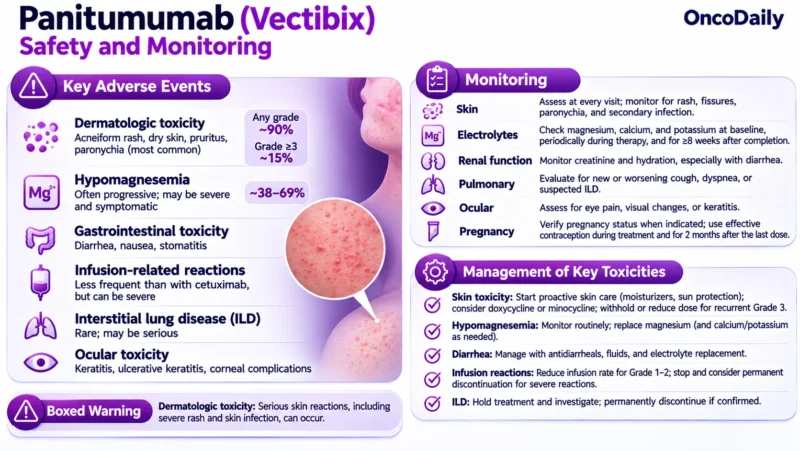
What Monitoring Is Required During Panitumumab Treatment?
Dermatologic Monitoring
Assess skin reactions at every treatment visit.
Monitor for:
- Acneiform rash
- Dry skin
- Paronychia
- Fissures
- Secondary infections
Preemptive skin care should begin before or at treatment initiation.
Electrolyte Monitoring
Assess:
- Magnesium
- Calcium
- Potassium
Monitor before treatment, periodically during therapy, and for:
At least 8 weeks after treatment completion.
Replace electrolytes as indicated.
Renal Function
Monitor serum creatinine and hydration status, particularly in patients with diarrhea or electrolyte depletion.
Gastrointestinal Monitoring
Assess:
- Diarrhea severity
- Hydration
- Oral intake
- Electrolyte abnormalities
Infusion Monitoring
Observe for hypersensitivity reactions and changes in respiratory or cardiovascular status during infusion.
Pulmonary Monitoring
Evaluate:
- New cough
- Dyspnea
- Hypoxia
- Suspected interstitial lung disease
Ocular Monitoring
Investigate eye pain, visual changes, photophobia, or worsening ocular inflammation.
Pregnancy Monitoring
Verify pregnancy status when clinically appropriate before starting treatment.
Counsel patients regarding embryo-fetal risk and contraception.