





Osimertinib (Tagrisso): Understanding Its Mechanism, Dosing, and Clinical Role in EGFR-Mutated Lung Cancer
Key takeaways
- Osimertinib is a third-generation irreversible EGFR TKI with activity against sensitizing EGFR mutations and T790M.
- The standard dose is: 80 mg orally once daily, with or without food.
- It is used across multiple settings of EGFR-mutated NSCLC, including adjuvant treatment, unresectable stage III disease after chemoradiation, and advanced/metastatic disease.
- FLAURA established first-line superiority over earlier EGFR TKIs, ADAURA demonstrated an adjuvant survival benefit, LAURA established its post-chemoradiation role, and FLAURA2 demonstrated that adding platinum-pemetrexed further improves survival in advanced disease.
- Important serious toxicities include ILD/pneumonitis, QT prolongation, cardiomyopathy, keratitis, severe cutaneous reactions, aplastic anemia, and myositis/CPK elevation.
Osimertinib (Tagrisso) is an oral, third-generation epidermal growth factor receptor (EGFR) tyrosine kinase inhibitor with activity against common sensitizing EGFR mutations and the T790M resistance mutation. It has become a central therapy across several stages of EGFR-mutated non-small cell lung cancer (NSCLC), including resected disease, unresectable stage III disease after chemoradiation, and locally advanced or metastatic disease.
Unlike first-generation EGFR inhibitors such as gefitinib and erlotinib, osimertinib irreversibly binds mutant EGFR and has clinically important central nervous system activity.
The standard dose is:
80 mg orally once daily.
Key Facts
- Generic name: Osimertinib
- Brand name: Tagrisso
- Drug class: Third-generation irreversible EGFR tyrosine kinase inhibitor
- Route: Oral
- Initial US approval: 2015
- Standard dose: 80 mg once daily
- Administration: With or without food
- Available strengths: 40 mg and 80 mg tablets
- Primary targets: EGFR exon 19 deletion, L858R, and T790M-mutated EGFR
- Important advantage: Clinically relevant CNS penetration
- Major toxicities: Rash, diarrhea, nail toxicity, stomatitis, cytopenias
- Important serious risks: Interstitial lung disease/pneumonitis, QT prolongation, cardiomyopathy, keratitis, severe cutaneous reactions, aplastic anemia, and myalgia/myositis with CPK elevation
- Major interaction: Strong CYP3A inducers
- Half-life: Approximately 48 hours.
What Is Osimertinib?
Osimertinib is an oral small-molecule kinase inhibitor designed to preferentially inhibit mutant forms of EGFR.
It binds irreversibly to EGFR containing:
- Exon 19 deletions
- Exon 21 L858R
- T790M
At clinically relevant concentrations, its inhibitory activity against these mutant receptors is substantially greater than against wild-type EGFR.
This mutant selectivity helped distinguish osimertinib from earlier-generation EGFR inhibitors and contributed to a different therapeutic and toxicity profile.
Another major characteristic is its ability to reach the central nervous system, making intracranial disease control an important component of its clinical activity.
What Is the Mechanism of Action of Osimertinib?
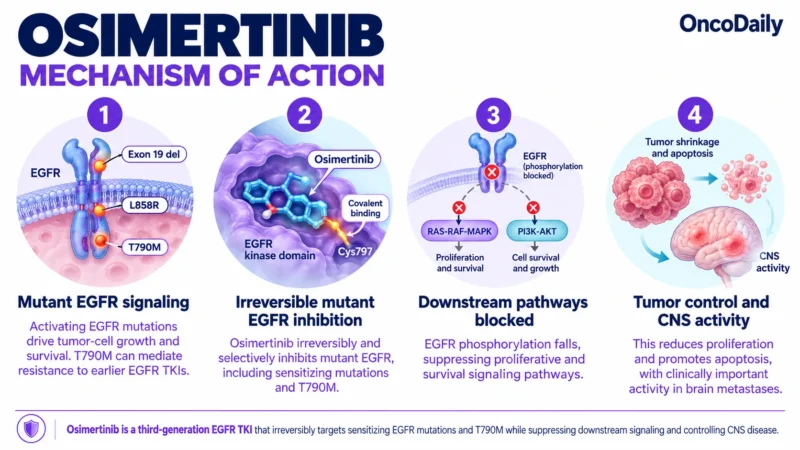
1. EGFR-Mutant Signaling
Activating mutations such as:
EGFR exon 19 deletion
and
EGFR L858R
produce persistent EGFR signaling that promotes tumor-cell proliferation and survival.
The T790M mutation can emerge after earlier-generation EGFR TKI therapy and historically represented an important mechanism of acquired resistance.
2. Irreversible Binding to Mutant EGFR
Osimertinib forms an irreversible covalent interaction with mutant EGFR.
It preferentially inhibits sensitizing EGFR mutations and T790M-mutant EGFR compared with wild-type EGFR.
3. EGFR Phosphorylation Is Suppressed
Kinase inhibition prevents normal receptor autophosphorylation.
This interrupts EGFR-dependent intracellular signaling.
4. Downstream Pathways Are Inhibited
Osimertinib suppresses pathways involved in malignant-cell proliferation and survival, including:
RAS–RAF–MAPK
and
PI3K–AKT.
5. Tumor Growth Is Suppressed
Persistent inhibition of EGFR signaling reduces tumor-cell proliferation and survival and can promote apoptosis.
The mechanism can be summarized as:
Osimertinib → irreversible mutant EGFR inhibition → reduced phosphorylation → suppression of MAPK/AKT signaling → decreased proliferation and survival → tumor-cell death.
What Is the Dose of Osimertinib?
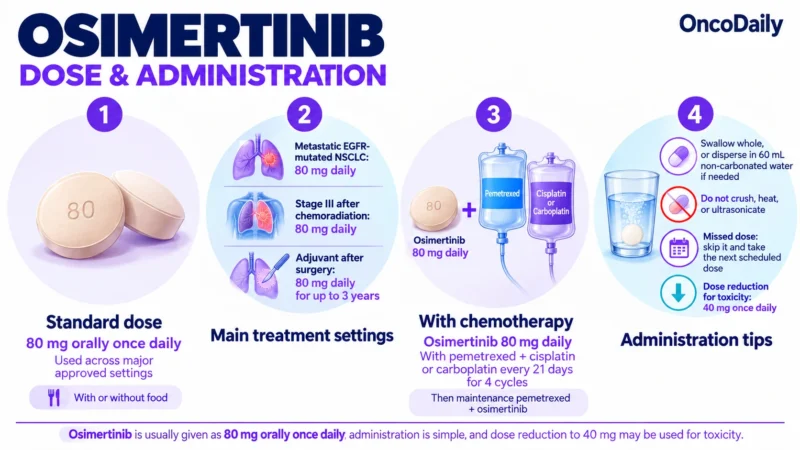
For the major approved indications, the standard dose is:
80 mg orally once daily.
It can be taken:
With or without food.
Metastatic EGFR-Mutated NSCLC
80 mg orally once daily
until disease progression or unacceptable toxicity.
First-Line Osimertinib Plus Chemotherapy
For locally advanced or metastatic NSCLC with EGFR exon 19 deletion or L858R:
Osimertinib 80 mg orally once daily
is administered with:
Pemetrexed 500 mg/m² + cisplatin 75 mg/m² or carboplatin AUC 5 on Day 1 every 21 days for 4 cycles.
This is followed by:
Osimertinib 80 mg daily + maintenance pemetrexed 500 mg/m² every 3 weeks.
Adjuvant Treatment After Surgery
The dose is:
80 mg once daily for up to 3 years
or until:
- Disease recurrence
- Unacceptable toxicity.
Unresectable Stage III NSCLC After Chemoradiation
For EGFR exon 19 deletion- or L858R-mutated disease that has not progressed during or after platinum-based chemoradiation:
80 mg orally once daily
until disease progression or unacceptable toxicity.
Previously Treated T790M-Positive Metastatic NSCLC
The labeled dose is also:
80 mg orally once daily
until progression or unacceptable toxicity.
How Is Osimertinib Administered?
Osimertinib may be taken:
With or without food.
The tablet should generally be swallowed whole.
If the Patient Cannot Swallow the Tablet
The tablet may be dispersed in:
60 mL of non-carbonated water.
It should be stirred until broken into small pieces and taken immediately.
The tablet should not be crushed, heated, or ultrasonicated.
The container should then be rinsed with:
120–240 mL of water
and the rinse consumed.
Administration through a nasogastric tube is also possible using the label-specified preparation technique.
Missed Dose
If a dose is missed:
Do not make up the missed dose.
The patient should simply take the next scheduled dose at the regular time.
How Are Osimertinib Dose Reductions Made?
For significant treatment-related toxicity, osimertinib may be temporarily withheld.
For a:
Grade 3 or higher adverse reaction
treatment may be withheld for up to:
3 weeks.
If toxicity improves to Grade 0–2 during this period, treatment may be restarted at:
80 mg or 40 mg once daily.
Thus, the principal dose-reduction step is:
80 mg → 40 mg once daily.
Certain toxicities require permanent discontinuation rather than simple dose reduction, particularly confirmed severe ILD/pneumonitis, life-threatening arrhythmia associated with QT prolongation, symptomatic heart failure, confirmed aplastic anemia, and selected severe cutaneous reactions.
Does Osimertinib Require Renal or Hepatic Dose Adjustment?
Renal Impairment
No dose adjustment is recommended for:
Creatinine clearance 15–89 mL/min.
There is no established recommended dose for:
CrCl <15 mL/min or end-stage renal disease.
Hepatic Impairment
No dose adjustment is recommended for:
- Mild hepatic impairment
- Moderate hepatic impairment
There is no established recommended dose for severe hepatic impairment.
What Is the Pharmacokinetic Profile of Osimertinib?
Distribution
Osimertinib distributes extensively into tissues.
Its apparent steady-state volume of distribution is approximately:
918 L.
Plasma protein binding is approximately:
95%.
Metabolism
Metabolism occurs predominantly through oxidation involving:
CYP3A
and dealkylation.
Two pharmacologically active metabolites have been identified:
- AZ7550
- AZ5104
Each represents approximately 10% of parent-drug exposure at steady state.
Half-Life
The estimated mean elimination half-life is:
Approximately 48 hours.
Elimination
Approximately:
- 68% is eliminated in feces
- 14% in urine.
Only approximately 2% is recovered as unchanged osimertinib.
What Are the Important Drug Interactions With Osimertinib?
Strong CYP3A Inducers
Strong CYP3A inducers can markedly reduce osimertinib exposure and potentially decrease efficacy.
Examples include:
- Rifampin
- Carbamazepine
- Phenytoin
- St John’s wort
Concomitant use should preferably be avoided.
If unavoidable, the US label recommends increasing osimertinib to:
160 mg once daily
during treatment with the strong CYP3A inducer.
The dose should return to:
80 mg daily three weeks after the inducer is discontinued.
Unlike gefitinib or erlotinib, gastric acid suppression is not a major absorption issue: omeprazole did not produce a clinically meaningful effect on osimertinib exposure.
What Are the Clinical Uses of Osimertinib?
First-Line Metastatic EGFR-Mutated NSCLC
Osimertinib is approved for first-line treatment of metastatic NSCLC with:
EGFR exon 19 deletion
or:
EGFR exon 21 L858R.
The FLAURA trial established its efficacy compared with first-generation EGFR TKIs.
First-Line Osimertinib Plus Chemotherapy
Osimertinib is also FDA-approved with pemetrexed plus platinum chemotherapy for first-line locally advanced or metastatic NSCLC with exon 19 deletion or L858R.
Importantly, final FLAURA2 results published in 2026 demonstrated an overall-survival benefit for the combination compared with osimertinib monotherapy.
Adjuvant Therapy After Complete Resection
Osimertinib is approved after complete resection of EGFR exon 19 deletion- or L858R-mutated NSCLC.
Treatment is given for:
Up to 3 years.
The ADAURA trial demonstrated major improvements in disease-free survival and subsequently overall survival.
Unresectable Stage III NSCLC After Chemoradiation
Osimertinib is approved for patients with unresectable stage III EGFR-mutated NSCLC whose disease has not progressed during or after definitive platinum-based chemoradiation.
This indication was established by the LAURA trial.
T790M-Positive NSCLC After Prior EGFR TKI Therapy
Osimertinib was originally developed for patients with acquired:
EGFR T790M
after progression on earlier EGFR TKIs.
The AURA3 trial demonstrated substantially longer PFS than platinum-pemetrexed chemotherapy in this setting.
What Did Osimertinib Clinical Trials Show?
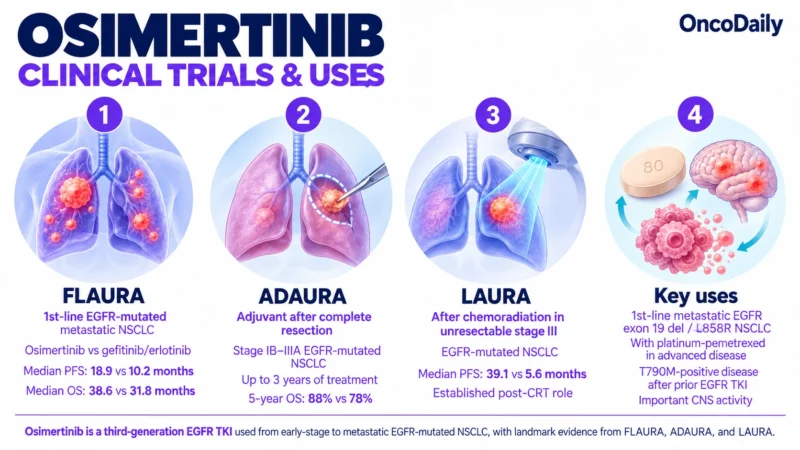
FLAURA: First-Line Osimertinib
FLAURA randomized 556 patients with previously untreated advanced EGFR exon 19 deletion- or L858R-mutated NSCLC to osimertinib or gefitinib/erlotinib.
Median Progression-Free Survival
- Osimertinib: 18.9 months
- Gefitinib/erlotinib: 10.2 months
Median Overall Survival
- Osimertinib: 38.6 months
- Comparator EGFR TKI: 31.8 months
The hazard ratio for death was approximately:
0.80.
The study established osimertinib as a major first-line EGFR-targeted therapy.
FLAURA2: Osimertinib Plus Chemotherapy
FLAURA2 randomized 557 patients to:
Osimertinib + platinum/pemetrexed
or:
Osimertinib alone.
Initial results showed median PFS of:
- Combination: 25.5 months
- Osimertinib alone: 16.7 months
Hazard ratio:
0.62.
The final overall-survival analysis, incorporated into the US label in September 2026, showed:
Median Overall Survival
- Osimertinib + chemotherapy: 47.5 months
- Osimertinib alone: 37.6 months
Hazard ratio for death:
0.77.
Grade ≥3 adverse events were more frequent with the chemotherapy-containing regimen.
Watch more: Osimertinib plus Chemotherapy in EGFR-Mutated NSCLC (FLAURA2) — NEJM Group. The video summarizes the FLAURA2 trial and the role of osimertinib plus chemotherapy in advanced EGFR-mutated NSCLC.
ADAURA: Adjuvant Osimertinib
ADAURA enrolled 682 patients with completely resected EGFR-mutated stage IB–IIIA NSCLC.
Patients received osimertinib or placebo for up to three years.
In the overall stage IB–IIIA population:
5-Year Overall Survival
- Osimertinib: 88%
- Placebo: 78%
The hazard ratio for death was:
0.49.
Among stage II–IIIA patients, 5-year survival was:
85% vs 73%.
LAURA: Unresectable Stage III NSCLC
LAURA evaluated osimertinib after definitive chemoradiation in patients with unresectable stage III EGFR-mutated NSCLC.
Median Progression-Free Survival
- Osimertinib: 39.1 months
- Placebo: 5.6 months
Hazard ratio:
0.16.
This substantial reduction in the risk of progression established osimertinib as an FDA-approved treatment following chemoradiation in this setting.
AURA3: T790M-Positive NSCLC
AURA3 compared osimertinib with platinum-pemetrexed chemotherapy after progression on previous EGFR TKI therapy.
Median Progression-Free Survival
- Osimertinib: 10.1 months
- Chemotherapy: 4.4 months
Hazard ratio:
0.30.
The trial established osimertinib as a highly active therapy for acquired T790M-mutated disease.
Is Osimertinib FDA Approved?
Yes.
Osimertinib first received US approval in:
2015
for previously treated metastatic T790M-positive NSCLC.
Its indications subsequently expanded to include:
- First-line metastatic EGFR exon 19 deletion/L858R NSCLC
- Adjuvant therapy following tumor resection
- First-line locally advanced/metastatic disease with platinum-pemetrexed chemotherapy
- Unresectable stage III disease after platinum-based chemoradiation.
What Is the Current Clinical Role of Osimertinib?
Osimertinib now has one of the broadest roles of any EGFR-directed therapy across the NSCLC disease continuum.
It may be used:
- After complete surgical resection
- After definitive chemoradiation for unresectable stage III disease
- As first-line monotherapy in metastatic disease
- With platinum-pemetrexed chemotherapy in first-line advanced disease
- In T790M-positive disease after prior EGFR TKI therapy.
Its CNS activity is particularly relevant because the brain is a frequent site of progression in EGFR-mutated NSCLC.
The first-line landscape has continued to evolve, and treatment selection now includes osimertinib monotherapy, osimertinib plus chemotherapy, and other EGFR-directed combinations. Choice depends on disease burden, CNS involvement, expected toxicity, comorbidities, patient preferences, and access.
Osimertinib has become a central treatment across multiple stages of EGFR-mutated NSCLC. Learn more about the evolving treatment landscape of EGFR-mutant NSCLC on OncoDaily.
What Are the Major Side Effects of Osimertinib?
Common adverse effects include:
- Rash
- Diarrhea
- Dry skin
- Nail toxicity/paronychia
- Stomatitis
- Reduced appetite
- Fatigue
- Cytopenias, particularly when combined with chemotherapy.
Interstitial Lung Disease and Pneumonitis
ILD/pneumonitis is one of the most important serious risks.
New or worsening:
- Dyspnea
- Cough
- Fever
- Pulmonary infiltrates
require prompt investigation.
Outside the recent post-chemoradiation setting, confirmed osimertinib-related ILD generally requires permanent discontinuation. Management after recent definitive chemoradiation is grade-dependent because radiation pneumonitis may complicate assessment.
The 2026 label also added eosinophilic pneumonia to postmarketing respiratory adverse reactions.
QTc Prolongation
Osimertinib can prolong the QT interval.
Periodic ECG and electrolyte monitoring should be considered in patients with:
- Congenital long-QT syndrome
- Heart failure
- Electrolyte abnormalities
- Concomitant QT-prolonging medications.
Cardiomyopathy
Osimertinib can cause:
- Reduced LVEF
- Heart failure
- Cardiomyopathy.
Across monotherapy trials, cardiomyopathy occurred in approximately 3.8% of patients.
With osimertinib plus chemotherapy in FLAURA2, cardiomyopathy occurred more frequently.
LVEF monitoring is recommended for monotherapy patients with cardiac risk factors and for all patients receiving osimertinib plus pemetrexed/platinum chemotherapy.
Keratitis
Keratitis is uncommon but clinically important.
Symptoms requiring ophthalmologic evaluation include:
- Eye pain
- Redness
- Photophobia
- Excessive tearing
- Blurred vision.
Severe Cutaneous Reactions
Rare postmarketing reactions include:
- Stevens–Johnson syndrome
- Toxic epidermal necrolysis
- Erythema multiforme major
- Cutaneous vasculitis.
Aplastic Anemia
Rare cases of aplastic anemia have been reported.
The current label recommends:
CBC with differential before starting treatment and periodically throughout therapy.
If aplastic anemia is suspected, osimertinib should be withheld and hematology evaluation obtained. Confirmed aplastic anemia requires permanent discontinuation.
Myalgia or Myositis With CPK Elevation
This is an important new 2026 safety update.
The FDA added a specific warning for:
Myalgia or myositis associated with creatine phosphokinase elevation.
Patients should report unexplained muscle pain, weakness, or tenderness, and CPK assessment should be considered when clinically indicated.
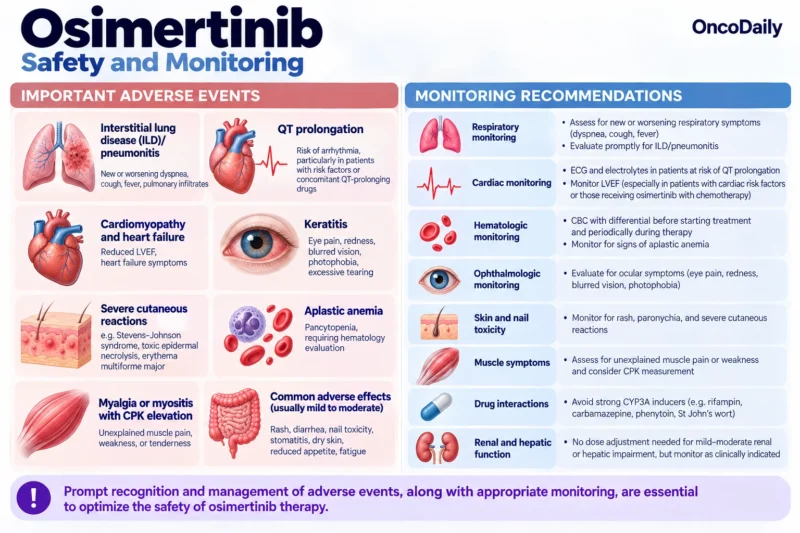
What Monitoring Is Required?
Monitoring during osimertinib therapy should include:
- EGFR mutation confirmation before treatment
- CBC with differential before therapy and periodically
- Respiratory symptoms for ILD/pneumonitis
- ECG and electrolytes in patients at risk of QT prolongation
- LVEF monitoring according to cardiac risk and treatment regimen
- Skin and nail toxicity
- Diarrhea and hydration
- Ocular symptoms
- Muscle pain or weakness and CPK when indicated
- Review of concomitant medications, particularly strong CYP3A inducers.
For patients receiving osimertinib with chemotherapy, hematologic and cardiac monitoring becomes particularly important because toxicity is greater than with osimertinib monotherapy.
FAQ
What Is Osimertinib Used For?
How Does Osimertinib Work?
What Is the Standard Dose?
Should Osimertinib Be Taken With Food?
How Long Is Osimertinib Given After Surgery?
or until recurrence or unacceptable toxicity.