


Ofatumumab (Arzerra, Kesimpta): Mechanism of Action, Dosing, Clinical Uses, Trials, and Side Effects
Ofatumumab (Arzerra, Kesimpta) is a fully human monoclonal antibody targeting CD20, a surface protein expressed on mature B lymphocytes and many B-cell malignancies. It induces B-cell depletion primarily through complement-dependent cytotoxicity and antibody-dependent immune mechanisms.
Initially approved by the FDA in 2009, ofatumumab was developed for chronic lymphocytic leukemia (CLL) under the brand name Arzerra. Its intravenous oncology formulation demonstrated activity in previously untreated, relapsed, and refractory CLL. However, Arzerra has subsequently been commercially discontinued in major markets, and its historical oncology indications should not be confused with currently available treatment options.
In August 2020, a subcutaneous formulation, Kesimpta, was FDA approved for adults with relapsing forms of multiple sclerosis (MS). Kesimpta remains a clinically important anti-CD20 therapy, administered as a 20-mg subcutaneous injection following an initial loading schedule.
Although both products contain ofatumumab, Arzerra and Kesimpta have different formulations, doses, administration routes, and clinical indications.
Key Facts
- Generic name: Ofatumumab
- Brand names: Arzerra (historical oncology product), Kesimpta
- Drug class: Anti-CD20 monoclonal antibody
- Antibody type: Fully human IgG1κ
- Molecular target: CD20
- Mechanism: Complement-dependent cytotoxicity, antibody-dependent cellular cytotoxicity, and B-cell depletion
- Initial FDA approval: 2009
- Kesimpta FDA approval: August 2020
- Historical oncology indication: Chronic lymphocytic leukemia
- Current Kesimpta indication: Relapsing forms of multiple sclerosis in adults
- Historical Arzerra route: Intravenous infusion
- Kesimpta route: Subcutaneous injection
- Historical CLL doses: 300 mg initially, followed by 1,000-mg or 2,000-mg infusions depending on the regimen
- Kesimpta dose: 20 mg at Weeks 0, 1, and 2, then monthly from Week 4
- Kesimpta strength: 20 mg/0.4 mL
- Major adverse reactions: Infusion or injection-related reactions, infections, headache, reduced immunoglobulins
- Serious risks: HBV reactivation, serious infections, hypersensitivity, liver injury
- Metabolism: Proteolytic catabolism
- Major trials: COMPLEMENT 1, COMPLEMENT 2, PROLONG, ASCLEPIOS I and II
- Important monitoring: HBV screening, immunoglobulins, liver function, infection surveillance
What Is Ofatumumab?
Ofatumumab is a fully human IgG1 monoclonal antibody that binds CD20 on mature B cells.
Its binding site is different from that of rituximab and includes a membrane-proximal epitope involving the small and large extracellular loops of CD20.
This binding pattern promotes potent complement activation and B-cell depletion.
CD20 is expressed on:
- Mature B lymphocytes
- Many malignant B cells in CLL
- Other CD20-positive B-cell malignancies
It is generally absent from hematopoietic stem cells and most plasma cells.
In CLL, ofatumumab was developed to directly eliminate malignant B cells.
In MS, B-cell depletion reduces immune activity associated with central nervous system inflammation and demyelination.
What Is the Mechanism of Action of Ofatumumab?
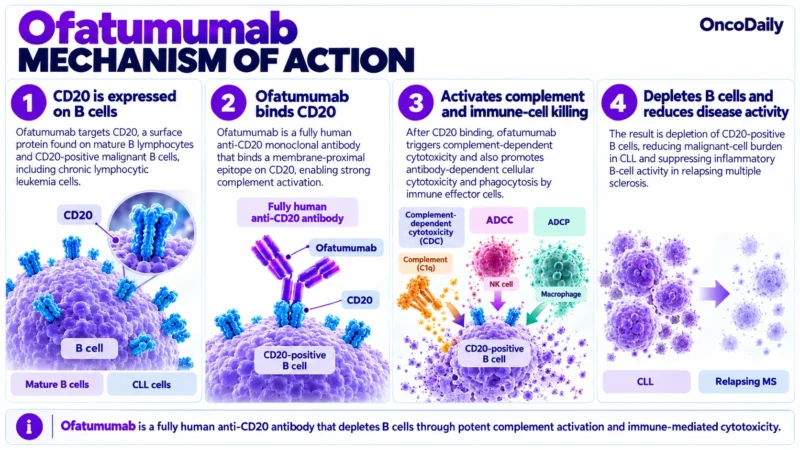
1. Ofatumumab Binds CD20
Ofatumumab binds a distinct, membrane-proximal CD20 epitope on B lymphocytes.
Its fully human antibody structure reduces the presence of nonhuman antibody sequences, although immunogenic reactions remain possible.
2. Complement-Dependent Cytotoxicity Is Activated
After binding CD20, the Fc region recruits complement component C1q.
This activates the classical complement cascade and promotes formation of the membrane attack complex.
The result is:
Complement-dependent cytotoxicity (CDC).
This is an important mechanism underlying ofatumumab-associated B-cell depletion.
3. Immune Effector Cells Are Recruited
Ofatumumab also engages Fcγ receptors on immune cells, including natural killer cells and macrophages.
This promotes:
- Antibody-dependent cellular cytotoxicity (ADCC)
- Antibody-dependent cellular phagocytosis (ADCP)
4. B-Cell Depletion Produces Clinical Effects
In CLL, depletion of malignant CD20-positive B cells reduces leukemic-cell burden.
In MS, depletion of circulating B cells helps reduce inflammatory disease activity.
The exact contribution of individual B-cell functions to MS treatment response remains incompletely understood.
Overall mechanism:
Ofatumumab → CD20 binding → complement activation + Fc-mediated immune-cell activity → B-cell depletion → antitumor or immunomodulatory effects.
What Is the Recommended Dose of Ofatumumab?
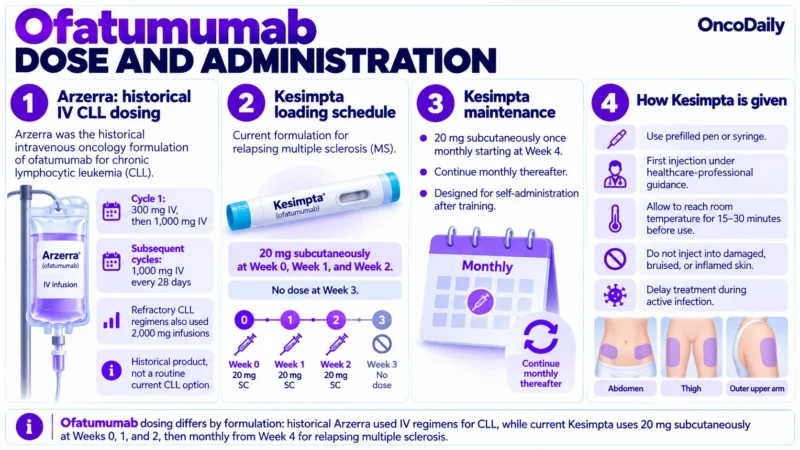
Dosing differs substantially between the historical oncology product and the current MS formulation.
Arzerra — Previously Untreated CLL (Historical Regimen)
When used with chlorambucil or bendamustine:
Cycle 1
- Day 1: 300 mg IV
- Day 8: 1,000 mg IV
Subsequent Cycles
1,000 mg IV on Day 1 of each 28-day cycle.
Treatment continued for a minimum of 3 cycles until best response, up to a maximum of 12 cycles.
Arzerra — Relapsed CLL (Historical Regimen)
In combination with fludarabine and cyclophosphamide:
Cycle 1
- Day 1: 300 mg IV
- Day 8: 1,000 mg IV
Cycles 2–6
1,000 mg IV on Day 1 of each 28-day cycle.
Arzerra — Refractory CLL (Historical Regimen)
The schedule consisted of 12 infusions:
- Infusion 1: 300 mg IV
- Infusions 2–8: 2,000 mg weekly
- Infusions 9–12: 2,000 mg every 4 weeks
This regimen was developed for patients with CLL refractory to fludarabine and alemtuzumab.
Arzerra — Extended Treatment in CLL (Historical Regimen)
For patients with CLL in complete or partial response after at least two previous treatment lines:
- Day 1: 300 mg IV
- Day 8: 1,000 mg IV
- Seven weeks later: 1,000 mg IV
- Subsequently: 1,000 mg every 8 weeks
Treatment could continue for up to 2 years.
These Arzerra regimens describe historical labeling and should not be interpreted as current preferred CLL treatment recommendations.
Kesimpta — Relapsing Multiple Sclerosis
Initial Dosing
20 mg subcutaneously at:
- Week 0
- Week 1
- Week 2
Maintenance Dosing
20 mg subcutaneously once monthly, starting at Week 4.
No injection is scheduled at Week 3.
The monthly maintenance schedule continues according to clinical assessment and treatment tolerability.
How Should Ofatumumab Be Administered?
Intravenous Administration — Historical Arzerra
Arzerra was administered as a diluted intravenous infusion under healthcare supervision.
Premedication included:
- Acetaminophen
- An antihistamine
- A corticosteroid
Infusion rates varied with dose, treatment indication, and previous infusion reactions.
For the historical 300-mg first infusion, the initial rate was 3.6 mg/hour, with stepwise increases according to the protocol.
For subsequent 1,000-mg infusions, treatment generally began at 25 mg/hour, with rate escalation if tolerated.
Severe infusion reactions required interruption or discontinuation.
Subcutaneous Administration — Kesimpta
Kesimpta is administered subcutaneously using a prefilled pen or syringe.
Approved injection sites include:
- Abdomen
- Thigh
- Outer upper arm
The first injection should be performed under the guidance of a healthcare professional.
Patients may subsequently self-administer treatment after appropriate training.
Before injection, allow the medication to reach room temperature for approximately 15–30 minutes.
Do not inject into damaged, bruised, or inflamed skin.
Kesimpta must not be administered intravenously.
What Should You Do If an Ofatumumab Dose Is Missed?
Kesimpta
If a dose is missed:
Administer it as soon as possible without waiting until the next scheduled dose.
Subsequent injections should follow the recommended dosing interval.
Historical Arzerra
Missed intravenous infusions required rescheduling and adjustment according to the CLL regimen and treating team’s assessment.
There is no universal recommendation to double an infusion.
How Are Ofatumumab Dose Modifications Managed?
Kesimpta
No routine stepwise dose-reduction schedule is established.
Management may involve:
- Delaying treatment during active infection
- Evaluating injection-related or hypersensitivity reactions
- Monitoring immunoglobulin abnormalities
- Discontinuing treatment when clinically necessary
Active HBV infection and a history of life-threatening Kesimpta injection-related reactions or hypersensitivity to ofatumumab are contraindications.
Historical Arzerra
Dose modifications focused primarily on infusion-rate reduction, interruption, or permanent discontinuation.
Severe infusion reactions, serious infections, HBV reactivation, and other significant toxicities required individualized management.
What Drug Interactions Are Important With Ofatumumab?
Ofatumumab is not metabolized through CYP450 pathways.
Its important interactions are primarily related to additive immunosuppression.
Other Immunosuppressive Agents
Concomitant chemotherapy or immunomodulatory therapy may increase infection risk.
This is particularly relevant when transitioning between MS disease-modifying therapies or combining oncology treatments.
Live Vaccines
Live vaccines should be avoided during Kesimpta treatment and until B-cell recovery following discontinuation.
When possible, indicated vaccines should be administered before starting treatment.
Other Vaccines
Antibody responses to vaccines may be reduced during B-cell depletion.
Vaccination timing should be planned before therapy when feasible.
Does Ofatumumab Require Dose Adjustment in Renal or Hepatic Impairment?
Renal Impairment
Ofatumumab is a large monoclonal antibody predominantly cleared through protein catabolism.
Routine renal dose adjustments are not established.
Formal pharmacokinetic studies in renal impairment are limited.
Hepatic Impairment
No established hepatic dose-reduction algorithm is available.
However, the current Kesimpta label includes a warning for clinically significant liver injury.
Baseline liver function tests are required, with further assessment when liver injury is suspected.
HBV screening is also necessary before treatment.
What Is the Pharmacokinetic Profile of Ofatumumab?
Half-Life
For subcutaneous Kesimpta:
Approximately 16 days at steady state.
The half-life varies with B-cell burden and target-mediated clearance.
Distribution
Distribution is predominantly within vascular and extracellular compartments.
Metabolism
Ofatumumab undergoes:
Proteolytic degradation into peptides and amino acids.
Clearance
Elimination occurs through:
- Nonspecific protein catabolism
- Target-mediated B-cell-associated clearance
As B cells are depleted, target-mediated clearance decreases.
B-Cell Depletion
Kesimpta produces rapid depletion of circulating CD19-positive B cells, which are used as a surrogate marker because CD20 measurement may be affected by antibody binding.
B-cell recovery can take several months after discontinuation.
What Are the Clinical Uses of Ofatumumab?
Chronic Lymphocytic Leukemia — Historical Oncology Use
Ofatumumab was developed for several CLL treatment settings, including:
- Previously untreated CLL in patients unsuitable for fludarabine-based therapy
- Relapsed CLL with fludarabine/cyclophosphamide
- CLL refractory to fludarabine and alemtuzumab
- Extended treatment after response to previous therapy
These indications helped establish the efficacy of CD20-directed treatment in CLL.
However, modern CLL treatment has shifted toward BTK inhibitors, BCL2-directed therapy, and newer combinations.
Read More: Michael Hallek: Fixed-Duration Versus Continuous Treatment for Chronic Lymphocytic Leukemia by OncoDaily.
Relapsing Multiple Sclerosis — Current Use
Kesimpta is FDA approved for adults with relapsing forms of MS, including:
- Clinically isolated syndrome
- Relapsing-remitting MS
- Active secondary progressive MS
Its monthly self-administered subcutaneous schedule distinguishes it from several other anti-CD20 therapies.
What Testing Is Required Before Ofatumumab?
Hepatitis B Screening
Before initiating Kesimpta, assess HBV status.
Active HBV infection is a contraindication.
Patients with evidence of previous HBV infection require specialist evaluation.
For historical Arzerra therapy, HBV reactivation was also a major safety concern.
Immunoglobulin Levels
Obtain quantitative immunoglobulins before Kesimpta treatment.
Monitor during treatment and after discontinuation until B-cell recovery when clinically indicated.
Liver Function
Obtain:
- ALT
- AST
- Alkaline phosphatase
- Bilirubin
before initiating Kesimpta.
Other Assessments
Review:
- Infection status
- Vaccination history
- Previous immunosuppressive therapies
- Pregnancy considerations
- Neurological disease activity for MS
For historical CLL treatment, additional assessments included complete blood count, tumor burden, renal function, and tumor lysis risk.
What Did the Pivotal Clinical Trials Show?
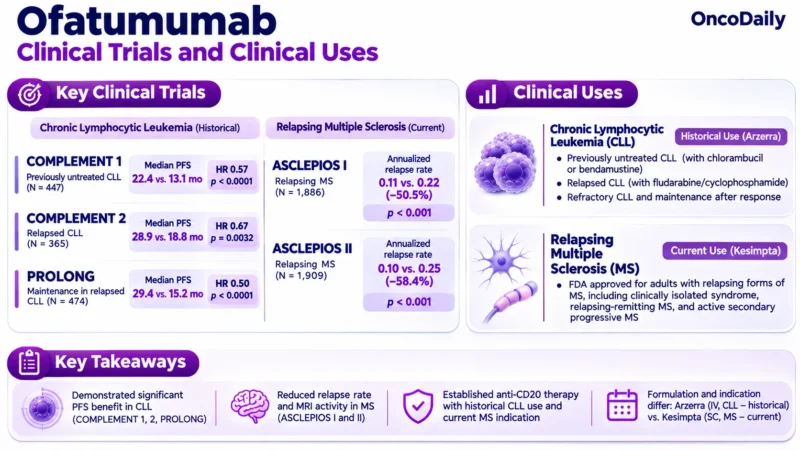
COMPLEMENT 1 — Previously Untreated CLL
The phase III COMPLEMENT 1 trial compared ofatumumab plus chlorambucil with chlorambucil alone in previously untreated patients with CLL who were unsuitable for intensive fludarabine-based therapy.
The study randomized:
447 patients.
Median Progression-Free Survival
- Ofatumumab + chlorambucil: 22.4 months
- Chlorambucil alone: 13.1 months
HR: 0.57
p < 0.0001
The study demonstrated a clinically meaningful improvement in disease control with the addition of ofatumumab.
COMPLEMENT 2 — Relapsed CLL
COMPLEMENT 2 evaluated ofatumumab plus fludarabine/cyclophosphamide versus fludarabine/cyclophosphamide alone.
The study randomized:
365 patients.
Median Progression-Free Survival
- Ofatumumab + FC: 28.9 months
- FC alone: 18.8 months
HR: 0.67
p = 0.0032
Overall Response Rate
- Ofatumumab + FC: 84%
- FC alone: 68%
These results supported the historical relapsed CLL indication.
PROLONG — Extended Treatment in Relapsed CLL
PROLONG compared ofatumumab maintenance with observation in patients with relapsed CLL who responded to previous treatment.
The trial randomized:
474 patients.
Median Progression-Free Survival
- Ofatumumab: 29.4 months
- Observation: 15.2 months
HR: 0.50
p < 0.0001
The study demonstrated significantly prolonged PFS, although greater neutropenia and infection risk were observed with maintenance treatment.
ASCLEPIOS I — Relapsing Multiple Sclerosis
ASCLEPIOS I compared subcutaneous ofatumumab with oral teriflunomide.
Annualized Relapse Rate
- Ofatumumab: 0.11
- Teriflunomide: 0.22
This represented approximately:
50.5% relative reduction in relapse rate.
p < 0.001
ASCLEPIOS II — Relapsing Multiple Sclerosis
ASCLEPIOS II used the same treatment comparison.
Annualized Relapse Rate
- Ofatumumab: 0.10
- Teriflunomide: 0.25
This represented approximately:
58.4% relative reduction in relapse rate.
p < 0.001
Confirmed Disability Worsening — Pooled Analysis
At 3 months:
- Ofatumumab: 10.9%
- Teriflunomide: 15.0%
HR: 0.66
The ASCLEPIOS trials established the clinical efficacy of monthly subcutaneous ofatumumab in relapsing MS.
Watch More: Journey to KESIMPTA (Ofatumumab): Pivotal and Long-Term Data.
Does Ofatumumab Have CNS Activity?
Ofatumumab is a large monoclonal antibody with limited penetration across an intact blood–brain barrier.
However, its efficacy in MS is not dependent on achieving high drug concentrations within the CNS.
By depleting peripheral CD20-positive B cells, ofatumumab can reduce immune-mediated inflammatory activity associated with CNS injury.
In ASCLEPIOS I and II, ofatumumab significantly reduced gadolinium-enhancing MRI lesions and new or enlarging T2 lesions compared with teriflunomide.
This should be distinguished from direct antitumor activity against CNS lymphoma.
Ofatumumab is not an established CNS-directed lymphoma treatment.
Is Ofatumumab FDA Approved?
Yes, but its formulations have different regulatory histories.
Arzerra — Oncology
Intravenous Arzerra received initial U.S. approval in 2009 for refractory CLL, with additional CLL indications subsequently added.
The product was withdrawn from the European market in February 2019 for commercial reasons.
U.S. oncology product records also document discontinuation of major Arzerra presentations in 2026.
Therefore, the historical Arzerra indications and dosing should not be presented as evidence of routine current availability.
Kesimpta — Multiple Sclerosis
Subcutaneous Kesimpta received FDA approval in August 2020.
It remains approved for relapsing forms of MS in adults.
The U.S. prescribing information was updated in April 2026, including fetal-risk information.
What Is the Current Clinical Role of Ofatumumab in 2026?
Chronic Lymphocytic Leukemia
Ofatumumab has largely historical relevance in CLL.
Contemporary strategies increasingly use:
- BTK inhibitors
- Venetoclax-based regimens
- Other anti-CD20 antibodies
- Molecularly guided targeted treatments
Ofatumumab’s CLL studies remain scientifically relevant to the development of anti-CD20 therapy, but Arzerra is not a standard contemporary CLL option.
Multiple Sclerosis
Kesimpta is an established high-efficacy disease-modifying therapy for adults with relapsing MS.
Its advantages include:
- Subcutaneous self-administration
- Monthly maintenance dosing
- Strong suppression of relapse activity
- Reduction of inflammatory MRI lesions
- Lower rates of confirmed disability worsening compared with teriflunomide
Treatment selection must consider infection risk, immunoglobulin status, vaccination, pregnancy planning, and the broader MS treatment strategy.
What Are the Major Side Effects of Ofatumumab?
Injection-Related Reactions — Kesimpta
Common symptoms include:
- Fever
- Headache
- Myalgia
- Chills
- Fatigue
Reactions occur most frequently following the initial injection.
Local injection-site reactions may include redness, pain, itching, and swelling.
Infusion-Related Reactions — Historical Arzerra
Intravenous ofatumumab could cause:
- Fever and chills
- Hypotension
- Dyspnea
- Bronchospasm
- Hypersensitivity reactions
Severe and fatal infusion reactions were reported.
Infections
B-cell depletion may increase susceptibility to respiratory, urinary, and other infections.
Serious infections can occur, especially in patients with additional immunosuppression.
Hepatitis B Reactivation
Anti-CD20 therapy can cause HBV reactivation, including in patients with prior resolved infection.
The historical Arzerra label carried a boxed warning for HBV reactivation.
Active HBV infection is a contraindication for Kesimpta.
Hypogammaglobulinemia
Prolonged B-cell depletion may reduce immunoglobulin concentrations.
Clinically significant reductions can contribute to recurrent infections.
Liver Injury
The current Kesimpta label warns of clinically significant liver injury.
Symptoms may include:
- Fatigue
- Nausea
- Right upper abdominal discomfort
- Dark urine
- Jaundice
Liver function testing is required before treatment.
Progressive Multifocal Leukoencephalopathy
PML was a boxed-warning risk for historical intravenous Arzerra.
Although PML was not reported in the pivotal Kesimpta MS trials, it remains an important concern associated with B-cell-depleting therapies and immunosuppression.
New neurological abnormalities require prompt evaluation.
Additional Risks
Other important concerns include:
- Hypersensitivity
- Reduced vaccine responses
- Fetal B-cell depletion
- Neutropenia and thrombocytopenia, particularly with
- historical oncology treatment
- Tumor lysis syndrome in high-burden CLL
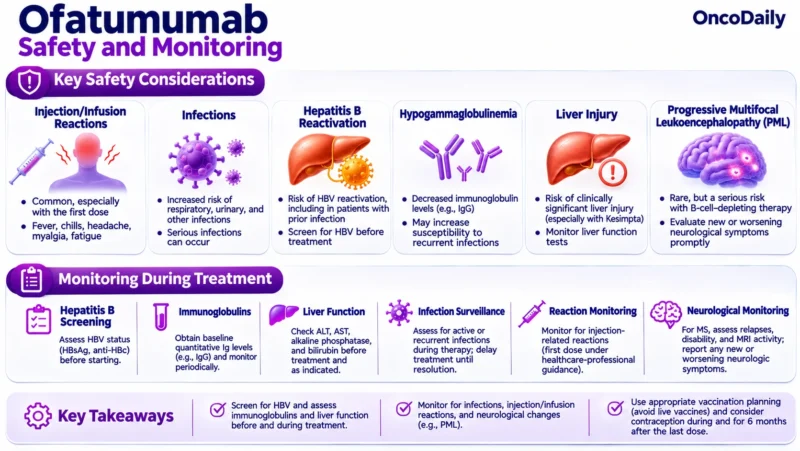
What Monitoring Is Required During Ofatumumab Treatment?
Hepatitis B Screening
Assess HBV status before therapy.
Patients with active HBV infection should not receive Kesimpta.
Immunoglobulin Monitoring
Obtain baseline quantitative immunoglobulins and reassess during treatment and after discontinuation as clinically indicated.
Liver Function Monitoring
Check:
- ALT
- AST
- Alkaline phosphatase
- Bilirubin
before starting Kesimpta and when clinically indicated during therapy.
Infection Monitoring
Assess for active or recurrent infections during treatment.
Delay Kesimpta in patients with active infections until resolution.
Injection or Infusion Reactions
Monitor for systemic and local reactions.
The first Kesimpta injection should occur under healthcare-professional guidance.
Neurological Monitoring
For MS, assess:
- Clinical relapses
- Neurological disability
- MRI disease activity
- New or unexplained neurological symptoms
Hematologic Monitoring
For historical oncology regimens, complete blood counts were important for monitoring cytopenias.
Vaccination and Reproductive Monitoring
Review vaccinations before treatment.
Females of reproductive potential should use effective contraception during Kesimpta treatment and for 6 months after the last dose.