


Nilotinib: Understanding Its Mechanism, Dosing, Clinical Uses, and Role in Chronic Myeloid Leukemia
Key takeaways
- Nilotinib is a second-generation BCR::ABL1 TKI used primarily in Ph+ CML.
- Tasigna is given at 300 mg BID first line or 400 mg BID in resistant/intolerant adult disease.
- Tasigna requires strict fasting: no food 2 hours before and 1 hour after dosing.
- Danziten is a newer nilotinib formulation dosed at 142 mg BID or 190 mg BID, depending on indication, and can be taken with or without food.
- The two formulations are not interchangeable milligram-for-milligram.
- ENESTnd showed significantly deeper molecular responses with nilotinib than imatinib.
- Ten-year MMR with nilotinib 300 mg BID was 77.7% vs 62.5% with imatinib.
- Nilotinib supports a strong treatment-free remission strategy in appropriately selected patients.
- ENESTfreedom showed approximately 48% estimated treatment-free survival at 5 years.
- Major safety concerns are QT prolongation, arterial cardiovascular events, metabolic toxicity, myelosuppression, and hepatopancreatic toxicity.
- Cardiovascular risk should strongly influence whether nilotinib is the optimal TKI.
Nilotinib is a potent second-generation BCR::ABL1 tyrosine kinase inhibitor (TKI) used primarily in Philadelphia chromosome-positive chronic myeloid leukemia (Ph+ CML). It was designed to bind BCR::ABL1 with greater potency than imatinib and remains an important option for both newly diagnosed disease and CML resistant or intolerant to prior therapy.
A particularly important practical point in 2026 is that nilotinib now exists in formulations with different dosing and food instructions. Tasigna capsules remain dosed at 300 mg twice daily for newly diagnosed chronic-phase CML and must be taken fasting, whereas Danziten tablets use lower bioequivalent doses and can be taken with or without food. These products are not interchangeable milligram-for-milligram.
Key Facts
- Generic name: Nilotinib
- Brands/formulations: Tasigna capsules; Danziten tablets
- Drug class: Second-generation BCR::ABL1 TKI
- Primary target: BCR::ABL1
- Additional targets: KIT, PDGFR
- Route: Oral
- Initial US approval: 2007
- Tasigna first-line adult dose: 300 mg twice daily
- Tasigna resistant/intolerant CML dose: 400 mg twice daily
- Danziten first-line adult dose: 142 mg twice daily
- Danziten resistant/intolerant dose: 190 mg twice daily
- Major boxed warning: QT prolongation and sudden death
- Characteristic longer-term concern: Arterial cardiovascular and peripheral vascular events
- Important metabolic toxicities: Hyperglycemia and dyslipidemia
- Major interaction pathway: CYP3A4.
What Is Nilotinib?
Nilotinib is a small-molecule kinase inhibitor designed to inhibit the abnormal BCR::ABL1 fusion tyrosine kinaseproduced by the Philadelphia chromosome:
t(9;22) → BCR::ABL1
BCR::ABL1 drives uncontrolled myeloid-cell proliferation and survival in CML.
Nilotinib also inhibits several other kinases, including:
- KIT
- PDGFR-α
- PDGFR-β
It was structurally developed from the imatinib framework but has stronger binding affinity for BCR::ABL1.
What Is the Mechanism of Action of Nilotinib?
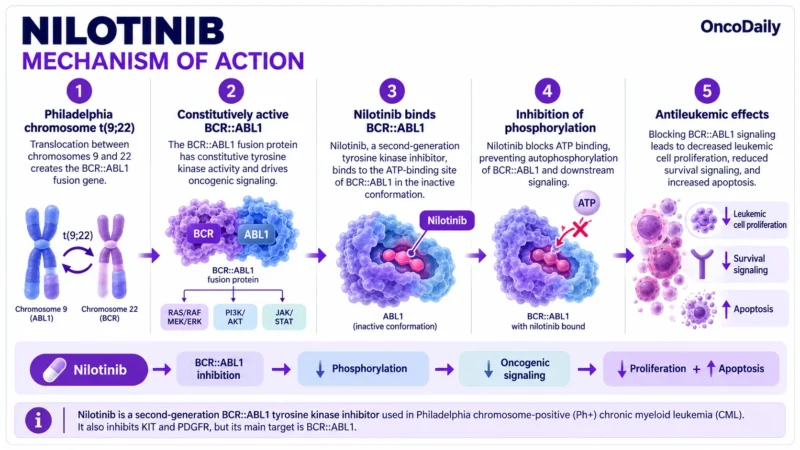
1. BCR::ABL1 Is Constitutively Active
In Ph+ CML, the BCR::ABL1 fusion protein continuously activates kinase signaling.
This stimulates pathways such as:
- RAS–RAF–MEK–ERK
- PI3K–AKT
- JAK/STAT
leading to increased:
- Leukemic-cell proliferation
- Survival
- Resistance to apoptosis
2. Nilotinib Binds the ABL Kinase Domain
Nilotinib binds the ATP-binding region of the inactive conformation of BCR::ABL1.
3. ATP-Dependent Phosphorylation Is Prevented
This blocks phosphorylation of downstream signaling proteins.
4. Oncogenic Signaling Falls
The result is reduced:
- Proliferation
- Survival signaling
- Leukemic clone expansion
5. Leukemic Cells Undergo Apoptosis
Overall:
Nilotinib → BCR::ABL1 inhibition → ↓ phosphorylation → ↓ oncogenic signaling → ↓ proliferation + ↑ apoptosis
Nilotinib retains activity against many imatinib-resistant BCR::ABL1 mutations, but T315I is resistant to nilotinib.
What Is the Recommended Dose of Nilotinib?
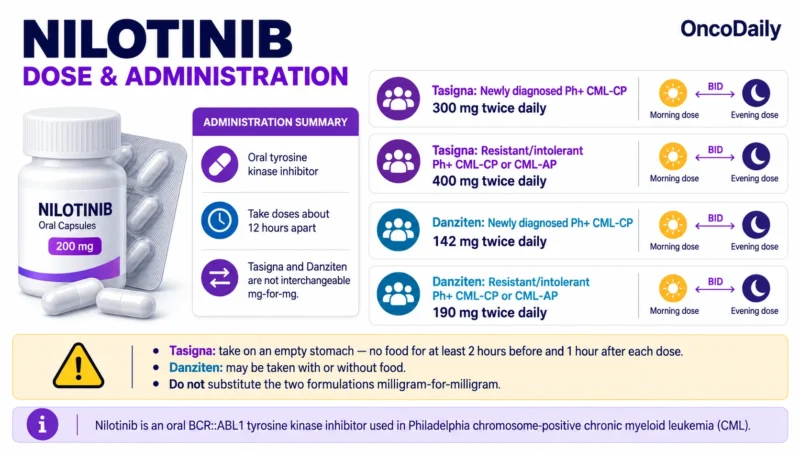
Tasigna Capsules
Newly Diagnosed Adult Ph+ Chronic-Phase CML
300 mg orally twice daily.
Resistant or Intolerant Adult Ph+ CML
For chronic-phase or accelerated-phase CML after prior therapy including imatinib:
400 mg orally twice daily.
Pediatric Patients ≥1 Year
Recommended dose:
230 mg/m² orally twice daily
rounded to the nearest available dose, with a maximum single dose of:
400 mg.
Danziten Tablets
Danziten is a newer nilotinib formulation with different bioavailability and therefore different doses.
Newly Diagnosed Adult Ph+ CML-CP
142 mg orally twice daily.
Resistant or Intolerant Adult Ph+ CML-CP or CML-AP
190 mg orally twice daily.
Importantly:
Danziten and Tasigna must not be substituted milligram-for-milligram.
How Should Nilotinib Be Taken?
Tasigna
Tasigna capsules should be taken approximately:
12 hours apart.
They must be taken on an empty stomach.
Patients should avoid food:
- For at least 2 hours before
- And 1 hour after
each dose.
This is important because food significantly increases nilotinib exposure and may increase QT-prolongation risk.
Danziten
Danziten may be taken:
With or without food.
Doses should still be taken approximately:
12 hours apart.
Tablets should be swallowed whole with water and should not be:
- Cut
- Crushed
- Chewed.
What If a Dose Is Missed?
If a dose is missed:
- Skip the missed dose
- Take the next scheduled dose at the regular time
- Do not take two doses together.
How Are Nilotinib Dose Reductions Managed?
Dose interruption or reduction may be required for:
- Neutropenia
- Thrombocytopenia
- QT prolongation
- Hepatotoxicity
- Pancreatitis
- Other clinically significant toxicity
For Tasigna, reductions commonly move from:
300 mg twice daily → 400 mg once daily
in newly diagnosed disease when clinically required.
For patients receiving:
400 mg twice daily
for resistant/intolerant disease, reduction to:
400 mg once daily
may be required depending on the toxicity.
Specific modification should always follow the current product label because dose rules differ by formulation and indication.
What Drug Interactions Are Important With Nilotinib?
Nilotinib is predominantly metabolized through:
CYP3A4.
Strong CYP3A4 Inhibitors
These can increase nilotinib exposure and QT risk.
Examples include:
- Ketoconazole
- Itraconazole
- Clarithromycin
- Ritonavir
Avoid strong inhibitors when possible. Novartis
Strong CYP3A4 Inducers
These can reduce nilotinib concentrations.
Examples include:
- Rifampin
- Carbamazepine
- Phenytoin
- Phenobarbital
- St. John’s wort
These should generally be avoided.
Grapefruit
Patients should avoid:
- Grapefruit
- Grapefruit juice
- Grapefruit-containing supplements
- because of CYP3A4 inhibition.
Does Nilotinib Require Dose Adjustment in Renal or Hepatic Impairment?
Renal Impairment
Renal elimination accounts for only a small proportion of nilotinib clearance.
Routine dose modification based solely on mild-to-moderate renal dysfunction is generally not required.
However, renal function should still be monitored, particularly in patients with:
- Cardiovascular disease
- Diabetes
- Metabolic abnormalities
Other comorbidities affecting renal function
Hepatic Impairment
Nilotinib exposure may increase in hepatic impairment.
Dose reduction may be required, particularly with Tasigna, depending on the degree of hepatic dysfunction.
Liver-function tests should be monitored throughout therapy.
What Is the Pharmacokinetic Profile of Nilotinib?
Nilotinib is administered orally and is highly protein bound.
It is primarily metabolized through:
CYP3A4.
For Tasigna, food significantly increases systemic exposure, which explains the strict fasting requirement.
Danziten was developed to provide more predictable bioavailability and may be administered:
With or without food.
The pharmacokinetic differences between formulations are the reason Tasigna and Danziten should not be substituted milligram-for-milligram.
What Are the Clinical Uses of Nilotinib?
Newly Diagnosed Ph+ Chronic-Phase CML
Nilotinib is approved for the first-line treatment of:
Philadelphia chromosome-positive chronic-phase chronic myeloid leukemia.
Its major advantages include:
- Rapid molecular response
- High rates of major molecular response
- High rates of deep molecular response
- Greater likelihood of achieving treatment-free remission eligibility compared with imatinib
Resistant or Intolerant CML
Nilotinib is also used in patients with:
- Chronic-phase CML
- Accelerated-phase CML
who are resistant or intolerant to prior therapy, including imatinib.
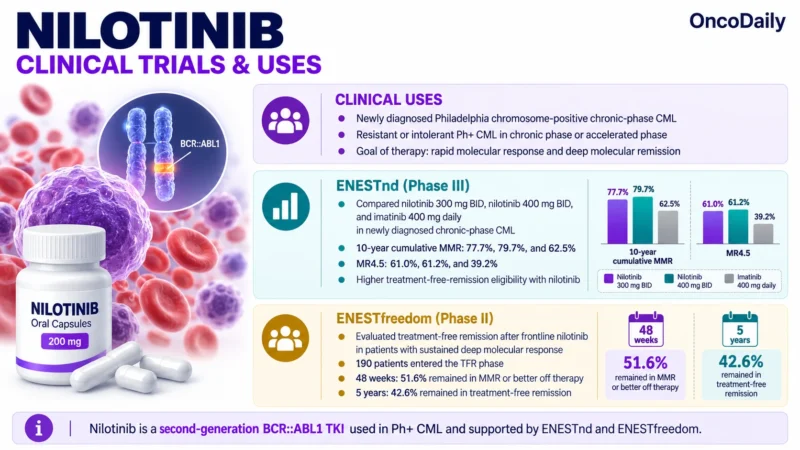
What Did the Pivotal Clinical Trials Show?
ENESTnd
The pivotal phase III ENESTnd trial compared:
- Nilotinib 300 mg twice daily
- Nilotinib 400 mg twice daily
- Imatinib 400 mg once daily
in patients with newly diagnosed chronic-phase CML.
At approximately 10 years, cumulative major molecular response rates were:
- Nilotinib 300 mg BID: 77.7%
- Nilotinib 400 mg BID: 79.7%
- Imatinib: 62.5%
Cumulative MR4.5 rates were:
- 61.0%
- 61.2%
- 39.2%, respectively
These findings demonstrated substantially deeper molecular responses with nilotinib than with imatinib.
Cumulative 10-year eligibility for treatment-free remission was:
- 48.6% with nilotinib 300 mg BID
- 47.3% with nilotinib 400 mg BID
- 29.7% with imatinib
Estimated 10-year overall survival was:
- 87.6% with nilotinib 300 mg BID
- 90.3% with nilotinib 400 mg BID
- 88.3% with imatinib
The major advantage of nilotinib over imatinib was therefore not a large overall-survival difference, but rather:
- Faster molecular response
- Deeper molecular response
- Greater likelihood of TFR eligibility
- Lower risk of progression
These benefits must be balanced against greater cardiovascular toxicity.
ENESTfreedom
The phase II ENESTfreedom study evaluated treatment discontinuation after frontline nilotinib in patients with sustained deep molecular response.
A total of:
190 patients
entered the treatment-free remission phase.
At 48 weeks:
51.6%
remained in major molecular response or better without therapy.
At 5 years:
- 42.6% remained in treatment-free remission
- Estimated treatment-free survival was 48.2%
Among patients who restarted nilotinib after losing MMR:
- 98.9% regained MMR
- 92.3% regained MR4.5
These data support the feasibility of treatment-free remission in carefully selected patients with sustained deep molecular response and access to close molecular monitoring.
Is Nilotinib FDA Approved?
Yes.
Tasigna
Tasigna is approved for:
- Newly diagnosed adult Ph+ CML-CP
- Adult resistant or intolerant Ph+ CML-CP
- Adult resistant or intolerant Ph+ CML-AP
- Pediatric patients aged ≥1 year with newly diagnosed CML-CP
- Pediatric resistant or intolerant CML-CP/CML-AP
Danziten
Danziten is approved for adults with:
- Newly diagnosed Ph+ CML-CP
- Resistant or intolerant Ph+ CML-CP
- Resistant or intolerant Ph+ CML-AP
The different formulations have different doses and food requirements and should not be considered directly interchangeable.
What Is the Current Clinical Role of Nilotinib in 2026?
First-Line CML
Nilotinib remains an effective first-line TKI for chronic-phase CML.
Its strengths include:
- Potent BCR::ABL1 inhibition
- Rapid molecular response
- High rates of MMR
- High rates of deep molecular response
- Strong potential for future treatment-free remission
Choice of first-line TKI should nevertheless be individualized according to:
- Disease risk
- Mutation profile
- Cardiovascular comorbidities
- Metabolic risk
- Treatment-free remission goals
- Patient preference
- Access
Read more: FDA Approves Generic Nilotinib: Expanding Access to Chronic Myeloid Leukemia Treatment by OncoDaily.
Watch more: The efficacy of nilotinib treatment approaches in frontline CML — Timothy Hughes, MD, discusses nilotinib-based frontline strategies in chronic myeloid leukemia.
Treatment-Free Remission
Nilotinib has one of the best-established datasets supporting TFR after sustained deep molecular response.
Candidates for treatment discontinuation generally require:
- Chronic-phase disease
- Adequate duration of TKI therapy
- Sustained deep molecular response
- Reliable access to standardized BCR::ABL1 PCR testing
- Willingness to undergo frequent molecular monitoring
Treatment discontinuation should only be attempted within established TFR criteria.
Cardiovascular Risk and TKI Selection
A major limitation of nilotinib is its cardiovascular toxicity profile.
ENESTnd showed cumulative cardiovascular events at 10 years in:
- 16.5% with nilotinib 300 mg BID
- 23.5% with nilotinib 400 mg BID
- 3.6% with imatinib
Nilotinib may therefore be less attractive in patients with substantial:
- Coronary artery disease
- Peripheral arterial disease
- Cerebrovascular disease
- Diabetes
- Dyslipidemia
- Smoking history
- High baseline cardiovascular risk
What Are the Major Side Effects of Nilotinib?
Common or clinically important adverse events include:
- Rash
- Pruritus
- Headache
- Nausea
- Fatigue
- Myalgia
- Arthralgia
- Cytopenias
- Elevated bilirubin
- Elevated transaminases
- Elevated lipase
- Hyperglycemia
- Hypercholesterolemia
Important serious toxicities include:
- QT prolongation
- Sudden death
- Arterial occlusive cardiovascular events
- Peripheral arterial occlusive disease
- Cerebrovascular ischemic events
- Myelosuppression
- Hepatotoxicity
- Pancreatitis
- Electrolyte disturbances
- Hemorrhage
- Fluid retention
- Tumor lysis syndrome
QT Prolongation
Nilotinib carries a boxed warning for:
QT prolongation and sudden death.
Do not initiate therapy in patients with:
- Hypokalemia
- Hypomagnesemia
- Long QT syndrome
Electrolyte abnormalities should be corrected before treatment.
ECG monitoring is recommended:
- At baseline
- Approximately 7 days after initiation
- Periodically thereafter
- After dose changes
Cardiovascular and Arterial Occlusive Events
Long-term nilotinib use is associated with increased risk of:
- Ischemic heart disease
- Peripheral arterial occlusive disease
- Cerebrovascular ischemic events
This risk is particularly important when treatment is expected to continue for many years.
Baseline cardiovascular risk assessment should therefore be performed before initiating treatment.
Metabolic Toxicity
Nilotinib can increase:
- Blood glucose
- Total cholesterol
- LDL cholesterol
- Triglycerides
Monitoring should include:
- Fasting glucose or HbA1c
- Lipid profile
Cardiovascular risk factors should be treated aggressively when appropriate.
Myelosuppression
Nilotinib may cause:
- Neutropenia
- Thrombocytopenia
- Anemia
CBC monitoring is generally recommended:
- Every 2 weeks during the first 2 months
- Then monthly
- Or as clinically indicated
Clinically significant cytopenias may require treatment interruption or dose modification.
Hepatotoxicity and Pancreatic Toxicity
Nilotinib may cause:
- ALT elevation
- AST elevation
- Hyperbilirubinemia
- Lipase elevation
- Pancreatitis
Monitoring should include:
- ALT
- AST
- Bilirubin
- Lipase
Clinically significant abnormalities may require interruption, dose reduction, or discontinuation.
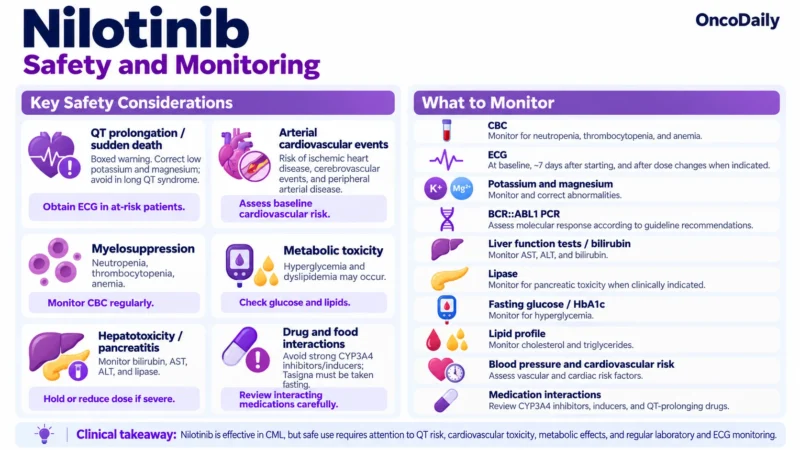
What Monitoring Is Required During Nilotinib Treatment?
Patients receiving nilotinib should undergo regular monitoring of:
- CBC
- BCR::ABL1 quantitative PCR
- ECG
- Potassium
- Magnesium
- Calcium
- ALT
- AST
- Bilirubin
- Lipase
- Fasting glucose or HbA1c
- Lipid profile
- Blood pressure
- Cardiovascular risk factors
- Symptoms of peripheral arterial disease
- Medication interactions
- Pregnancy status when relevant
For patients attempting treatment-free remission, more frequent BCR::ABL1 PCR monitoring is essential.
FAQ
What is nilotinib used for?
What is the usual Tasigna dose?
What dose is used after imatinib resistance or intolerance?
400 mg twice daily.
Does nilotinib need to be taken fasting?
No food for:
2 hours before and 1 hour after each dose.
Danziten, however, can be taken with or without food.
Can Tasigna and Danziten be substituted milligram-for-milligram?
They have different bioavailability and approved doses.
What is the most important safety warning?
Does nilotinib increase cardiovascular risk?
Is nilotinib active against T315I?
The BCR::ABL1 T315I mutation confers resistance.