


Mosunetuzumab (Lunsumio, Lunsumio Velo): Mechanism of Action, Dosing, Clinical Uses, Trials, and Side Effects
Key takeaways
- Mosunetuzumab is a CD20×CD3 bispecific T-cell-engaging antibody.
- It redirects T cells to destroy malignant CD20-positive B cells.
- IV Lunsumio received initial FDA approval in 2022.
- SC Lunsumio Velo received FDA approval in December 2025.
- Both formulations are approved for relapsed/refractory follicular lymphoma after at least two prior systemic therapies.
- The IV and SC formulations have different step-up schedules.
- GO29781 demonstrated an IV ORR of 80% and CR rate of 60%.
- The pivotal SC cohort demonstrated an ORR of 75% and CR rate of 59%.
- CELESTIMO announced positive phase III progression-free survival results in September 2026.
- CRS is the principal boxed-warning toxicity.
- Neurological toxicity, infections, cytopenias, HLH, and tumor flare require monitoring.
- Fixed-duration treatment is a defining clinical feature.
Mosunetuzumab-axgb (Lunsumio) is a CD20×CD3 bispecific T-cell-engaging monoclonal antibody used to treat relapsed or refractory follicular lymphoma (FL). By simultaneously binding CD20 on malignant B cells and CD3 on T lymphocytes, mosunetuzumab redirects the patient’s own T cells to destroy lymphoma cells.
Unlike conventional anti-CD20 monoclonal antibodies such as rituximab, mosunetuzumab actively recruits cytotoxic T cells through CD3 engagement. Unlike antibody–drug conjugates, it does not carry a cytotoxic chemotherapy payload.
Mosunetuzumab received initial FDA approval on December 22, 2022, for adults with relapsed or refractory follicular lymphoma after at least two previous lines of systemic therapy.
On December 19, 2025, the FDA also granted accelerated approval to Lunsumio Velo, a subcutaneous formulation that provides an alternative to intravenous administration.
The two formulations have distinct dosing schedules:
- Lunsumio IV: Step-up dosing of 1 mg, 2 mg, and 60 mg, followed by 30-mg maintenance doses.
- Lunsumio Velo SC: Step-up dosing of 5 mg followed by 45 mg, with subsequent 45-mg doses.
Mosunetuzumab is administered for a fixed number of treatment cycles, depending on response.
Its clinical activity was established in the phase I/II GO29781 trial, with additional evidence from the subcutaneous development program and the phase III CELESTIMO trial.
Key Facts
- Generic name: Mosunetuzumab-axgb
- Brand names: Lunsumio; Lunsumio Velo
- Drug class: Bispecific T-cell-engaging monoclonal antibody
- Targets: CD20 and CD3
- Antibody format: Full-length humanized IgG1-based bispecific antibody
- Mechanism: T-cell recruitment, immunological synapse formation, T-cell-mediated cytotoxicity
- Initial FDA approval: December 22, 2022
- Subcutaneous approval: December 19, 2025
- Administration: Intravenous infusion or subcutaneous injection, depending on formulation
- IV doses: 1 mg, 2 mg, 60 mg, and 30 mg
- SC doses: 5 mg and 45 mg
- Cycle length: 21 days
- Treatment duration: Eight cycles for complete responders; up to 17 cycles for partial responders or patients with stable disease
- FDA indication: Relapsed or refractory follicular lymphoma after at least two prior systemic therapies
- Biomarker: CD20 expression
- Pivotal study: GO29781 (NCT02500407)
- Confirmatory study: CELESTIMO (NCT04712097)
- Major adverse reactions: Cytokine release syndrome, fatigue, rash, infections, headache, cytopenias
- Boxed warning: Cytokine release syndrome
- Other serious risks: ICANS, hemophagocytic lymphohistiocytosis, severe infections, tumor flare
- Monitoring: CRS, neurological symptoms, infection, CBC, liver function, and tumor response
What Is Mosunetuzumab?
Mosunetuzumab is a bispecific antibody engineered to recognize two different antigens.
One antigen-binding region recognizes CD20, a surface protein expressed on normal and malignant mature B cells.
The other recognizes CD3, a component of the T-cell receptor complex.
By binding both antigens, mosunetuzumab physically brings cytotoxic T lymphocytes into contact with CD20-positive lymphoma cells.
This promotes T-cell activation and targeted lymphoma-cell destruction.
A major characteristic of mosunetuzumab is its fixed-duration treatment strategy, which differs from therapies that are administered continuously until disease progression.
What Is the Mechanism of Action of Mosunetuzumab?
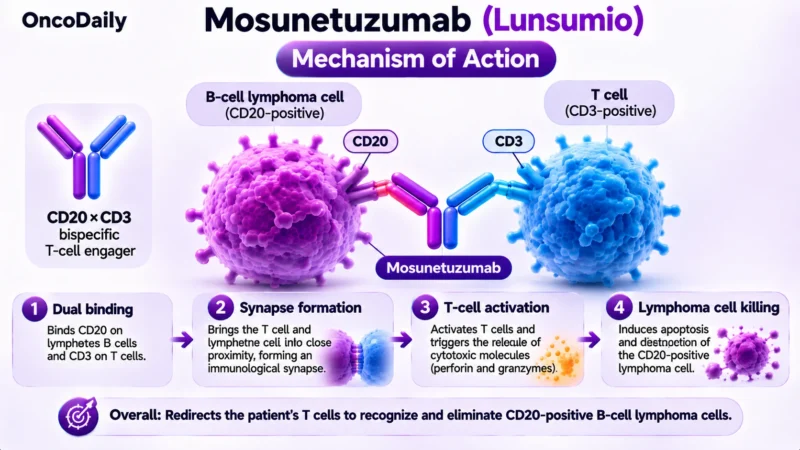
1. CD20 Recognition on Lymphoma Cells
CD20 is expressed on malignant B cells in most follicular lymphomas.
Mosunetuzumab recognizes CD20 on the lymphoma-cell membrane.
2. CD3 Binding on T Cells
The second antigen-binding region recognizes CD3 on T lymphocytes.
This enables mosunetuzumab to recruit T cells toward the tumor.
3. Immunological Synapse Formation
Simultaneous engagement of CD20 and CD3 brings both cells into close proximity.
An immunological synapse forms between the malignant B cell and the T cell.
This activates T-cell receptor-associated signaling.
4. T-Cell Activation
Activated T cells release cytotoxic molecules, including:
- Perforin
- Granzymes
These molecules penetrate the malignant cell and initiate apoptosis.
5. Serial Tumor-Cell Killing
After destroying one CD20-positive lymphoma cell, an activated T cell can engage additional targets.
This enables repeated T-cell-mediated cytotoxicity.
6. Cytokine Release
T-cell activation stimulates inflammatory cytokine production.
Cytokines include:
- IL-6
- IL-2
- Interferon-gamma
- TNF-alpha
Although this activity contributes to immune activation, excessive cytokine release can produce cytokine release syndrome (CRS).
Overall mechanism:
Mosunetuzumab → CD20 binding + CD3 binding → immunological synapse → T-cell activation → perforin/granzyme release → lymphoma-cell apoptosis.
What Is the Recommended Dose of Mosunetuzumab?
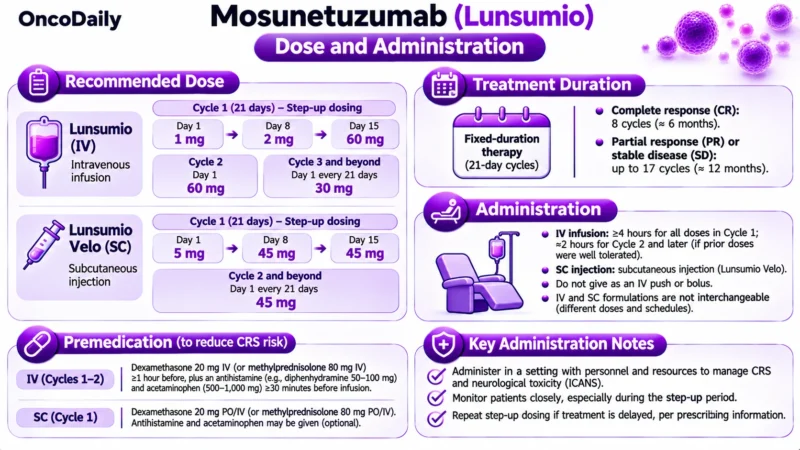
The recommended schedule depends on whether the intravenous or subcutaneous formulation is used.
Both formulations use 21-day treatment cycles, but their doses are not interchangeable.
Intravenous Lunsumio
Cycle 1 — Step-Up Dosing
Day 1: 1 mg IV
Day 8: 2 mg IV
Day 15: 60 mg IV
Cycle 2
Day 1: 60 mg IV
Cycle 3 Onward
Day 1: 30 mg IV every 21 days.
Subcutaneous Lunsumio Velo
Cycle 1 — Step-Up Dosing
Day 1: 5 mg SC
Day 8: 45 mg SC
Day 15: 45 mg SC
Cycle 2 Onward
Day 1: 45 mg SC every 21 days.
Duration of Treatment
Complete Response
Patients who achieve a complete response by Cycle 8 stop treatment after completing eight cycles.
Partial Response or Stable Disease
Patients with partial response or stable disease after Cycle 8 may continue for an additional nine cycles.
Maximum planned treatment duration: 17 cycles.
Treatment stops earlier for progressive disease or unacceptable toxicity.
How Should Mosunetuzumab Be Administered?
Intravenous Lunsumio
Lunsumio IV is administered through a dedicated intravenous infusion line.
First-Cycle Infusions
Administer over at least:
4 hours.
Subsequent Infusions
Cycle 2 and later infusions may be administered over approximately:
2 hours, if prior infusions were well tolerated.
Do not administer as an IV push or bolus.
An in-line filter must not be used for IV Lunsumio administration.
Subcutaneous Lunsumio Velo
Lunsumio Velo is administered by subcutaneous injection by a qualified healthcare professional.
The formulation is supplied as a ready-to-use solution.
It should not be diluted for intravenous administration.
The subcutaneous product must not be substituted for intravenous Lunsumio using a direct milligram-for-milligram conversion.
Premedication — Intravenous Lunsumio
For all patients during Cycles 1 and 2:
Corticosteroid
Dexamethasone 20 mg IV, preferably, or methylprednisolone 80 mg IV.
Complete at least one hour before infusion.
Antihistamine
Diphenhydramine 50–100 mg, or an equivalent H1 antihistamine, at least 30 minutes before infusion.
Antipyretic
Acetaminophen 500–1,000 mg orally, at least 30 minutes before infusion.
For Cycle 3 onward, premedication is recommended when the preceding dose caused CRS.
Premedication — Subcutaneous Lunsumio Velo
During Cycle 1, all patients receive corticosteroid premedication:
- Dexamethasone 20 mg orally or IV, or
- Methylprednisolone 80 mg orally or IV.
Antihistamine and acetaminophen may also be administered, but are optional under the U.S. SC label.
For Cycle 2 onward, corticosteroid premedication is required for patients who experienced CRS with the preceding dose.
Patient Monitoring
Both formulations must be administered in a setting with personnel and resources to manage severe CRS, neurological toxicity, and other serious adverse reactions.
Hospitalization is not universally required for every administration, but patients developing significant CRS may require inpatient management.
What Should You Do If a Mosunetuzumab Dose Is Missed?
If treatment is delayed:
- Contact the oncology team.
- Assess the duration of the interruption.
- Determine the last administered dose.
- Follow the formulation-specific restart algorithm.
- Repeat step-up doses when required.
- Do not double a subsequent dose.
Long delays can require restarting treatment at a lower dose to reduce CRS risk.
The restart schedules differ between Lunsumio IV and Lunsumio Velo SC.
How Are Mosunetuzumab Dose Modifications Managed?
Cytokine Release Syndrome
Treatment modification depends on CRS severity.
Grade 1 CRS
Ensure symptom resolution before administering the next dose.
Premedicate and increase monitoring when indicated.
Grade 2 CRS
Withhold treatment until symptoms resolve.
Provide supportive care and consider hospitalization according to clinical status.
Grade 3 CRS
Interrupt treatment and manage according to established CRS protocols.
Depending on formulation and previous dose, restarting may require additional step-up dosing and inpatient observation.
Recurrent Grade 3 CRS may require permanent discontinuation.
Grade 4 CRS
Permanently discontinue mosunetuzumab.
ICANS or Severe Neurological Toxicity
Withhold treatment and promptly evaluate neurological symptoms.
Severe or recurrent neurotoxicity may require permanent discontinuation.
Serious Infections
Withhold therapy during serious active infection until adequate recovery.
Cytopenias
Treatment may be delayed for severe or persistent neutropenia, thrombocytopenia, or anemia.
Dose modification should follow the formulation-specific label.
Hemophagocytic Lymphohistiocytosis
HLH is a serious inflammatory complication requiring urgent investigation, treatment interruption, and specialist management.
What Drug Interactions Are Important With Mosunetuzumab?
CYP450 Substrates
Mosunetuzumab is not primarily metabolized through CYP450 pathways.
However, inflammatory cytokine release may transiently suppress CYP450 enzyme activity.
This can increase exposure to certain medications, particularly those with a narrow therapeutic index.
Examples include selected anticoagulants, immunosuppressants, and other CYP-metabolized drugs.
Monitor appropriately during treatment initiation and CRS episodes.
Immunosuppressive Agents
Concomitant immunosuppressive therapy may increase infection susceptibility.
Live Vaccines
Live-virus vaccination should be avoided during significant treatment-related immunosuppression.
Other Antilymphoma Treatments
Combination regimens may increase the risks of:
- Infections
- Cytopenias
- Inflammatory toxicity
- Organ dysfunction
Does Mosunetuzumab Require Dose Adjustment in Renal or Hepatic Impairment?
Renal Impairment
No routine dose adjustment is required for mild or moderate renal impairment.
Evidence in severe renal impairment is limited.
Hepatic Impairment
No routine adjustment is established for mild hepatic impairment.
The pharmacokinetics in moderate or severe hepatic impairment remain inadequately characterized.
What Is the Pharmacokinetic Profile of Mosunetuzumab?
Distribution
Mosunetuzumab has a relatively limited volume of distribution, consistent with its monoclonal antibody structure.
Metabolism
It undergoes proteolytic catabolism to peptides and amino acids.
Clearance
Clearance includes target-mediated and nonspecific antibody-catabolic pathways.
Half-Life
Mosunetuzumab has time-dependent pharmacokinetics.
The apparent elimination half-life increases with repeated treatment as clearance decreases.
There is no single half-life estimate applicable to all dosing phases.
Intravenous Versus Subcutaneous Exposure
Subcutaneous administration results in slower absorption than intravenous infusion.
The SC formulation was developed to provide comparable clinically relevant exposure while simplifying treatment administration.
What Are the Clinical Uses of Mosunetuzumab?
Relapsed or Refractory Follicular Lymphoma
Mosunetuzumab is FDA approved for adults with follicular lymphoma following at least two previous lines of systemic therapy.
The supporting trials enrolled patients previously treated with an anti-CD20 antibody and an alkylating agent.
Mosunetuzumab provides a chemotherapy-free, T-cell-directed immunotherapy option.
Patients Previously Exposed to Anti-CD20 Therapy
Patients may respond to mosunetuzumab despite prior rituximab or other anti-CD20 antibody exposure.
Its CD3-mediated T-cell-engaging activity differs from conventional anti-CD20 monoclonal antibody mechanisms.
However, retained CD20 expression and other tumor characteristics may influence treatment response.
High-Risk Follicular Lymphoma
Clinical studies have demonstrated activity in patients with:
- Progression within 24 months (POD24)
- Refractory disease after anti-CD20 therapy
- Multiple previous treatment lines
- Bulky disease
Earlier-Line Follicular Lymphoma
The phase III CELESTIMO trial is investigating mosunetuzumab combined with lenalidomide against rituximab plus lenalidomide after at least one previous treatment line.
The combination is investigational for this earlier-line setting as of November 2026.
Other B-Cell Lymphomas
Mosunetuzumab has also been investigated in diffuse large B-cell lymphoma and other B-cell non-Hodgkin lymphomas.
These indications are not part of its current FDA-approved monotherapy label.
What Molecular Testing Is Required Before Mosunetuzumab?
CD20 Expression
CD20 is the relevant tumor target.
Confirm B-cell lymphoma histology and assess CD20 expression using immunohistochemistry or flow cytometry as appropriate.
Follicular Lymphoma Diagnosis
Testing typically includes:
- Histopathological assessment
- CD20
- CD10
- BCL6
- BCL2
- Ki-67
- Additional immunophenotypic markers
- Cytogenetic or molecular studies when indicated
Assessment for Transformation
Patients with rapidly growing disease, unusual symptoms, or disproportionate metabolic activity may require repeat biopsy to exclude transformation to aggressive lymphoma.
Baseline Clinical Assessment
Before treatment, assess:
- CBC
- Liver and renal function
- Infection status
- Neurological history
- Tumor burden
- Previous therapies
- Performance status
What Did the Pivotal Clinical Trials Show?
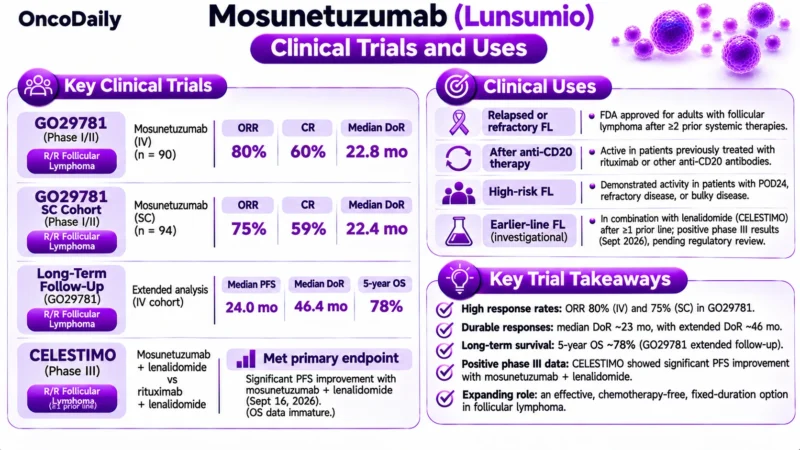
GO29781 — Intravenous Mosunetuzumab in Relapsed/Refractory Follicular Lymphoma
GO29781 (NCT02500407) was an open-label, multicenter phase I/II study.
The pivotal IV cohort included 90 patients with follicular lymphoma following at least two prior systemic treatments.
Overall Response Rate
80%
Complete Response Rate
60%
Median Duration of Response
22.8 months
Median Time to First Response
1.4 months
The study demonstrated substantial activity in a heavily pretreated population.
GO29781 — Subcutaneous Mosunetuzumab Cohort
The pivotal SC cohort included 94 patients receiving the 5/45/45-mg step-up regimen.
Objective Response Rate
75%
Complete Response Rate
59%
Median Duration of Response
22.4 months
Response Remaining at 18 Months
60%
These independent-review results supported the approval of Lunsumio Velo.
A separate published analysis reported an overall response rate of 76.6% and complete response rate of 61.7%, reflecting differences in assessment and analysis.
Long-Term Follow-Up of Intravenous Mosunetuzumab
Extended follow-up demonstrated durable responses after fixed-duration treatment.
Median Progression-Free Survival
Approximately 24.0 months.
Median Duration of Response
Approximately 46.4 months in the extended analysis.
Five-Year Overall Survival
Approximately 78%.
These longer-term results support the potential for durable treatment-free remissions in selected patients, although the study was not randomized against another active treatment.
Watch More: Mosunetuzumab Induces Deep and Durable Remissions in Relapsed/Refractory Follicular Lymphoma.
CELESTIMO — Phase III Mosunetuzumab Plus Lenalidomide
The phase III CELESTIMO trial (NCT04712097) compares:
- Mosunetuzumab plus lenalidomide
- Rituximab plus lenalidomide
in patients with relapsed/refractory follicular lymphoma after at least one previous line of treatment.
September 2026 Interim Analysis
The trial met its primary endpoint, demonstrating a statistically significant progression-free survival improvement with mosunetuzumab plus lenalidomide.
Overall survival data were immature.
Detailed numerical PFS results had not yet been publicly reported in the September 2026 announcement.
This is an important potential expansion into earlier-line follicular lymphoma treatment, but the combination should not be described as FDA approved for this setting without an updated regulatory authorization.
Read More: Mosunetuzumab Plus Lenalidomide Improves PFS in Follicular Lymphoma in Phase 3 CELESTIMO Trial by OncoDaily.
Does Mosunetuzumab Have CNS Activity?
Mosunetuzumab is not an established CNS-directed lymphoma treatment.
Like other large antibody therapies, penetration across an intact blood–brain barrier is limited.
Patients with CNS lymphoma were excluded from the pivotal follicular lymphoma cohorts.
Its efficacy in CNS lymphoma has not been established through prospective randomized trials.
Is Mosunetuzumab FDA Approved?
Yes.
December 22, 2022
Initial accelerated FDA approval of intravenous Lunsumio for adults with relapsed/refractory follicular lymphoma after at least two previous systemic therapies.
December 19, 2025
Accelerated FDA approval of subcutaneous Lunsumio Velo for the same population.
Both approvals are based on response outcomes, and continued approval may depend on confirmatory evidence of clinical benefit.
What Is the Current Clinical Role of Mosunetuzumab in 2026?
Third-Line or Later Follicular Lymphoma
Mosunetuzumab is an established FDA-approved bispecific immunotherapy option after at least two prior treatment lines.
Fixed-Duration Immunotherapy
Unlike many therapies continued until progression, mosunetuzumab can be completed after eight cycles in patients with complete response.
Subcutaneous Treatment
The availability of Lunsumio Velo provides an alternative route of administration.
This may reduce treatment-related time and logistical burden.
Earlier-Line Combination Therapy
The positive CELESTIMO phase III interim results suggest that mosunetuzumab plus lenalidomide may become an important earlier-line treatment option.
Regulatory approval for that specific combination and treatment line remains a separate question.
Relationship to CAR-T Therapy
Both mosunetuzumab and CAR-T therapy use T-cell-mediated antitumor activity.
However:
- Mosunetuzumab redirects endogenous T cells through a bispecific antibody.
- CAR-T therapy uses genetically modified T cells.
Mosunetuzumab does not require leukapheresis or individualized cellular manufacturing.
What Are the Major Side Effects of Mosunetuzumab?
Cytokine Release Syndrome
CRS is the most important acute toxicity and carries an FDA boxed warning.
It results from inflammatory cytokine release following T-cell activation.
Symptoms include:
- Fever
- Chills
- Hypotension
- Tachycardia
- Hypoxia
- Headache
- Confusion
- Organ dysfunction
In the IV safety population, CRS occurred in approximately 39% of patients, while the SC pivotal population had CRS in approximately 30%.
Most events were Grade 1–2, but severe reactions can occur.
Neurological Toxicity and ICANS
Neurological adverse events may include:
- Headache
- Confusion
- Tremor
- Aphasia
- Encephalopathy
- Seizures
Severe cases require urgent evaluation.
Serious Infections
Infections may include:
- Respiratory infections
- Pneumonia
- Viral infections
- Opportunistic infections
- Sepsis
Progressive Multifocal Leukoencephalopathy
In April 2026, the manufacturer issued a healthcare-professional safety communication concerning the potential risk of PML with CD20-directed therapies, including mosunetuzumab.
New or progressive neurological symptoms require prompt evaluation, including assessment for possible PML.
Hemophagocytic Lymphohistiocytosis
HLH is a potentially life-threatening hyperinflammatory syndrome.
It may present with fever, cytopenias, liver abnormalities, elevated ferritin, and multiorgan dysfunction.
Cytopenias
Mosunetuzumab may cause:
- Neutropenia
- Anemia
- Thrombocytopenia
Tumor Flare
Tumor flare can produce painful enlargement of lymphoma lesions or local inflammatory symptoms.
Subcutaneous Injection-Site Reactions
Lunsumio Velo may cause:
- Redness
- Swelling
- Pain
- Itching
- Localized inflammation
Embryo-Fetal Toxicity
Mosunetuzumab may cause fetal harm.
Females of reproductive potential should use effective contraception during treatment and for three months after the final dose.
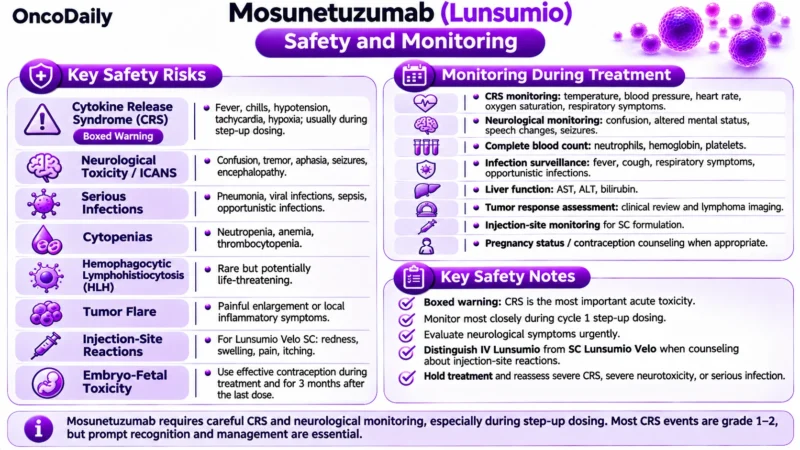
What Monitoring Is Required During Mosunetuzumab Treatment?
CRS Monitoring
Monitor for:
- Temperature
- Blood pressure
- Heart rate
- Oxygen saturation
- Respiratory symptoms
Closely assess patients during the step-up dosing period.
Neurological Monitoring
Evaluate for:
- Confusion
- Altered mental status
- Speech disturbances
- Seizures
- Progressive weakness
Complete Blood Count
Monitor:
- Neutrophils
- Hemoglobin
- Platelets
Infection Surveillance
Evaluate for fever, respiratory symptoms, and opportunistic infections.
Consider prophylaxis according to patient-specific risk and institutional guidance.
Liver Function
Monitor:
- AST
- ALT
- Bilirubin
Tumor Response
Assess treatment response using appropriate lymphoma imaging and clinical evaluation.
Response status after eight cycles determines whether additional treatment is required.
Injection-Site Monitoring
For SC Lunsumio Velo, monitor local skin reactions.
Pregnancy Monitoring
Assess pregnancy status when clinically appropriate and provide contraception counseling.