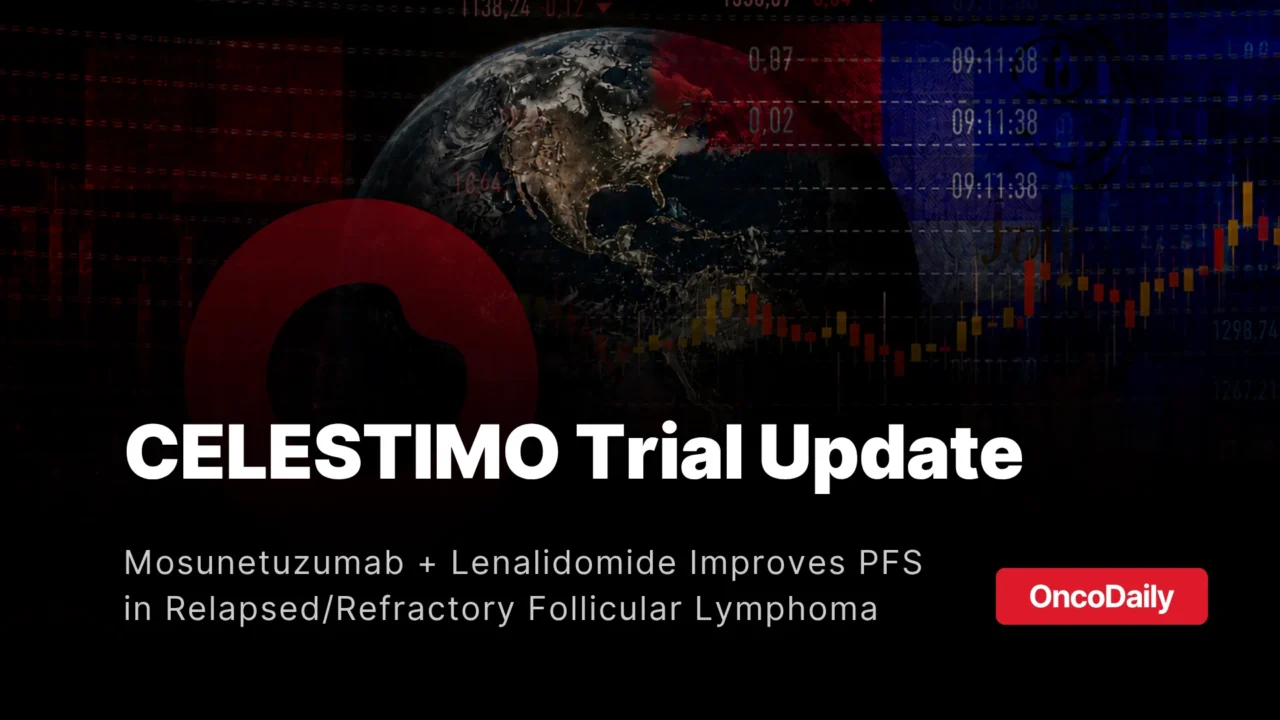
Roche announced positive results from the Phase 3 CELESTIMO trial, evaluating mosunetuzumab plus lenalidomide in patients with relapsed or refractory follicular lymphoma who had received at least one prior line of systemic therapy.
At a planned interim analysis, the study met its primary endpoint, with mosunetuzumab plus lenalidomide demonstrating a statistically significant and clinically meaningful improvement in progression-free survival (PFS) compared with rituximab plus lenalidomide.
Overall survival data were immature at the time of the interim analysis. According to Roche, the safety profile of the combination was consistent with the known safety profiles of the individual study medicines, with no new safety signals identified.
The company plans to submit the CELESTIMO findings to health authorities and present the results at an upcoming medical meeting. Detailed efficacy results, including the magnitude of the progression-free survival benefit, have not yet been disclosed.
Levi Garraway, MD, PhD, Roche’s Chief Medical Officer and Head of Global Product Development, highlighted the need for therapies that can provide clinical benefit while limiting the impact of treatment on patients’ everyday lives.
“People living with relapsed or refractory follicular lymphoma need treatment options that provide meaningful clinical benefit and minimal disruptions to everyday care.”
Garraway added that the CELESTIMO findings suggest the two-drug outpatient mosunetuzumab regimen could provide another treatment option earlier in the course of relapsed or refractory follicular lymphoma.
CELESTIMO Could Support Earlier Use of Mosunetuzumab
CELESTIMO (NCT04712097) is a Phase 3 trial comparing mosunetuzumab plus lenalidomide with rituximab plus lenalidomide in patients with relapsed or refractory follicular lymphoma who have received at least one previous line of systemic therapy.
Beyond assessing the efficacy and safety of the combination, CELESTIMO has an important confirmatory role in the clinical development of mosunetuzumab.
The study is required to support conversion of the accelerated approval and conditional marketing authorization of mosunetuzumab monotherapy in third-line or later follicular lymphoma to full approval. The findings are also intended to support an indication for mosunetuzumab plus lenalidomide in patients treated in the second-line or later setting.
The positive PFS result therefore could contribute to moving mosunetuzumab-based therapy earlier in the follicular lymphoma treatment pathway, pending detailed results and regulatory review.
Roche also emphasized several practical characteristics of the regimen, including its outpatient administration and dosing schedule. The company is developing mosunetuzumab with flexibility between intravenous and subcutaneous administration routes.
Mosunetuzumab and Roche’s Bispecific Antibody Program
Mosunetuzumab is a CD20xCD3 T-cell-engaging bispecific antibody designed to simultaneously target CD20 on the surface of B cells and CD3 on T cells.
By bringing the two cell types together, the therapy activates and redirects a patient’s existing T cells to recognize and eliminate malignant B cells.
Mosunetuzumab is currently approved as a fixed-duration monotherapy for adults with third-line or later relapsed or refractory follicular lymphoma. Roche reported that the therapy is approved for this setting in 60 countries worldwide and has been used to treat more than 3,800 patients.
The drug is available in both intravenous and subcutaneous formulations and forms part of Roche’s broader CD20xCD3 bispecific antibody program.
According to Roche, mosunetuzumab has the longest follow-up data of any bispecific antibody in lymphoma. Its clinical development program spans several B-cell malignancies and treatment settings, including both follicular lymphoma and diffuse large B-cell lymphoma.
The CELESTIMO findings are part of an effort to evaluate mosunetuzumab earlier in the follicular lymphoma treatment pathway. Roche is also conducting the Phase 3 MorningLyte study, which is investigating a mosunetuzumab-based approach in the first-line follicular lymphoma setting.
Development is also continuing in diffuse large B-cell lymphoma. Roche noted that the U.S. Food and Drug Administration recently accepted a supplemental Biologics License Application for mosunetuzumab in combination with polatuzumab vedotin for second-line or later diffuse large B-cell lymphoma based on results from the SUNMO study.
About Follicular Lymphoma
Follicular lymphoma is the most common indolent, or slow-growing, form of non-Hodgkin lymphoma, representing approximately one in five cases.
Although the disease typically responds to treatment, its course is often characterized by repeated periods of remission and relapse. Roche noted that follicular lymphoma may become increasingly difficult to treat with each relapse, while early disease progression can be associated with a poorer long-term prognosis.
More than 110,000 people are estimated to be diagnosed with follicular lymphoma worldwide each year.
This pattern of recurring disease has created a need for treatment options that can maintain disease control while being suitable for repeated and potentially long-term management of patients.
The full CELESTIMO results will provide additional information on the magnitude of the progression-free survival improvement and the overall benefit-risk profile of mosunetuzumab plus lenalidomide. Roche plans to present the findings at an upcoming medical meeting and submit the data to health authorities.
Read further on OncoDaily: Follicular Lymphoma (FL): Evolving Biology and Modern Therapeutic Paradigms