





Mobocertinib (Exkivity): Understanding Its Mechanism, Dosing, Clinical Development, and Role in EGFR Exon 20 Insertion–Positive Lung Cancer
Key takeaways
- Mobocertinib (Exkivity) is an oral, irreversible EGFR tyrosine kinase inhibitor developed specifically for EGFR exon 20 insertion–positive NSCLC.
- It received accelerated FDA approval in 2021 for patients with locally advanced or metastatic disease progressing on or after platinum-based chemotherapy.
- The historical standard dose was 160 mg orally once daily, with dose reductions to 120 mg and 80 mg once daily when needed for toxicity.
- In the platinum-pretreated population supporting accelerated approval, mobocertinib produced an objective response rate of approximately 28%, with a median PFS of 7.3 months and median overall survival of 24.0 months.
- The confirmatory phase III EXCLAIM-2 trial did not improve progression-free survival compared with platinum-based chemotherapy: 9.6 months vs 9.6 months.
- Because the confirmatory trial failed to verify clinical benefit, the US indication was withdrawn in 2024.
- Important toxicities included diarrhea, nausea, vomiting, rash, paronychia, and stomatitis.
- A particularly important safety concern was QTc prolongation and torsades de pointes, which required ECG, electrolyte, and drug-interaction monitoring.
- Other serious risks included interstitial lung disease/pneumonitis and cardiac toxicity.
- Mobocertinib is not currently FDA approved in the United States, but it remains important historically in the development of targeted therapy for EGFR exon 20 insertion–positive lung cancer.
Mobocertinib (Exkivity) is an oral, irreversible epidermal growth factor receptor (EGFR) tyrosine kinase inhibitor developed specifically for non-small cell lung cancer (NSCLC) harboring EGFR exon 20 insertion mutations. These alterations are structurally distinct from the more common sensitizing EGFR exon 19 deletion and exon 21 L858R mutations and historically showed limited sensitivity to conventional EGFR tyrosine kinase inhibitors.
Mobocertinib was designed to selectively inhibit mutant EGFR containing exon 20 insertions and received accelerated FDA approval in September 2021 for adults with locally advanced or metastatic EGFR exon 20 insertion–positive NSCLC whose disease had progressed on or after platinum-based chemotherapy. However, the confirmatory phase III EXCLAIM-2 trial failed to demonstrate superiority over platinum-based chemotherapy, and the US indication was formally withdrawn on July 15, 2024.
Key Facts
- Generic name: Mobocertinib
- Brand name: Exkivity
- Drug class: Irreversible EGFR tyrosine kinase inhibitor
- Route: Oral
- Initial US approval: September 15, 2021
- US withdrawal date: July 15, 2024
- Former FDA-approved indication: Locally advanced or metastatic NSCLC with EGFR exon 20 insertion mutations after progression on or after platinum-based chemotherapy
- Historical standard dose: 160 mg orally once daily
- Dose reductions: 120 mg → 80 mg once daily
- Administration: With or without food
- Dosage form: 40 mg capsules
- Major target: EGFR exon 20 insertion-mutant receptor
- Active metabolites: AP32960 and AP32914
- Major toxicities: Diarrhea, rash, nausea, vomiting, stomatitis, decreased appetite, paronychia, dry skin, and weight loss
- Important serious toxicities: QTc prolongation and torsades de pointes, interstitial lung disease/pneumonitis, and cardiac toxicity
- Important interactions: CYP3A inhibitors, CYP3A inducers, and QT-prolonging drugs
- Half-life: Approximately 18 hours
- Current US status: Not FDA approved; indication withdrawn.
What Is Mobocertinib?
Mobocertinib is a small-molecule kinase inhibitor specifically developed to target EGFR exon 20 insertion mutations.
EGFR exon 20 insertions represent a heterogeneous group of activating mutations located within or near the C-helix and loop region of the EGFR kinase domain.
Unlike classical sensitizing EGFR mutations such as:
- Exon 19 deletion
- Exon 21 L858R
many exon 20 insertion mutations preserve a kinase conformation that allows strong ATP binding while reducing access or affinity for several conventional EGFR TKIs.
This historically made EGFR exon 20 insertion-positive NSCLC particularly difficult to treat with earlier-generation EGFR inhibitors.
Mobocertinib was designed to preferentially inhibit mutant EGFR containing exon 20 insertions while maintaining a therapeutic window relative to wild-type EGFR.
What Is the Mechanism of Action of Mobocertinib?
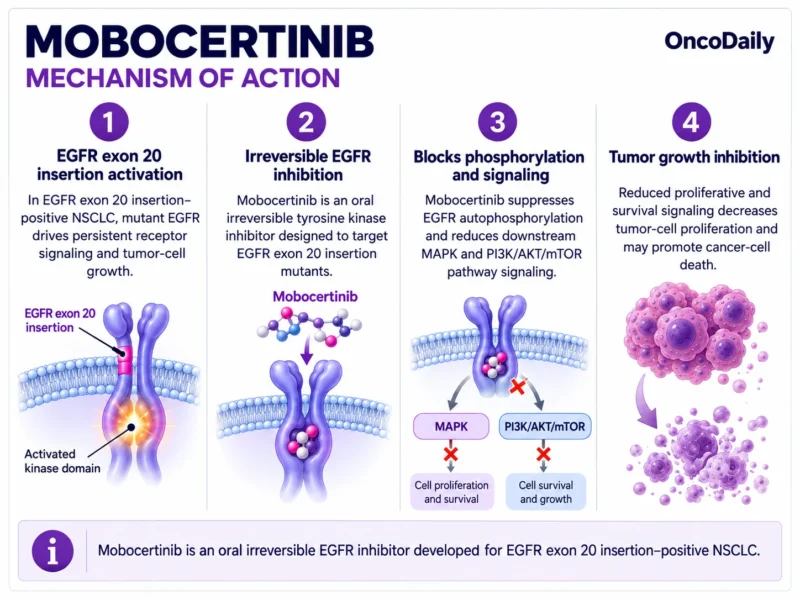
1. EGFR Exon 20 Insertions Activate Tumor Signaling
EGFR exon 20 insertion mutations can cause constitutive activation of the EGFR kinase domain.
Persistent EGFR activation promotes:
- Tumor-cell proliferation
- Survival
- Growth
- Invasion
- Resistance to apoptosis
2. Mobocertinib Irreversibly Inhibits EGFR
Mobocertinib is an:
ATP-competitive, irreversible EGFR tyrosine kinase inhibitor.
It binds covalently within the EGFR kinase domain and inhibits mutant EGFR proteins containing exon 20 insertion alterations.
Mobocertinib also produces two active metabolites:
- AP32960
- AP32914
which contribute to overall pharmacologic activity.
3. EGFR Autophosphorylation Is Reduced
Inhibition of the kinase domain decreases EGFR autophosphorylation.
This limits receptor-driven intracellular signaling.
4. Downstream Signaling Is Suppressed
Reduced EGFR activation decreases signaling through important pathways including:
RAS–RAF–MEK–ERK
and
PI3K–AKT–mTOR.
These pathways are central to malignant-cell proliferation and survival.
5. Tumor Growth Is Inhibited
Persistent EGFR inhibition can therefore reduce proliferation and survival of EGFR exon 20 insertion-mutant tumor cells.
The mechanism can be summarized as:
Mobocertinib → irreversible inhibition of EGFR exon 20 insertion-mutant kinase → reduced EGFR phosphorylation → suppression of MAPK and PI3K/AKT signaling → decreased tumor-cell proliferation and survival.
What Is the Dose of Mobocertinib?
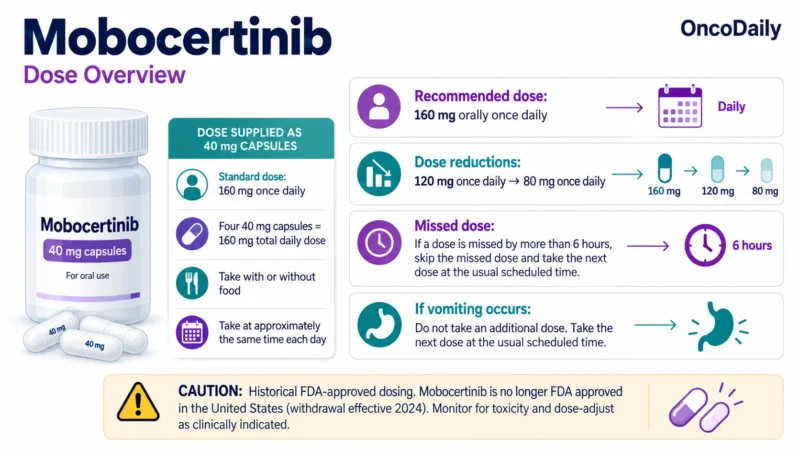
The historical recommended dose was:
160 mg orally once daily.
Treatment continued until:
- Disease progression
- Unacceptable toxicity
Mobocertinib could be administered:
With or without food.
Because the US indication has been withdrawn, this dose reflects the former FDA-approved regimen rather than a current US-approved treatment.
What If a Dose Is Missed?
If a dose was missed by more than:
6 hours
the patient was instructed to skip the missed dose and take the next dose at the regularly scheduled time.
If vomiting occurred after taking mobocertinib:
An additional dose should not be taken.
The next dose should be taken at the usual scheduled time.
How Are Mobocertinib Dose Reductions Made?
The historical dose-reduction sequence was:
160 mg → 120 mg → 80 mg once daily.
Dose interruption or reduction could be required for clinically significant toxicity, particularly:
- Severe diarrhea
- QTc prolongation
- Other cardiac toxicity
- Severe nonhematologic toxicity
- Significant gastrointestinal toxicity
Permanent discontinuation could be required for certain serious toxicities, including confirmed treatment-related ILD/pneumonitis or clinically significant cardiac events.
How Is Mobocertinib Administered?
Mobocertinib was supplied as:
40 mg oral capsules.
The standard 160 mg dose therefore consisted of:
Four 40 mg capsules once daily.
It could be taken:
With or without food.
Unlike intravenous anticancer therapy, mobocertinib required:
- No IV access
- No infusion preparation
- No in-line filter
- No infusion-related premedication
However, treatment required careful attention to:
- ECG monitoring
- Electrolytes
- Gastrointestinal toxicity
- Cardiac risk
- Drug interactions
What Are the Important Drug Interactions With Mobocertinib?
CYP3A Inhibitors
Mobocertinib is primarily metabolized through:
CYP3A.
Strong or moderate CYP3A inhibitors can increase mobocertinib exposure and potentially increase toxicity.
This is especially important because greater exposure can increase the risk of:
- QTc prolongation
- Cardiac arrhythmias
- Other adverse effects
Strong CYP3A inhibitors should generally be avoided.
CYP3A Inducers
Strong CYP3A inducers can substantially reduce mobocertinib exposure.
This may decrease antitumor activity.
Concomitant use of strong CYP3A inducers should therefore generally be avoided.
QT-Prolonging Drugs
Mobocertinib was associated with concentration-dependent QTc prolongation.
The largest mean QTc increase reported after 160 mg once daily was approximately:
23 milliseconds.
Other drugs that prolong the QT interval should therefore be avoided when possible.
Particular caution is required when QT-prolonging medications are combined with CYP3A inhibitors that may simultaneously increase mobocertinib concentrations.
Does Mobocertinib Require Renal or Hepatic Dose Adjustment?
Renal Impairment
For mild-to-moderate renal impairment, pharmacokinetic changes were not considered clinically meaningful.
The FDA subsequently updated the prescribing information with specific recommendations for patients with:
Severe renal impairment.
Because the indication is now withdrawn, these recommendations are primarily of historical prescribing relevance.
Hepatic Impairment
No clinically meaningful pharmacokinetic differences were identified in patients with mild or moderate hepatic impairment.
Data for severe hepatic impairment were more limited.
What Is the Pharmacokinetic Profile of Mobocertinib?
Absorption
After oral administration, mobocertinib reaches peak plasma concentration at a median of approximately:
4 hours
with a reported range of approximately:
1–8 hours.
Exposure was approximately dose proportional over the studied dose range.
Distribution
Mobocertinib is extensively distributed into tissues.
The apparent steady-state volume of distribution is approximately:
3,509 L.
Plasma protein binding is high.
Mobocertinib is approximately:
99.3% protein bound.
Its active metabolites are also highly protein bound.
Metabolism
Mobocertinib is primarily metabolized by:
CYP3A.
The two principal active metabolites are:
- AP32960
- AP32914
Both contribute to pharmacologic activity.
Half-Life
The mean terminal half-life of mobocertinib is approximately:
18 hours.
The active metabolite AP32960 has a somewhat longer half-life of approximately:
24 hours.
Elimination
Following radiolabeled administration, most drug-related material was recovered in:
Feces.
Only a small proportion was recovered in urine.
What Are the Clinical Uses of Mobocertinib?
EGFR Exon 20 Insertion–Positive NSCLC
The former FDA-approved indication was:
Treatment of adults with locally advanced or metastatic NSCLC harboring an EGFR exon 20 insertion mutation, detected by an FDA-approved test, whose disease had progressed on or after platinum-based chemotherapy.
This indication was granted under the:
Accelerated approval pathway.
Approval was based primarily on:
- Objective response rate
- Duration of response
rather than confirmed improvement in progression-free or overall survival.
Continued approval therefore depended on verification of clinical benefit in a confirmatory trial.
What Did Mobocertinib Clinical Trials Show?
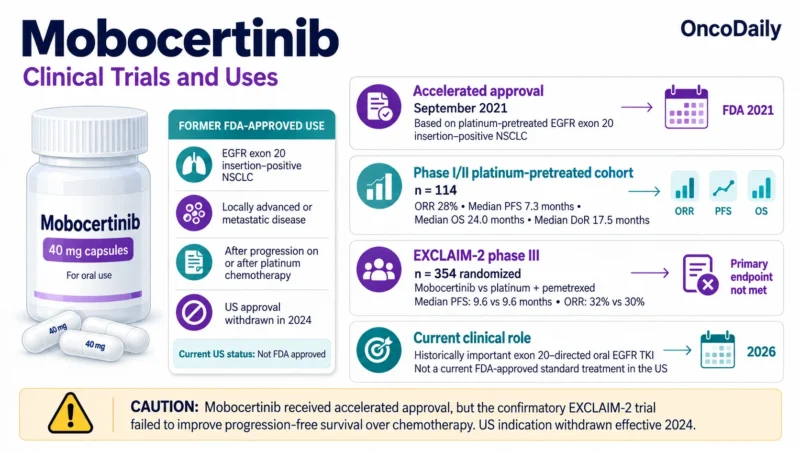
Phase I/II Study — Platinum-Pretreated Population
The pivotal early study evaluated mobocertinib in patients with EGFR exon 20 insertion-positive metastatic NSCLC.
The platinum-pretreated population included:
114 patients.
All patients had previously received platinum-based chemotherapy.
Objective Response Rate
Confirmed objective response rate by independent review committee was:
28%
95% CI:
20%–37%.
Investigator-assessed ORR was:
35%.
Disease Control Rate
Confirmed disease control rate by independent review was:
78%.
Median Duration of Response
Median duration of response was:
17.5 months
95% CI:
7.4–20.3 months.
Median Progression-Free Survival
Median PFS was:
7.3 months
95% CI:
5.5–9.2 months.
Median Overall Survival
Median overall survival was:
24.0 months
95% CI:
14.6–28.8 months.
These results demonstrated clinically meaningful activity in a population that historically had limited targeted treatment options.
What About Brain Metastases?
CNS disease represented an important limitation in mobocertinib development.
In the platinum-pretreated population:
35%
of patients had baseline brain metastases.
Although extracranial responses were observed, intracranial control appeared less robust than desired for a modern EGFR-targeted therapy.
The brain was a frequent site of subsequent progression in patients with baseline CNS disease.
This became clinically important because CNS control is a major treatment objective in EGFR-mutated NSCLC.
What Was EXCLAIM-2?
EXCLAIM-2 was the randomized phase III confirmatory trial designed to determine whether first-line mobocertinib could improve outcomes compared with standard chemotherapy.
A total of:
354 patients
with previously untreated EGFR exon 20 insertion-positive advanced or metastatic NSCLC were randomized.
Patients received:
- Mobocertinib 160 mg orally once daily
- Platinum-based chemotherapy plus pemetrexed
The groups included:
- Mobocertinib: 179 patients
- Chemotherapy: 175 patients
Progression-Free Survival
Median PFS by blinded independent central review was:
- Mobocertinib: 9.6 months
- Chemotherapy: 9.6 months
Hazard ratio:
1.04
95% CI:
0.77–1.39
P = 0.803.
The trial crossed the prespecified futility boundary.
Therefore:
Mobocertinib did not demonstrate superior progression-free survival compared with platinum-based chemotherapy.
Objective Response Rate
Confirmed ORR was:
- Mobocertinib: 32%
- Chemotherapy: 30%
Median Duration of Response
Median duration of response was:
- Mobocertinib: 12.0 months
- Chemotherapy: 8.4 months.
Although response duration was numerically longer with mobocertinib, the primary endpoint was not met.
Why Was Mobocertinib Withdrawn?
Mobocertinib received accelerated approval based on early response data.
Accelerated approval requires subsequent confirmation that the drug provides meaningful clinical benefit.
EXCLAIM-2 served as that confirmatory study.
Because median PFS was:
9.6 months in both treatment arms
and the hazard ratio was:
1.04,
the trial failed to establish superiority over chemotherapy.
The mobocertinib indication was therefore withdrawn.
The FDA records:
Initial approval: September 15, 2021
and:
Withdrawal: July 15, 2024.
Is Mobocertinib FDA Approved?
No.
Mobocertinib received accelerated FDA approval on:
September 15, 2021.
The indication was withdrawn effective:
July 15, 2024.
Therefore, as of 2026:
Mobocertinib is not an FDA-approved treatment in the United States.
This distinction is particularly important when discussing mobocertinib because older references may still describe Exkivity as an approved EGFR exon 20 insertion-directed therapy.
What Is the Current Clinical Role of Mobocertinib?
Mobocertinib does not have a routine FDA-approved role in US clinical practice in 2026.
Its importance today is primarily:
- Historical
- Scientific
- Regulatory
- Drug-development related
Mobocertinib demonstrated that oral targeted inhibition of EGFR exon 20 insertion mutations was feasible and could produce durable responses in a subset of previously treated patients.
However, the negative EXCLAIM-2 confirmatory trial showed that this activity did not translate into superior first-line progression-free survival compared with platinum-based chemotherapy.
Mobocertinib therefore remains highly relevant to the evolution of EGFR exon 20 insertion drug development, but it should not be presented as a current standard US treatment.
Read more about current treatment advances in EGFR exon 20 insertion–positive NSCLC in OncoDaily’s coverage of sunvozertinib and evolving exon 20–directed therapy.
Watch more: OncoDaily TV — The Future of EGFR-Mutant NSCLC: Antibody-Drug Conjugates & Combination Therapies, featuring Dr. Jordi Ramon discussing EGFR-mutant NSCLC, third-generation EGFR TKIs, resistance, and emerging combinations
What Are the Major Side Effects of Mobocertinib?
The toxicity profile of mobocertinib was dominated by:
- Gastrointestinal toxicity
- Dermatologic toxicity
- Cardiac electrophysiologic effects
The most common adverse effects included:
- Diarrhea
- Rash
- Stomatitis
- Vomiting
- Decreased appetite
- Paronychia
- Nausea
- Musculoskeletal pain
- Dry skin
- Fatigue
- Cough
- Pruritus
- Weight loss.
Diarrhea
Diarrhea was the most characteristic treatment-limiting toxicity.
It could lead to:
- Dehydration
- Electrolyte abnormalities
- Renal dysfunction
- Dose interruption
- Dose reduction
- Treatment discontinuation
In EXCLAIM-2, Grade ≥3 diarrhea occurred in:
20%
of patients receiving mobocertinib compared with:
1%
receiving chemotherapy.
Early antidiarrheal therapy and hydration were therefore important.
Rash and Dermatologic Toxicity
EGFR inhibition can produce characteristic cutaneous effects including:
- Acneiform rash
- Dry skin
- Pruritus
- Skin irritation
These effects reflect inhibition of EGFR signaling in normal epithelial tissues.
Paronychia
Inflammation around the nails was another typical EGFR-related adverse effect.
It may become:
- Painful
- Inflamed
- Secondarily infected
Stomatitis
Oral mucosal toxicity can include:
- Mouth soreness
- Ulceration
- Difficulty eating
- Reduced oral intake
QTc Prolongation and Torsades de Pointes
One of the most important safety concerns with mobocertinib was:
QTc prolongation.
Mobocertinib carried a boxed warning regarding:
QTc prolongation and torsades de pointes.
At the 160 mg once-daily dose, the largest mean QTc increase was approximately:
23 milliseconds.
Risk could increase with:
- Electrolyte abnormalities
- Concomitant QT-prolonging medications
- CYP3A inhibitors
- Higher systemic mobocertinib exposure
- Underlying cardiac risk factors
Cardiac Toxicity
In addition to QT prolongation, other cardiac adverse events were clinically important.
Patients required monitoring for:
- Palpitations
- Dizziness
- Syncope
- Dyspnea
- Signs of heart failure or other cardiac dysfunction
Careful medication review was also important because several interacting agents could further increase cardiac risk.
Interstitial Lung Disease/Pneumonitis
Interstitial lung disease and pneumonitis were uncommon but potentially serious adverse effects.
Patients developing:
- New or worsening dyspnea
- Cough
- Fever
- Hypoxia
- Pulmonary infiltrates
required prompt evaluation.
Suspected treatment-related ILD generally required treatment interruption, and confirmed clinically significant ILD could require permanent discontinuation.
Embryo-Fetal Toxicity
Based on its mechanism of action and preclinical findings, mobocertinib could cause fetal harm.
Patients of reproductive potential required counseling regarding effective contraception during treatment.
Breastfeeding was not recommended during therapy.
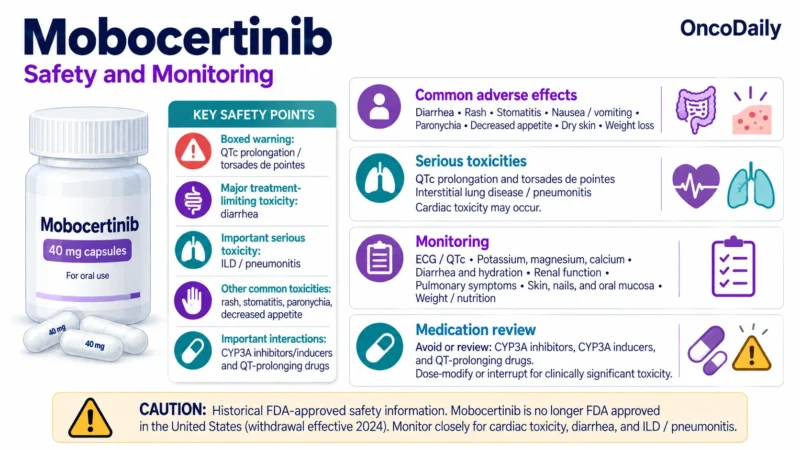
What Monitoring Is Required?
Monitoring during mobocertinib treatment historically included:
- Baseline and periodic ECG
- QTc interval
- Potassium
- Magnesium
- Calcium
- Diarrhea frequency and severity
- Hydration status
- Renal function
- Skin toxicity
- Nail changes
- Oral mucosal toxicity
- Weight and nutritional status
- Respiratory symptoms suggesting ILD/pneumonitis
- Cardiac symptoms
- Concomitant CYP3A inhibitors
- Concomitant CYP3A inducers
- Concomitant QT-prolonging medications
Particular attention to ECG, electrolytes, diarrhea, hydration, and interacting medications was essential because these factors could significantly affect treatment safety.