Sunvozertinib was just presented during ASCO 2026 by John Heymach, MD, PhD, in the primary analysis of the multinational phase 3 WU-KONG28 trial. The study compared sunvozertinib monotherapy with platinum-based chemotherapy as first-line treatment for patients with advanced non-small cell lung cancer harboring EGFR exon 20 insertion mutations. This is an important setting because EGFR exon20ins-positive NSCLC has historically had limited targeted options in the frontline setting, and platinum-based chemotherapy has remained a common standard of care.
In WU-KONG28, sunvozertinib significantly improved progression-free survival compared with chemotherapy, with a median PFS of 10.3 months versus 7.5 months and a hazard ratio of 0.65. The benefit was accompanied by a higher confirmed objective response rate, 58.9% versus 31.1%, and a longer median duration of response, 11.2 versus 7.1 months. Overall survival data were immature at the time of analysis, while the safety profile was described as manageable and consistent with previous reports.
Background
Patients with advanced NSCLC harboring EGFR exon 20 insertion mutations have historically had fewer effective targeted treatment options than patients with more common EGFR mutations, such as exon 19 deletions or L858R. Platinum-based chemotherapy has remained an important first-line standard, but outcomes are limited, and targeted therapies are increasingly being studied earlier in the disease course.
Sunvozertinib is an oral EGFR inhibitor developed for tumors with EGFR exon20ins.
Prior single-arm phase 2 studies, including WU-KONG1B and WU-KONG6, supported its activity after platinum-based chemotherapy. The WU-KONG28 trial was designed as a confirmatory, multinational, randomized phase 3 study to determine whether sunvozertinib could provide superior first-line disease control compared with chemotherapy.
Methods
Eligible patients with advanced NSCLC and EGFR exon20ins were randomized in a 1:1 ratio to receive either sunvozertinib 300 mg once daily or platinum-based chemotherapy with carboplatin and pemetrexed every 3 weeks for up to 6 cycles, followed by pemetrexed maintenance until disease progression or discontinuation.
Randomization was stratified by baseline brain metastasis status, reflecting the clinical importance of CNS involvement in this population. Patients assigned to chemotherapy were allowed to cross over to sunvozertinib after confirmed disease progression by blinded independent central review.
The primary endpoint was progression-free survival assessed by blinded independent central review according to RECIST 1.1. Secondary endpoints included overall survival, objective response rate, duration of response, and safety.
Results
A total of 324 patients were randomized, including 163 patients assigned to sunvozertinib and 161 assigned to chemotherapy. Baseline characteristics were generally balanced between the treatment arms.
Sunvozertinib significantly improved progression-free survival compared with chemotherapy. Median PFS was 10.3 months with sunvozertinib versus 7.5 months with chemotherapy, with a hazard ratio of 0.65 and a 95% confidence interval of 0.50 to 0.85. The result was statistically significant, with a p-value of 0.0008.
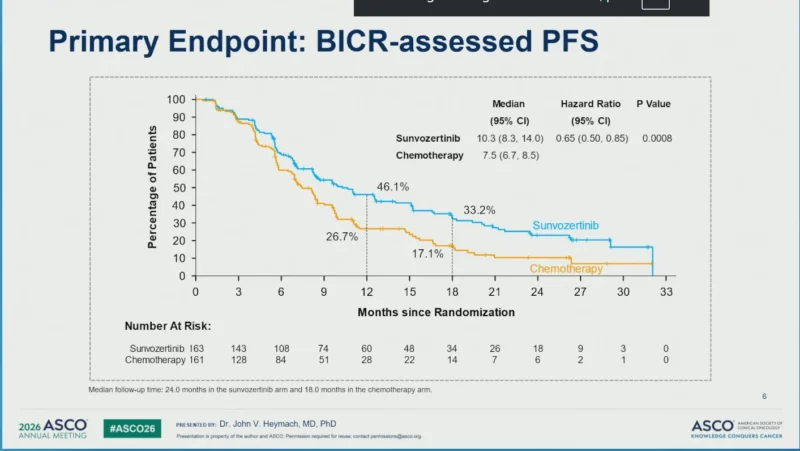
The PFS benefit was generally consistent across subgroups. In the chemotherapy arm, 90.2% of patients with BICR-confirmed disease progression crossed over to receive sunvozertinib, which is important when interpreting later overall survival results.
Objective response also favored sunvozertinib. The confirmed objective response rate was 58.9% with sunvozertinib compared with 31.1% with chemotherapy. Responses were also more durable with sunvozertinib, with a median duration of response of 11.2 months versus 7.1 months in the chemotherapy arm.At the time of the primary analysis, overall survival data remained immature.
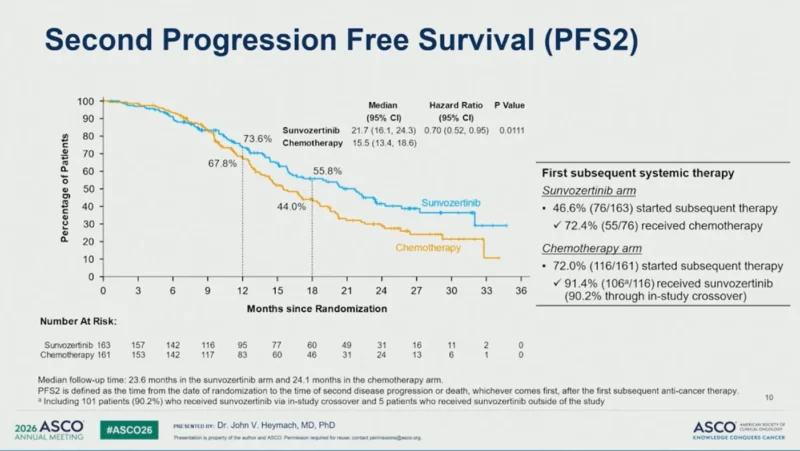
PFS2 also favored sunvozertinib, suggesting that earlier use of the oral EGFR inhibitor may provide longer disease control beyond first progression. Median PFS2 was 21.7 months with sunvozertinib compared with 15.5 months with chemotherapy, with a hazard ratio of 0.70, 95% CI 0.52–0.95, and a p-value of 0.0111.
At 12 months, the PFS2 rate was 73.6% with sunvozertinib versus 67.8% with chemotherapy, and at 18 months it was 55.8% versus 44.0%, respectively. Subsequent therapy patterns are important for interpretation: 46.6% of patients in the sunvozertinib arm started subsequent systemic therapy, most commonly chemotherapy, while 72.0% of patients in the chemotherapy arm received subsequent therapy, with 91.4% receiving sunvozertinib, including 90.2% through in-study crossover.
Safety
The safety profile of sunvozertinib was described as consistent with previous reports. Drug-related treatment-emergent adverse events leading to treatment discontinuation occurred in 7.4% of patients treated with sunvozertinib.
No drug-related treatment-emergent adverse event leading to a fatal outcome was reported. These findings suggest that the improved efficacy was achieved with a manageable safety profile, although longer follow-up remains important, especially for patients receiving targeted therapy in the first-line setting.
Key Takeaway
In the primary analysis of the phase 3 WU-KONG28 trial presented at ASCO 2026, sunvozertinib demonstrated superior antitumor efficacy compared with platinum-based chemotherapy as first-line treatment for advanced NSCLC with EGFR exon20ins, with a median PFS of 10.3 versus 7.5 months, a higher confirmed ORR of 58.9% versus 31.1%, and a manageable safety profile. The high crossover rate from chemotherapy to sunvozertinib may make overall survival more difficult to interpret, and the OS data remain immature. Longer follow-up will be important to understand survival, CNS outcomes, resistance patterns, and the long-term safety profile.