


Margetuximab (Margenza): Mechanism of Action, Dosing, Clinical Uses, Trials, and Side Effects
Key takeaways
- Margetuximab is an Fc-engineered HER2-directed monoclonal antibody.
- It targets the same HER2 extracellular epitope as trastuzumab.
- Its Fc modifications enhance activating immune-receptor binding and reduce inhibitory receptor engagement.
- It was FDA approved in December 2020.
- Its approved indication is previously treated HER2-positive metastatic breast cancer in combination with chemotherapy.
- Recommended dosing is 15 mg/kg IV every three weeks.
- SOPHIA demonstrated improved PFS: 5.8 versus 4.9 months.
- Final OS was 21.6 versus 21.9 months, with no statistically significant advantage.
- FCGR3A genotype findings remain exploratory.
- Major safety concerns include infusion reactions, cardiac dysfunction, cytopenias, and embryo-fetal toxicity.
- LVEF monitoring is required before and during treatment.
- In 2026, margetuximab is a later-line option rather than a preferred early-line HER2-directed treatment.
Margetuximab-cmkb (Margenza) is an Fc-engineered, HER2-directed monoclonal antibody developed to enhance immune-mediated destruction of HER2-positive tumor cells. Like trastuzumab, margetuximab binds the extracellular domain of HER2, but its modified Fc region increases interaction with activating immune receptors while reducing binding to inhibitory receptors.
Margetuximab received FDA approval in December 2020 in combination with chemotherapy for adults with metastatic HER2-positive breast cancer who have received at least two prior anti-HER2 regimens, including at least one for metastatic disease.
Its approval was based on the phase III SOPHIA trial, which demonstrated a modest progression-free survival advantage over trastuzumab combined with chemotherapy. However, the final overall survival analysis did not demonstrate a statistically significant survival benefit.
Margetuximab is administered intravenously at 15 mg/kg every three weeks, with cardiac monitoring and precautions for infusion-related reactions.
Key Facts
- Generic name: Margetuximab-cmkb
- Brand name: Margenza
- Drug class: HER2-directed monoclonal antibody
- Antibody type: Fc-engineered chimeric IgG1κ
- Molecular target: HER2/ERBB2
- Mechanism: HER2 signaling inhibition and enhanced antibody-dependent cellular cytotoxicity (ADCC)
- Initial FDA approval: December 2020
- Route: Intravenous infusion
- Recommended dose: 15 mg/kg every 3 weeks
- First infusion: 120 minutes
- Subsequent infusions: At least 30 minutes
- Available strength: 250 mg/10 mL (25 mg/mL)
- Approved indication: Previously treated HER2-positive metastatic breast cancer, in combination with chemotherapy
- Essential biomarker: HER2 overexpression or gene amplification
- Pivotal trial: SOPHIA
- Median PFS in SOPHIA: 5.8 versus 4.9 months
- Final median OS: 21.6 versus 21.9 months
- Major adverse reactions: Fatigue, nausea, diarrhea, vomiting, infusion reactions, and peripheral neuropathy
- Boxed warnings: Left ventricular dysfunction and embryo-fetal toxicity
- Important monitoring: LVEF, infusion reactions, CBC, and pregnancy status
- Elimination half-life: Approximately 19.2 days
- Metabolism: Proteolytic catabolism
What Is Margetuximab?
Margetuximab is a next-generation HER2-targeted antibody designed to improve upon the immune-effector functions of trastuzumab.
It recognizes the same HER2 extracellular epitope as trastuzumab but differs in its Fc region, the portion of an antibody responsible for interacting with immune effector cells.
The Fc region of margetuximab has been engineered to:
- Increase binding to activating FcγRIIIa (CD16A) receptors
- Decrease binding to inhibitory FcγRIIb (CD32B) receptors
- Enhance natural killer cell activation
- Increase antibody-dependent cellular cytotoxicity
These modifications were intended to improve immune-mediated tumor-cell killing, particularly in patients carrying lower-affinity CD16A receptor variants.
However, enhanced laboratory immune activity does not necessarily translate into improved overall survival, as demonstrated by the final SOPHIA results.
What Is the Mechanism of Action of Margetuximab?
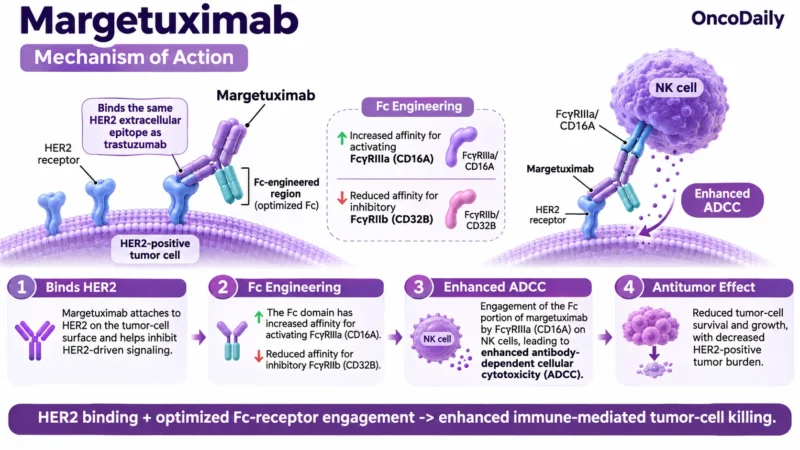
1. HER2 Overexpression Promotes Tumor Growth
HER2 is a receptor tyrosine kinase involved in cellular proliferation and survival.
HER2 amplification or overexpression increases signaling through pathways including:
- PI3K–AKT
- RAS–RAF–MEK–ERK
This contributes to uncontrolled tumor-cell proliferation.
2. Margetuximab Binds HER2
Margetuximab attaches to the extracellular domain of HER2.
This inhibits tumor-cell proliferation and reduces HER2 extracellular-domain shedding.
Its HER2-binding region is similar to trastuzumab.
3. Fc Engineering Enhances Immune Recognition
The modified Fc region increases affinity for:
FcγRIIIa (CD16A)
on immune effector cells.
It simultaneously decreases binding to:
FcγRIIb (CD32B)
an inhibitory immune receptor.
4. Antibody-Dependent Cellular Cytotoxicity Is Enhanced
Natural killer cells recognize antibody-coated HER2-positive tumor cells through activating Fc receptors.
This promotes:
Antibody-dependent cellular cytotoxicity (ADCC).
In vitro studies demonstrate enhanced NK-cell activation and ADCC compared with conventional trastuzumab.
5. Tumor-Cell Destruction Occurs
The combination of HER2-directed antiproliferative activity and Fc-mediated immune recruitment contributes to tumor-cell killing.
Overall mechanism:
Margetuximab → HER2 binding → enhanced activating Fc receptor engagement + reduced inhibitory Fc receptor binding → increased ADCC → reduced HER2-positive tumor-cell growth.
What Is the Recommended Dose of Margetuximab?
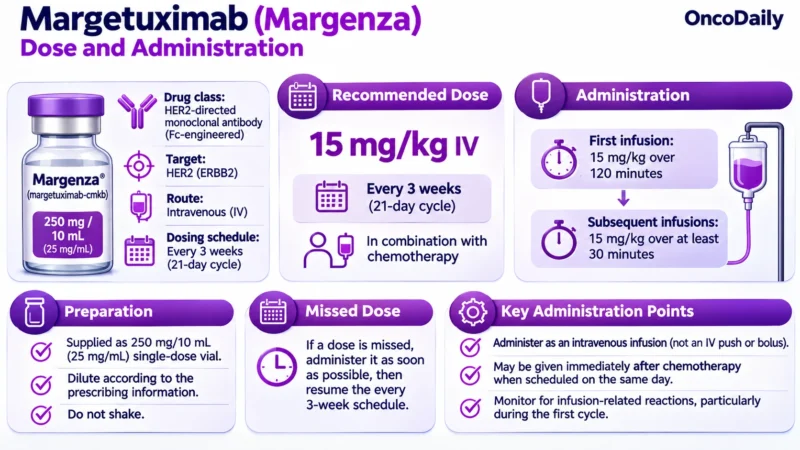
Metastatic HER2-Positive Breast Cancer
The FDA-recommended dose is:
15 mg/kg intravenously every three weeks.
Each cycle lasts:
21 days.
Treatment continues until:
- Disease progression
- Unacceptable toxicity
Margetuximab must be administered in combination with chemotherapy.
Chemotherapy Partners
In the SOPHIA trial, permitted chemotherapy agents included:
- Capecitabine
- Eribulin
- Gemcitabine
- Vinorelbine
The specific chemotherapy dose and schedule depend on the selected agent.
Margetuximab has no approved indication as routine single-agent therapy.
How Should Margetuximab Be Administered?
Intravenous Administration
Margetuximab is administered as a diluted intravenous infusion.
It must not be administered as an IV push or bolus.
First Infusion
15 mg/kg over 120 minutes.
Subsequent Infusions
15 mg/kg over at least 30 minutes every three weeks.
When chemotherapy and margetuximab are scheduled on the same day, margetuximab may be administered immediately after chemotherapy.
Premedication
Routine premedication is not universally mandated.
For patients who develop mild or moderate infusion reactions, consider:
- Antihistamines
- Corticosteroids
- Antipyretics
The infusion should be administered in a setting equipped to manage severe reactions.
Preparation
Margetuximab is supplied as:
250 mg/10 mL single-dose vials.
The solution must be diluted according to the prescribing information.
Do not shake the vial.
What Should You Do If a Margetuximab Dose Is Missed?
If a scheduled dose is missed:
Administer the missed dose as soon as possible.
Adjust the subsequent schedule to maintain:
Three-week intervals between doses.
A separate loading dose is not required after a missed infusion under the current prescribing instructions.
How Are Margetuximab Dose Modifications Managed?
Margetuximab does not have a routine stepwise dose-reduction schedule.
Management focuses on treatment interruption or discontinuation.
Left Ventricular Dysfunction
Withhold margetuximab for at least four weeks if:
- LVEF decreases by 16 percentage points or more from baseline; or
- LVEF falls below the institutional lower limit of normal, or below 50% if no institutional limit is available, with an absolute decrease of 10 percentage points or more from baseline.
Treatment may resume if, within eight weeks:
- LVEF returns to normal limits
- The absolute decrease from baseline is no more than 15 percentage points
Permanently discontinue if significant LVEF reduction persists for more than eight weeks or treatment has been interrupted more than three times because of LVEF decline.
Infusion-Related Reactions
For mild or moderate reactions:
- Reduce the infusion rate.
- Provide symptomatic treatment.
- Continue monitoring.
For dyspnea or clinically significant hypotension:
Interrupt the infusion.
For severe or life-threatening reactions:
Permanently discontinue margetuximab.
What Drug Interactions Are Important With Margetuximab?
Anthracyclines
The most important concern is additive cardiotoxicity.
The FDA label advises avoiding anthracycline-based treatment for up to:
Four months after discontinuing margetuximab.
If anthracycline treatment is unavoidable, cardiac function requires close monitoring.
Cytotoxic Chemotherapy
Combination chemotherapy may increase the risk of:
- Neutropenia
- Febrile neutropenia
- Nausea and diarrhea
- Peripheral neuropathy
- Fatigue
Toxicity management should follow the selected chemotherapy regimen.
CYP450 Interactions
Margetuximab is not primarily metabolized through CYP450 pathways.
Conventional CYP-mediated drug interactions are not expected to be clinically important.
Does Margetuximab Require Dose Adjustment in Renal or Hepatic Impairment?
Renal Impairment
No clinically significant pharmacokinetic differences have been observed in patients with mild or moderate renal impairment.
Routine dose adjustment is not established for these patients.
The effects of severe renal impairment and end-stage renal disease remain insufficiently characterized.
Hepatic Impairment
Mild hepatic impairment does not appear to substantially alter margetuximab exposure.
The effects of moderate or severe hepatic impairment remain unknown.
No established hepatic dose-reduction algorithm is available.
What Is the Pharmacokinetic Profile of Margetuximab?
Half-Life
The terminal elimination half-life is approximately:
19.2 days.
Distribution
The estimated steady-state volume of distribution is:
5.47 L.
Clearance
The estimated clearance is approximately:
0.22 L/day.
Metabolism
Margetuximab undergoes proteolytic catabolism into smaller peptides and amino acids.
Steady State
Steady-state concentrations are reached after approximately:
Two months.
Persistence After Treatment
Four months after discontinuation, circulating concentrations decline to approximately 3% of the steady-state trough concentration.
What Are the Clinical Uses of Margetuximab?
Previously Treated HER2-Positive Metastatic Breast Cancer
Margetuximab is FDA approved with chemotherapy for adults with metastatic HER2-positive breast cancer who have received:
- At least two previous anti-HER2 regimens
- At least one anti-HER2 regimen in the metastatic setting
Its approval was based on a randomized comparison with trastuzumab in patients with previously treated metastatic disease.
Biomarker-Selected Treatment
Treatment requires confirmed HER2-positive disease.
Patients with HER2-low tumors without HER2 amplification are not eligible under the approved indication solely because of HER2-low expression.
Other Investigational Uses
Margetuximab has also been investigated in combinations for other HER2-positive malignancies, including gastroesophageal cancer.
However, these settings are not part of its FDA-approved indication.
What Molecular Testing Is Required Before Margetuximab?
HER2 Testing
HER2 positivity should be established using validated testing methods.
These include:
- Immunohistochemistry (IHC)
- In situ hybridization (ISH)
HER2-positive breast cancer generally requires:
IHC 3+ or HER2 amplification by ISH, according to the applicable testing algorithm.
FcγR Genotyping
Margetuximab was designed to enhance activity through activating Fc receptors.
Exploratory SOPHIA analyses assessed:
FCGR3A/CD16A genetic variants.
However, routine CD16A genotyping is not required for FDA-approved use.
The exploratory findings do not establish a validated genotype-based treatment-selection strategy.
Cardiac Assessment
Obtain baseline LVEF before initiating treatment.
Additional assessment includes previous anthracycline exposure and cardiovascular risk factors.
What Did the Pivotal Clinical Trials Show?
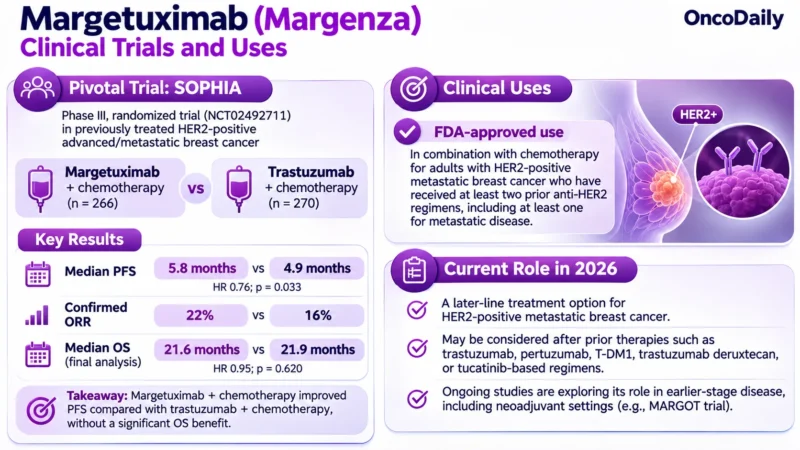
SOPHIA — Margetuximab Versus Trastuzumab in Metastatic Breast Cancer
The randomized phase III SOPHIA trial (NCT02492711) compared:
- Margetuximab + physician’s choice of chemotherapy
- Trastuzumab + physician’s choice of chemotherapy
The study randomized:
536 patients
with previously treated HER2-positive advanced or metastatic breast cancer.
Median Progression-Free Survival
By blinded independent central review:
- Margetuximab: 5.8 months
- Trastuzumab: 4.9 months
HR: 0.76
p = 0.033
Margetuximab demonstrated a statistically significant but modest improvement in progression-free survival.
Confirmed Objective Response Rate
- Margetuximab: 22%
- Trastuzumab: 16%
These figures represent centrally assessed confirmed responses.
Median Duration of Response
- Margetuximab: 6.1 months
- Trastuzumab: 6.0 months
Final Median Overall Survival
- Margetuximab: 21.6 months
- Trastuzumab: 21.9 months
HR: 0.95
p = 0.620
The final overall survival analysis did not demonstrate a statistically significant benefit for margetuximab.
This distinction is essential when interpreting SOPHIA: the trial showed a PFS advantage, but not an overall survival advantage.
Exploratory CD16A Subgroup Analysis
Among patients with the lower-affinity CD16A-158FF genotype:
- Margetuximab median OS: 23.6 months
- Trastuzumab median OS: 19.2 months
HR: 0.72
This result was exploratory and not adjusted for formal confirmatory hypothesis testing. It should not be interpreted as definitive evidence of genotype-specific survival benefit.
Does Margetuximab Have CNS Activity?
Margetuximab is a large monoclonal antibody with limited expected penetration across an intact blood–brain barrier.
It does not have established standalone intracranial efficacy.
Patients with brain metastases were included in SOPHIA, but the trial did not establish a dedicated CNS efficacy benefit.
For HER2-positive metastatic breast cancer with brain metastases, treatments with stronger CNS evidence may include:
- Tucatinib-containing regimens
- Trastuzumab deruxtecan
- Appropriate local CNS-directed treatment
Margetuximab should not be considered a preferred CNS-directed therapy.
Is Margetuximab FDA Approved?
Yes.
Margetuximab received FDA approval on:
December 16, 2020.
Its approved indication is:
In combination with chemotherapy for adults with metastatic HER2-positive breast cancer who have received at least two prior anti-HER2 regimens, including at least one for metastatic disease.
It is not FDA approved for:
- Early-stage breast cancer
- Neoadjuvant treatment
- Adjuvant treatment
- Gastric or gastroesophageal cancer
- HER2-low breast cancer without HER2-positive eligibility
What Is the Current Clinical Role of Margetuximab in 2026?
Margetuximab remains a later-line treatment option for selected patients with HER2-positive metastatic breast cancer.
However, its relative position has become more limited because of the availability of newer HER2-directed strategies.
These include:
- Trastuzumab deruxtecan
- Tucatinib + trastuzumab + capecitabine
- Trastuzumab emtansine in selected circumstances
- Other HER2-directed treatment combinations
The FDA approval of trastuzumab deruxtecan plus pertuzumab for first-line metastatic disease in December 2025 further changed the overall treatment sequence.
Margetuximab may be considered when patients have already received several HER2-directed therapies and an additional antibody-plus-chemotherapy option is appropriate.
The modest PFS improvement and absence of an overall survival advantage in SOPHIA should inform treatment decisions.
Read More: The MARGOT Study: Optimizing Preoperative Therapy for HER2-Positive Breast Cancer by OncoDaily.
Watch More: Margetuximab for the Treatment of HER2+ Breast Cancer.
What Are the Major Side Effects of Margetuximab?
Fatigue
Fatigue or asthenia occurred in approximately:
57% of patients
receiving margetuximab plus chemotherapy in SOPHIA.
Grade 3–4 fatigue/asthenia occurred in approximately 7%.
Gastrointestinal Toxicity
Common reactions included:
- Nausea: 33%
- Diarrhea: 25%
- Vomiting: 21%
- Constipation: 19%
These adverse effects may also reflect the accompanying chemotherapy.
Infusion-Related Reactions
Infusion reactions occurred in approximately:
13% of patients.
Grade 3 infusion-related reactions occurred in approximately:
1.5%.
Symptoms can include:
- Fever and chills
- Hypotension
- Dyspnea
- Rash
- Headache
- Tachycardia
Most reactions occurred during the first cycle.
Left Ventricular Dysfunction
Left ventricular dysfunction is an important serious toxicity and carries an FDA boxed warning.
In the SOPHIA safety population, left ventricular dysfunction was reported in approximately:
1.9% of margetuximab-treated patients.
Patients may develop reduced LVEF or symptomatic heart failure.
Neutropenia
Neutropenia may occur with combination chemotherapy.
In SOPHIA:
- Decreased neutrophils: 34%
- Grade 3–4 decreased neutrophils: 9%
Febrile neutropenia is an important serious complication.
Other Adverse Reactions
Reported adverse reactions included:
- Headache
- Alopecia
- Peripheral neuropathy
- Arthralgia/myalgia
- Cough
- Dyspnea
- Decreased appetite
- Palmar-plantar erythrodysesthesia
Embryo-Fetal Toxicity
Margetuximab can cause fetal harm.
Potential complications associated with HER2-directed antibody exposure include oligohydramnios and fetal renal developmental abnormalities.
This risk is included in the FDA boxed warning.
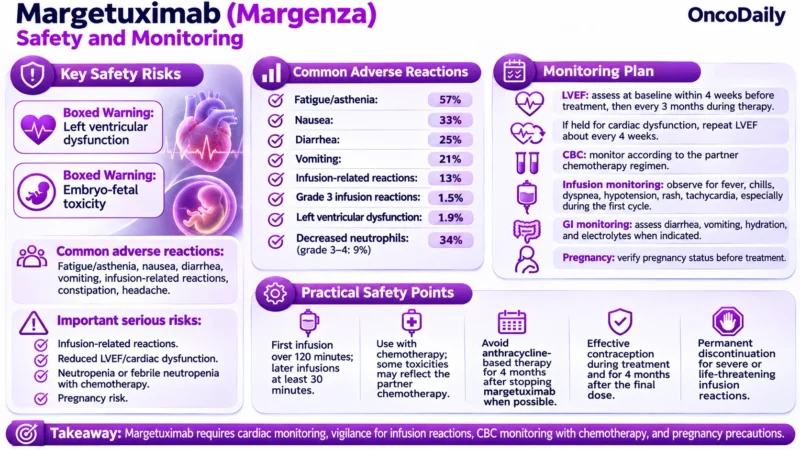
What Monitoring Is Required During Margetuximab Treatment?
Cardiac Monitoring
Assess LVEF by echocardiography or MUGA scan.
Recommended monitoring includes:
- Baseline: Within four weeks before treatment
- During treatment: Every three months
- At treatment completion: Repeat assessment
- If treatment is withheld for cardiac dysfunction: Repeat LVEF approximately every four weeks
Infusion Monitoring
Monitor for:
- Fever and chills
- Hypotension
- Dyspnea
- Hypersensitivity
- Tachycardia
Emergency treatment must be available.
Complete Blood Count
Monitor:
- Neutrophils
- Hemoglobin
- Platelets
Frequency should follow the accompanying chemotherapy regimen.
Gastrointestinal Monitoring
Assess diarrhea, vomiting, hydration, and electrolyte abnormalities when clinically indicated.
Pregnancy Monitoring
Verify pregnancy status before treatment in females of reproductive potential.
Effective contraception is recommended during therapy and for:
Four months after the final dose.
Additional Monitoring
Assess kidney and liver function according to the patient’s clinical condition and chemotherapy regimen.
Monitor for fatigue, infection, peripheral neuropathy, and other treatment-related toxicity.