





Lorlatinib(Lorbrena): Understanding Its Mechanism, Dosing, Clinical Uses, and Role in ALK-Positive Lung Cancer
Key takeaways
- Lorlatinib is a third-generation ALK/ROS1 inhibitor with strong CNS penetration.
- The standard dose is 100 mg orally once daily.
- Dose reductions follow the sequence 100 mg → 75 mg → 50 mg once daily.
- Lorlatinib may be taken with or without food.
- Strong CYP3A inducers are contraindicated because of the risk of serious hepatotoxicity.
- CROWN demonstrated a 5-year PFS rate of 60% with lorlatinib versus 8% with crizotinib.
- Median PFS remained not reached after 5 years with lorlatinib.
- Lorlatinib dramatically reduces intracranial progression, with an intracranial progression HR of approximately 0.06 versus crizotinib.
- Characteristic toxicities include hyperlipidemia, CNS effects, peripheral neuropathy, edema, hypertension, hyperglycemia, and AV block.
- In 2026, lorlatinib remains a strongly recommended first-line option for metastatic ALK-positive NSCLC.
Lorlatinib (Lorbrena) is an oral, third-generation anaplastic lymphoma kinase (ALK) and ROS1 tyrosine kinase inhibitor designed to overcome resistance mechanisms seen with earlier ALK inhibitors and to achieve strong penetration into the central nervous system (CNS). It is FDA approved for ALK-positive metastatic non-small cell lung cancer (NSCLC) and is used both in the first-line setting and after progression on earlier ALK-directed therapies.
Lorlatinib has become one of the most potent first-line ALK inhibitors available. In the phase III CROWN trial, its progression-free survival benefit over crizotinib remained striking after 5 years of follow-up, with median PFS still not reached and a 5-year PFS rate of 60% versus 8% with crizotinib. Its ability to prevent and control intracranial progression is a major clinical advantage, although treatment requires careful monitoring for characteristic toxicities including hyperlipidemia, CNS effects, edema, neuropathy, hypertension, hyperglycemia, and cardiac conduction abnormalities.
Key Facts
- Generic name: Lorlatinib
- Brand name: Lorbrena
- Drug class: Third-generation ALK/ROS1 tyrosine kinase inhibitor
- Route: Oral
- Initial US approval: 2018
- First-line ALK-positive NSCLC approval: March 3, 2021
- FDA-approved indication: ALK-positive metastatic NSCLC in adults
- Standard dose: 100 mg orally once daily
- Dose reductions: 75 mg → 50 mg once daily
- Administration: With or without food
- Available strengths: 25 mg and 100 mg tablets
- Major targets: ALK and ROS1
- Major toxicities: Hypercholesterolemia, hypertriglyceridemia, edema, peripheral neuropathy, cognitive effects, mood effects, fatigue, weight gain, arthralgia, diarrhea, and hypertension
- Important serious toxicities: CNS effects, AV block, ILD/pneumonitis, severe hyperlipidemia, hypertension, hyperglycemia, and serious hepatotoxicity with strong CYP3A inducers
- Important interaction: Strong CYP3A inducers are contraindicated
- Half-life: Approximately 24 hours
- Current US status: FDA approved.
What Is Lorlatinib?
Lorlatinib is a highly potent, brain-penetrant small-molecule tyrosine kinase inhibitor targeting:
- ALK
- ROS1
It was specifically designed to address several limitations of earlier ALK inhibitors, including:
- Acquired ALK resistance mutations
- Poor or incomplete CNS penetration
- Intracranial disease progression
ALK rearrangements, most commonly:
EML4–ALK
produce constitutively active fusion proteins that continuously stimulate signaling pathways involved in tumor-cell proliferation and survival.
Lorlatinib retains activity against multiple ALK resistance mutations that can emerge after earlier-generation ALK inhibitors, including some compound resistance patterns.
Its ability to cross the blood-brain barrier is central to its clinical value in ALK-positive NSCLC.
What Is the Mechanism of Action of Lorlatinib?
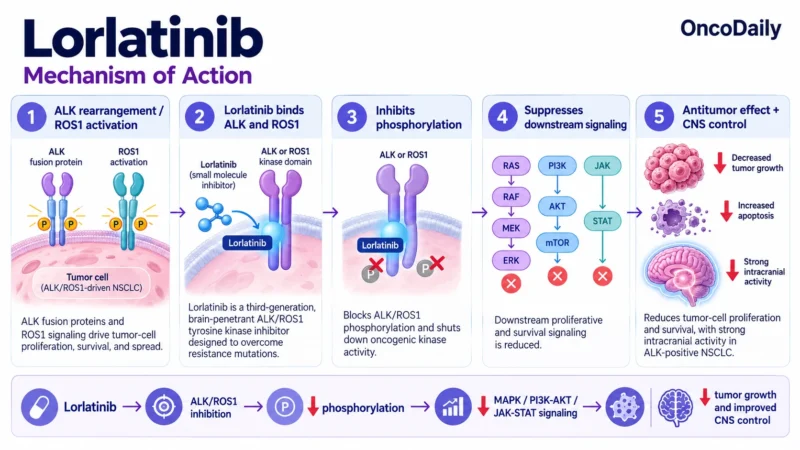
1. ALK Rearrangements Drive Persistent Oncogenic Signaling
ALK fusion proteins create constitutively active kinase signaling.
This stimulates downstream pathways that promote:
- Tumor-cell proliferation
- Survival
- Growth
- Migration
- Invasion
2. Lorlatinib Inhibits ALK and ROS1
Lorlatinib is an:
ATP-competitive tyrosine kinase inhibitor.
It binds to and inhibits the kinase activity of:
ALK
and:
ROS1.
Its structure was specifically optimized to retain activity against several resistance-associated ALK mutations and penetrate the CNS.
3. ALK Phosphorylation Is Suppressed
Lorlatinib decreases ALK autophosphorylation and blocks activation of ALK-dependent signaling.
4. Downstream Signaling Is Reduced
Inhibition of ALK suppresses pathways including:
RAS–RAF–MEK–ERK
PI3K–AKT–mTOR
and:
JAK–STAT.
5. Tumor-Cell Growth and Survival Decline
This leads to:
- Reduced tumor-cell proliferation
- Reduced survival
- Increased apoptosis
- Tumor regression
- Strong intracranial disease control
The mechanism can therefore be summarized as:
Lorlatinib → ALK/ROS1 inhibition → reduced receptor phosphorylation → suppression of MAPK, PI3K/AKT, and JAK/STAT signaling → decreased tumor-cell proliferation and survival.
What Is the Dose of Lorlatinib?
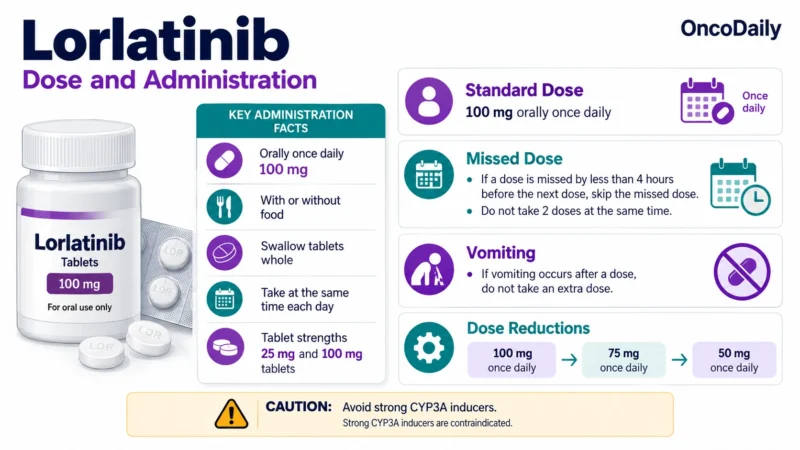
The recommended dose is:
100 mg orally once daily.
Treatment continues until:
- Disease progression
- Unacceptable toxicity
Lorlatinib may be taken:
With or without food.
What If a Dose Is Missed?
If a dose is missed:
The patient should take it when remembered unless the next dose is due within approximately:
4 hours.
If less than 4 hours remain before the next scheduled dose:
Skip the missed dose.
Do not take two doses at the same time.
If vomiting occurs after taking lorlatinib:
Do not take an additional replacement dose.
Continue with the next scheduled dose.
How Are Lorlatinib Dose Reductions Made?
The standard dose is:
100 mg once daily.
The first dose reduction is:
75 mg once daily.
The second dose reduction is:
50 mg once daily.
If the patient is unable to tolerate:
50 mg once daily
lorlatinib should generally be permanently discontinued.
Dose interruption or reduction may be required for:
- CNS toxicity
- Severe hyperlipidemia
- AV block
- Hypertension
- Hyperglycemia
- Other clinically significant toxicities
Treatment-related ILD/pneumonitis generally requires permanent discontinuation.
How Is Lorlatinib Administered?
Lorlatinib is supplied as immediate-release film-coated tablets containing:
- 25 mg
- 100 mg
The usual adult dose is:
One 100 mg tablet once daily.
Lorlatinib may be taken:
With or without food.
The tablets should be swallowed whole.
Treatment is continued until:
- Disease progression
- Unacceptable toxicity.
What Are the Important Drug Interactions With Lorlatinib?
Strong CYP3A Inducers
This is one of the most important prescribing issues with lorlatinib.
Strong CYP3A inducers are:
Contraindicated.
Combining lorlatinib with rifampin caused severe hepatotoxicity in healthy volunteers.
Among 12 subjects receiving lorlatinib with rifampin:
- Grade 3–4 ALT or AST elevations occurred in 83%
- Grade 2 elevations occurred in 8%.
Strong CYP3A inducers should be discontinued for:
3 plasma half-lives
before beginning lorlatinib.
Moderate CYP3A Inducers
Moderate CYP3A inducers should generally be:
Avoided.
If unavoidable, the current prescribing information allows increasing lorlatinib to:
125 mg once daily.
Strong CYP3A Inhibitors
Strong CYP3A inhibitors can increase lorlatinib exposure.
They should generally be avoided.
If unavoidable, reduce the dose from:
100 mg → 75 mg once daily.
If the patient is already receiving 75 mg because of toxicity:
75 mg → 50 mg once daily.
Effect of Lorlatinib on Other Drugs
Lorlatinib can induce:
- CYP3A
- P-glycoprotein
It may therefore reduce concentrations of certain sensitive substrates.
Drugs for which even a small decrease in concentration could result in serious therapeutic failure should generally be avoided.
Does Lorlatinib Require Renal or Hepatic Dose Adjustment?
Renal Impairment
No routine dose adjustment is required for mild-to-moderate renal impairment.
For severe renal impairment, the recommended dose is:
75 mg orally once daily.
Hepatic Impairment
No clinically meaningful pharmacokinetic differences have been demonstrated in mild or moderate hepatic impairment.
For severe hepatic impairment, the current prescribing information recommends:
50 mg orally once daily.
What Is the Pharmacokinetic Profile of Lorlatinib?
Absorption
Lorlatinib is orally administered and reaches clinically meaningful systemic exposure following once-daily dosing.
It can be given:
With or without food.
Distribution
Lorlatinib is approximately:
66% protein bound.
Its blood-to-plasma ratio is approximately:
0.99.
A key pharmacologic characteristic is:
High CNS penetration.
This contributes to its strong activity against both established and emerging brain metastases.
Metabolism
Lorlatinib is primarily metabolized by:
- CYP3A4
- UGT1A4
with smaller contributions from:
- CYP2C8
- CYP2C19
- CYP3A5
- UGT1A3
Its major circulating metabolite:
M8
is pharmacologically inactive.
Half-Life
The mean plasma elimination half-life after a single 100 mg dose is approximately:
24 hours.
Elimination
Following radiolabeled administration:
- 48% of radioactivity was recovered in urine
- 41% was recovered in feces
Less than 1% of the dose was excreted unchanged in urine.
What Are the Clinical Uses of Lorlatinib?
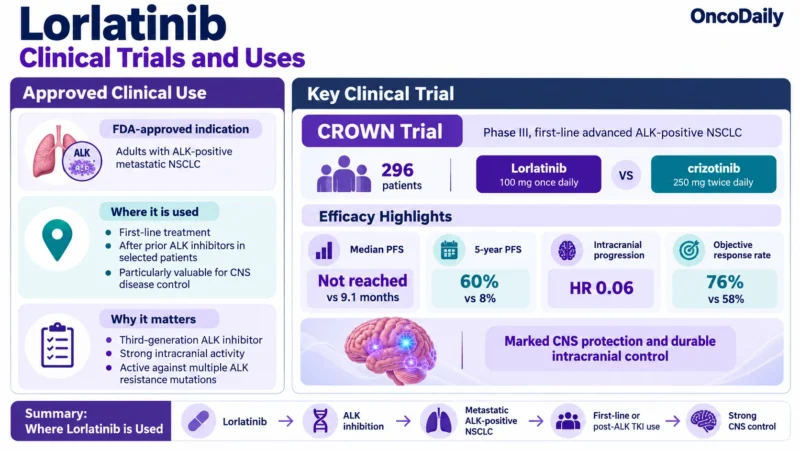
ALK-Positive Metastatic NSCLC
Lorlatinib is FDA approved for:
Adults with metastatic NSCLC whose tumors are ALK-positive, detected by an FDA-approved test.
It may be used:
- As first-line therapy
- After crizotinib
- After other ALK inhibitors such as alectinib or brigatinib, depending on clinical context and resistance patterns
Lorlatinib’s ability to control CNS disease is particularly relevant in patients with:
- Existing brain metastases
- High risk of future intracranial progression
What Did Lorlatinib Clinical Trials Show?
CROWN — Lorlatinib Versus Crizotinib
The pivotal phase III CROWN study enrolled:
296 patients
with previously untreated advanced ALK-positive NSCLC.
Patients were randomized to:
Lorlatinib 100 mg once daily: 149 patients
Crizotinib 250 mg twice daily: 147 patients.
Progression-Free Survival
At approximately 5 years of follow-up:
Median PFS was:
- Lorlatinib: Not reached
- Crizotinib: 9.1 months
Hazard ratio:
0.19
95% CI:
0.13–0.27.
This corresponds to an approximately:
81% reduction in the risk of progression or death.
Five-Year PFS
At 5 years:
- Lorlatinib: 60%
- Crizotinib: 8%.
This represents one of the longest sustained progression-free survival outcomes reported with first-line targeted therapy in metastatic ALK-positive NSCLC.
What About Brain Metastases?
Intracranial efficacy is one of the major strengths of lorlatinib.
In the 5-year CROWN analysis:
Median time to intracranial progression was:
- Lorlatinib: Not reached
- Crizotinib: 16.4 months
Hazard ratio:
0.06
95% CI:
0.03–0.12.
This represents an approximately:
94% reduction in the risk of intracranial progression.
Among patients with brain metastases at baseline:
Median PFS was:
- Lorlatinib: Not reached
- Crizotinib: 6.0 months
Hazard ratio:
0.08.
Five-year PFS with lorlatinib in this subgroup was approximately:
53%.
Among patients without baseline brain metastases, CNS progression was also substantially reduced, demonstrating an important CNS-protective effect.
What About Objective Response?
Lorlatinib produced high systemic response rates in CROWN.
The original CROWN analysis demonstrated an objective response rate of approximately:
76%
with lorlatinib compared with:
58%
with crizotinib.
Among patients with measurable brain metastases, intracranial response rates were particularly high, further supporting its strong CNS penetration.
What About Resistance Mutations?
One of the major reasons lorlatinib was developed was to overcome resistance to earlier ALK inhibitors.
Lorlatinib retains activity against numerous ALK resistance mutations arising after:
- Crizotinib
- Ceritinib
- Alectinib
- Brigatinib
However, complex:
Compound ALK mutations
can eventually produce resistance even to lorlatinib.
This makes repeat molecular profiling increasingly relevant after disease progression on sequential ALK inhibitors.
Is Lorlatinib FDA Approved?
Yes.
Lorlatinib received its initial FDA approval in:
2018
for previously treated ALK-positive metastatic NSCLC.
Its indication was expanded on:
March 3, 2021
to include first-line treatment of ALK-positive metastatic NSCLC.
Lorlatinib remains FDA approved in 2026.
What Is the Current Clinical Role of Lorlatinib?
Lorlatinib is one of the major first-line standards for metastatic ALK-positive NSCLC.
Current 2026 ASCO guidance recommends:
- Alectinib
- Brigatinib
- Lorlatinib
as first-line therapy for metastatic ALK-positive disease.
For a broader look at current ALK-targeted treatment recommendations, see OncoDaily’s 7 Powerful Advances in the ASCO 2026 Guideline for Driver-Positive Stage IV NSCLC.
Lorlatinib may also be used after progression on:
- Crizotinib
- Alectinib
- Brigatinib
particularly when resistance patterns or CNS progression make lorlatinib attractive.
Its main strengths include:
- Very prolonged PFS
- Excellent intracranial efficacy
- Strong CNS prevention
- Activity against multiple ALK resistance mutations
- Once-daily administration
Its main tradeoff is a distinctive toxicity profile, particularly:
- Hyperlipidemia
- CNS effects
- Peripheral neuropathy
- Edema
- Weight gain
- Hypertension
- Hyperglycemia
These toxicities require active monitoring and management.
Watch more: Explore OncoDaily’s discussion on targeted therapies in lung cancer and the evolving treatment landscape for oncogene-driven NSCLC.
What Are the Major Side Effects of Lorlatinib?
Common adverse effects include:
- Edema
- Peripheral neuropathy
- Weight gain
- Cognitive effects
- Mood effects
- Hypercholesterolemia
- Hypertriglyceridemia
- Fatigue
- Arthralgia
- Diarrhea
- Hypertension
- Visual disturbances.
Hyperlipidemia
Hyperlipidemia is one of the most characteristic toxicities of lorlatinib.
Grade 3–4 elevations occurred in:
- Total cholesterol: 18%
- Triglycerides: 19%.
Median time to onset was approximately:
15 days.
Approximately:
83%
of patients required initiation of lipid-lowering therapy.
Lipid monitoring should therefore begin early.
Central Nervous System Effects
Lorlatinib has a distinctive spectrum of CNS adverse effects.
These may include:
- Cognitive changes
- Mood changes
- Speech disturbance
- Psychotic effects
- Seizures
- Mental-status changes
- Sleep disturbance
Overall CNS effects occurred in approximately:
52%
of patients receiving 100 mg once daily in pooled clinical studies.
Cognitive Effects
Occurred in approximately:
28%.
Mood Effects
Occurred in approximately:
21%.
Speech Effects
Occurred in approximately:
11%.
Psychotic Effects
Occurred in approximately:
7%.
Patients should be monitored carefully for behavioral, cognitive, or neurologic changes.
Peripheral Neuropathy
Peripheral neuropathy is common.
Symptoms may include:
- Numbness
- Tingling
- Paresthesia
- Burning sensation
- Sensory changes
- Weakness
Peripheral neuropathy occurred in approximately:
47%
of patients in one pooled analysis.
Dose interruption or reduction may be required for persistent or severe symptoms.
Edema
Edema is another characteristic toxicity.
It may involve:
- Lower extremities
- Face
- Eyelids
- Generalized swelling
In pooled data, edema occurred in approximately:
57%
of patients.
Atrioventricular Block
Lorlatinib can prolong the PR interval and cause:
AV block.
Among patients with baseline ECG monitoring:
1.9%
experienced AV block.
Approximately:
0.2%
experienced Grade 3 AV block and required pacemaker placement.
ECG monitoring is particularly important in patients with:
- Pre-existing conduction disease
- Bradycardia
- Concomitant AV-node blocking medications
Interstitial Lung Disease/Pneumonitis
ILD/pneumonitis occurred in approximately:
1.9%
of patients.
Grade 3–4 events occurred in approximately:
0.6%.
Patients developing:
- New or worsening dyspnea
- Cough
- Fever
- Hypoxia
- Pulmonary infiltrates
require immediate evaluation.
For any treatment-related ILD/pneumonitis:
Lorlatinib should be permanently discontinued.
Hypertension
Hypertension occurred in approximately:
13%
of patients.
Grade 3–4 hypertension occurred in approximately:
6%.
Blood pressure should be:
- Checked before treatment
- Monitored during treatment
Antihypertensive therapy should be initiated or adjusted when necessary.
Hyperglycemia
Hyperglycemia occurred in approximately:
9%
of patients.
Grade 3–4 hyperglycemia occurred in approximately:
3.2%.
Glucose should therefore be measured:
- Before treatment
- Periodically during therapy
Patients with diabetes may require adjustment of antihyperglycemic medications.
Embryo-Fetal Toxicity
Lorlatinib can cause fetal harm.
Patients of reproductive potential should use effective contraception during treatment.
Because lorlatinib may reduce concentrations of hormonal contraceptives through enzyme induction, a:
Nonhormonal contraceptive method
may be needed.
Breastfeeding is not recommended during treatment.
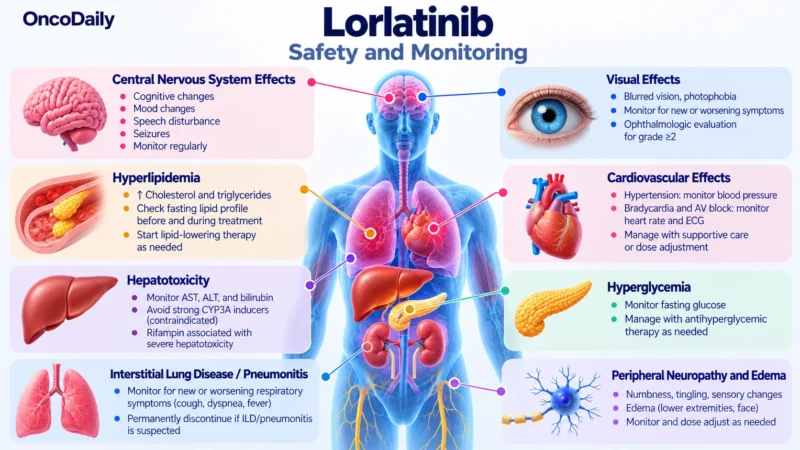
What Monitoring Is Required?
Monitoring during lorlatinib therapy should include:
- Fasting cholesterol
- Triglycerides
- Cognitive function
- Mood and psychiatric symptoms
- Speech changes
- Sleep changes
- Peripheral neuropathy
- Weight
- Edema
- Blood pressure
- Fasting glucose
- ECG and PR interval when clinically indicated
- Respiratory symptoms for ILD/pneumonitis
- Concomitant CYP3A inducers
- Concomitant CYP3A inhibitors
- CYP3A and P-gp substrate interactions
Lipid levels should be checked:
- Before treatment
- Shortly after treatment begins
- Periodically thereafter
because clinically significant hyperlipidemia commonly develops early.
FAQ
What Is Lorlatinib Used For?
How Does Lorlatinib Work?
What Is the Standard Lorlatinib Dose?
Can Lorlatinib Be Taken With Food?
Lorlatinib may be taken: With or without food.
What Are the Dose Reductions?
Does Lorlatinib Work in Brain Metastases?
What Did the CROWN Trial Show?
- 60% with lorlatinib
- 8% with crizotinib
and median PFS remained unreached with lorlatinib.