


Lenvatinib (Lenvima): Understanding Its Mechanism, Dosing, Clinical Uses, and Role in Thyroid Cancer, RCC, HCC, and Endometrial Cancer
Key takeaways
- Lenvatinib is an oral multikinase inhibitor targeting VEGFR-1/2/3, FGFR-1–4, PDGFR-α, RET, and KIT.
- Dosing varies by disease: 24 mg in DTC; 8/12 mg weight-based in HCC; 20 mg with pembrolizumab or belzutifan; 18 mg with everolimus.
- SELECT demonstrated PFS 18.3 vs 3.6 months in RAI-refractory DTC.
- REFLECT established lenvatinib as noninferior to sorafenib for OS in unresectable HCC: 13.6 vs 12.3 months.
- CLEAR established lenvatinib + pembrolizumab as a major first-line RCC regimen.
- KEYNOTE-775 established lenvatinib + pembrolizumab in previously treated advanced endometrial cancer.
- In September 2026, the FDA approved belzutifan + lenvatinib after prior PD-1/PD-L1 therapy in advanced clear-cell RCC.
- LITESPARK-011 showed PFS 14.8 vs 10.7 months versus cabozantinib.
- Major monitoring priorities are hypertension, proteinuria, renal and hepatic function, thyroid dysfunction, QT prolongation, diarrhea, cardiac dysfunction, and bleeding.
- Lenvatinib remains clinically important across endocrine, GU, GI, and gynecologic oncology.
Lenvatinib (Lenvima) is an oral multikinase inhibitor with potent antiangiogenic and antitumor activity. It inhibits VEGFR-1, VEGFR-2, VEGFR-3, FGFR-1–4, PDGFR-α, RET, and KIT, thereby suppressing tumor angiogenesis, vascular support, proliferation, and signaling pathways involved in treatment resistance.
As of October 2026, lenvatinib has FDA-approved roles in radioactive iodine-refractory differentiated thyroid cancer (DTC), unresectable hepatocellular carcinoma (HCC), advanced renal cell carcinoma (RCC), and advanced endometrial carcinoma. Its RCC indications now include combinations with pembrolizumab, everolimus, and—following a September 2026 FDA approval—belzutifan for previously treated advanced clear-cell RCC.
Key Facts
- Generic name: Lenvatinib
- Brand name: Lenvima
- Drug class: Multitargeted tyrosine kinase inhibitor
- Major targets: VEGFR-1/2/3, FGFR-1/2/3/4, PDGFR-α, RET, KIT
- Route: Oral
- Initial US approval: 2015
- Available capsule strengths: 4 mg and 10 mg, supplied in multiple daily-dose packs
- DTC dose: 24 mg once daily
- HCC dose: 12 mg once daily if ≥60 kg; 8 mg once daily if <60 kg
- RCC + pembrolizumab: 20 mg once daily
- RCC + belzutifan: 20 mg once daily
- RCC + everolimus: 18 mg once daily
- Endometrial cancer + pembrolizumab: 20 mg once daily
- Administration: Once daily, with or without food
- Important toxicities: Hypertension, proteinuria, diarrhea, hepatotoxicity, cardiac dysfunction, arterial thromboembolism, QT prolongation, hypothyroidism, renal impairment, hemorrhage, fistula/perforation, impaired wound healing.
What Is Lenvatinib?
Lenvatinib is a small-molecule inhibitor of multiple receptor tyrosine kinases involved in:
- Angiogenesis
- Tumor-cell proliferation
- Tumor vascularization
- Stromal signaling
- Invasion and progression
Its major targets include:
VEGFR-1, VEGFR-2, VEGFR-3
These receptors regulate tumor angiogenesis and vascular permeability.
FGFR-1, FGFR-2, FGFR-3, FGFR-4
FGF signaling can contribute to tumor-cell proliferation and resistance to VEGF-directed treatment.
PDGFR-α
Supports stromal and vascular signaling.
RET and KIT
Can directly drive proliferation in selected malignancies.
What Is the Mechanism of Action of Lenvatinib?
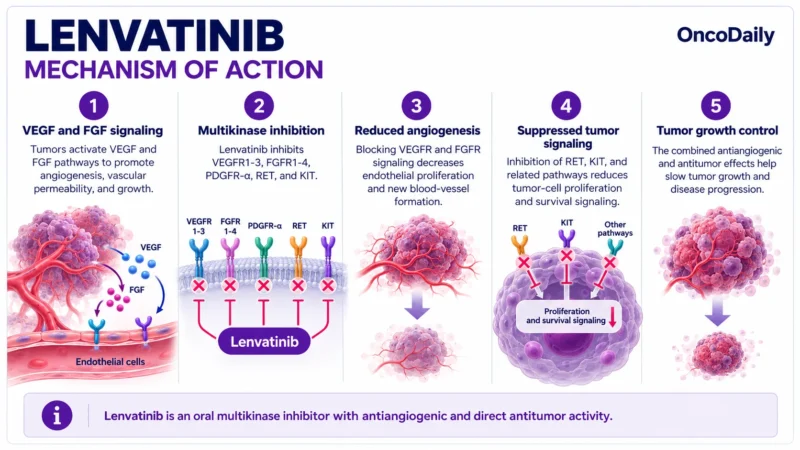
1. VEGF Promotes Tumor Angiogenesis
Tumor cells release VEGF, activating:
VEGFR-1 → VEGFR-2 → VEGFR-3
on endothelial cells.
This promotes:
- Endothelial proliferation
- Migration
- Vascular permeability
- New blood-vessel formation
2. FGF Signaling Can Support Tumor Growth
FGFR signaling contributes to:
- Cell proliferation
- Tumor survival
- Angiogenesis
- Resistance to VEGF-pathway inhibition
3. Lenvatinib Blocks Multiple Kinases
Lenvatinib inhibits:
- VEGFR-1/2/3
- FGFR-1–4
- PDGFR-α
- RET
- KIT.
4. Angiogenic Signaling Falls
Inhibition of VEGFR and FGFR signaling results in:
- Reduced endothelial proliferation
- Reduced tumor neovascularization
- Reduced tumor blood supply
5. Direct Tumor Signaling Is Also Suppressed
Inhibition of RET, KIT, FGFR, and related pathways can reduce:
- Tumor-cell proliferation
- Survival signaling
- Invasive potential
6. Tumor Growth Is Restricted
The overall effect is:
Lenvatinib → VEGFR/FGFR/RET/KIT inhibition → ↓angiogenesis + ↓tumor signaling → reduced tumor growth and progression.
What Is the Dose of Lenvatinib?
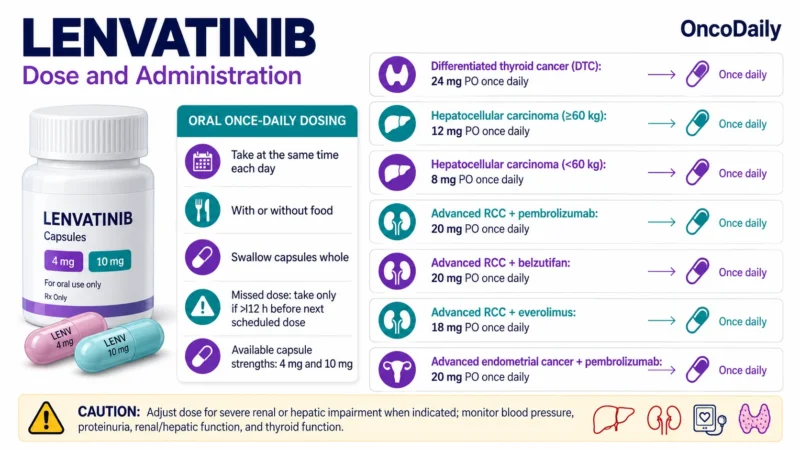
Lenvatinib dosing varies substantially by indication.
Differentiated Thyroid Cancer
Recommended dose:
24 mg orally once daily
until:
- Disease progression
- Unacceptable toxicity
Unresectable Hepatocellular Carcinoma
Dosing is based on actual body weight.
≥60 kg
12 mg once daily
<60 kg
8 mg once daily.
First-Line Advanced RCC With Pembrolizumab
Lenvatinib 20 mg orally once daily
plus pembrolizumab.
Lenvatinib may continue after completion of the planned pembrolizumab course until progression or unacceptable toxicity.
Advanced Clear-Cell RCC With Belzutifan
Following the September 24, 2026 FDA approval, the regimen is:
Lenvatinib 20 mg orally once daily
plus:
Belzutifan 120 mg orally once daily
for adults with advanced clear-cell RCC after prior PD-1 or PD-L1 inhibitor therapy.
Advanced RCC With Everolimus
Recommended dose:
Lenvatinib 18 mg orally once daily
plus:
Everolimus 5 mg orally once daily.
Advanced Endometrial Carcinoma
Recommended dose:
Lenvatinib 20 mg orally once daily
with pembrolizumab.
How Should Lenvatinib Be Taken?
Lenvatinib should be taken:
- Once daily
- At approximately the same time each day
- With or without food
Capsules should be:
Swallowed whole.
Do not:
- Crush
- Chew
An oral suspension may also be prepared when necessary, including for feeding-tube administration according to prescribing instructions.
What If a Dose Is Missed?
If the missed dose can still be taken more than:
12 hours before the next scheduled dose, take it when remembered.
If the next dose is due within:
12 hours, skip the missed dose.
Do not double the next dose.
How Are Lenvatinib Dose Reductions Made?
Differentiated Thyroid Cancer
- Starting dose: 24 mg once daily
- First reduction: 20 mg once daily
- Second reduction: 14 mg once daily
- Third reduction: 10 mg once daily.
RCC and Endometrial Cancer
For regimens starting at 20 mg daily:
- Starting dose: 20 mg once daily
- First reduction: 14 mg once daily
- Second reduction: 10 mg once daily
- Third reduction: 8 mg once daily.
HCC — Body Weight ≥60 kg
- Starting dose: 12 mg once daily
- First reduction: 8 mg once daily
- Second reduction: 4 mg once daily
- Third reduction: 4 mg every other day.
HCC — Body Weight <60 kg
- Starting dose: 8 mg once daily
- First reduction: 4 mg once daily
- Second reduction: 4 mg every other day
- Further intolerance generally requires discontinuation.
Dose Modification for Hypertension
Hypertension should be controlled before starting therapy.
For persistent Grade 3 hypertension despite optimal antihypertensive therapy:
- Withhold lenvatinib
- Resume at a reduced dose once controlled to Grade ≤2
For:
Grade 4 hypertension
permanently discontinue lenvatinib.
Does Lenvatinib Require Renal Dose Adjustment?
For mild or moderate renal impairment:
No starting-dose adjustment is generally required.
For severe renal impairment with creatinine clearance:
<30 mL/min
recommended doses are:
- DTC: 14 mg once daily
- RCC: 10 mg once daily
- Endometrial cancer: 10 mg once daily
There is no recommended dose for HCC with severe renal impairment.
Does Lenvatinib Require Hepatic Dose Adjustment?
For DTC, RCC, or endometrial cancer:
- Child-Pugh A: no adjustment
- Child-Pugh B: no routine adjustment
- Child-Pugh C: reduce dose
Recommended Child-Pugh C doses:
- DTC: 14 mg once daily
- RCC: 10 mg once daily
- Endometrial cancer: 10 mg once daily
For HCC:
- Child-Pugh A: no dose adjustment
- There is no recommended dose for moderate or severe hepatic impairment.
What Are the Important Drug Interactions With Lenvatinib?
Lenvatinib has fewer clinically dominant CYP interactions than several other VEGFR TKIs, but medication review remains important.
One particularly relevant interaction is with:
QT-prolonging drugs.
Because lenvatinib can prolong the QT/QTc interval, concomitant use with medications known to prolong QT should generally be avoided where possible.
Patients should also be assessed for drugs that:
- Increase hypertension
- Affect electrolyte balance
- Increase bleeding risk
- Increase nephrotoxicity
depending on the clinical situation.
What Is the Pharmacokinetic Profile of Lenvatinib?
Lenvatinib is rapidly absorbed after oral administration.
Peak plasma concentrations generally occur within approximately:
1–4 hours.
It is highly protein bound and undergoes extensive metabolism and elimination through multiple pathways.
The terminal half-life is approximately:
28 hours
which supports:
Once-daily administration.
Food does not produce a clinically meaningful effect requiring dose adjustment, so lenvatinib may be given with or without food.
What Are the Clinical Uses of Lenvatinib?
1. Radioactive Iodine-Refractory Differentiated Thyroid Cancer
Lenvatinib is FDA approved for:
Locally recurrent or metastatic, progressive differentiated thyroid carcinoma refractory to radioactive iodine.
The approval was established by the pivotal:
SELECT trial.
2. Unresectable Hepatocellular Carcinoma
Lenvatinib is approved as:
First-line treatment of unresectable HCC.
Its registration was based on:
REFLECT.
3. Advanced RCC With Pembrolizumab
Lenvatinib + pembrolizumab is an established:
First-line therapy for advanced RCC.
The pivotal evidence comes from:
CLEAR.
4. Advanced RCC With Everolimus
Lenvatinib + everolimus is approved for advanced RCC and was established through randomized phase II evidence demonstrating superior PFS compared with everolimus alone.
5. Advanced ccRCC With Belzutifan
As of September 2026, lenvatinib + belzutifan is approved for adults with advanced RCC containing a clear-cell component after previous PD-1/PD-L1 inhibitor treatment.
6. Advanced Endometrial Carcinoma
Lenvatinib + pembrolizumab is FDA approved for appropriate patients with:
Advanced endometrial carcinoma
and has become an important systemic therapy after prior platinum-based treatment.
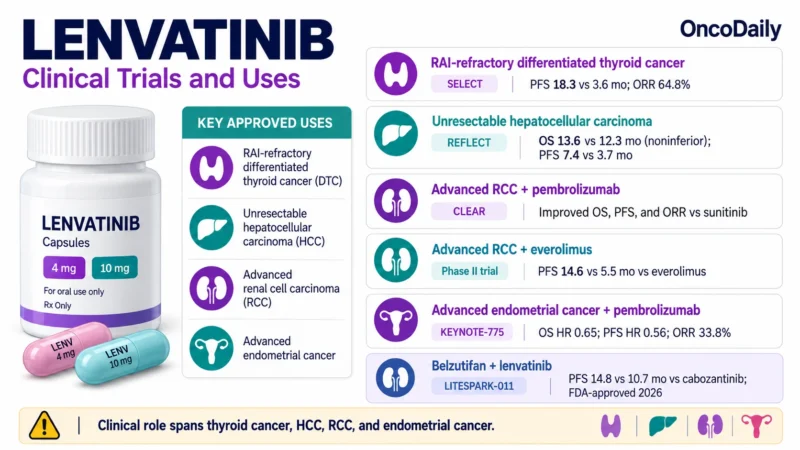
What Did the SELECT Trial Show?
The phase III SELECT trial randomized:
392 patients
with progressive radioactive iodine-refractory DTC to:
- Lenvatinib 24 mg daily
- Placebo.
Median Progression-Free Survival
- 18.3 months with lenvatinib
- 3.6 months with placebo
Hazard ratio:
0.21
P < 0.001.
Objective Response Rate
- Lenvatinib: 64.8%
- Placebo: 1.5%.
SELECT established lenvatinib as one of the most active systemic therapies in RAI-refractory DTC.
What Did the REFLECT Trial Show?
REFLECT enrolled:
954 patients
with previously untreated unresectable HCC.
Patients received:
- Lenvatinib 12 mg/day if ≥60 kg or 8 mg/day if <60 kg
- Sorafenib 400 mg twice daily.
Median Overall Survival
- 13.6 months with lenvatinib
- 12.3 months with sorafenib
Hazard ratio:
0.92
which met the study’s criterion for noninferiority.
Median PFS
- 7.4 months
- 3.7 months
HR:
0.66.
Lenvatinib also produced substantially higher tumor response rates than sorafenib.
What Did the CLEAR Trial Show?
The phase III CLEAR trial established lenvatinib + pembrolizumab as a major first-line RCC regimen.
Patients received:
Lenvatinib 20 mg once daily + pembrolizumab
versus:
Sunitinib.
The combination significantly improved:
- Progression-free survival
- Objective response rate
- Overall survival
compared with sunitinib.
Final prespecified OS analysis continued to support the survival advantage of lenvatinib + pembrolizumab.
What Did the Lenvatinib + Everolimus RCC Trial Show?
The randomized phase II study evaluated:
- Lenvatinib
- Everolimus
- Lenvatinib + everolimus
in previously treated metastatic clear-cell RCC.
For the approved combination:
Lenvatinib 18 mg + everolimus 5 mg daily
median PFS was approximately:
- 14.6 months with lenvatinib + everolimus
- 5.5 months with everolimus alone
with an HR of approximately:
0.37.
What Did KEYNOTE-775 Show?
Study 309/KEYNOTE-775 evaluated:
Lenvatinib 20 mg daily + pembrolizumab
against physician’s-choice chemotherapy in previously treated advanced endometrial cancer.
A total of:
827 patients
were randomized.
Updated analysis showed benefit in:
Overall Survival
All-comer HR:
0.65
Progression-Free Survival
All-comer HR:
0.56
Objective Response Rate
- 33.8% with lenvatinib + pembrolizumab
- 14.7% with chemotherapy.
Five-year follow-up published in 2026 confirmed durable survival benefit with no new major safety signal.
What Did LITESPARK-011 Show?
The phase III LITESPARK-011 trial compared:
Belzutifan 120 mg + lenvatinib 20 mg
with:
Cabozantinib 60 mg
after prior PD-1/PD-L1 therapy in advanced clear-cell RCC.
A total of:
747 patients
were randomized.
Median PFS
- 14.8 months with belzutifan + lenvatinib
- 10.7 months with cabozantinib
HR:
0.70
P < 0.0001.
Median OS
- 34.9 months
- 27.6 months
HR:
0.85
The OS difference was not statistically significant at the reported analysis.
These data supported the September 2026 FDA approval.
Is Lenvatinib FDA Approved?
Yes.
As of October 2026, FDA-approved uses include:
Differentiated Thyroid Cancer
Progressive, locally recurrent or metastatic RAI-refractory DTC.
Hepatocellular Carcinoma
First-line treatment of unresectable HCC.
Advanced RCC
- With pembrolizumab in the first-line setting
- With everolimus
- With belzutifan after prior PD-1/PD-L1 therapy in clear-cell RCC.
Advanced Endometrial Carcinoma
With pembrolizumab in the appropriate previously treated setting.
What Is the Current Clinical Role of Lenvatinib in 2026?
Differentiated Thyroid Cancer
Lenvatinib remains one of the major systemic therapies for:
Progressive RAI-refractory DTC.
Its high response rate in SELECT makes it especially relevant when meaningful tumor shrinkage is clinically desirable.
Renal Cell Carcinoma
Lenvatinib has an unusually broad RCC role.
Pembrolizumab + Lenvatinib
This remains an established first-line regimen supported by CLEAR.
Lenvatinib + Everolimus
This remains an established later-line targeted combination.
Belzutifan + Lenvatinib
The September 2026 approval adds an important post-PD-1/PD-L1 option and reflects the growing role of combined:
HIF-2α + VEGFR pathway blockade.
Read more: Exploring New Horizons in Kidney Cancer Treatment: An Interview with Dr. Ilya Tsimafeyeu by OncoDaily.
Watch more: OncoDaily discussion on first-line treatment strategies in advanced renal cell carcinoma, including VEGFR-TKI and immunotherapy combinations relevant to lenvatinib.
Hepatocellular Carcinoma
Lenvatinib remains an FDA-approved first-line TKI for unresectable HCC.
Its use is now more selective because modern HCC treatment increasingly incorporates immune-based combinations, but it remains clinically relevant when:
- Immunotherapy is inappropriate
- A TKI-based strategy is preferred
- Other first-line approaches are unavailable or unsuitable.
Endometrial Cancer
Lenvatinib + pembrolizumab remains a major systemic option after platinum therapy, particularly in pMMR disease, where immune-checkpoint inhibitor monotherapy is substantially less active.
Long-term KEYNOTE-775 follow-up continues to support durable benefit.
What Are the Major Side Effects of Lenvatinib?
Common adverse reactions include:
- Hypertension
- Diarrhea
- Fatigue
- Decreased appetite
- Weight loss
- Nausea
- Proteinuria
- Hypothyroidism
- Stomatitis
- Palmar-plantar erythrodysesthesia
- Musculoskeletal pain
Important serious risks include:
- Severe hypertension
- Cardiac dysfunction
- Arterial thromboembolism
- Hepatotoxicity
- Renal failure
- Proteinuria
- Severe diarrhea
- Fistula or GI perforation
- QT prolongation
- Hypocalcemia
- PRES/RPLS
- Hemorrhage
- Thyroid dysfunction
- Impaired wound healing
- Osteonecrosis of the jaw.
Hypertension
Hypertension is one of lenvatinib’s most important and frequent toxicities.
It may occur:
Early after treatment initiation.
Blood pressure should be controlled before treatment starts and monitored closely during therapy.
Persistent Grade 3 hypertension despite treatment requires:
Treatment interruption and dose reduction.
Grade 4 hypertension requires:
Permanent discontinuation.
Cardiac Dysfunction
Lenvatinib may cause:
- Reduced LVEF
- Cardiomyopathy
- Congestive heart failure
Across DTC, RCC, and HCC studies, Grade ≥3 cardiac dysfunction occurred in approximately 1% of lenvatinib-treated patients.
Clinical cardiac assessment and LVEF evaluation should be considered when appropriate.
Proteinuria
Proteinuria may be clinically significant.
Monitor:
- Urinalysis
- Urine protein
before and during treatment.
Clinically significant proteinuria may require:
- Interruption
- Dose reduction
and nephrotic syndrome requires permanent discontinuation.
Hepatotoxicity
Lenvatinib may cause elevations in:
- ALT
- AST
- Bilirubin
and clinically important liver injury.
Liver-function testing should be performed:
- Before treatment
- Regularly during therapy
- More frequently if abnormalities occur.
QT Prolongation
Lenvatinib can prolong the:
QT/QTc interval.
Avoid other QT-prolonging medications where possible.
Monitor:
- ECG in high-risk patients
- Potassium
- Magnesium
- Calcium.
Thyroid Dysfunction
Lenvatinib commonly causes:
Hypothyroidism
and can impair normal TSH suppression in thyroid cancer patients.
Monitor:
- TSH
- Thyroid function
regularly during therapy.
Diarrhea
Diarrhea is common and may become severe.
Management includes:
- Early antidiarrheal therapy
- Hydration
- Electrolyte replacement
- Treatment interruption for significant toxicity
- Dose reduction when appropriate.
Hemorrhage
Lenvatinib can increase bleeding risk.
Monitor for:
- Epistaxis
- Hematuria
- GI bleeding
- Hemoptysis
- Tumor-associated hemorrhage
and intervene promptly for significant bleeding.
Impaired Wound Healing
Lenvatinib may impair wound healing.
Patients should inform clinicians about planned surgery, and treatment should be withheld around major procedures according to prescribing recommendations and restarted only after adequate wound healing.
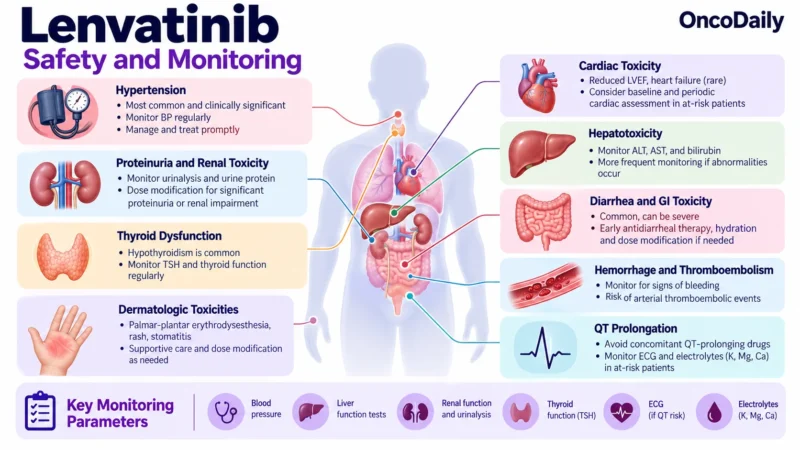
What Monitoring Is Required?
Monitoring during lenvatinib therapy should include:
- Blood pressure
- ALT
- AST
- Bilirubin
- Serum creatinine
- Renal function
- Urinalysis / urine protein
- TSH and thyroid function
- Electrolytes
- Calcium
- Potassium
- Magnesium
- ECG when QT risk exists
- Cardiac symptoms / LVEF when indicated
- Stool frequency and diarrhea
- Weight and nutritional status
- Signs of bleeding
- Neurologic symptoms suggesting PRES
- Symptoms of fistula or GI perforation
- Wound healing
- Oral/dental health
- Toxicities of combination partners such as pembrolizumab, everolimus, or belzutifan.
FAQ
What Is Lenvatinib Used For?
- RAI-refractory differentiated thyroid cancer
- Unresectable HCC
- Advanced RCC
- Advanced endometrial cancer.
What Is the Standard Dose for Thyroid Cancer?
What Is the HCC Dose?
- <60 kg: 8 mg once daily.
What Is the Dose With Pembrolizumab?
What Is the Dose With Belzutifan?
What Is the Dose With Everolimus?
Can Lenvatinib Be Taken With Food?
It can be taken:
With or without food.
What Did SELECT Show?
- 18.3 months with lenvatinib
- 3.6 months with placebo
HR 0.21.
What Did REFLECT Show?
- 13.6 months
- 12.3 months
with lenvatinib versus sorafenib, demonstrating noninferiority.