





Ifosfamide: An Established Alkylating Chemotherapy for Testicular Cancer and Sarcomas
Key takeaways
- Ifosfamide is a prodrug activated in the liver into metabolites that form DNA cross-links and interfere with cancer-cell replication.
- The FDA-labeled regimen is 1.2 g/m² intravenously daily for 5 days, repeated every 3 weeks or after blood-count recovery.
- Ifosfamide must be administered with mesna and at least 2 liters of oral or intravenous fluid daily to reduce urinary toxicity.
- The infusion should last at least 30 minutes, although many oncology protocols use longer or continuous infusions.
- Important toxicities include encephalopathy, renal tubular injury, hemorrhagic cystitis, myelosuppression, infection, and infertility.
- Ifosfamide is FDA approved specifically for third-line germ-cell testicular cancer, while use in sarcomas and other cancers is generally protocol-based.
- Dose and schedule vary substantially across regimens and must not be interchanged.
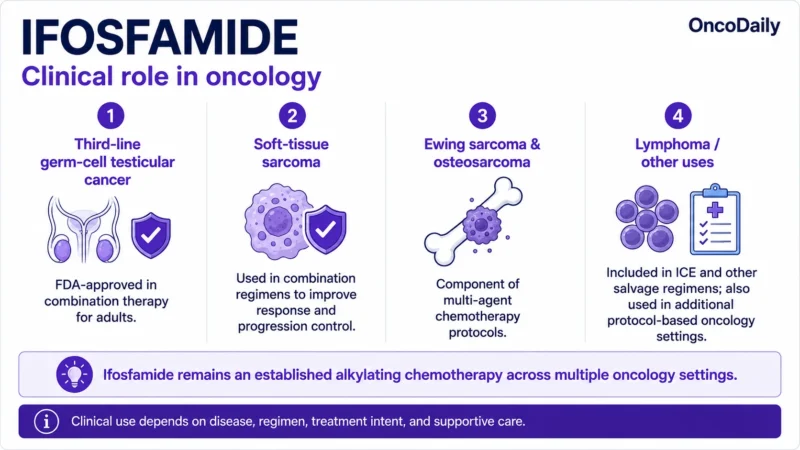
Ifosfamide is an intravenous alkylating chemotherapy structurally related to cyclophosphamide. In the United States, it is approved in combination with other anticancer agents for adults receiving third-line treatment for germ-cell testicular cancer. It is also widely incorporated into treatment protocols for soft-tissue sarcoma, Ewing sarcoma, osteosarcoma, lymphoma, and several other cancers, although many of these uses are not included in the FDA-approved indication.
This article aims to review ifosfamide’s mechanism of action, dose, administration, preparation requirements, clinical-trial findings, safety profile, approval status, and current role in oncology.
Ifosfamide Key Facts
- Generic name: Ifosfamide
- Brand name: Ifex
- Drug class: Alkylating agent; nitrogen-mustard derivative
- Treatment type: Cytotoxic chemotherapy
- Administration: Intravenous infusion
- FDA-labeled dose: 1.2 g/m² daily for 5 consecutive days
- Cycle frequency: Every 3 weeks or after recovery from hematologic toxicity
- Required supportive treatment: Mesna and extensive hydration
- FDA-approved indication: Third-line combination chemotherapy for adult germ-cell testicular cancer
- Common protocol-based uses: Soft-tissue sarcoma, Ewing sarcoma, osteosarcoma, lymphoma, and other solid tumors
- Important toxicities: Myelosuppression, encephalopathy, nephrotoxicity, hemorrhagic cystitis, infertility, cardiotoxicity, and secondary malignancies
- Approval status: FDA approved
What Is Ifosfamide?
Ifosfamide is a synthetic analogue of cyclophosphamide and belongs to the oxazaphosphorine group of nitrogen-mustard chemotherapy agents.
It is supplied as a sterile powder for intravenous administration and must be metabolically activated before it becomes cytotoxic. In the United States, the labeled indication is limited to adults with germ-cell testicular cancer who are receiving third-line combination chemotherapy.
Common ifosfamide-containing regimens include:
- VIP: Etoposide, ifosfamide, and cisplatin
- VeIP: Vinblastine, ifosfamide, and cisplatin
- AIM: Doxorubicin, ifosfamide, and mesna
- ICE: Ifosfamide, carboplatin, and etoposide
- Protocols for Ewing sarcoma and osteosarcoma
- High-dose ifosfamide regimens for recurrent sarcoma
These regimens have different doses, schedules, infusion durations, and supportive-care requirements.
Ifosfamide Mechanism of Action
Ifosfamide is inactive when administered and requires activation by hepatic cytochrome P450 enzymes.
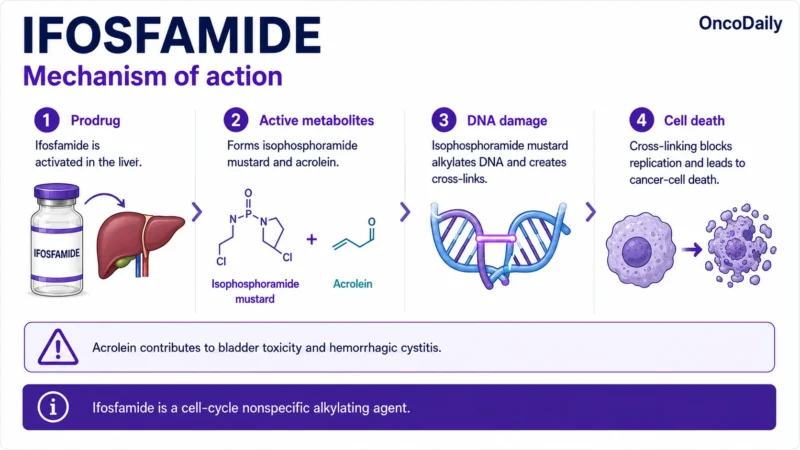
The mechanism involves several steps:
- Hepatic activation: Ifosfamide is converted into 4-hydroxyifosfamide.
- Formation of active metabolites: The intermediate produces isophosphoramide mustard.
- DNA alkylation: Isophosphoramide mustard binds primarily to the N-7 position of guanine.
- DNA cross-linking: Interstrand and intrastrand cross-links prevent DNA strands from separating.
- Inhibition of replication: Cancer cells cannot copy their DNA or divide normally.
- Cell death: Accumulated DNA damage leads to cytotoxicity and cell death.
Ifosfamide metabolism also produces two clinically important toxic metabolites:
- Acrolein, which causes bladder and urinary-tract toxicity
- Chloroacetaldehyde, which contributes to encephalopathy and renal tubular injury
Mesna binds urotoxic metabolites in urine but does not prevent neurologic or renal tubular toxicity.
What Is the Dose of Ifosfamide?
There is no single dose that applies to every ifosfamide-containing regimen.
FDA-Labeled Dose
The FDA-recommended regimen is:
Ifosfamide 1.2 g/m² intravenously once daily for 5 consecutive days.
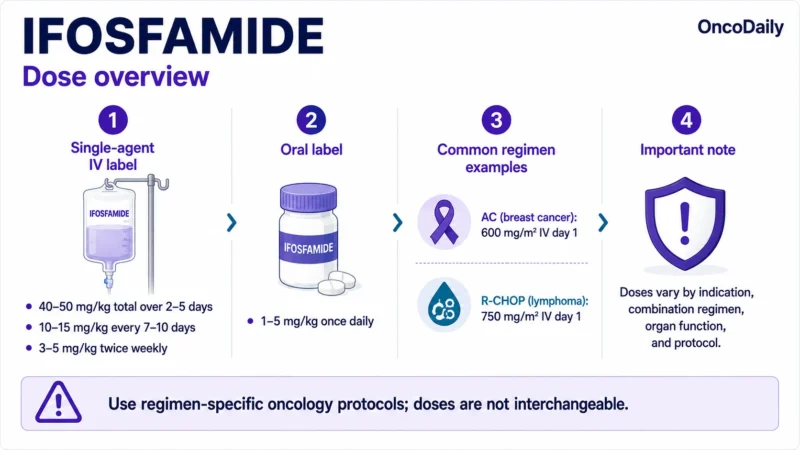
Each dose should be given as a slow intravenous infusion lasting at least 30 minutes. The cycle is repeated every 3 weeks or after recovery from hematologic toxicity.
The total labeled dose per cycle is:
6 g/m² over 5 days.
VIP Regimen for Germ-Cell Testicular Cancer
The FDA clinical studies used:
Ifosfamide 1.2 g/m² IV on days 1–5
Cisplatin 20 mg/m² IV on days 1–5
Etoposide 75 mg/m² IV on days 1–5
or
Vinblastine 0.22 mg/kg IV on day 1
This was used as third-line or later salvage therapy.
High-Dose Ifosfamide
High-dose schedules are used in selected sarcoma protocols. These may involve:
- Higher daily doses
- Continuous infusions over several days
- Larger cumulative doses per cycle
- Intensive mesna, hydration, and laboratory monitoring
High-dose regimens carry greater risks of encephalopathy, nephrotoxicity, myelosuppression, and urinary toxicity and should only be administered according to a defined oncology protocol.
How Is Ifosfamide Administered?
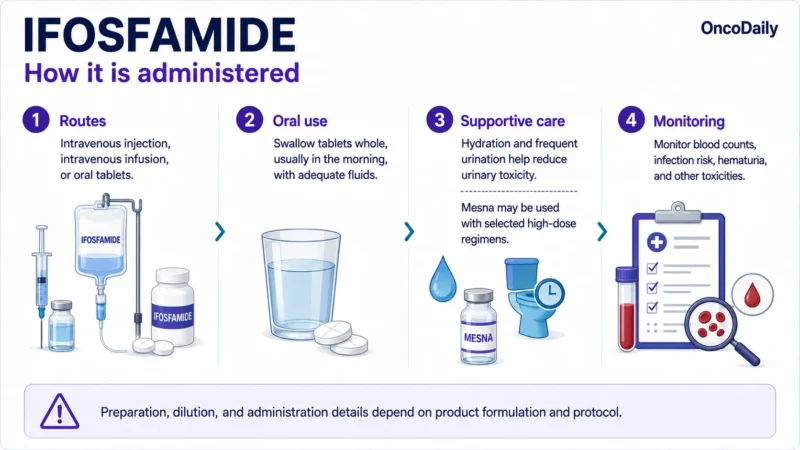
Ifosfamide is administered intravenously in a hospital, infusion center, or specialized oncology unit.
Required Hydration
Patients should receive at least:
2 liters of oral or intravenous fluid per day.
Hydration promotes urine production and reduces the concentration and contact time of toxic metabolites within the bladder.
Higher-dose protocols may require substantially more intensive intravenous hydration and close monitoring of:
- Fluid balance
- Urine output
- Body weight
- Electrolytes
- Renal function
- Hematuria
Required Mesna
Ifosfamide should be administered with mesna to reduce the incidence and severity of hemorrhagic cystitis.
A commonly labeled mesna schedule for short ifosfamide infusions uses:
- Mesna IV equal to 20% of the ifosfamide dose at hour 0
- Mesna equal to 20% at 4 hours
- Mesna equal to 20% at 8 hours
Another approved approach uses IV mesna at hour 0 followed by oral mesna at later time points. The exact mesna dose and duration depend on the ifosfamide schedule, particularly when ifosfamide is administered as a prolonged or continuous infusion.
Infusion Duration
The FDA label specifies an infusion lasting:
At least 30 minutes.
Some protocols administer ifosfamide over several hours or continuously over multiple days to deliver higher cumulative doses.
Monitoring Before Each Dose
Before each dose, clinicians should assess:
- Complete blood count
- Kidney function
- Serum electrolytes, including potassium and phosphorus
- Urinalysis
- Mental status
- Infection symptoms
- Urinary obstruction or urinary-tract infection
The FDA label recommends obtaining a urinalysis before each dose. Treatment should be withheld when microscopic hematuria exceeds 10 red blood cells per high-power field until it resolves.
How Is Ifosfamide Prepared?
For the powder formulation, the vial is reconstituted to:
50 mg/mL.
The labeled preparation is:
- 1-g vial plus 20 mL diluent
- 3-g vial plus 60 mL diluent
The solution may then be diluted to a final concentration of 0.6–20 mg/mL. Compatible fluids include:
- 5% dextrose
- 0.9% sodium chloride
- Lactated Ringer’s solution
- Sterile water for injection
Reconstituted or further diluted solutions should be refrigerated and used within 24 hours. Benzyl-alcohol-containing solutions may reduce stability.
Ifosfamide is a hazardous cytotoxic drug and requires appropriate protective equipment, handling, preparation, and disposal procedures.
Does Ifosfamide Require an In-Line Filter?
The current FDA label does not specify a universal in-line-filter requirement.
The prepared solution should be visually inspected for particulate matter and discoloration before administration. Any filter requirement should follow:
The specific manufacturer’s instructions
Institutional pharmacy policy
The complete chemotherapy protocol
The type of infusion tubing or delivery system
Is Premedication Required?
There is no single universal premedication regimen, but supportive treatment is routinely required.
Antiemetic Prophylaxis
Ifosfamide-containing combinations are often highly emetogenic, particularly when combined with cisplatin or anthracyclines.
Antiemetic prophylaxis may include:
- A 5-HT3 receptor antagonist
- Dexamethasone
- An NK1 receptor antagonist
- Olanzapine
- Additional rescue antiemetics
The regimen should be selected according to the emetogenic risk of the complete combination rather than ifosfamide alone.
Mesna and Hydration
Mesna and hydration are not optional antiemetic premedications; they are essential uroprotective measures administered with ifosfamide.
Growth-Factor Support
Granulocyte colony-stimulating factor may be used when the complete regimen carries a significant risk of febrile neutropenia or when patient-specific risk factors justify prophylaxis.
Are Dose Reductions Used?
Yes. Treatment may be delayed, reduced, interrupted, or permanently discontinued because of toxicity.
The FDA label advises avoiding administration when:
- White blood cell count is below 2,000/µL
- Platelet count is below 50,000/µL
- Active infection is present
- Severe immunosuppression is present
Encephalopathy
If confusion, somnolence, hallucinations, seizures, or other neurologic symptoms occur:
- Stop or interrupt ifosfamide
- Assess metabolic and medication-related causes
- Provide supportive treatment
- Consider permanent discontinuation depending on severity
- Methylene blue may be considered as treatment in selected cases
Rechallenge can lead to recurrent, occasionally fatal neurotoxicity.
Hematuria
If urinalysis shows more than 10 red blood cells per high-power field:
- Withhold ifosfamide
- Continue evaluation and supportive management
- Resume only after complete resolution
- Use vigorous hydration and protocol-directed mesna with subsequent treatment
Renal Tubular Toxicity
Clinically important Fanconi syndrome, electrolyte wasting, reduced glomerular filtration, or progressive renal injury may require dose reduction or discontinuation.
What Is Known About Ifosfamide Pharmacokinetics?
Ifosfamide demonstrates dose-dependent and nonlinear pharmacokinetics at higher doses.
It has:
- Low plasma-protein binding
- A volume of distribution of approximately 0.64–0.72 L/kg in one repeated-dose study
- Extensive hepatic metabolism
- Substantial urinary elimination of parent drug and metabolites
- Considerable variation in metabolism between patients
Ifosfamide is metabolized through two principal pathways:
- Activation to 4-hydroxyifosfamide and the cytotoxic mustard
- Dechloroethylation, which produces inactive metabolites and toxic chloroacetaldehyde
After a radiolabeled 5-g/m² dose, approximately 70%–86% of radioactivity was recovered in urine. The percentage eliminated as unchanged drug varies with dose.
CYP3A4 inducers may increase formation of active as well as neurotoxic or nephrotoxic metabolites. CYP3A4 inhibitors may reduce metabolic activation and potentially reduce treatment effectiveness.
Are Renal or Hepatic Dose Adjustments Required?
Renal Impairment
No single FDA-defined dose-reduction table is provided.
Ifosfamide and its metabolites may accumulate when renal function is reduced. Patients with renal impairment should be closely monitored, and dose modification should be considered according to:
- Creatinine clearance
- Degree of tubular dysfunction
- Previous nephrotoxic treatment
- Planned cumulative dose
- Treatment intent
- Protocol-specific guidance
Ifosfamide and its metabolites are dialyzable.
Hepatic Impairment
Ifosfamide is extensively metabolized in the liver into both active and toxic metabolites.
The FDA label does not provide a validated dose-adjustment table for hepatic impairment. Patients with impaired hepatic function should be monitored closely for toxicity and potentially altered efficacy.
What Did Ifosfamide Clinical Trials Show?
Third-Line Germ-Cell Testicular Cancer
The FDA-supported clinical evidence included 59 patients with refractory testicular cancer treated with ifosfamide, cisplatin, and either etoposide or vinblastine.
Results included:
- Overall response: 54%
- Disease-free after treatment with or without surgery: 39%
- Median time to progression: 19 weeks
- Median survival: 53 weeks
- Median survival exceeded 2 years in the VIP group in one comparison, versus less than 1 year in historical controls
The comparison used historical rather than randomized concurrent controls, which limits interpretation by current trial standards.
Soft-Tissue Sarcoma
A randomized Phase 3 trial compared doxorubicin alone with doxorubicin plus ifosfamide in advanced or metastatic soft-tissue sarcoma. Combination treatment was developed to increase tumor shrinkage and progression control, although the additional toxicity means treatment selection depends on whether rapid response is clinically important. The registered trial is NCT00061984.
Watch more: Explore recent developments in sarcoma treatment in OncoDaily Grand Rounds at ASCO 2026: Sarcoma Edition.
Recurrent or Refractory Ewing Sarcoma
The randomized rEECur trial compared commonly used salvage regimens.
High-dose ifosfamide produced:
- Median overall survival: 15.4 months
- Median event-free survival: 5.7 months
Topotecan plus cyclophosphamide produced:
Median overall survival: 10.5 months
Median event-free survival: 3.7 months
High-dose ifosfamide therefore produced longer survival in that comparison, although its toxicity and patient suitability remain important considerations.
Read more: Explore the diagnosis, treatment, and current management of Ewing sarcoma on OncoDaily
Ongoing Research
Current research continues to evaluate ifosfamide in:
- Recurrent Ewing sarcoma
- Osteosarcoma
- Soft-tissue sarcoma
- Lymphoma salvage regimens
- Combination treatment with targeted therapies
- Transplant-conditioning and mobilization approaches
NCI continues to list active ifosfamide-containing clinical trials.
Is Ifosfamide Approved?
Yes. Ifosfamide is FDA approved.
Its precise US indication is:
Use in adults, in combination with other approved anticancer agents, as third-line chemotherapy for germ-cell testicular cancer.
The FDA indication should be distinguished from common protocol-based uses in sarcoma, lymphoma, and other cancers.
What Is the Current Status of Ifosfamide?
Ifosfamide remains an established generic chemotherapy.
It continues to have an important role in:
- Salvage treatment for germ-cell tumors
- Selected soft-tissue sarcoma regimens
- Ewing sarcoma
- Osteosarcoma
- ICE-based lymphoma therapy
- Other intensive multidrug chemotherapy protocols
Its use is limited by substantial neurologic, renal, hematologic, and urinary toxicity. Treatment selection therefore depends on disease type, treatment goal, prior therapy, organ function, and availability of alternative regimens.
What Are the Side Effects of Ifosfamide?
Common or clinically important adverse effects include:
- Leukopenia
- Neutropenia
- Anemia
- Thrombocytopenia
- Infection
- Nausea and vomiting
- Hair loss
- Fatigue
- Reduced appetite
- Mucositis
- Hematuria
- Electrolyte abnormalities
- Renal dysfunction
- Neurologic symptoms
- Infertility
Ifosfamide Encephalopathy
Neurologic toxicity may include:
- Confusion
- Somnolence
- Hallucinations
- Agitation
- Seizures
- Abnormal movements
- Loss of consciousness
- Coma
Symptoms may occur within hours to days of treatment and can be fatal. Risk factors include high doses, low albumin, renal impairment, poor performance status, bulky abdominal or pelvic disease, cisplatin exposure, CNS-active medicines, and alcohol use.
Nephrotoxicity
Ifosfamide can damage both glomerular and tubular kidney function.
Possible consequences include:
- Acute kidney injury
- Chronic kidney disease
- Fanconi syndrome
- Glucose or protein loss in urine
- Phosphate wasting
- Hypokalemia
- Metabolic acidosis
- Renal rickets in children
Tubular injury may become evident months or years after treatment.
Hemorrhagic Cystitis
Acrolein may cause:
- Dysuria
- Microscopic or visible hematuria
- Bladder pain
- Hemorrhagic cystitis
- Severe urinary bleeding
Mesna and hydration reduce but do not completely eliminate this risk.
Myelosuppression and Infection
Ifosfamide may cause severe or fatal myelosuppression, sepsis, and septic shock. The leukocyte nadir generally occurs during the second week after administration.
Fertility and Pregnancy
Ifosfamide can cause:
- Amenorrhea
- Ovarian failure
- Premature menopause
- Oligospermia
- Azoospermia
- Temporary or permanent infertility
It can also cause fetal harm. The current label recommends effective contraception during treatment and for 12 months after the last dose for females, and during treatment and for 6 months afterward for males with partners who could become pregnant.
Written by Mirna Antabian, MD