


Gilteritinib (Xospata): Understanding Its Mechanism, Dosing, Clinical Uses, and Role in Relapsed or Refractory FLT3-Mutated AML
Key takeaways
- Gilteritinib is an oral FLT3 inhibitor used for relapsed or refractory FLT3-mutated AML.
- It is active against FLT3-ITD and FLT3-TKD disease.
- The standard dose is 120 mg once daily, equivalent to three 40 mg tablets.
- It can be taken with or without food.
- Treatment should generally continue for at least 6 months in patients without progression or unacceptable toxicity because responses can occur late.
- ADMIRAL showed median OS of 9.3 vs 5.6 months compared with salvage chemotherapy.
- CR/CRh was 34.0% vs 15.3% with chemotherapy.
- Gilteritinib can serve as a bridge to allogeneic transplantation.
- MORPHO suggests post-transplant benefit is greatest in patients with detectable FLT3-ITD MRD.
- The major boxed warning is differentiation syndrome.
- Other important risks are QT prolongation, PRES and pancreatitis.
- Strong CYP3A inhibitors can substantially increase drug exposure, while strong CYP3A/P-gp inducers can substantially reduce it.
- ECG, CBC, chemistry, electrolytes and clinical monitoring for differentiation syndrome are essential.
Gilteritinib (Xospata) is an oral, highly selective FLT3 tyrosine kinase inhibitor used for adults with relapsed or refractory acute myeloid leukemia (AML) harboring a FLT3 mutation, as detected by an FDA-approved test. Its current U.S. prescribing information was revised in October 2026.
Gilteritinib has activity against both major clinically relevant FLT3 mutation classes, including FLT3-ITD and FLT3-TKD mutations such as D835/I836, and remains a key targeted option in relapsed or refractory FLT3-mutated AML. The pivotal ADMIRAL trial demonstrated significantly longer overall survival compared with salvage chemotherapy.
Key Facts
- Generic name: Gilteritinib
- Brand name: Xospata
- Drug class: FLT3 tyrosine kinase inhibitor
- Primary target: FLT3
- Mutation activity: FLT3-ITD and FLT3-TKD
- Route: Oral
- Initial U.S. approval: 2018
- FDA-approved indication: Relapsed or refractory FLT3-mutated AML in adults
- Standard dose: 120 mg orally once daily
- Tablet strength: 40 mg
- Food: With or without food
- Recommended treatment duration: At least 6 months in the absence of progression or unacceptable toxicity because responses may be delayed
- Dose reduction for toxicity: 80 mg once daily
- Boxed warning: Differentiation syndrome
- Other important risks: QT prolongation, PRES, pancreatitis, embryo-fetal toxicity
- Major interaction pathway: CYP3A.
What Is Gilteritinib?
Gilteritinib is a small-molecule kinase inhibitor designed to suppress abnormal signaling from mutated FLT3 receptors in AML.
FLT3 is a receptor tyrosine kinase expressed on hematopoietic progenitor cells. Activating FLT3 mutations can drive continuous signaling that promotes:
- Leukemic blast proliferation
- Cell survival
- Resistance to apoptosis
- Disease progression
The two major clinically relevant mutation groups are:
- FLT3 internal tandem duplication (FLT3-ITD)
- FLT3 tyrosine kinase domain mutations (FLT3-TKD), particularly D835/I836 mutations
Gilteritinib is active against both classes, which distinguishes it from some more mutation-restricted FLT3 inhibitors. The ADMIRAL trial enrolled patients with FLT3-ITD or D835/I836 TKD mutations.
What Is the Mechanism of Action of Gilteritinib?
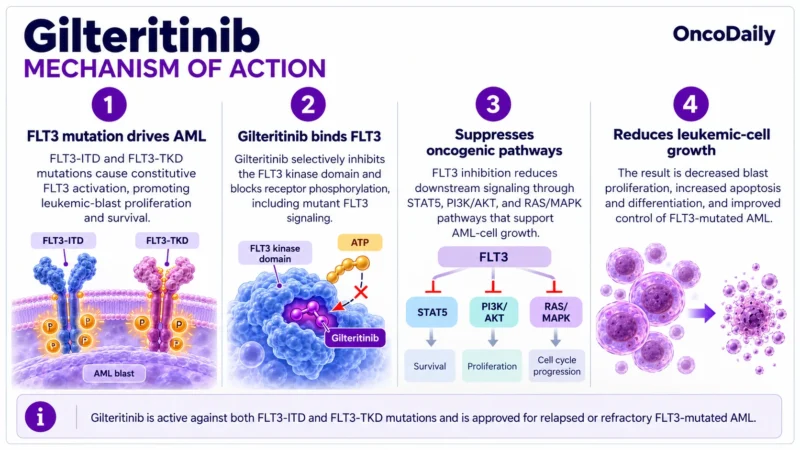
1. FLT3 Becomes Constitutively Activated
In FLT3-mutated AML, activating mutations cause continuous FLT3 signaling without normal ligand dependence.
This promotes persistent activation of downstream pathways such as:
- RAS–RAF–MEK–ERK
- PI3K–AKT
- STAT5 signaling
2. Abnormal Signaling Supports AML Blasts
Persistent FLT3 activity promotes:
- Proliferation
- Survival
- Resistance to apoptosis
- Expansion of the leukemic clone
3. Gilteritinib Inhibits Mutated FLT3
Gilteritinib binds the FLT3 kinase domain and inhibits kinase activation.
It retains activity against:
- FLT3-ITD
- FLT3-TKD mutations
including D835/I836 mutations represented in the pivotal clinical program.
4. FLT3 Phosphorylation and Downstream Signaling Fall
FLT3 inhibition reduces downstream phosphorylation and suppresses signaling through pathways responsible for leukemic-cell proliferation and survival.
5. Leukemic-Cell Growth Is Suppressed
The overall effect is:
Gilteritinib → FLT3 inhibition → ↓ oncogenic phosphorylation → ↓ proliferative and survival signaling → ↑ differentiation/apoptosis of AML cells
The ability of AML blasts to undergo differentiation during treatment also explains the clinically important risk of differentiation syndrome.
What Is the Recommended Dose of Gilteritinib?
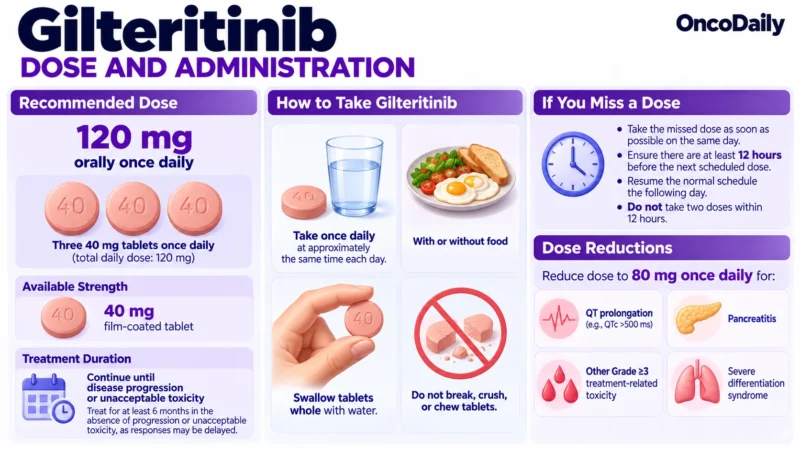
The recommended starting dose is:
120 mg orally once daily.
Because each Xospata tablet contains:
40 mg
the standard daily dose consists of:
three 40 mg tablets once daily.
Treatment should continue until:
- Disease progression
- Unacceptable toxicity
Importantly, clinical response can be delayed.
Therefore, in patients without progression or unacceptable toxicity, treatment for at least:
6 months
is recommended to allow sufficient time for response.
How Should Gilteritinib Be Taken?
Gilteritinib should be taken:
- Once daily
- At approximately the same time each day
- With or without food
Tablets should be swallowed whole.
Do not:
- Break
- Crush
the tablets.
What Should You Do If You Miss a Dose of Gilteritinib?
If a dose is missed or not taken at the usual time:
- Take it as soon as possible on the same day
- Ensure there are at least 12 hours before the next scheduled dose
- Resume the normal schedule the following day
- Never take two doses within 12 hours.
How Are Gilteritinib Dose Reductions Managed?
The principal reduced dose is:
80 mg once daily.
QT Prolongation
If:
QTc >500 ms
- Interrupt gilteritinib
- Resume at 80 mg once daily once QTc returns to within 30 ms of baseline or ≤480 ms.
If QTc increases by >30 ms on:
Day 8 of Cycle 1
repeat ECG on Day 9.
If confirmed:
consider reducing to 80 mg once daily.
Pancreatitis
If pancreatitis develops:
- Interrupt gilteritinib
- Wait until pancreatitis resolves
- Resume at 80 mg once daily.
Other Grade ≥3 Treatment-Related Toxicity
- Interrupt therapy
- Wait until toxicity resolves or improves to Grade 1
- Resume at 80 mg once daily.
Differentiation Syndrome
If differentiation syndrome is suspected:
- Start systemic corticosteroids immediately
- Begin hemodynamic monitoring
- Continue steroids for at least 3 days
- Interrupt gilteritinib if severe signs or symptoms persist for >48 hours after corticosteroids are started
- Resume when symptoms improve to Grade ≤2.
What Drug Interactions Are Important With Gilteritinib?
Strong CYP3A Inhibitors
Strong CYP3A inhibitors can significantly increase gilteritinib exposure.
Itraconazole increased:
- Cmax by approximately 20%
- AUC by approximately 120%.
Examples include:
- Itraconazole
- Posaconazole
- Voriconazole
- Ketoconazole
- Clarithromycin
- Ritonavir
Alternative therapies should be considered when possible.
If concomitant use is necessary, patients should be monitored carefully for gilteritinib-related toxicity.
This is particularly relevant in AML because azole antifungal prophylaxis is common.
Moderate CYP3A Inhibitors
Fluconazole increased:
- Cmax by approximately 16%
- AUC by approximately 40%.
Combined P-gp and Strong CYP3A Inducers
These should be avoided because they can substantially reduce gilteritinib exposure.
Rifampin reduced:
- Cmax by approximately 30%
- AUC by approximately 70%.
Other examples include:
- Carbamazepine
- Phenytoin
- Phenobarbital
- St. John’s wort
Does Gilteritinib Require Dose Adjustment in Renal or Hepatic Impairment?
Renal Impairment
Mild or moderate renal impairment does not have a clinically meaningful effect on gilteritinib pharmacokinetics.
This includes:
CrCl 30–80 mL/min.
Routine dose adjustment is therefore not generally required.
The effect of:
CrCl ≤29 mL/min
has not been established.
Hepatic Impairment
Mild or moderate hepatic impairment:
- Child-Pugh A
- Child-Pugh B
does not meaningfully alter gilteritinib pharmacokinetics.
Routine starting-dose adjustment is generally not required.
The effect of:
Child-Pugh C severe hepatic impairment
is unknown.
What Is the Pharmacokinetic Profile of Gilteritinib?
Absorption
Median time to maximum concentration is approximately:
4–6 hours
after administration in the fasting state.
Food Effect
A high-fat meal decreased:
- Cmax by approximately 26%
- AUC by <10%
while delaying Tmax by approximately:
2 hours.
These changes are not considered clinically meaningful enough to require fasting administration.
Protein Binding
Gilteritinib is approximately:
94% protein bound.
Half-Life
The estimated terminal half-life is approximately:
113 hours.
This prolonged half-life supports once-daily dosing. DailyMed
Steady State
Steady-state concentrations are reached within approximately:
15 days
with roughly:
10-fold accumulation.
What Are the Clinical Uses of Gilteritinib?
Relapsed or Refractory FLT3-Mutated AML
Gilteritinib is FDA approved for adults with:
relapsed or refractory AML with a FLT3 mutation
confirmed by an FDA-approved test.
This includes patients with clinically relevant:
- FLT3-ITD
- FLT3-TKD
mutations.
Gilteritinib is administered as oral monotherapy and can serve as:
- Definitive therapy in selected patients
- A bridge to allogeneic transplantation
- A strategy for restoring remission before transplant
What Did the Pivotal Clinical Trials Show?
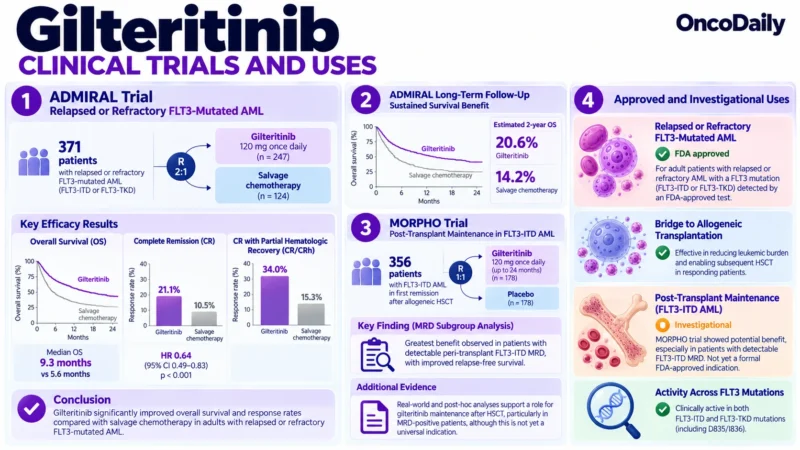
ADMIRAL
The pivotal phase III ADMIRAL trial compared:
- Gilteritinib 120 mg once daily
- Investigator-selected salvage chemotherapy
in adults with relapsed or refractory FLT3-mutated AML.
Patients were randomized:
2:1
to gilteritinib or salvage chemotherapy.
Overall Survival
Median overall survival was:
- Gilteritinib: 9.3 months
- Salvage chemotherapy: 5.6 months
Hazard ratio for death:
0.64
95% CI:
0.49–0.83
P < 0.001.
Complete Remission With Full or Partial Hematologic Recovery
CR/CRh:
- Gilteritinib: 34.0%
- Salvage chemotherapy: 15.3%
Complete Remission
- Gilteritinib: 21.1%
- Salvage chemotherapy: 10.5%.
Event-Free Survival
Median EFS was:
- 2.8 months
- 0.7 months, respectively.
The trial established gilteritinib as the standard targeted treatment for relapsed or refractory FLT3-mutated AML.
ADMIRAL Long-Term Follow-Up
Longer-term follow-up confirmed durable benefit.
Median overall survival remained:
- 9.3 months with gilteritinib
- 5.6 months with salvage chemotherapy
and estimated 2-year survival was:
- 20.6%
- 14.2%, respectively.
Some patients proceeded to transplantation and subsequently restarted gilteritinib after transplantation.
MORPHO
The randomized phase III MORPHO/BMT CTN 1506 trial evaluated:
Gilteritinib 120 mg once daily vs placebo
for up to:
24 months
after allogeneic hematopoietic cell transplantation in patients with FLT3-ITD AML in first remission.
A total of:
356 patients
were randomized.
The overall trial did not establish universal benefit for every transplanted patient.
However, subsequent analyses showed a clinically important interaction with:
FLT3-ITD measurable residual disease (MRD).
Patients with detectable peri-transplant FLT3-ITD MRD appeared to derive the clearest relapse-free survival benefit from gilteritinib maintenance, whereas little benefit was evident in patients who were MRD-negative.
Among placebo-treated patients:
- 42.2% with detectable FLT3-ITD MRD relapsed
- 13.4% without detectable MRD relapsed.
These findings have strengthened interest in MRD-guided post-transplant FLT3 inhibition, although post-transplant maintenance remains distinct from the current FDA-approved relapsed/refractory indication.
Is Gilteritinib FDA Approved?
Yes.
Xospata is FDA approved for:
adult patients with relapsed or refractory AML with a FLT3 mutation detected by an FDA-approved test.
It is not currently FDA approved as standard frontline therapy for newly diagnosed AML.
Post-transplant maintenance is also not the core labeled indication, despite important emerging evidence from MORPHO and subsequent analyses.
What Is the Current Clinical Role of Gilteritinib in 2026?
Relapsed or Refractory FLT3-Mutated AML
Gilteritinib remains a central standard of care in:
relapsed or refractory FLT3-mutated AML.
Its advantages include:
- Oral administration
- Single-agent activity
- Activity against FLT3-ITD
- Activity against FLT3-TKD
- Survival benefit over salvage chemotherapy
- Ability to bridge responding patients to transplant.
FLT3 mutation testing should therefore be repeated or confirmed at relapse because FLT3 status can evolve during the disease course.
Continuing Treatment Long Enough for Response
Responses to gilteritinib may occur relatively late.
A 2026 analysis of ADMIRAL and COMMODORE data reinforced that patients who are clinically stable and tolerating therapy may respond after several cycles and supported continuing gilteritinib for at least:
6 cycles
when there is no progression or unacceptable toxicity.
This aligns with the FDA label recommendation for a minimum of approximately 6 months to allow sufficient response time.
Bridge to Allogeneic Transplantation
For eligible patients, gilteritinib can:
- Reduce leukemic burden
- Induce remission
- Permit subsequent allogeneic hematopoietic cell transplantation
ADMIRAL transplant analyses showed that patients could proceed to HSCT following gilteritinib therapy.
Post-Transplant Maintenance
MORPHO has shifted attention toward a more individualized approach.
The strongest evidence for maintenance benefit appears in patients with:
detectable peri-transplant FLT3-ITD MRD.
A 2026 real-world Japanese study also reported better 3-year relapse-free survival among patients receiving post-transplant gilteritinib:
- 58.8% with maintenance
- 36.4% without maintenance
although these observational findings should not be interpreted as equivalent to randomized evidence.
Thus, in 2026, post-transplant gilteritinib is increasingly considered within an MRD- and risk-adapted strategy, while the formal FDA indication remains relapsed/refractory FLT3-mutated AML.
Read more: Talha Badar: Post-transplant FLT3 maintenance therapy for AML by OncoDaily.
Watch more: ADMIRAL: Gilteritinib as treatment for patients with relapsed or refractory acute myeloid leukaemia — Prof. Alexander Perl discusses the phase III ADMIRAL results comparing gilteritinib with salvage chemotherapy.
What Are the Major Side Effects of Gilteritinib?
Common nonhematologic adverse reactions include:
- Elevated transaminases
- Myalgia/arthralgia
- Fatigue
- Fever
- Mucositis
- Edema
- Rash
- Diarrhea
- Dyspnea
- Nausea
- Cough
- Constipation
- Eye disorders
- Headache
- Dizziness
- Hypotension
- Vomiting
- Renal impairment.
Major clinically significant risks include:
- Differentiation syndrome
- QT prolongation
- Posterior reversible encephalopathy syndrome
- Pancreatitis
- Hepatic toxicity
- Cytopenias
- Embryo-fetal toxicity.
Differentiation Syndrome
Gilteritinib carries a boxed warning for differentiation syndrome.
In clinical trials, approximately:
3%
of treated patients developed differentiation syndrome.
Symptoms may include:
- Fever
- Dyspnea
- Hypoxia
- Pulmonary infiltrates
- Pleural effusion
- Pericardial effusion
- Pulmonary edema
- Rapid weight gain
- Peripheral edema
- Hypotension
- Renal dysfunction
- Rash
Onset has been reported from:
Day 1 through Day 82
after starting treatment.
If suspected:
Dexamethasone 10 mg IV every 12 hours
or equivalent corticosteroid treatment should be initiated promptly, along with hemodynamic monitoring.
Steroids should be continued for at least:
3 days
and tapered only after symptoms resolve.
QT Prolongation
Gilteritinib can prolong ventricular repolarization.
In clinical studies:
- Approximately 1% developed QTc >500 ms
- Approximately 7% experienced QTc increase >60 ms from baseline.
Correct:
- Hypokalemia
- Hypomagnesemia
before and during therapy.
Posterior Reversible Encephalopathy Syndrome
PRES occurred in approximately:
1%
of patients in the clinical program.
Symptoms can include:
- Seizures
- Altered mental status
- Headache
- Visual disturbance
Diagnosis should be confirmed by brain imaging, preferably MRI.
If PRES develops:
permanently discontinue gilteritinib.
Pancreatitis
Pancreatitis occurred in approximately:
4%
of treated patients.
Symptoms such as significant abdominal pain should prompt evaluation.
If pancreatitis occurs:
- Interrupt therapy
- Resume at 80 mg once daily after resolution.
Cytopenias
AML itself and prior therapy contribute substantially to:
- Anemia
- Thrombocytopenia
- Neutropenia
In ADMIRAL, common Grade ≥3 adverse events included:
- Febrile neutropenia: 45.9%
- Anemia: 40.7%
- Thrombocytopenia: 22.8%.
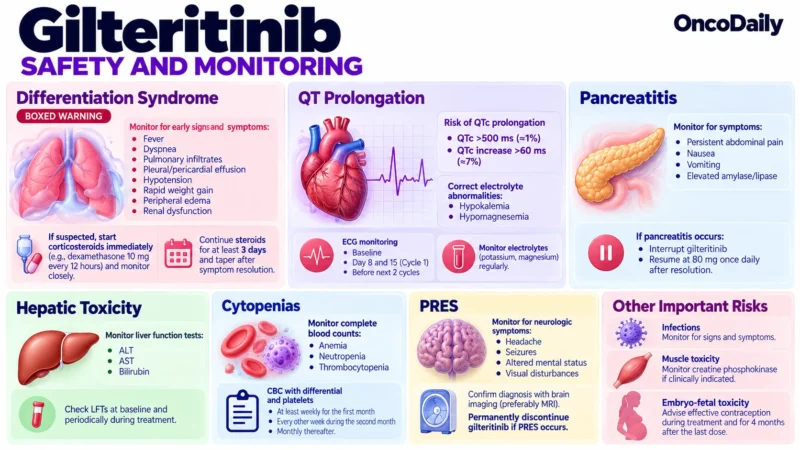
What Monitoring Is Required During Gilteritinib Treatment?
Blood Counts and Blood Chemistries
Assess:
- CBC
- Platelets
- Serum chemistries
- Creatinine
- Liver enzymes
- Creatine phosphokinase
before treatment.
Then monitor:
- At least weekly during the first month
- Every other week during the second month
- Monthly thereafter.
ECG
Perform ECG:
- Before treatment
- Day 8 of Cycle 1
- Day 15 of Cycle 1
- Before the next two subsequent cycles.
Electrolytes
Monitor and correct:
- Potassium
- Magnesium
because abnormalities increase QT risk.
Differentiation Syndrome
Monitor closely for:
- Fever
- Dyspnea
- Weight gain
- Hypoxia
- Pulmonary infiltrates
- Peripheral edema
- Pleural/pericardial effusion
- Hypotension
- Renal dysfunction
particularly during the first several weeks.
Pancreatic Toxicity
Monitor for symptoms of pancreatitis and check:
- Amylase
- Lipase
when clinically indicated.
Neurologic Monitoring
Monitor for symptoms suggestive of PRES:
- Seizures
- Altered mental status
- Headache
- Visual symptoms
Disease Response
Monitor:
- Bone marrow blasts
- Peripheral blood counts
- FLT3 status when clinically indicated
- MRD when available
- Transplant eligibility
- Evidence of disease progression
FAQ
What is gilteritinib used for?
What is the standard dose?
How many tablets is 120 mg?
40 mg tablets once daily.
Does gilteritinib work against FLT3-ITD?
Does it work against FLT3-TKD?
It has clinically established activity against TKD mutations including D835/I836.
Can gilteritinib be taken with food?
It may be taken:
with or without food.
How long should treatment continue before deciding it has failed?
6 months
because responses can be delayed.
What is the most important safety warning?
Does gilteritinib prolong QT?
ECG and electrolyte monitoring are required.