





Gefitinib (Iressa): Understanding Its Mechanism, Dosing, and Clinical Role in EGFR-Mutated Lung Cancer
Key takeaways
- Gefitinib is an oral first-generation EGFR tyrosine kinase inhibitor.
- It reversibly inhibits EGFR phosphorylation and downstream proliferative signaling.
- The FDA-approved dose is 250 mg orally once daily.
- It may be taken with or without food.
- The current US indication is first-line metastatic NSCLC with EGFR exon 19 deletion or exon 21 L858R mutation.
- IPASS and NEJ002 established the importance of EGFR mutation selection for gefitinib therapy.
- Characteristic side effects include rash and diarrhea.
- Serious toxicities include interstitial lung disease, hepatotoxicity, keratitis, gastrointestinal perforation, and severe skin reactions.
- Drugs that raise gastric pH can reduce gefitinib exposure.
- - Modern EGFR-mutated NSCLC therapy has increasingly shifted toward newer-generation and combination strategies, but gefitinib remains an important drug historically and clinically.
Gefitinib (Iressa) is an oral, first-generation epidermal growth factor receptor (EGFR) tyrosine kinase inhibitor used in molecularly selected patients with non-small cell lung cancer (NSCLC).
In the United States, gefitinib is FDA-approved for the first-line treatment of metastatic NSCLC with EGFR exon 19 deletions or exon 21 L858R substitution mutations, detected by an FDA-approved test. The standard dose is 250 mg orally once daily.
Gefitinib was one of the drugs that helped establish the principle of biomarker-directed therapy in lung cancer. Its development also demonstrated why molecular selection matters: early studies in unselected NSCLC populations produced inconsistent results, whereas patients with sensitizing EGFR mutations showed substantial and durable responses.
Key Facts
- Generic name: Gefitinib
- Brand name: Iressa
- Drug class: First-generation EGFR tyrosine kinase inhibitor
- Route: Oral
- Standard dose: 250 mg once daily
- Administration: With or without food
- Current US indication: First-line metastatic NSCLC with EGFR exon 19 deletion or exon 21 L858R mutation
- First US accelerated approval: 2003
- Current biomarker-selected US approval: 2015
- Major mechanism: Reversible inhibition of EGFR tyrosine kinase activity
- Common toxicities: Acneiform rash, diarrhea, dry skin, elevated liver enzymes
- Important serious toxicities: Interstitial lung disease, hepatotoxicity, severe diarrhea, keratitis, gastrointestinal perforation, and severe cutaneous reactions
- Major interactions: CYP3A4 modulators and drugs that increase gastric pH
- Half-life: Approximately 48 hours
- Main elimination: Fecal/hepatobiliary
Gefitinib first received accelerated FDA approval in 2003 for previously treated, unselected NSCLC. That indication was subsequently restricted and withdrawn after confirmatory studies failed to demonstrate benefit in the unselected population. A new, biomarker-driven approval followed in 2015 for EGFR-mutated metastatic NSCLC.
What Is Gefitinib?
Gefitinib is a small-molecule EGFR tyrosine kinase inhibitor.
EGFR is a transmembrane receptor involved in signaling pathways regulating:
- Cell proliferation
- Cell survival
- Differentiation
- Angiogenesis
- Invasion and metastasis
Certain activating EGFR mutations can make malignant cells particularly dependent on EGFR signaling.
The two most important classical sensitizing mutations are:
EGFR exon 19 deletions
and
EGFR exon 21 L858R substitution mutations.
These mutations are the molecular basis of the current FDA-approved indication for gefitinib.
What Is the Mechanism of Action of Gefitinib?
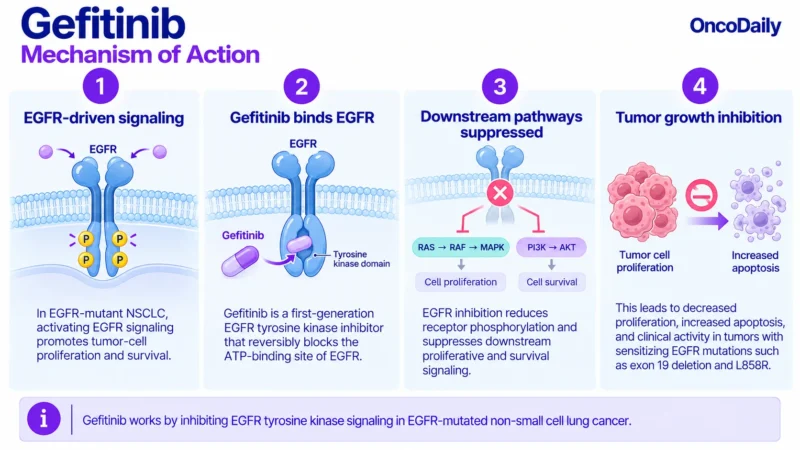
1. EGFR Activation
Under normal conditions, ligand binding activates EGFR and promotes receptor dimerization and intracellular tyrosine kinase activity.
This leads to phosphorylation of intracellular signaling proteins that promote cell proliferation and survival.
2. Activating EGFR Mutations
Mutations such as:
- Exon 19 deletion
- Exon 21 L858R
can produce constitutive or enhanced EGFR signaling and contribute to malignant-cell growth.
3. Gefitinib Binds the EGFR Kinase Domain
Gefitinib binds reversibly to the intracellular ATP-binding region of EGFR.
It inhibits EGFR tyrosine kinase activity and prevents receptor autophosphorylation.
4. Downstream Signaling Is Suppressed
Inhibition of EGFR reduces downstream proliferative and survival signaling, including pathways involving:
- RAS–RAF–MAPK
- PI3K–AKT
5. Cancer-Cell Growth Is Inhibited
Suppression of EGFR-dependent signaling reduces proliferation and survival and can promote apoptosis in EGFR-dependent malignant cells.
The mechanism can be summarized as:
Gefitinib → EGFR kinase inhibition → reduced receptor phosphorylation → suppression of downstream signaling → decreased proliferation and survival → cancer-cell death.
Gefitinib has greater binding affinity for EGFR containing exon 19 deletion or L858R mutations than for wild-type EGFR.
What Is the Dose of Gefitinib?
The recommended FDA dose is:
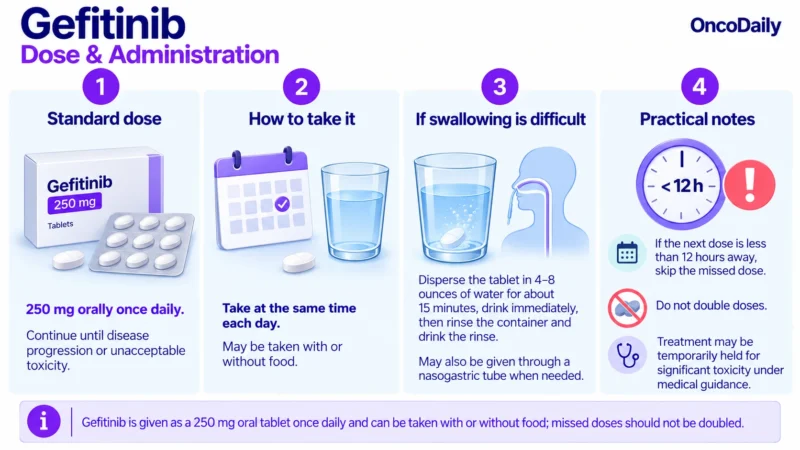
250 mg orally once daily.
Treatment is continued until:
- Disease progression, or
- Unacceptable toxicity.
Gefitinib can be taken:
With or without food.
If a dose is missed and the next scheduled dose is less than 12 hours away, the missed dose should be skipped rather than doubled.
How Is Gefitinib Administered?
Gefitinib is available as:
250 mg film-coated tablets.
The tablet is taken orally once each day.
For Patients Who Cannot Swallow Tablets
The tablet may be placed in:
4–8 ounces of water
and stirred for approximately:
15 minutes.
The mixture should be taken immediately.
The container should then be rinsed with another 4–8 ounces of water and the rinse consumed.
The same preparation can be administered through a nasogastric tube when clinically appropriate.
Are Dose Interruptions Used?
Yes.
Gefitinib may be withheld for up to 14 days for clinically significant toxicity.
Treatment should generally be temporarily withheld for:
- New or worsening dyspnea, cough, or fever while evaluating for interstitial lung disease
- Grade ≥2 ALT or AST elevation
- Grade ≥3 diarrhea
- Severe or worsening ocular toxicity, including keratitis
- Grade ≥3 skin toxicity
Treatment may be resumed after the toxicity has adequately improved.
Gefitinib should be permanently discontinued for conditions including:
- Confirmed interstitial lung disease
- Severe hepatic impairment related to toxicity
- Gastrointestinal perforation
- Persistent ulcerative keratitis.
Does Gefitinib Require Renal or Hepatic Dose Adjustment?
Renal Impairment
Less than 4% of gefitinib and its metabolites are eliminated through the kidneys.
Population pharmacokinetic analyses have not demonstrated a clinically meaningful effect of renal function when creatinine clearance is above approximately:
20 mL/min.
Therefore, routine dose reduction is not generally required for mild or moderate renal impairment.
However, gefitinib has not been adequately studied in patients with severe renal impairment, so closer monitoring is appropriate.
Hepatic Impairment
Gefitinib is primarily metabolized by the liver.
Exposure is increased in patients with hepatic impairment caused by cirrhosis, particularly with moderate or severe impairment.
There is no standard reduced-dose schedule comparable with some cytotoxic agents. Instead, patients with hepatic dysfunction should be monitored carefully for toxicity.
Liver function tests should also be monitored during therapy, and treatment should be withheld for clinically significant transaminase elevation.
Severe hepatic toxicity may require permanent discontinuation.
What Is the Pharmacokinetic Profile of Gefitinib?
Absorption
Mean oral bioavailability is approximately:
60%.
Peak plasma concentrations generally occur approximately:
3–7 hours after administration.
Food does not meaningfully alter bioavailability, which is why gefitinib may be taken with or without food.
Distribution
Gefitinib distributes extensively throughout the body.
The reported steady-state volume of distribution is approximately:
1,400 L.
Plasma protein binding is approximately:
90%.
Metabolism
Gefitinib undergoes extensive hepatic metabolism, predominantly through:
CYP3A4.
CYP2D6 contributes to formation of the metabolite O-desmethyl gefitinib.
Half-Life
The elimination half-life is approximately:
48 hours.
Steady-state concentrations are generally reached within approximately:
10 days of daily treatment.
Elimination
Elimination occurs mainly through the fecal route.
Approximately:
86% of administered drug-related material is recovered in feces.
Renal elimination accounts for:
less than 4%.
What Are the Important Drug Interactions With Gefitinib?
Strong CYP3A4 Inducers
Strong CYP3A4 inducers can substantially reduce gefitinib exposure.
Examples include:
- Rifampicin
- Phenytoin
- Certain other strong enzyme-inducing medications
The US prescribing information permits increasing gefitinib to:
500 mg once daily
during necessary treatment with a strong CYP3A4 inducer, provided severe toxicity is absent.
The dose should return to:
250 mg daily seven days after the inducer is discontinued.
Strong CYP3A4 Inhibitors
Strong CYP3A4 inhibitors can increase gefitinib exposure.
Examples include:
- Ketoconazole
- Itraconazole
Patients should be monitored more closely for adverse reactions.
Proton Pump Inhibitors
Gefitinib solubility decreases as gastric pH increases.
Therefore, proton pump inhibitors can reduce gefitinib exposure.
When possible, concomitant PPIs should be avoided.
If a PPI is required, gefitinib should be taken:
12 hours after the previous PPI dose or 12 hours before the next PPI dose.
H2-Receptor Antagonists and Antacids
Gefitinib should be taken:
6 hours before or 6 hours after
an H2-receptor antagonist or antacid.
Warfarin
Patients receiving warfarin should undergo regular:
PT/INR monitoring
because elevated INR and hemorrhage have been reported.
What Are the Clinical Uses of Gefitinib?
EGFR-Mutated Metastatic NSCLC
The FDA-approved indication is first-line treatment of metastatic NSCLC harboring:
EGFR exon 19 deletion
or:
EGFR exon 21 L858R substitution mutation.
Molecular testing should therefore be performed before treatment.
Testing may be performed on:
- Tumor tissue
- Plasma circulating tumor DNA
If plasma testing is negative and adequate tumor tissue is available, tumor testing should be considered because a negative plasma result does not necessarily exclude an EGFR mutation.
Other EGFR Mutations
The current US label specifically states that safety and efficacy are not established for metastatic NSCLC with EGFR mutations other than exon 19 deletion or exon 21 L858R.
Gefitinib has nevertheless demonstrated activity in some uncommon sensitizing mutations in clinical studies, but treatment decisions for uncommon EGFR mutations should follow mutation-specific evidence and contemporary guidelines rather than automatically extrapolating the classical-mutant indication.
What Did Gefitinib Clinical Trials Show?
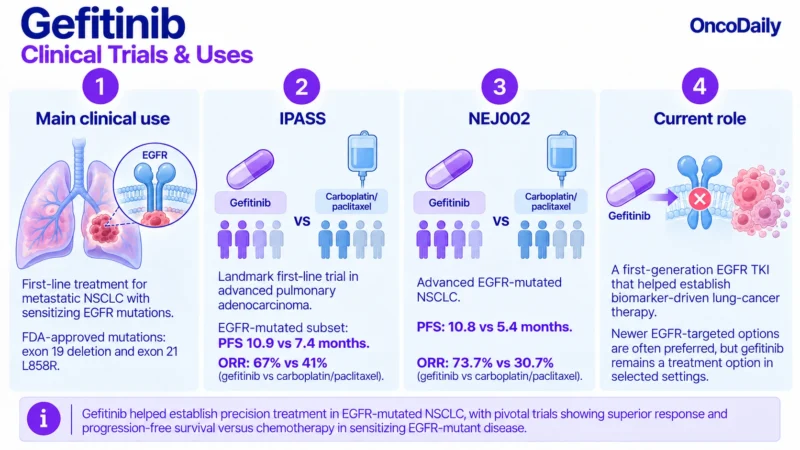
IPASS: Gefitinib Versus Carboplatin/Paclitaxel
The landmark IPASS trial randomized:
1,217 patients
with previously untreated advanced pulmonary adenocarcinoma who were never-smokers or former light smokers.
Patients received:
- Gefitinib 250 mg daily
- Carboplatin plus paclitaxel
The overall trial demonstrated that molecular EGFR status strongly predicted benefit.
Among patients with EGFR-mutated tumors, gefitinib produced substantially better progression-free outcomes and tumor response than chemotherapy.
In the FDA-reviewed EGFR-mutated subset assessed by blinded independent review:
Median progression-free survival:
- Gefitinib: 10.9 months
- Carboplatin/paclitaxel: 7.4 months
Objective response rate:
- Gefitinib: 67%
- Chemotherapy: 41%
Median duration of response was:
Gefitinib: 9.6 months
Chemotherapy: 5.5 months
IPASS became a landmark precision-oncology study by demonstrating that EGFR mutation status—not clinical characteristics alone—should guide EGFR-TKI treatment selection.
Watch more: Targeted Therapies in Lung Cancer — Bruce Johnson, MD, Dana-Farber Cancer Institute, presented in connection with WCLC 2021. It reviews the development of precision medicine in NSCLC, including EGFR mutations, gefitinib, and the IPASS trial.
NEJ002: Gefitinib Versus Carboplatin/Paclitaxel
NEJ002 enrolled approximately:
230 patients
with advanced NSCLC harboring sensitizing EGFR mutations.
Patients received first-line gefitinib or carboplatin/paclitaxel.
Median progression-free survival:
- Gefitinib: 10.8 months
- Chemotherapy: 5.4 months
Objective response rate:
Gefitinib: 73.7%
Chemotherapy: 30.7%
The PFS advantage was large enough that the study was stopped early.
Overall survival was not significantly different, largely in the context of treatment crossover and subsequent therapies.
IFUM: First-Line Gefitinib in EGFR-Mutated NSCLC
The phase IV IFUM study evaluated gefitinib in Caucasian patients with EGFR mutation-positive advanced NSCLC.
A total of:
106 patients
received gefitinib 250 mg daily.
Reported outcomes included:
Objective response rate: approximately 70%
Disease control rate: approximately 91%
Median progression-free survival: approximately 9.7 months
The study provided prospective evidence that gefitinib’s activity in EGFR-mutated NSCLC extended beyond the Asian populations in which much of the early randomized evidence had been generated.
INTEREST: Gefitinib Versus Docetaxel
The phase III INTEREST trial evaluated gefitinib versus docetaxel in previously treated advanced NSCLC.
The study included:
1,466 patients.
Median overall survival was:
- Gefitinib: 7.6 months
- Docetaxel: 8.0 months
Gefitinib met the prespecified criterion for noninferiority in overall survival.
Its toxicity profile differed substantially from docetaxel, with more rash and diarrhea but markedly less neutropenia and alopecia.
This trial predates routine molecular selection and illustrates why later development increasingly focused on EGFR-mutated disease.
Is Gefitinib FDA Approved?
Yes.
Gefitinib has an unusual regulatory history.
It first received accelerated US approval in May 2003 for previously treated advanced NSCLC in an unselected population.
That indication was later restricted and ultimately withdrawn after confirmatory studies failed to demonstrate the anticipated benefit.
As understanding of EGFR biology developed, gefitinib was reevaluated in biomarker-selected patients.
On July 13, 2015, the FDA approved gefitinib for first-line treatment of metastatic NSCLC with:
- EGFR exon 19 deletion, or
- EGFR exon 21 L858R substitution mutation.
What Is the Current Clinical Role of Gefitinib?
Gefitinib remains an effective first-generation EGFR TKI with strong historical and clinical evidence in sensitizing EGFR-mutated NSCLC.
However, the treatment landscape has changed considerably.
Modern first-line EGFR-mutated NSCLC therapy increasingly uses strategies with stronger systemic and central nervous system activity, including third-generation EGFR TKIs and newer combination approaches. Osimertinib-based regimens and amivantamab plus lazertinib are among contemporary options that have shifted gefitinib away from being the dominant first-line treatment in regions where newer therapies are accessible.
Gefitinib may nevertheless remain clinically relevant depending on:
- Drug availability
- Cost and reimbursement
- Regional approvals
- Patient comorbidities
- Previous therapy
- Toxicity considerations
- Local guideline recommendations
Its historical importance is substantial: gefitinib helped demonstrate that lung cancer treatment should be driven by tumor molecular biology rather than histology alone.
Gefitinib helped establish biomarker-driven treatment in lung cancer. Learn more about EGFR-mutant NSCLC and the evolving role of targeted therapy on OncoDaily.
What Are the Major Side Effects of Gefitinib?
The most characteristic toxicities of gefitinib involve the:
- Skin
- Gastrointestinal tract
- Liver
The most frequently reported adverse effects include:
- Acneiform rash
- Dry skin
- Pruritus
- Diarrhea
- Nausea
- Vomiting
- Reduced appetite
- Stomatitis
- Nail disorders
- Elevated ALT and AST
- Ocular irritation
Across major randomized studies, skin reactions and diarrhea were among the most common toxicities.
Acneiform Rash and Skin Toxicity
EGFR signaling is important in normal epidermal biology, so EGFR inhibition frequently causes dermatologic toxicity.
Skin manifestations may include:
- Acneiform rash
- Dry skin
- Erythema
- Pruritus
- Folliculitis
- Paronychia
- Nail changes
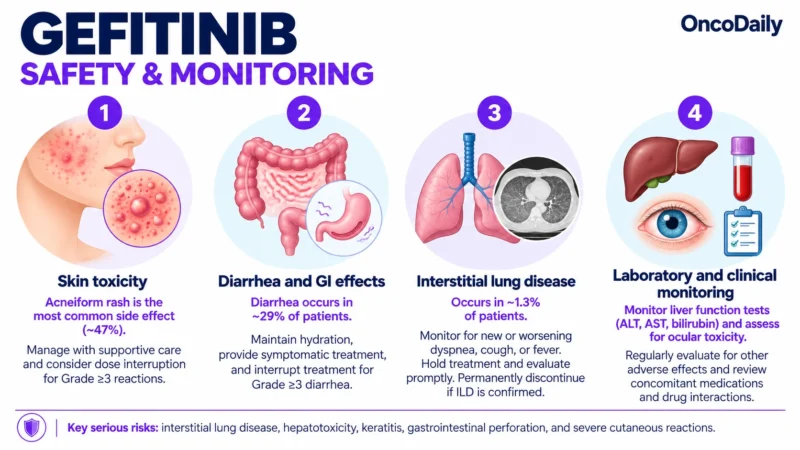
In one large controlled study, skin reactions occurred in approximately:
47% of gefitinib-treated patients.
Severe bullous or exfoliative disorders, including Stevens–Johnson syndrome and toxic epidermal necrolysis, are rare but potentially serious.
Diarrhea
Diarrhea is another common class effect of EGFR inhibition.
It occurred in approximately:
29%
of gefitinib-treated patients in one major controlled study.
Grade 3–4 diarrhea occurred in approximately:
3%.
Severe or persistent diarrhea may require treatment interruption.
Interstitial Lung Disease
Interstitial lung disease is one of the most important potentially fatal complications of gefitinib.
Across the clinical-trial safety database, ILD or ILD-like events occurred in approximately:
1.3%
of patients.
Symptoms may include:
- New or worsening dyspnea
- Cough
- Fever
- Hypoxemia
- New pulmonary infiltrates
Gefitinib should be withheld immediately while suspected ILD is investigated.
If ILD is confirmed:
Gefitinib should be permanently discontinued.
Hepatotoxicity
Gefitinib may cause elevations in:
- ALT
- AST
- Bilirubin
Periodic liver-function testing is recommended.
Clinically important worsening of liver function may require treatment interruption or discontinuation.
Ocular Toxicity
Potential ocular adverse effects include:
- Dry eye
- Conjunctivitis
- Blepharitis
- Corneal erosion
- Keratitis
Patients developing:
- Eye pain
- Photophobia
- Redness
- Excessive tearing
- Blurred vision
should undergo prompt assessment.
Persistent ulcerative keratitis requires permanent discontinuation.
Gastrointestinal Perforation
Gastrointestinal perforation is rare but serious.
Severe or unexplained abdominal pain should prompt urgent evaluation.
Confirmed gastrointestinal perforation requires permanent discontinuation.
Pregnancy and Reproductive Toxicity
Gefitinib can cause fetal harm.
Females of reproductive potential should use effective contraception during therapy and for at least:
2 weeks after the final dose.
What Monitoring Is Required?
Monitoring should include:
- EGFR mutation status before treatment
- Liver function tests periodically
- Skin toxicity
- Diarrhea and hydration
- Respiratory symptoms suggestive of ILD
- Ocular symptoms
- Concomitant medications affecting CYP3A4
- Proton pump inhibitor, H2-blocker, and antacid use
- PT/INR in patients receiving warfarin
- Pregnancy risk when relevant
Particular attention should be given to new respiratory symptoms, because early evaluation for interstitial lung disease is essential.
FAQ
What Is Gefitinib Used For?
How Does Gefitinib Work?
What Is the Standard Dose of Gefitinib?
Should Gefitinib Be Taken With Food?
Does Gefitinib Require EGFR Testing?
What Are the Most Common Side Effects?
- Acneiform rash
- Diarrhea
- Dry skin
- Liver-enzyme elevation