





Fulvestrant (Faslodex): Mechanism of Action, Dosage, Clinical Uses, Trials, and Side Effects
Key takeaways
- Fulvestrant is an injectable selective estrogen receptor degrader that antagonizes ERα and promotes receptor degradation.
- Its standard dose is 500 mg IM on Days 1, 15, and 29, followed by every 28 days.
- CONFIRM established the benefit of 500 mg over 250 mg.
- FALCON demonstrated improved PFS compared with anastrozole in endocrine therapy-naive advanced breast cancer.
- PALOMA-3, MONARCH 2, and MONALEESA-3 established the clinical value of fulvestrant as a backbone for CDK4/6 inhibitor combinations.
- Molecularly selected regimens have expanded fulvestrant's role in contemporary metastatic breast cancer.
- Injection-site complications, hepatic impairment, bleeding risk, and partner-drug toxicities are important clinical considerations.
Fulvestrant (Faslodex) is a selective estrogen receptor degrader (SERD), also described as a selective estrogen receptor downregulator, used in the treatment of hormone receptor-positive (HR-positive) advanced or metastatic breast cancer.
Unlike tamoxifen, which modulates estrogen receptor activity, and aromatase inhibitors, which reduce estrogen production, fulvestrant binds directly to estrogen receptors, blocks their activity, and promotes their degradation. This decreases estrogen-dependent gene transcription and suppresses hormone-sensitive breast cancer growth.
Fulvestrant is a steroidal estrogen receptor antagonist without clinically meaningful estrogen agonist activity. It is administered by deep intramuscular injection rather than orally.
First approved by the FDA in 2002, fulvestrant is used as monotherapy in selected postmenopausal women and in combination with targeted agents, including CDK4/6 inhibitors and therapies targeting the PI3K/AKT/mTOR pathway.
The pivotal CONFIRM and FALCON trials established important monotherapy evidence, while PALOMA-3, MONARCH 2, and MONALEESA-3 demonstrated the benefits of combining fulvestrant with CDK4/6 inhibition.
As of November 2026, fulvestrant remains a major endocrine treatment backbone, particularly after progression on aromatase inhibitors and in molecularly selected metastatic breast cancer.
Key Facts
- Generic name: Fulvestrant
- Brand name: Faslodex
- Drug class: Selective estrogen receptor degrader (SERD)
- Drug type: Steroidal endocrine therapy
- Molecular target: Estrogen receptor alpha (ERα), encoded by ESR1
- Mechanism: Estrogen receptor antagonism, destabilization, and degradation
- Initial FDA approval: 2002
- Administration: Intramuscular injection
- Standard dose: 500 mg IM on Days 1, 15, and 29, then every 28 days
- Formulation: 250 mg/5 mL prefilled syringe
- Injection volume: Two 5 mL injections per 500 mg dose
- Treatment duration: Until disease progression or unacceptable toxicity
- FDA uses: HR-positive advanced/metastatic breast cancer as monotherapy or in selected combinations
- Pivotal trials: CONFIRM, FALCON, PALOMA-3, MONARCH 2, MONALEESA-3
- Required biomarkers: ER and HER2 testing; molecular testing for selected combinations
- Metabolism: Extensive hepatic metabolism, including oxidation, conjugation, and sulfone formation
- Elimination half-life: Approximately 40 days with the long-acting IM formulation
- Major adverse effects: Injection-site pain, nausea, arthralgia, hot flashes, fatigue, and elevated liver enzymes
- Important precautions: Bleeding risk, sciatic nerve injury, hepatic impairment, and embryo-fetal toxicity
- Boxed warning: None
- Monitoring: Injection-site reactions, liver function, bleeding risk, treatment response, and combination-specific toxicities
What Is Fulvestrant?
Fulvestrant is an injectable endocrine therapy designed to inhibit estrogen receptor signaling through receptor antagonism and degradation.
In HR-positive breast cancer, estrogen binds ERα and activates transcriptional pathways that regulate proliferation and survival.
Fulvestrant competes with estradiol for estrogen receptor binding, but unlike tamoxifen, it has no significant estrogen agonist activity.
Its binding changes receptor conformation, interferes with receptor activation, and increases receptor degradation.
The consequent reduction in functional estrogen receptors limits ligand-dependent transcriptional activity.
Fulvestrant is frequently used in patients whose tumors have developed resistance to aromatase inhibitors, especially when endocrine sensitivity remains sufficient to justify further endocrine-based therapy.
How Does Fulvestrant Differ From Tamoxifen and Aromatase Inhibitors?
Fulvestrant: Directly antagonizes and promotes degradation of estrogen receptors.
Tamoxifen: Competitively binds estrogen receptors and produces tissue-dependent antagonist or agonist effects.
Letrozole, anastrozole, and exemestane: Inhibit aromatase and suppress estrogen production.
Unlike aromatase inhibitors, fulvestrant does not depend on reducing estrogen synthesis.
However, resistance can still develop through estrogen receptor alterations and downstream oncogenic signaling.
What Is the Mechanism of Action of Fulvestrant?
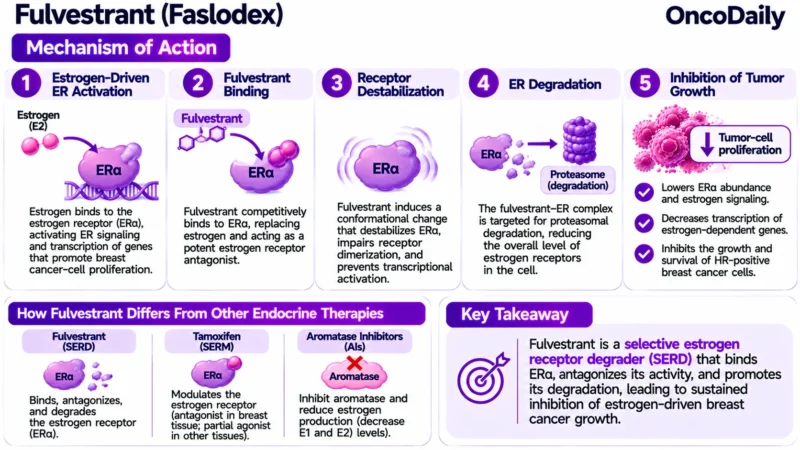
1. Estrogen Receptor Activation
Estradiol binds ERα in hormone receptor-positive breast cancer cells.
Activated estrogen receptors regulate genes involved in proliferation, cell-cycle progression, and survival.
2. Competitive Estrogen Receptor Binding
Fulvestrant competes with estradiol for the estrogen receptor ligand-binding domain.
Its binding prevents normal estrogen-dependent receptor activation.
3. Estrogen Receptor Conformational Change
Fulvestrant produces a receptor conformation unfavorable for transcriptional activation.
It impairs receptor dimerization, nuclear signaling, and interactions with transcriptional coregulators.
4. Receptor Destabilization and Degradation
Fulvestrant promotes estrogen receptor turnover and degradation, involving proteasome-dependent pathways.
This receptor-degrading activity distinguishes fulvestrant from tamoxifen.
5. Suppression of Estrogen-Dependent Transcription
Reduced receptor abundance and receptor activity decrease expression of estrogen-responsive genes.
These include genes involved in cell-cycle progression and tumor survival.
6. Inhibition of Tumor-Cell Proliferation
Reduced estrogen signaling suppresses proliferation in endocrine-sensitive breast cancer.
This may result in disease stabilization or tumor regression.
7. Endocrine Resistance
Resistance may emerge through:
- ESR1 ligand-binding domain mutations
- PI3K/AKT/mTOR pathway activation
- Growth factor receptor signaling
- Cell-cycle dysregulation
- Other estrogen-independent survival mechanisms
Although fulvestrant retains activity against certain ESR1-mutant receptors, mutations can reduce sensitivity, and responses vary by mutation and disease context.
Overall mechanism:
Fulvestrant → ERα binding → receptor antagonism and degradation → reduced estrogen-dependent transcription → inhibition of breast cancer-cell proliferation.
What Is the Recommended Dose of Fulvestrant?
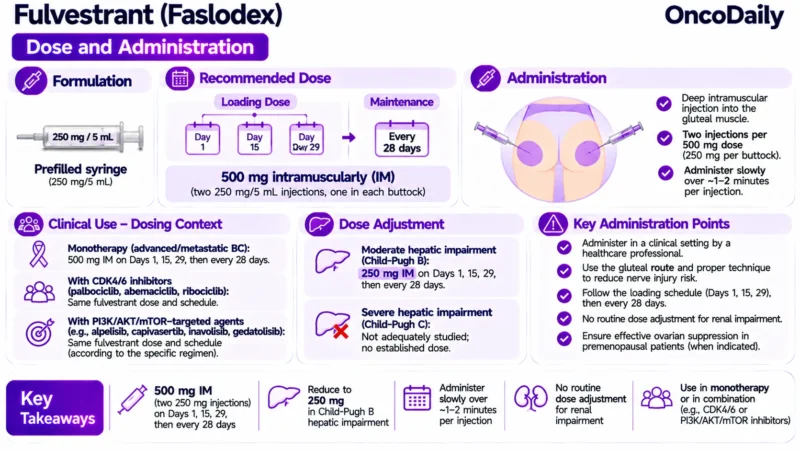
Standard Adult Dose
The FDA-recommended regimen is:
500 mg intramuscularly on Days 1, 15, and 29, followed by 500 mg every 28 days.
Each 500 mg dose consists of two separate 250 mg/5 mL injections, one into each buttock.
The initial loading schedule accelerates achievement of therapeutic exposure.
Monotherapy for Advanced or Metastatic Breast Cancer
For eligible postmenopausal patients:
500 mg IM on Days 1, 15, and 29, then every 28 days.
Continue until progression or unacceptable toxicity.
Combination With Palbociclib
- Fulvestrant: 500 mg IM on Days 1, 15, 29, then every 28 days
- Palbociclib: 125 mg orally daily, Days 1–21 of a 28-day cycle, with dose modifications as appropriate
This regimen is established for selected patients with HR-positive/HER2-negative advanced breast cancer following endocrine therapy.
Combination With Abemaciclib
Fulvestrant: 500 mg IM on Days 1, 15, 29, then every 28 days
Abemaciclib: 150 mg orally twice daily, continuously, with dose modifications as appropriate
Combination With Ribociclib
- Fulvestrant: 500 mg IM on Days 1, 15, 29, then every 28 days
- Ribociclib: 600 mg orally once daily on Days 1–21 of a 28-day cycle, with dose modifications as appropriate
Ribociclib-containing treatment requires additional monitoring, including ECG, electrolytes, liver function, and blood counts.
Combination With Molecularly Targeted Agents
Fulvestrant is also used in selected approved combinations targeting PI3K/AKT/mTOR signaling.
These include alpelisib, capivasertib, inavolisib-containing regimens, and gedatolisib-containing regimens, according to the molecular and clinical eligibility criteria of each treatment.
Fulvestrant generally retains its standard 500 mg loading and maintenance schedule, while the accompanying targeted agent follows its own prescribing information.
Moderate Hepatic Impairment
For patients with Child-Pugh class B hepatic impairment:
250 mg IM on Days 1, 15, and 29, then 250 mg every 28 days.
Each dose consists of one 5 mL injection.
Severe Hepatic Impairment
Fulvestrant has not been adequately studied in Child-Pugh class C hepatic impairment.
No validated dosing recommendation is established.
The regimen above follows U.S. prescribing information.
How Should Fulvestrant Be Administered?
Intramuscular Injection
Fulvestrant is administered as a deep intramuscular injection into the gluteal muscle by a healthcare professional.
It must not be administered intravenously or subcutaneously.
Injection Technique
For a 500 mg dose:
- Administer one 250 mg/5 mL injection into each buttock.
- Deliver each injection slowly over approximately 1–2 minutes.
- Use appropriate gluteal injection technique.
- Exercise caution at dorsogluteal sites because of proximity to the sciatic nerve.
Preparation and Storage
Fulvestrant is supplied in single-dose prefilled syringes.
The branded product is stored refrigerated at 2–8°C, protected from light in the original carton.
The manufacturer’s preparation and administration instructions should be followed.
Premedication
Routine premedication is not required.
Duration
Continue treatment until progression or unacceptable toxicity, according to the applicable regimen.
What Should You Do If a Fulvestrant Dose Is Missed?
Fulvestrant is administered at scheduled clinic visits, not taken at home.
If a dose is missed:
- Contact the treating oncology team to arrange administration.
- Avoid prolonged delays when possible.
- Do not administer an additional compensatory dose without clinical instructions.
- Reassess the schedule if several injections have been missed.
The prescribing information does not provide a universal algorithm for every delayed-dose scenario.
How Are Fulvestrant Dose Modifications Managed?
Fulvestrant has no standard toxicity-based dose-reduction schedule for most adverse effects.
Moderate Hepatic Impairment
Reduce to 250 mg per administration for Child-Pugh class B hepatic impairment.
Injection-Site Reactions
Mild reactions usually require supportive management.
Severe pain, persistent neurological symptoms, or suspected nerve injury requires clinical evaluation.
Bleeding or Hematoma
Exercise caution in patients with thrombocytopenia, bleeding disorders, or anticoagulant use.
Clinically significant bleeding may require delaying treatment or reassessing injection safety.
Hepatic Toxicity
Consider interruption or discontinuation for clinically important liver injury.
Combination-Treatment Toxicity
When fulvestrant is combined with a CDK4/6 inhibitor or PI3K/AKT/mTOR-targeted agent, dose modification generally focuses on the accompanying treatment according to its prescribing information.
What Drug Interactions Are Important With Fulvestrant?
CYP3A4 Inhibitors and Inducers
Fulvestrant undergoes hepatic metabolism, including CYP3A4-mediated pathways.
However, clinical pharmacokinetic studies with ketoconazole and rifampin did not identify clinically significant changes in fulvestrant exposure.
Therefore, routine fulvestrant dose modifications are not recommended for CYP3A4 inhibitors or inducers.
Anticoagulants and Antiplatelet Medications
Fulvestrant is administered intramuscularly.
Patients taking anticoagulants or with significant thrombocytopenia have an increased risk of injection-related bleeding or hematoma.
Use caution and assess bleeding risk.
Estradiol Immunoassays
Fulvestrant may interfere with estradiol immunoassays, producing falsely elevated results.
This is especially important when estradiol is measured to assess ovarian suppression.
If accurate estradiol measurement is needed, a suitably validated mass spectrometry-based assay may be preferable.
Combination Therapies
Clinically significant drug interactions frequently arise from the accompanying targeted agent rather than fulvestrant itself.
For example, ribociclib requires assessment of QT-prolonging drugs and CYP3A interactions, while other targeted combinations may require additional metabolic, hepatic, or hematological monitoring.
Does Fulvestrant Require Dose Adjustment in Renal or Hepatic Impairment?
Renal Impairment
No routine dose adjustment is recommended for mild or moderate renal impairment.
Clinical experience in severe renal dysfunction is limited.
Mild Hepatic Impairment
No dose adjustment is required for Child-Pugh class A hepatic impairment.
Moderate Hepatic Impairment
Reduce to 250 mg IM on the standard loading and maintenance schedule.
Severe Hepatic Impairment
Fulvestrant has not been adequately evaluated in Child-Pugh class C hepatic impairment.
Use requires individualized risk assessment because no established dosing regimen is available.
What Is the Pharmacokinetic Profile of Fulvestrant?
Absorption
After intramuscular injection, fulvestrant is released slowly from its oil-based formulation.
The recommended loading regimen produces therapeutic concentrations more rapidly than monthly administration without loading.
Distribution
Fulvestrant is extensively distributed and approximately 99% protein-bound.
Metabolism
Fulvestrant undergoes extensive hepatic metabolism through multiple pathways, including oxidation, aromatic hydroxylation, conjugation, and sulfone formation.
CYP3A4 contributes to metabolism, but clinically important interactions with strong CYP3A4 modulators have not been consistently demonstrated.
Elimination Half-Life
The apparent elimination half-life after long-acting IM administration is approximately 40 days.
Its prolonged pharmacokinetic profile reflects slow absorption from the injection depot.
Steady State
With the recommended loading regimen, concentrations approach steady state within approximately the first month.
Excretion
Fulvestrant is eliminated predominantly through the fecal route.
Renal elimination is minimal.
Pharmacodynamics
Fulvestrant reduces functional estrogen receptor availability and inhibits estrogen-dependent signaling without directly reducing estrogen synthesis.
What Are the Clinical Uses of Fulvestrant?
First-Line Endocrine Monotherapy
Fulvestrant is approved as monotherapy for selected postmenopausal women with HR-positive/HER2-negative advanced breast cancer who have not previously received endocrine therapy.
FALCON demonstrated improved progression-free survival compared with anastrozole.
However, contemporary combination therapies are frequently preferred when appropriate.
Advanced Breast Cancer After Endocrine Progression
Fulvestrant can be used following progression on previous endocrine therapy.
Its receptor-degrading mechanism makes it a different endocrine strategy from aromatase inhibitors.
Combination With CDK4/6 Inhibitors
Fulvestrant is an established endocrine backbone for combinations with:
- Palbociclib
- Abemaciclib
- Ribociclib
The treatment setting, prior therapy, and menopausal status must be considered.
PI3K/AKT Pathway-Altered Breast Cancer
Molecularly selected fulvestrant-containing regimens include:
- Alpelisib + fulvestrant: PIK3CA-mutated advanced breast cancer
- Capivasertib + fulvestrant: PIK3CA/AKT1/PTEN-altered advanced breast cancer
- Inavolisib + palbociclib + fulvestrant: Selected PIK3CA-mutated endocrine-resistant disease
These combinations have specific approved eligibility criteria and safety requirements.
Read More: CAPItello-291: Final OS Data Show No Significant Survival Benefit, but Capivasertib Plus Fulvestrant Extends Disease Control by OncoDaily.
PIK3CA-Wild-Type Disease After Endocrine Treatment
On July 14, 2026, the FDA approved gedatolisib with fulvestrant, with or without palbociclib, for selected patients with HR-positive/HER2-negative locally advanced or metastatic breast cancer without a detected PIK3CA mutation, following at least one line of endocrine therapy in the metastatic setting.
This expands the relevance of fulvestrant-containing combinations beyond PIK3CA-mutant disease.
Premenopausal Breast Cancer
Fulvestrant may be used in selected premenopausal women with effective ovarian function suppression, usually as part of an appropriate metastatic treatment regimen.
Fulvestrant monotherapy without ovarian suppression is not a standard approach for women with functioning ovaries.
Early-Stage Breast Cancer
Fulvestrant is not FDA-approved for routine adjuvant treatment of early-stage breast cancer.
What Molecular Testing Is Required Before Fulvestrant?
Estrogen Receptor Testing
ER immunohistochemistry is essential when selecting fulvestrant-based treatment.
Tumors with ER expression are more likely to respond to endocrine therapy.
Progesterone Receptor Testing
PR testing provides additional information about hormone sensitivity and tumor biology.
HER2 Testing
HER2 status determines eligibility for HR-positive/HER2-negative targeted regimens and guides broader systemic therapy.
ESR1 Mutation Testing
ESR1 mutations can contribute to endocrine resistance by enabling estrogen receptor activation despite estrogen deprivation.
Fulvestrant may retain activity against certain ESR1-mutant tumors, although its activity depends on mutation type and clinical context.
As of 2026, ESR1 testing is increasingly important because additional oral estrogen receptor-directed therapies have become available.
PIK3CA Testing
PIK3CA mutation status is essential for selecting specific PI3K inhibitor-containing regimens.
AKT1 and PTEN Testing
AKT1 mutations and PTEN alterations help identify eligibility for capivasertib plus fulvestrant.
Menopausal Status
Patients with functioning ovaries generally require effective ovarian suppression when receiving fulvestrant-based endocrine regimens.
What Did the Pivotal Clinical Trials Show?
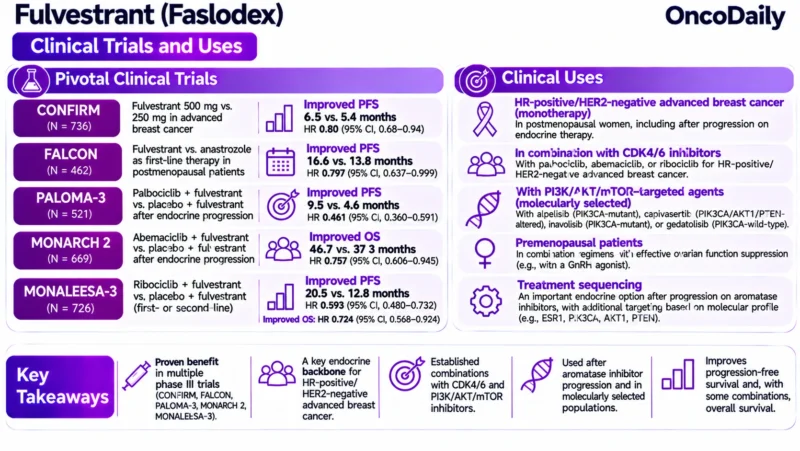
1. CONFIRM — Fulvestrant 500 mg Versus 250 mg
CONFIRM (NCT00099437) randomized 736 postmenopausal women with advanced breast cancer following progression or recurrence after endocrine therapy.
It compared fulvestrant 500 mg with fulvestrant 250 mg.
Median Progression-Free Survival
- 500 mg: 6.5 months
- 250 mg: 5.4 months
Hazard Ratio: 0.80 (95% CI, 0.68–0.94)
P = 0.006
Median Overall Survival — Updated Analysis
- 500 mg: 26.4 months
- 250 mg: 22.3 months
HR: 0.81 (95% CI, 0.69–0.96)
The updated overall survival analysis was not multiplicity-adjusted and should be interpreted accordingly.
CONFIRM established the superiority of the 500 mg regimen, which became the standard fulvestrant dose.
2. FALCON — Fulvestrant Versus Anastrozole
FALCON (NCT01602380) randomized 462 postmenopausal women with HR-positive/HER2-negative locally advanced or metastatic breast cancer who had not previously received endocrine therapy.
Patients received fulvestrant 500 mg or anastrozole 1 mg daily.
Median Progression-Free Survival
- Fulvestrant: 16.6 months
- Anastrozole: 13.8 months
HR: 0.797 (95% CI, 0.637–0.999)
P = 0.049
Objective Response Rate in Measurable Disease
- Fulvestrant: 46.1%
- Anastrozole: 44.9%
The study demonstrated a modest but statistically significant improvement in PFS with fulvestrant monotherapy.
The results support endocrine activity but do not establish fulvestrant monotherapy as superior to current endocrine-targeted combinations.
3. PALOMA-3 — Palbociclib Plus Fulvestrant
PALOMA-3 (NCT01942135) randomized 521 women with HR-positive/HER2-negative advanced breast cancer that had progressed during or after previous endocrine therapy.
Patients received palbociclib plus fulvestrant or placebo plus fulvestrant.
Pre- and perimenopausal patients received ovarian suppression.
Median Progression-Free Survival
- Palbociclib + fulvestrant: 9.5 months
- Placebo + fulvestrant: 4.6 months
HR: 0.461 (95% CI, 0.360–0.591)
P < 0.0001
Median Overall Survival — Final Analysis
- Combination: 34.9 months
- Control: 28.0 months
HR: 0.814 (95% CI, 0.644–1.029)
The overall survival difference did not meet statistical significance in the prespecified analysis.
PALOMA-3 demonstrated substantially improved PFS when palbociclib was added to fulvestrant.
4. MONARCH 2 — Abemaciclib Plus Fulvestrant
MONARCH 2 (NCT02107703) randomized 669 women with HR-positive/HER2-negative advanced breast cancer following progression on endocrine therapy.
Patients received abemaciclib plus fulvestrant or placebo plus fulvestrant.
Median Progression-Free Survival
- Abemaciclib + fulvestrant: 16.4 months
- Placebo + fulvestrant: 9.3 months
HR: 0.553 (95% CI, 0.449–0.681)
P < 0.0001
Median Overall Survival — Reported Interim Analysis
- Combination: 46.7 months
- Control: 37.3 months
HR: 0.757 (95% CI, 0.606–0.945)
MONARCH 2 established improvements in PFS and overall survival with abemaciclib plus fulvestrant.
5. MONALEESA-3 — Ribociclib Plus Fulvestrant
MONALEESA-3 (NCT02422615) randomized 726 postmenopausal women with HR-positive/HER2-negative advanced breast cancer.
Patients received ribociclib plus fulvestrant or placebo plus fulvestrant.
The study included patients receiving initial endocrine-based treatment and patients previously treated with endocrine therapy.
Median Progression-Free Survival — Primary Analysis
- Ribociclib + fulvestrant: 20.5 months
- Placebo + fulvestrant: 12.8 months
HR: 0.593 (95% CI, 0.480–0.732)
P < 0.0001
Overall Survival — Reported Analysis
HR: 0.724 (95% CI, 0.568–0.924)
P = 0.00455
Ribociclib plus fulvestrant significantly improved PFS and overall survival, supporting its role in appropriate HR-positive/HER2-negative advanced breast cancer settings.
Does Fulvestrant Have CNS Activity?
Fulvestrant is not considered a CNS-directed endocrine therapy.
Because it has limited demonstrated intracranial activity and there is insufficient prospective evidence of meaningful CNS response as monotherapy, it should not be relied upon to treat active brain metastases.
In patients with HR-positive breast cancer and CNS metastases, the systemic treatment plan should account for neurological symptoms, CNS disease burden, molecular subtype, and available local or systemic therapies.
Fulvestrant is not approved for primary CNS malignancies.
Is Fulvestrant FDA Approved?
Yes.
Fulvestrant received its initial U.S. approval in 2002.
The standalone Faslodex label includes:
- HR-positive/HER2-negative advanced breast cancer in postmenopausal women not previously treated with endocrine therapy
- HR-positive advanced breast cancer in postmenopausal women after progression on endocrine therapy
- Fulvestrant plus ribociclib for eligible HR-positive/HER2-negative advanced breast cancer
- Fulvestrant plus palbociclib or abemaciclib following endocrine progression in eligible women
Additional approved combinations, including selected PI3K/AKT/mTOR-targeted therapies, are described in the prescribing information for their respective partner drugs.
image
FASLODEX- fulvestrant injection+1
What Is the Current Clinical Role of Fulvestrant in 2026?
Fulvestrant remains an important injectable endocrine backbone for HR-positive/HER2-negative metastatic breast cancer.
Its role is especially relevant after prior aromatase inhibitor exposure and when combining endocrine therapy with a targeted agent.
For patients with PIK3CA, AKT1, or PTEN alterations, molecularly directed combinations may offer substantial benefit.
For patients without a PIK3CA mutation, the 2026 approval of gedatolisib-containing therapy has expanded available options.
Fulvestrant is not the only estrogen receptor-directed treatment available in 2026. Oral SERDs and newer receptor antagonists have introduced additional options, including biomarker-directed approaches for ESR1-mutant disease.
Treatment selection should be guided by prior endocrine therapy, CDK4/6 inhibitor exposure, ESR1 and PI3K/AKT pathway status, disease burden, and patient tolerability.
Watch More: Dr. Matti Aapro on CDK4/6 Inhibitors in Breast Cancer | BGICC 2025 by OncoDaily.
What Are the Major Side Effects of Fulvestrant?
Injection-Site Reactions
Injection-site pain is one of the most characteristic adverse effects.
Patients may experience pain, swelling, bruising, or inflammation at the injection site.
Rare complications include injection-related neuropathy, sciatica, and nerve injury.
Careful administration technique is important.
Musculoskeletal Symptoms
Common adverse effects include:
- Arthralgia
- Bone pain
- Myalgia
- Back pain
- Pain in the extremities
These symptoms can affect daily activity and treatment adherence.
Vasomotor Symptoms
Hot flashes and other menopausal symptoms may occur due to estrogen receptor antagonism.
Gastrointestinal Symptoms
Nausea, vomiting, constipation, and reduced appetite have been reported.
Fatigue
Fatigue and asthenia are common, particularly during prolonged treatment.
Elevated Liver Enzymes
Fulvestrant may increase ALT, AST, and alkaline phosphatase.
In clinical studies, liver enzyme elevations were reported in more than 15% of patients.
Clinically significant hepatic toxicity is less common but requires assessment.
Bleeding and Hematoma Risk
Because fulvestrant is administered intramuscularly, injection-related bleeding is a concern in patients with:
- Thrombocytopenia
- Bleeding disorders
- Anticoagulant treatment
Hypersensitivity
Hypersensitivity reactions, including urticaria and angioedema, have been reported.
Reproductive Toxicity
Fulvestrant can cause fetal harm.
Patients with reproductive potential should use effective contraception during treatment and for one year after the final dose, according to U.S. prescribing information.
Breastfeeding is not recommended during treatment or for one year after the final dose.
Additional Toxicity From Combination Therapy
When fulvestrant is combined with targeted agents, additional toxicities depend on the partner drug.
Examples include:
- Palbociclib: Neutropenia and infections
- Abemaciclib: Diarrhea, neutropenia, hepatotoxicity, and thromboembolism
- Ribociclib: Neutropenia, hepatotoxicity, and QT prolongation
- Alpelisib: Hyperglycemia, rash, and diarrhea
- Capivasertib: Diarrhea, rash, and hyperglycemia
These events should not be attributed automatically to fulvestrant monotherapy.
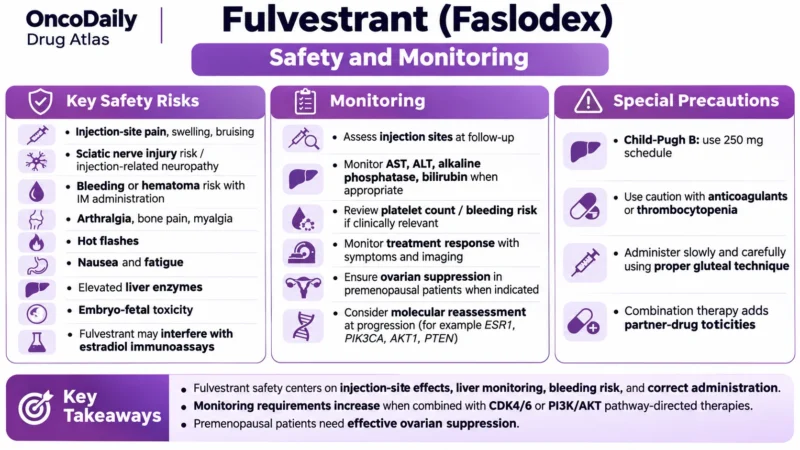
What Monitoring Is Required During Fulvestrant Treatment?
Injection-Site Assessment
Inspect and assess injection sites during treatment.
Investigate severe pain, persistent numbness, weakness, or symptoms suggestive of nerve injury.
Liver Function
Assess AST, ALT, alkaline phosphatase, and bilirubin at baseline when appropriate and periodically based on clinical circumstances.
More frequent monitoring may be necessary for patients receiving hepatotoxic targeted agents.
Bleeding Risk
Review platelet counts, bleeding history, and anticoagulant use before intramuscular administration when relevant.
Treatment Response
Monitor disease status through:
- Clinical assessment
- Symptom evaluation
- Appropriate imaging
- RECIST-based response assessment when applicable
Ovarian Suppression
In premenopausal patients, ensure effective ovarian function suppression throughout fulvestrant-based treatment.
Remember that fulvestrant may interfere with certain estradiol immunoassays.
Molecular Reassessment
At progression, consider appropriate molecular testing, including ESR1 and PI3K/AKT pathway alterations, to guide subsequent treatment.
Combination-Specific Monitoring
Follow the partner drug’s prescribing information for CBC, liver function, glucose, ECG, electrolytes, and other required assessments.
Treatment Adherence
Ensure patients attend scheduled injections, particularly during the loading phase.