





Erlotinib (Tarceva): Understanding Its Mechanism, Dosing, and Clinical Role in Cancer
Key takeaways
- Erlotinib is a first-generation oral EGFR tyrosine kinase inhibitor that reversibly inhibits EGFR signaling. The standard NSCLC dose is 150 mg once daily, while pancreatic cancer treatment uses 100 mg once daily with gemcitabine.
- Unlike gefitinib, erlotinib must be taken on an empty stomach, because food substantially increases drug exposure.
- The EURTAC and OPTIMAL trials established its activity in EGFR exon 19 deletion- and L858R-mutated NSCLC, while PA.3 established its combination role with gemcitabine in pancreatic cancer.
- The most characteristic adverse effects are acneiform rash and diarrhea, while serious risks include ILD, hepatotoxicity, renal failure, severe skin reactions, ocular toxicity, and GI perforation.
Erlotinib (Tarceva) is an oral, first-generation epidermal growth factor receptor (EGFR) tyrosine kinase inhibitor used in EGFR-mutated non-small cell lung cancer (NSCLC) and, in combination with gemcitabine, in locally advanced, unresectable, or metastatic pancreatic cancer.
Like gefitinib, erlotinib reversibly inhibits the intracellular tyrosine kinase domain of EGFR. In EGFR-mutated lung cancer, this suppresses signaling pathways required for tumor-cell proliferation and survival.
A clinically important difference from gefitinib is administration: erlotinib must be taken on an empty stomach, because food substantially increases drug exposure.
Key Facts
- Generic name: Erlotinib
- Brand name: Tarceva
- Drug class: First-generation EGFR tyrosine kinase inhibitor
- Route: Oral
- Initial US approval: 2004
- NSCLC dose: 150 mg orally once daily
- Pancreatic cancer dose: 100 mg orally once daily with gemcitabine
- Administration: Empty stomach — at least 1 hour before or 2 hours after food
- Available strengths: 25 mg, 100 mg, and 150 mg tablets
- NSCLC biomarker: EGFR exon 19 deletion or exon 21 L858R mutation
- Major mechanism: Reversible inhibition of EGFR tyrosine kinase activity
- Characteristic toxicities: Acneiform rash and diarrhea
- Important serious toxicities: Interstitial lung disease, hepatotoxicity, renal failure, gastrointestinal perforation, severe skin reactions, and ocular toxicity
- Important interactions: CYP3A4 modulators, cigarette smoking, and acid-suppressing drugs.
What Is Erlotinib?
Erlotinib is a small-molecule inhibitor of the EGFR receptor tyrosine kinase.
EGFR signaling regulates cellular proliferation, survival, differentiation, and other processes. In some NSCLCs, activating EGFR mutations make malignant cells highly dependent on this signaling pathway.
The classical sensitizing mutations are:
EGFR exon 19 deletions
and
EGFR exon 21 L858R substitutions.
Erlotinib has greater binding affinity for EGFR carrying these mutations than for wild-type EGFR.
What Is the Mechanism of Action of Erlotinib?
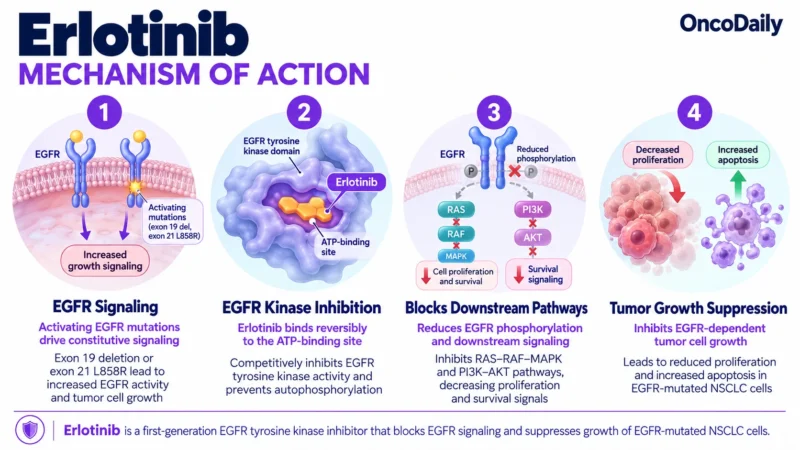
1. EGFR Activation
Activation of EGFR normally stimulates receptor autophosphorylation and downstream signaling involved in tumor-cell growth and survival.
2. Erlotinib Binds the EGFR Kinase Domain
Erlotinib enters the cell and binds reversibly to the intracellular ATP-binding region of the EGFR tyrosine kinase domain.
3. EGFR Phosphorylation Is Inhibited
By blocking kinase activity, erlotinib prevents EGFR autophosphorylation.
4. Downstream Signaling Is Suppressed
EGFR inhibition reduces signaling through pathways including:
RAS–RAF–MAPK
and
PI3K–AKT.
These pathways normally promote proliferation and survival.
5. Tumor Growth Is Inhibited
Suppression of EGFR-dependent signaling decreases malignant-cell proliferation and survival and can promote apoptosis.
The mechanism can be summarized as:
Erlotinib → EGFR kinase inhibition → reduced phosphorylation → suppression of MAPK/AKT signaling → reduced proliferation and survival → tumor-cell death.
What Is the Dose of Erlotinib?
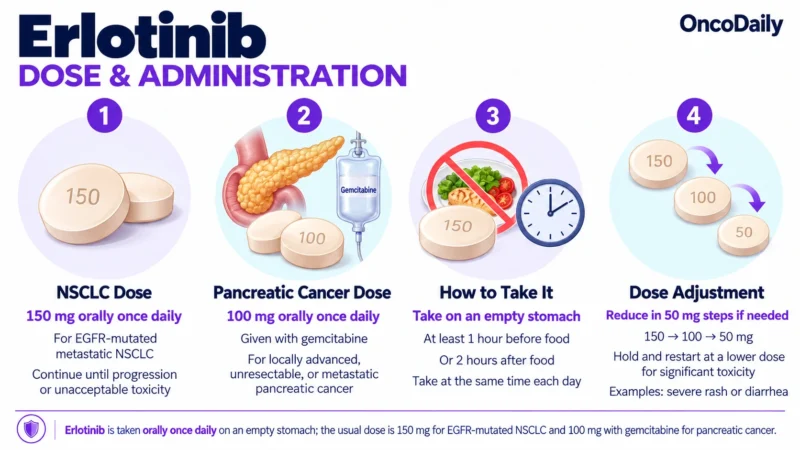
EGFR-Mutated NSCLC
The recommended dose is:
150 mg orally once daily.
Treatment generally continues until:
Disease progression or unacceptable toxicity.
Importantly, erlotinib should be taken:
At least 1 hour before or 2 hours after food.
Pancreatic Cancer
The recommended dose is:
100 mg orally once daily
in combination with:
Gemcitabine.
It should again be taken on an empty stomach.
The pancreatic cancer indication is for first-line treatment of locally advanced, unresectable, or metastatic pancreatic cancer.
Why Must Erlotinib Be Taken on an Empty Stomach?
Food substantially increases erlotinib exposure.
Oral absorption is approximately 60% under fasting conditions, while food can increase bioavailability toward approximately 100%.
For this reason, consistent fasting administration is important to avoid unexpectedly high drug exposure and toxicity.
How Is Erlotinib Administered?
Erlotinib is supplied as oral tablets in:
25 mg, 100 mg, and 150 mg strengths.
It should be taken once daily at approximately the same time, maintaining the fasting interval around the dose.
Unlike intravenous chemotherapy, erlotinib requires no infusion preparation, premedication, or in-line filter.
Dose Interruption and Reduction
For significant toxicity, treatment may be withheld until the adverse effect improves.
When treatment is restarted following a dose-limiting toxicity that has returned to baseline or approximately Grade 1 or lower, the prescribing information recommends reducing the dose in:
50 mg decrements.
For example:
150 mg → 100 mg → 50 mg
depending on the toxicity and clinical circumstances.
Treatment interruption or permanent discontinuation may be required for severe:
- Interstitial lung disease
- Hepatic toxicity
- Renal toxicity
- Persistent diarrhea
- Severe skin reactions
- Keratitis or corneal ulceration
- Gastrointestinal perforation.
What Are the Important Drug Interactions With Erlotinib?
Proton Pump Inhibitors
Erlotinib absorption is pH dependent.
Increasing gastric pH reduces its solubility and exposure.
With omeprazole, erlotinib exposure decreased substantially, including an approximately 46% reduction in AUC.
Therefore:
Proton pump inhibitors should be avoided when possible.
H2-Receptor Antagonists
If an H2 antagonist is required, the doses should be separated.
Erlotinib should be taken approximately:
10 hours after the H2 antagonist
and:
At least 2 hours before the next H2-antagonist dose.
Antacids
Antacids and erlotinib should be separated by:
Several hours.
CYP3A4 Inhibitors
Strong CYP3A4 inhibitors can increase erlotinib exposure.
Examples include certain azole antifungals, macrolide antibiotics, protease inhibitors, and grapefruit products.
If clinically significant toxicity occurs and the interacting medication cannot be avoided, erlotinib may require reduction in 50 mg increments.
CYP3A4 Inducers
Strong inducers can markedly reduce erlotinib exposure.
Examples include:
Rifampin, carbamazepine, phenytoin, phenobarbital, and St John’s wort.
If unavoidable, the label allows gradual dose escalation in selected patients, with careful monitoring.
Cigarette Smoking
This is particularly important with erlotinib.
Smoking induces CYP1A2 and substantially reduces erlotinib exposure. In pharmacokinetic studies, smoking decreased erlotinib AUC by approximately 64% compared with former or never smokers.
Patients should therefore be encouraged to stop smoking.
The prescribing information permits carefully increasing erlotinib in continuing smokers up to 300 mg daily, followed by immediate return to the standard dose when smoking stops.
What Is the Pharmacokinetic Profile of Erlotinib?
Absorption
Approximately 60% of an oral dose is absorbed under fasting conditions.
Peak plasma concentrations occur at approximately:
4 hours.
Food substantially increases bioavailability.
Distribution
Erlotinib is approximately:
93% protein bound.
The apparent volume of distribution is approximately:
232 L.
Metabolism
Erlotinib is metabolized mainly by:
CYP3A4
with contributions from:
CYP1A2 and CYP1A1.
Half-Life
The median elimination half-life is approximately:
36 hours.
Steady-state concentrations are generally reached after:
7–8 days.
Elimination
Following oral administration, most drug-related material is eliminated through the fecal route.
Approximately 83% is recovered in feces and 8% in urine.
What Are the Clinical Uses of Erlotinib?
EGFR-Mutated Metastatic NSCLC
The current US indication includes metastatic NSCLC harboring:
EGFR exon 19 deletion
or:
EGFR exon 21 L858R substitution mutation.
Patient selection should be based on an FDA-approved molecular test.
If plasma testing is negative and tumor tissue is available, tumor testing should be considered because a negative plasma test does not reliably exclude an EGFR mutation.
Erlotinib historically played an important role in establishing first-line targeted therapy for EGFR-mutated NSCLC.
Pancreatic Cancer
Erlotinib is also FDA-approved in combination with gemcitabine for:
Locally advanced, unresectable, or metastatic pancreatic cancer.
Its development in pancreatic cancer was notable because the PA.3 trial demonstrated a statistically significant, although modest, survival improvement when erlotinib was added to gemcitabine.
What Did Erlotinib Clinical Trials Show?
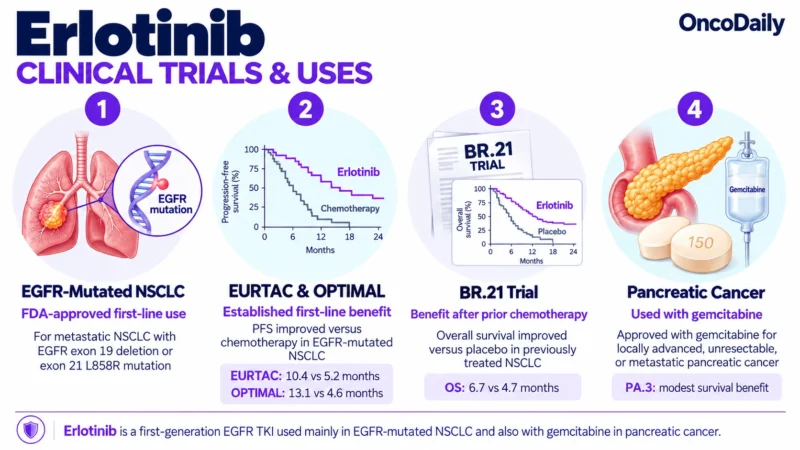
EURTAC: Erlotinib in EGFR-Mutated NSCLC
The phase III EURTAC trial evaluated erlotinib versus platinum-based chemotherapy in European patients with EGFR-mutated advanced NSCLC.
173 randomized patients were included.
In the regulatory analysis, median progression-free survival was approximately:
Erlotinib: 10.4 months
versus:
Chemotherapy: 5.2 months.
The objective response rate was approximately:
65% with erlotinib
versus:
16% with chemotherapy.
These results established the activity of first-line erlotinib in molecularly selected EGFR-mutated disease.
OPTIMAL / CTONG-0802
OPTIMAL compared erlotinib with gemcitabine plus carboplatin in Chinese patients with advanced NSCLC harboring exon 19 deletion or L858R mutations.
Median progression-free survival was:
13.1 months with erlotinib
versus:
4.6 months with chemotherapy.
This corresponded to a hazard ratio of approximately:
0.16.
The trial provided strong evidence that EGFR mutation-selected patients derive substantially greater disease-control benefit from targeted EGFR inhibition than from conventional first-line chemotherapy.
Final overall survival was similar between treatment groups, influenced in part by subsequent therapies and crossover.
BR.21: Erlotinib After Previous Chemotherapy
BR.21 randomized 731 patients with previously treated advanced NSCLC to erlotinib or placebo.
Median overall survival was:
Erlotinib: 6.7 months
versus:
Placebo: 4.7 months.
Progression-free survival was:
2.2 vs 1.8 months.
The objective response rate was:
8.9% with erlotinib
versus:
less than 1% with placebo.
This trial was important in the early development of erlotinib, before routine molecular EGFR selection became standard practice.
PA.3: Erlotinib + Gemcitabine in Pancreatic Cancer
The phase III PA.3 trial enrolled:
569 patients
with advanced pancreatic cancer.
Patients received gemcitabine plus either erlotinib or placebo.
Median overall survival was:
6.24 months with erlotinib + gemcitabine
versus:
5.91 months with gemcitabine alone.
One-year survival was:
23% vs 17%.
Progression-free survival was also statistically improved.
The magnitude of benefit was modest, but the study established the pancreatic cancer indication.
Is Erlotinib FDA Approved?
Yes.
Erlotinib received its initial US approval in 2004.
Its current US indications include EGFR exon 19 deletion- or exon 21 L858R-mutated metastatic NSCLC and first-line treatment of locally advanced, unresectable, or metastatic pancreatic cancer in combination with gemcitabine.
What Is the Current Clinical Role of Erlotinib?
Erlotinib remains a biologically effective first-generation EGFR TKI and continues to have regulatory approval for sensitizing EGFR-mutated metastatic NSCLC.
However, the treatment landscape has evolved substantially. Newer EGFR-directed strategies—including osimertinib-based treatment and amivantamab plus lazertinib—now provide additional first-line options with stronger contemporary evidence, including improved CNS activity and newer survival data.
As a result, erlotinib is used less frequently as the dominant first-line EGFR inhibitor in regions where newer therapies are readily accessible, although it can remain relevant according to availability, cost, toxicity profile, prior therapy, and regional practice.
Its role in pancreatic cancer also remains part of the FDA label, although the survival improvement demonstrated with gemcitabine was relatively small.
Erlotinib helped establish EGFR-directed treatment in lung cancer. Learn more about EGFR-mutant NSCLC and the evolving role of targeted therapy on OncoDaily.
Watch more: Targeted Therapies in Lung Cancer — Bruce Johnson, MD, Dana-Farber Cancer Institute, discussing the development of precision medicine in NSCLC, including EGFR mutations and first-generation EGFR TKIs such as erlotinib and gefitinib.
What Are the Major Side Effects of Erlotinib?
Acneiform Rash
Rash is one of the most characteristic adverse effects of erlotinib.
Across clinical studies, rash occurred frequently, and in the first-line EGFR-mutated NSCLC trial it was reported in approximately:
85% of patients, with Grade 3–4 rash in approximately 14%.
The rash typically affects areas rich in sebaceous glands, including the:
Face, scalp, upper chest, and back.
Median time to onset in the first-line study was approximately:
15 days.
Diarrhea
Diarrhea is another major EGFR-TKI class effect.
In the first-line EGFR-mutated NSCLC study it occurred in approximately:
62% of patients.
Persistent severe diarrhea can cause:
Dehydration, electrolyte abnormalities, and renal dysfunction.
Severe diarrhea that does not respond to appropriate medical treatment may require treatment interruption.
Interstitial Lung Disease
ILD is uncommon but potentially fatal.
Across approximately 32,000 erlotinib-treated patients in clinical and uncontrolled studies, the reported incidence was approximately:
1.1%.
Symptoms may include:
New or worsening dyspnea, cough, fever, hypoxemia, or pulmonary infiltrates.
Erlotinib should be withheld while suspected ILD is investigated.
If ILD is confirmed:
Permanently discontinue erlotinib.
Hepatotoxicity
Erlotinib can cause elevated:
ALT, AST, bilirubin, and alkaline phosphatase.
Rare cases of hepatic failure and hepatorenal syndrome have occurred.
Periodic liver-function testing is therefore required.
Renal Toxicity
Severe renal failure has been reported, particularly in association with:
Dehydration, severe diarrhea, or underlying hepatic disease.
Renal function and electrolytes should be monitored, especially in patients at increased risk.
Ocular Toxicity
Potential ocular effects include:
Dry eye, abnormal eyelash growth, keratitis, corneal ulceration, and rarely corneal perforation.
New eye pain, redness, photophobia, excessive tearing, or visual changes require prompt assessment.
Gastrointestinal Perforation
GI perforation is rare but potentially fatal.
Risk may be increased with concomitant:
Antiangiogenic therapy, corticosteroids, NSAIDs, taxanes, or a history of peptic ulcer or diverticular disease.
Confirmed GI perforation requires permanent discontinuation.
Severe Skin Reactions
Rare bullous, blistering, or exfoliative disorders, including reactions resembling Stevens–Johnson syndrome or toxic epidermal necrolysis, have been reported.
Severe reactions require treatment discontinuation.
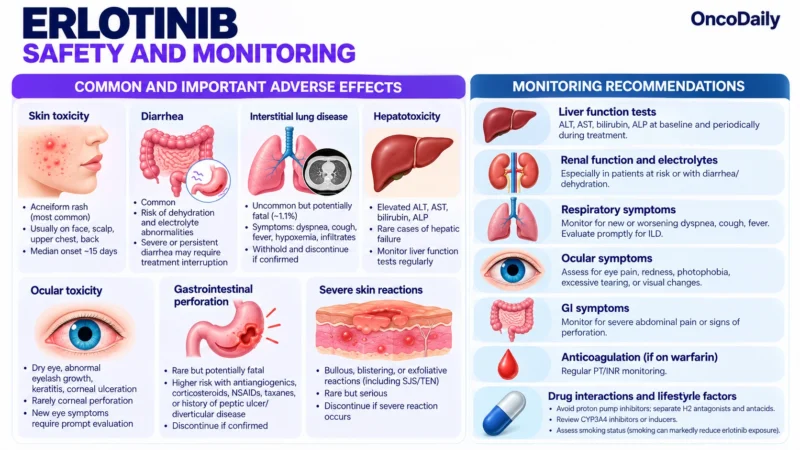
What Monitoring Is Required?
Monitoring should include clinical assessment of rash and diarrhea, periodic liver-function tests, renal function and electrolytes, respiratory symptoms suggestive of ILD, ocular symptoms, hydration status, and review of interacting medications.
Smoking status should also be reviewed because tobacco can markedly reduce erlotinib exposure.
Patients receiving warfarin or another coumarin-derived anticoagulant require regular PT/INR monitoring because serious bleeding associated with elevated INR has been reported.
FAQ
What Is Erlotinib Used For?
How Does Erlotinib Work?
What Is the Standard Dose of Erlotinib?
For pancreatic cancer: 100 mg orally once daily with gemcitabine.
Should Erlotinib Be Taken With Food?
It should be taken at least: 1 hour before or 2 hours after food.
What Is the Difference Between Erlotinib and Gefitinib Administration?
Erlotinib should be taken on an empty stomach because food significantly increases its bioavailability.