


Epcoritamab (Epkinly): Mechanism of Action, Dosing, Clinical Uses, Trials, and Side Effects
Key takeaways
- Epcoritamab is a CD20×CD3 bispecific T-cell-engaging antibody.
- It brings malignant B cells and cytotoxic T cells into close proximity, causing T-cell-mediated apoptosis.
- It was initially FDA approved in 2023.
- Its full treatment dose is 48 mg subcutaneously.
- DLBCL uses two initial step-up doses; FL uses three.
- EPCORE NHL-1 demonstrated an ORR of 61% and CR rate of 38% in the initial regulatory DLBCL/high-grade B-cell lymphoma efficacy population.
- EPCORE NHL-1 demonstrated an ORR of 82% and CR rate of 60% in relapsed/refractory FL.
- EPCORE FL-1 demonstrated superior PFS with epcoritamab plus lenalidomide and rituximab (HR 0.21).
- The FL combination received FDA approval in November 2025.
- The principal safety concerns are CRS, ICANS, serious infections, and cytopenias.
Epcoritamab-bysp (Epkinly) is a CD20×CD3 bispecific T-cell-engaging antibody used to treat selected relapsed or refractory B-cell non-Hodgkin lymphomas. It simultaneously binds CD20 on malignant B cells and CD3 on T lymphocytes, bringing these cells into close contact and triggering T-cell-mediated tumor destruction.
Unlike conventional anti-CD20 monoclonal antibodies such as rituximab, epcoritamab directly recruits cytotoxic T cells. Unlike antibody–drug conjugates, it does not carry a chemotherapy payload.
Initially approved by the FDA on May 19, 2023, epcoritamab became one of the first subcutaneously administered CD20×CD3 bispecific antibodies approved for aggressive B-cell lymphoma.
Its indications subsequently expanded to follicular lymphoma (FL), including a major regulatory update on November 18, 2025, when the FDA approved epcoritamab with lenalidomide and rituximab for relapsed or refractory FL and converted its FL monotherapy indication to traditional approval.
Major clinical trials include EPCORE NHL-1 and EPCORE FL-1.
What Are the Key Facts About Epcoritamab?
- Generic name: Epcoritamab-bysp
- Brand name: Epkinly
- Drug class: Bispecific T-cell-engaging monoclonal antibody
- Targets: CD20 and CD3
- Antibody format: Full-length IgG1-based bispecific antibody
- Mechanism: T-cell recruitment, immunological synapse formation, perforin/granzyme-mediated cytotoxicity
- Initial FDA approval: May 19, 2023
- Administration: Subcutaneous injection
- Full treatment dose: 48 mg
- Cycle duration: 28 days
- Main indications: Relapsed/refractory DLBCL, high-grade B-cell lymphoma, and follicular lymphoma in specified settings
- Approved combination: Epcoritamab + lenalidomide + rituximab
- Key trials: EPCORE NHL-1 and EPCORE FL-1
- Required tumor target: CD20
- Boxed warnings: Cytokine release syndrome (CRS) and immune effector cell-associated neurotoxicity syndrome (ICANS)
- Other serious risks: Infections, cytopenias, tumor flare, and embryo-fetal toxicity
- Monitoring: Vital signs, neurological status, CBC, infections, liver function, and treatment response
- Metabolism: Proteolytic catabolism
What Is Epcoritamab?
Epcoritamab is a bispecific antibody engineered to bind two different antigens:
CD20: A surface protein expressed on normal mature B cells and malignant B cells in many non-Hodgkin lymphomas.
CD3: A component of the T-cell receptor complex expressed on T lymphocytes.
By engaging both proteins, epcoritamab redirects endogenous T cells toward lymphoma cells.
It does not require collection, genetic modification, or reinfusion of a patient’s T cells, distinguishing it from CAR-T-cell therapy.
Epcoritamab is administered subcutaneously, with gradually increasing initial doses to reduce the frequency and severity of CRS.
What Is the Mechanism of Action of Epcoritamab?
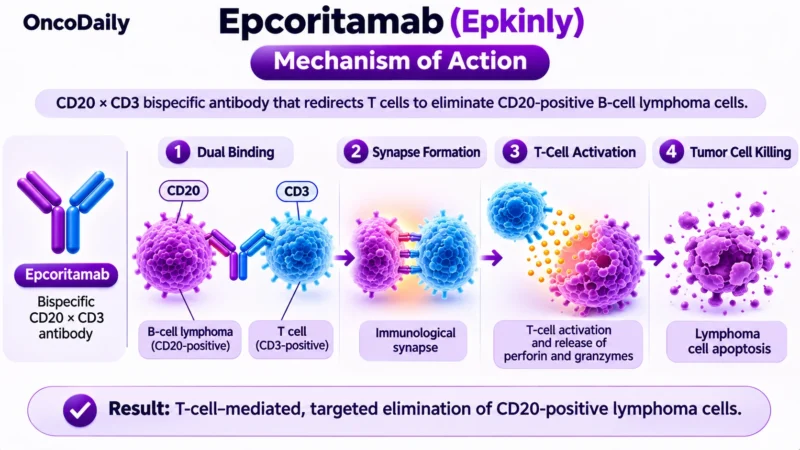
1. CD20 Binding
Epcoritamab binds CD20 on the surface of malignant B cells.
CD20 expression is characteristic of many DLBCL, high-grade B-cell lymphoma, and follicular lymphoma cases.
2. CD3 Binding
The other antibody-binding region recognizes CD3 on T lymphocytes.
This recruits T cells toward malignant B cells.
3. Immunological Synapse Formation
Simultaneous CD20 and CD3 binding brings the two cells into close contact.
An immunological synapse forms and activates intracellular T-cell signaling pathways.
4. Cytotoxic T-Cell Activation
Activated T cells release:
- Perforin
- Granzymes
These cytotoxic molecules initiate apoptosis of the lymphoma cell.
5. Serial Tumor-Cell Killing
A T cell may subsequently engage additional malignant B cells, allowing repeated targeted killing.
6. Cytokine Release
T-cell activation also promotes inflammatory cytokine production.
This contributes to the risk of CRS.
Overall mechanism:
Epcoritamab → CD20 binding + CD3 binding → immunological synapse → T-cell activation → perforin/granzyme release → lymphoma-cell apoptosis.
What Is the Recommended Dose of Epcoritamab?
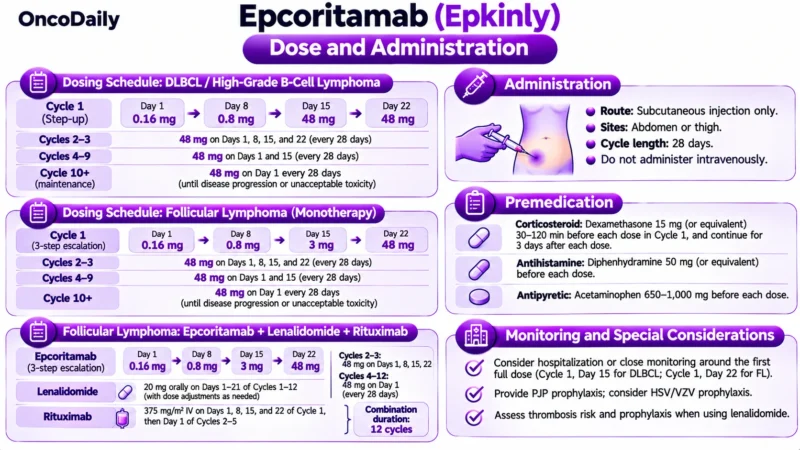
Epcoritamab uses different schedules for aggressive B-cell lymphoma and follicular lymphoma.
All doses are administered subcutaneously, using 28-day cycles. The full treatment dose is 48 mg.
DLBCL and High-Grade B-Cell Lymphoma
Cycle 1 — Two Step-Up Doses
- Day 1: 0.16 mg
- Day 8: 0.8 mg
- Day 15: 48 mg
- Day 22: 48 mg
Cycles 2–3
48 mg on Days 1, 8, 15, and 22.
Cycles 4–9
48 mg on Days 1 and 15.
Cycle 10 Onward
48 mg on Day 1 every 28 days.
Treatment continues until progression or unacceptable toxicity.
Follicular Lymphoma — Monotherapy
Cycle 1 — Three Step-Up Doses
- Day 1: 0.16 mg
- Day 8: 0.8 mg
- Day 15: 3 mg
- Day 22: 48 mg
Cycles 2–3
48 mg on Days 1, 8, 15, and 22.
Cycles 4–9
48 mg on Days 1 and 15.
Cycle 10 Onward
48 mg on Day 1 every 28 days.
Continue until progression or unacceptable toxicity.
Follicular Lymphoma — Epcoritamab + Lenalidomide + Rituximab
The combination uses the same three-step escalation in Cycle 1.
Cycle 1
Day 1: 0.16 mg
Day 8: 0.8 mg
Day 15: 3 mg
Day 22: 48 mg
Cycles 2–3
48 mg on Days 1, 8, 15, and 22.
Cycles 4–12
48 mg on Day 1 of each 28-day cycle.
The accompanying regimen includes:
- Lenalidomide: 20 mg orally on Days 1–21 of Cycles 1–12, adjusted when indicated.
- Rituximab: 375 mg/m² IV on Days 1, 8, 15, and 22 of Cycle 1, followed by Day 1 of Cycles 2–5.
Maximum planned combination duration: 12 cycles, or until progression or unacceptable toxicity.
These are the schedules in the June 2026 U.S. prescribing information.
How Should Epcoritamab Be Administered?
Subcutaneous Injection
Epkinly is administered by a qualified healthcare professional.
It is injected into the abdomen or thigh according to product-specific instructions.
Do not administer intravenously.
The 0.16-mg and 0.8-mg doses require preparation using the label’s dilution procedures. The 3-mg and 48-mg doses do not require dilution.
Premedication
During Cycle 1, all patients should receive:
Corticosteroid
- Dexamethasone 15 mg orally or IV, or
- Prednisolone 100 mg orally or IV, or equivalent.
Administer 30–120 minutes before each weekly dose and continue corticosteroids for three consecutive days after each dose.
Antihistamine
Diphenhydramine 50 mg orally or IV, or equivalent, before administration.
Antipyretic
Acetaminophen 650–1,000 mg orally before administration.
During subsequent cycles, additional corticosteroid prophylaxis is indicated in patients who experienced Grade 2–3 CRS with the preceding dose.
Hospitalization and Observation
The 2026 U.S. label recommends individualized assessment of hospitalization versus outpatient monitoring around the first 48-mg dose:
- DLBCL/high-grade B-cell lymphoma: Cycle 1, Day 15.
- Follicular lymphoma: Cycle 1, Day 22.
Patients receiving outpatient monitoring should remain near a facility capable of evaluating and managing CRS.
Infection Prophylaxis
Provide Pneumocystis jirovecii pneumonia (PJP) prophylaxis during treatment.
Consider herpesvirus prophylaxis against HSV and VZV according to patient risk.
For the lenalidomide-containing combination, assess thromboprophylaxis requirements.
What Should You Do If an Epcoritamab Dose Is Missed?
If a dose is delayed:
- Review the interval since the last dose.
- Determine whether repeat step-up dosing is required.
- Reassess infection, CRS, and neurological symptoms.
- Restart according to the disease-specific FDA label.
- Do not double the next dose.
The restart algorithm differs between DLBCL and FL.
How Are Epcoritamab Dose Modifications Managed?
Cytokine Release Syndrome
Withhold epcoritamab until CRS resolves.
Grade 1–2 CRS generally requires supportive treatment and appropriate assessment.
Grade 3 CRS may require intensive management, hospitalization, corticosteroids, and cytokine-directed therapy according to established CRS guidelines.
Grade 4 CRS requires permanent discontinuation.
ICANS
Withhold epcoritamab for suspected ICANS and initiate appropriate neurological assessment and treatment.
Severe or life-threatening ICANS may require permanent discontinuation.
Severe Infections
Withhold treatment during serious active infection until adequate recovery.
Cytopenias
Severe or persistent neutropenia, thrombocytopenia, or anemia may require treatment interruption and supportive care.
Tumor Flare
Evaluate tumor enlargement or local inflammatory symptoms carefully to distinguish tumor flare from progressive disease.
What Drug Interactions Are Important With Epcoritamab?
CYP450-Metabolized Medications
Epcoritamab does not undergo conventional CYP450 metabolism.
However, cytokine release may transiently suppress CYP450 enzyme activity, potentially altering exposure to drugs with narrow therapeutic indices.
Immunosuppressive Medications
Concomitant immunosuppression may increase infection risk.
Lenalidomide
Combination treatment requires monitoring for:
- Neutropenia
- Thrombocytopenia
- Infections
- Thromboembolic events
- Embryo-fetal toxicity
Live Vaccines
Live-virus vaccination should generally be avoided during clinically significant immunosuppression.
Does Epcoritamab Require Dose Adjustment in Renal or Hepatic Impairment?
Renal Impairment
No routine epcoritamab dose adjustment is established for mild or moderate renal impairment.
Data in severe renal impairment are limited.
Lenalidomide requires renal dose assessment when used in the Epkinly-R² combination.
Hepatic Impairment
No routine adjustment is established for mild hepatic impairment.
Clinical evidence in moderate or severe hepatic impairment is limited.
What Is the Pharmacokinetic Profile of Epcoritamab?
Epcoritamab is absorbed after subcutaneous administration and undergoes protein catabolism rather than conventional hepatic small-molecule metabolism.
Its exposure increases nonlinearly over the studied dose range, with pharmacokinetics influenced by dose, time, and target-mediated processes.
The antibody has a relatively limited volume of distribution compared with small-molecule drugs.
No clinically significant pharmacokinetic differences have been identified between the studied relapsed/refractory LBCL and FL populations.
What Are the Clinical Uses of Epcoritamab?
Relapsed or Refractory Diffuse Large B-Cell Lymphoma
Epcoritamab is FDA approved for adults with DLBCL not otherwise specified, including DLBCL transformed from indolent lymphoma, after two or more lines of systemic therapy.
It is also approved in the same treatment-line setting for high-grade B-cell lymphoma.
This provides an off-the-shelf immunotherapy option, including for selected patients previously treated with CAR-T-cell therapy.
Relapsed or Refractory Follicular Lymphoma — Monotherapy
Epcoritamab monotherapy is FDA approved for adults with FL after at least two prior systemic treatment lines.
Its activity has been demonstrated in patients previously exposed to anti-CD20 antibodies, alkylating agents, and other treatments.
Relapsed or Refractory Follicular Lymphoma — Combination Treatment
Epcoritamab combined with lenalidomide and rituximab is FDA approved for adults with relapsed or refractory FL.
Unlike the monotherapy indication, this combination is not restricted to patients with at least two prior lines.
EPCORE FL-1 enrolled patients after at least one previous systemic therapy and demonstrated a significant progression-free survival benefit.
Other B-Cell Lymphomas
Epcoritamab is under investigation in earlier-line DLBCL, frontline combinations, and other B-cell lymphomas.
These investigational regimens should be distinguished from currently approved indications.
What Molecular Testing Is Required Before Epcoritamab?
CD20 Expression
CD20 is the principal tumor target.
Confirm the lymphoma diagnosis through histopathology and immunophenotyping, including CD20 assessment.
DLBCL and High-Grade B-Cell Lymphoma
Relevant testing includes:
- CD20, CD19, CD10, BCL6, BCL2, and Ki-67
- MYC, BCL2, and BCL6 rearrangements when indicated
- Other markers required for accurate lymphoma classification
Follicular Lymphoma
Relevant assessments include:
- CD20
- CD10
- BCL2
- BCL6
- Ki-67
- Appropriate molecular or cytogenetic studies
Patients with rapidly progressing FL may require rebiopsy to exclude transformation.
Baseline Evaluation
Before treatment, assess CBC, renal and hepatic function, infection history, performance status, tumor burden, and neurological status.
What Did the Pivotal Clinical Trials Show?
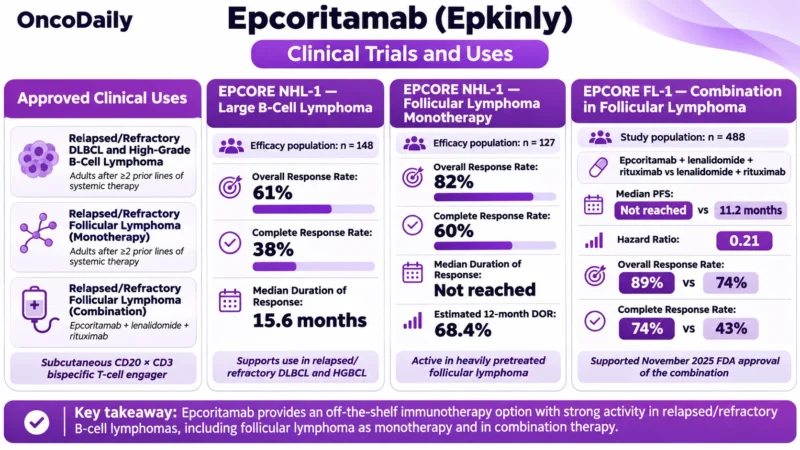
EPCORE NHL-1 — Relapsed or Refractory Large B-Cell Lymphoma
EPCORE NHL-1 (NCT03625037) was a phase I/II, multicenter, single-arm trial evaluating subcutaneous epcoritamab in previously treated B-cell lymphomas.
The FDA efficacy population included 148 patients with DLBCL or high-grade B-cell lymphoma.
Overall Response Rate
61%
Complete Response Rate
38%
Median Duration of Response
15.6 months
These independently reviewed findings supported the initial FDA approval in 2023.
Three-Year Follow-Up
A 2026 publication reported mature outcomes in the broader 157-patient large B-cell lymphoma cohort:
- ORR: 59%
- CR: 41%
- Median duration of response: 20.8 months
- Median duration of complete response: 36.1 months
- Median overall survival: 18.5 months
The mature results suggest that complete responders may experience sustained disease control. They should not be directly compared with the initial regulatory analysis because the analysis populations, assessment methods, and follow-up differ.
EPCORE NHL-1 — Relapsed or Refractory Follicular Lymphoma
The follicular lymphoma cohort evaluated epcoritamab in patients who had received at least two prior systemic therapies.
The primary efficacy population included 127 patients.
Overall Response Rate
82%
Complete Response Rate
60%
Median Duration of Response
Not reached at the primary analysis.
Estimated 12-Month Duration of Response
68.4%
These findings supported the June 2024 accelerated approval for FL monotherapy, subsequently converted to traditional approval in November 2025.
Importantly, the primary efficacy cohort received the earlier two-step escalation regimen. A separate 86-patient cohort evaluated the current three-step escalation schedule, with comparable efficacy.
EPCORE FL-1 — Epcoritamab Plus Lenalidomide and Rituximab
EPCORE FL-1 (NCT05409066) was a randomized phase III trial comparing:
- Epcoritamab + lenalidomide + rituximab
- Lenalidomide + rituximab
The study enrolled 488 patients with relapsed or refractory FL following at least one prior systemic therapy.
Median Progression-Free Survival
- Epcoritamab combination: Not reached
- Lenalidomide + rituximab: 11.2 months
HR: 0.21; p < 0.0001
Overall Response Rate
- Epcoritamab combination: 89%
- Control: 74%
Complete Response Rate
- Epcoritamab combination: 74%
- Control: 43%
The trial demonstrated significantly improved disease control and deeper responses with the addition of epcoritamab.
It supported the November 18, 2025 FDA approval of the combination.
Overall survival data were immature at the initial regulatory analysis.
Read More: FDA Approval of Epcoritamab for Relapsed or Refractory Follicular Lymphoma by OncoDaily.
Watch More: Primary Results From the Phase III EPCORE FL-1 Trial: Epcoritamab Plus R² Versus R².
Does Epcoritamab Have CNS Activity?
Epcoritamab is not an established CNS-directed lymphoma treatment.
Patients with known CNS involvement were excluded from the pivotal regulatory efficacy cohorts.
Although bispecific antibodies may have activity in some CNS lymphoma settings, available evidence is insufficient to establish epcoritamab as a standard standalone therapy for CNS lymphoma.
Is Epcoritamab FDA Approved?
Yes. Its regulatory milestones include:
- May 19, 2023: Accelerated approval for relapsed/refractory DLBCL and high-grade B-cell lymphoma after two or more systemic therapies.
- June 26, 2024: Accelerated approval for relapsed/refractory FL monotherapy after at least two prior lines.
- November 18, 2025: Traditional approval for FL monotherapy and approval of epcoritamab with lenalidomide and rituximab for relapsed/refractory FL.
As of November 2026, its DLBCL/high-grade B-cell lymphoma indication remains under accelerated approval, whereas its FL monotherapy indication has traditional approval.
What Is the Current Clinical Role of Epcoritamab in 2026?
Later-Line DLBCL
Epcoritamab is an important option after at least two previous treatment lines, particularly when CAR-T therapy is not available, appropriate, or has already been used.
Follicular Lymphoma Monotherapy
Epcoritamab provides a chemotherapy-free T-cell-engaging treatment option after at least two previous treatment lines.
Follicular Lymphoma Combination Therapy
The positive EPCORE FL-1 study established epcoritamab plus lenalidomide and rituximab as a major earlier-line option.
Relationship to Other Bispecific Antibodies
Epcoritamab and mosunetuzumab both target CD20 and CD3, but differ in approved indications, treatment schedules, and administration strategies.
Epcoritamab is administered subcutaneously in 28-day cycles, while mosunetuzumab has distinct IV and SC formulations with 21-day cycles.
What Are the Major Side Effects of Epcoritamab?
Cytokine Release Syndrome
CRS is an FDA boxed-warning toxicity.
It results from inflammatory cytokine release following T-cell activation.
Symptoms include fever, chills, hypotension, tachycardia, dyspnea, and hypoxia.
In EPCORE NHL-1, CRS occurred in approximately 51% of large B-cell lymphoma patients.
With the recommended three-step FL schedule, CRS occurred in approximately 49% of the evaluated monotherapy safety cohort.
In EPCORE FL-1, CRS occurred in 24% of patients receiving the epcoritamab combination at the recommended schedule.
Most events were Grade 1–2, but severe or fatal reactions are possible.
Neurological Toxicity and ICANS
ICANS is the second FDA boxed-warning toxicity.
Symptoms can include:
- Confusion
- Tremor
- Aphasia
- Dysgraphia
- Encephalopathy
- Seizures
- Changes in consciousness
ICANS occurred in approximately 6% of the large B-cell lymphoma safety population. Fatal ICANS has been reported.
Serious Infections
Epcoritamab can cause severe and opportunistic infections, including pneumonia, sepsis, CMV infection, and herpesvirus infections.
The June 2026 prescribing information also warns of progressive multifocal leukoencephalopathy (PML), including fatal cases.
New or progressive neurological symptoms require prompt evaluation, considering both ICANS and alternative diagnoses such as PML.
Cytopenias
Important hematologic toxicities include neutropenia, lymphopenia, anemia, and thrombocytopenia.
In EPCORE FL-1, Grade 3–4 neutrophil decreases occurred in approximately 67% of patients receiving epcoritamab plus lenalidomide and rituximab.
Injection-Site Reactions
Common subcutaneous reactions include redness, pain, swelling, and local inflammation.
Tumor Flare and Tumor Lysis Syndrome
Tumor flare can cause transient painful enlargement of lymphoma lesions.
Tumor lysis syndrome may occur in patients with significant tumor burden.
Other Common Adverse Reactions
Fatigue, fever, musculoskeletal pain, nausea, diarrhea, rash, and respiratory infections.
Embryo-Fetal Toxicity
Epcoritamab may cause fetal harm.
Females of reproductive potential should use effective contraception during treatment and for four months after the last dose.
Additional pregnancy-prevention requirements apply to lenalidomide.
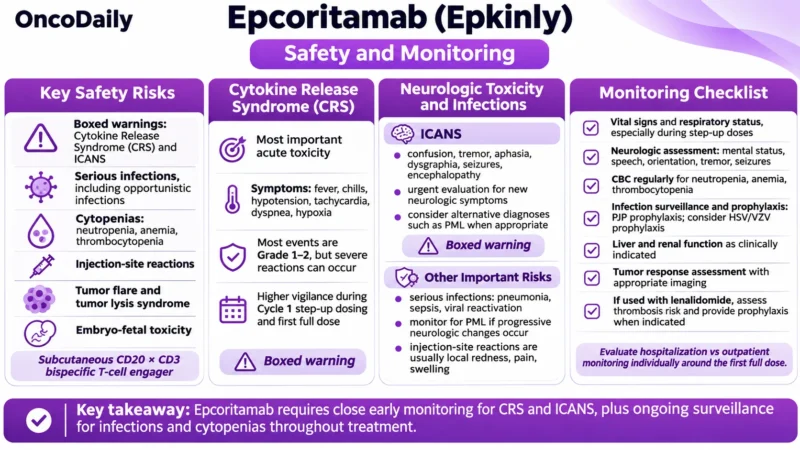
What Monitoring Is Required During Epcoritamab Treatment?
CRS Monitoring
Closely monitor temperature, blood pressure, heart rate, oxygen saturation, and respiratory symptoms, particularly during Cycle 1 step-up dosing.
Neurological Monitoring
Evaluate mental status, speech, orientation, tremor, and seizure symptoms. Investigate suspected ICANS or PML immediately.
Complete Blood Count
Monitor neutrophils, hemoglobin, platelets, and lymphocyte counts regularly.
Infection Surveillance
Assess for fever, respiratory symptoms, and opportunistic infections. Provide PJP prophylaxis, consider herpesvirus prophylaxis, and assess immunoglobulin levels when clinically indicated.
Liver and Renal Function
Monitor organ function according to treatment tolerance, clinical condition, and accompanying medicines.
Tumor Response
Perform appropriate imaging and clinical assessment using recognized lymphoma response criteria.
Thrombosis Risk
Patients receiving lenalidomide should undergo thrombosis-risk assessment and receive appropriate prophylaxis.