





Entrectinib (Rozlytrek): Understanding Its Mechanism, Dosing, Clinical Uses, and Role in ROS1-Positive NSCLC and NTRK Fusion-Positive Tumors
Key takeaways
- Entrectinib is a CNS-active inhibitor of ROS1 and TRKA/B/C.
- The standard adult dose is 600 mg orally once daily, with or without food.
- Adult dose reductions are 600 mg → 400 mg → 200 mg once daily.
- It is FDA approved for ROS1-positive metastatic NSCLC and qualifying NTRK fusion-positive solid tumors.
- The NTRK indication applies to adults and children older than 1 month.
- In an updated ROS1 analysis of 161 patients, ORR was 67.1%, median DoR 15.7 months, and median PFS 15.7 months.
- In patients with measurable ROS1-positive CNS metastases, intracranial ORR was 79.2%.
- In updated NTRK data, ORR was 61.2%, median DoR 20.0 months, and median PFS 13.8 months.
- Important toxicities include heart failure, CNS effects, fractures, hepatotoxicity, hyperuricemia, QT prolongation, and visual disorders.
- Baseline LVEF, uric acid, ECG/QT interval, and electrolytes should be assessed before treatment.
Entrectinib (Rozlytrek) is an oral, CNS-active tyrosine kinase inhibitor targeting ROS1 and the tropomyosin receptor kinases TRKA, TRKB, and TRKC, encoded by NTRK1, NTRK2, and NTRK3. It was designed to achieve meaningful systemic and intracranial activity, making it particularly relevant in cancers driven by ROS1 or NTRK gene fusions.
Entrectinib is FDA approved for adult patients with ROS1-positive metastatic non-small cell lung cancer (NSCLC)and for adult and pediatric patients older than 1 month with qualifying NTRK gene fusion-positive solid tumors. The NTRK indication is tumor-agnostic and remains under accelerated approval based on response rate and durability of response.
Key Facts
- Generic name: Entrectinib
- Brand name: Rozlytrek
- Drug class: Multitargeted tyrosine kinase inhibitor
- Primary targets: ROS1, TRKA, TRKB, TRKC
- Route: Oral
- Initial US approval: 2019
- Adult dose: 600 mg orally once daily
- Administration: With or without food
- Dose reductions in adults: 600 mg → 400 mg → 200 mg once daily
- Capsule strengths: 100 mg and 200 mg
- Oral pellets: 50 mg per packet
- FDA indications: ROS1-positive metastatic NSCLC; qualifying NTRK fusion-positive solid tumors
- Major safety concerns: Congestive heart failure, CNS effects, skeletal fractures, hepatotoxicity, hyperuricemia, QT prolongation, and visual disorders
- Major metabolism: CYP3A4
- Active metabolite: M5
- Current US status: FDA approved
What Is Entrectinib?
Entrectinib is a small-molecule inhibitor of oncogenic kinases produced by rearrangements involving:
- ROS1
- NTRK1
- NTRK2
- NTRK3
NTRK rearrangements result in abnormal fusion proteins involving:
- TRKA
- TRKB
- TRKC
These fusion proteins become constitutively active and continuously stimulate pathways responsible for:
- Cell proliferation
- Survival
- Differentiation
- Migration
- Tumor growth
Similarly, ROS1 fusion proteins function as constitutively activated tyrosine kinases and act as oncogenic drivers in a subset of NSCLC.
Entrectinib was specifically developed with the ability to penetrate the central nervous system, which is clinically important because brain metastases are frequent in oncogene-driven NSCLC.
What Is the Mechanism of Action of Entrectinib?
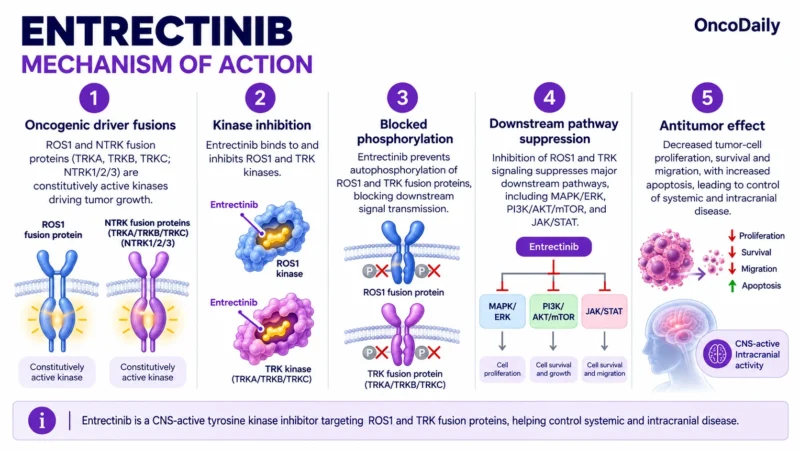
1. ROS1 or NTRK Fusions Create Constitutively Active Kinases
Genomic rearrangements can create abnormal fusion proteins involving:
ROS1
or:
TRKA / TRKB / TRKC.
These fusion proteins signal continuously without normal ligand regulation.
2. Entrectinib Binds the Kinase Domain
Entrectinib is an:
ATP-competitive tyrosine kinase inhibitor.
It binds to the ATP-binding site of:
- ROS1
- TRKA
- TRKB
- TRKC
and inhibits kinase activity.
3. Autophosphorylation Is Reduced
By blocking ATP-dependent kinase activity, entrectinib reduces phosphorylation of the oncogenic fusion proteins.
4. Downstream Signaling Is Suppressed
Key signaling pathways affected include:
RAS–RAF–MEK–ERK
PI3K–AKT–mTOR
and:
JAK–STAT.
5. Tumor Growth Is Inhibited
The result is:
- Reduced tumor-cell proliferation
- Reduced survival signaling
- Increased apoptosis
- Reduced migration and invasion
- Tumor regression in fusion-driven cancers
The mechanism can be summarized as:
Entrectinib → inhibition of ROS1/TRK fusion kinase activity → reduced phosphorylation → suppression of MAPK, PI3K/AKT, and JAK/STAT signaling → decreased tumor-cell proliferation and survival.
What Is the Dose of Entrectinib?
Adults
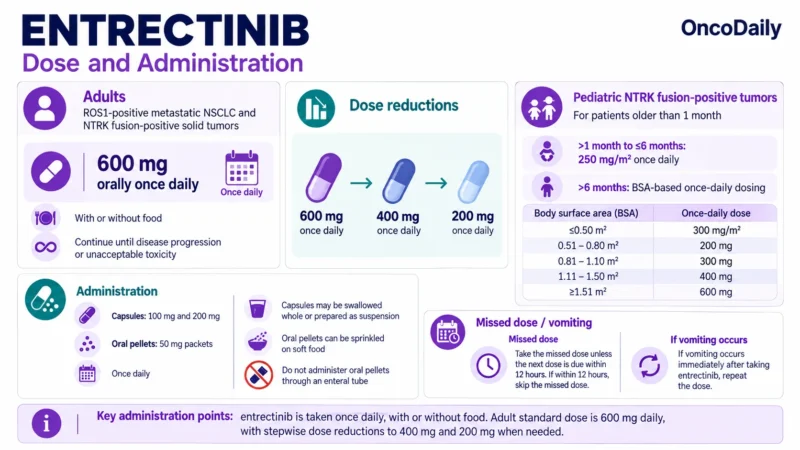
The recommended dose for adult patients with:
- ROS1-positive metastatic NSCLC
- NTRK fusion-positive solid tumors
is:
600 mg orally once daily.
Entrectinib may be taken:
With or without food.
Treatment is continued until:
Disease progression
Unacceptable toxicity.
Pediatric Dose for NTRK Fusion-Positive Tumors
For pediatric patients:
Older than 1 month to ≤6 months
250 mg/m² once daily.
Older than 6 months
Dose is based on body surface area:
- BSA ≤0.50 m²: 300 mg/m² once daily
- BSA 0.51–0.80 m²: 200 mg once daily
- BSA 0.81–1.10 m²: 300 mg once daily
- BSA 1.11–1.50 m²: 400 mg once daily
- BSA ≥1.51 m²: 600 mg once daily.
What If a Dose Is Missed?
If a dose is missed:
Take it when remembered unless the next dose is due within 12 hours.
If the next dose is due within 12 hours:
Skip the missed dose.
If vomiting occurs immediately after taking entrectinib:
Repeat the dose.
How Are Entrectinib Dose Reductions Made?
For adults starting at:
600 mg once daily
the first dose reduction is:
400 mg once daily.
The second reduction is:
200 mg once daily.
If the patient cannot tolerate treatment after two dose reductions:
Permanently discontinue entrectinib.
For pediatric patients, dose reductions depend on the starting dose and may involve reducing to:
- Two-thirds of the starting dose
- One-third of the starting dose
depending on age, BSA, and formulation.
How Is Entrectinib Administered?
Entrectinib is available as:
- 100 mg capsules
- 200 mg capsules
- 50 mg oral pellet packets
It can be administered as:
- Whole capsules
- Capsules prepared as an oral suspension
- Oral pellets sprinkled onto soft food
Capsules prepared as suspension can also be administered through an:
Enteral feeding tube.
However:
Oral pellets should not be administered through an enteral tube, because they may clog the tube.
Entrectinib is taken:
Once daily, with or without food.
What Are the Important Drug Interactions With Entrectinib?
Strong and Moderate CYP3A Inhibitors
Entrectinib is primarily metabolized through:
CYP3A4.
Strong or moderate CYP3A inhibitors can increase entrectinib exposure.
For adults and pediatric patients aged ≥2 years:
Dose modification is required if concomitant use cannot be avoided.
For pediatric patients younger than 2 years:
Avoid concomitant administration.
Examples include:
- Clarithromycin
- Ketoconazole
- Itraconazole
- Certain protease inhibitors
CYP3A Inducers
Moderate or strong CYP3A inducers can substantially reduce entrectinib exposure.
These should be:
Avoided.
Examples include:
- Rifampin
- Carbamazepine
- Phenytoin
- St. John’s wort
QT-Prolonging Drugs
Because entrectinib can prolong the QT interval:
Avoid concomitant use with other QT-prolonging medications when possible.
Does Entrectinib Require Renal or Hepatic Dose Adjustment?
Renal Impairment
No clinically meaningful effect on entrectinib pharmacokinetics has been demonstrated in:
Mild or moderate renal impairment.
Data remain limited in patients with:
Severe renal impairment.
Hepatic Impairment
No standard dose adjustment is generally required for mild hepatic impairment.
Clinical data in moderate-to-severe hepatic dysfunction are more limited, and treatment should be used cautiously with appropriate monitoring.
What Is the Pharmacokinetic Profile of Entrectinib?
Absorption
Median time to maximum plasma concentration is approximately:
4–6 hours.
Steady State
Steady-state exposure is generally achieved within:
- Approximately 1 week for entrectinib
- Approximately 2 weeks for its active metabolite M5
Protein Binding
Entrectinib and M5 are:
>99% protein bound.
Distribution
The apparent volume of distribution is approximately:
- 551 L for entrectinib
- 81.1 L for M5
indicating extensive tissue distribution.
Metabolism
Entrectinib is predominantly metabolized by:
CYP3A4.
Its major active metabolite is:
M5.
M5 exposure is approximately:
40% of parent-drug exposure.
Half-Life
Approximate terminal half-lives are:
- Entrectinib: 20 hours
- M5: 40 hours
Elimination
Approximately:
- 83% is recovered in feces
- 3% in urine
indicating predominantly hepatobiliary/fecal elimination.
What Are the Clinical Uses of Entrectinib?
ROS1-Positive Metastatic NSCLC
Entrectinib is FDA approved for:
Adult patients with ROS1-positive metastatic NSCLC detected by an FDA-approved test.
Its strong CNS penetration makes it especially relevant when:
- Brain metastases are present
- CNS control is an important therapeutic priority
NTRK Fusion-Positive Solid Tumors
Entrectinib is also approved for:
Adult and pediatric patients older than 1 month with solid tumors that have an NTRK gene fusion without a known acquired resistance mutation, are metastatic or where surgery would likely result in severe morbidity, and have progressed after treatment or have no satisfactory alternative therapy.
This is a:
Tumor-agnostic indication.
That means treatment is selected based on the molecular alteration rather than the organ of origin.
What Did Entrectinib Clinical Trials Show?
Entrectinib was evaluated across several early-phase trials, particularly:
- ALKA-372-001
- STARTRK-1
- STARTRK-2
Data from these studies were pooled to evaluate activity in ROS1-positive NSCLC and NTRK fusion-positive tumors.
ROS1-Positive NSCLC — Initial Integrated Analysis
In the initial pooled analysis, the efficacy-evaluable population included:
53 patients
with ROS1 fusion-positive NSCLC.
Objective response occurred in approximately:
77%
of patients in the original integrated analysis.
These data helped establish entrectinib as a highly active ROS1-directed therapy.
Updated ROS1 Integrated Analysis
A later integrated analysis included:
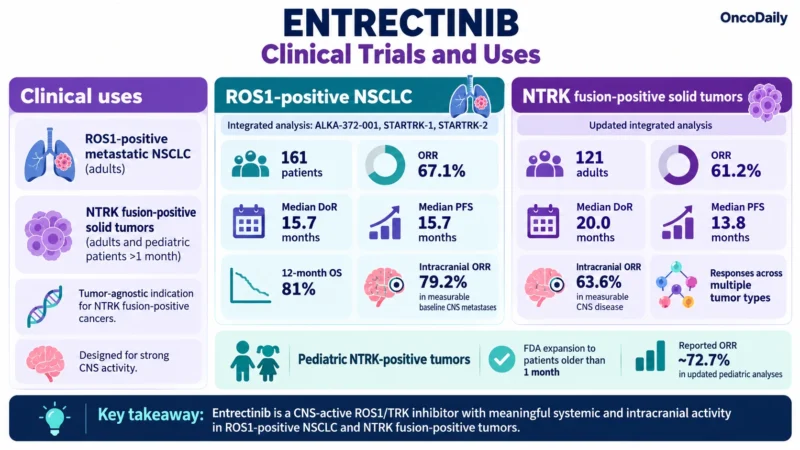
161 patients
with locally advanced or metastatic ROS1 fusion-positive NSCLC.
Objective Response Rate
ORR was:
67.1%.
Median Duration of Response
Median DoR was:
15.7 months.
Median Progression-Free Survival
Median PFS was:
15.7 months.
12-Month Overall Survival
The 12-month OS rate was:
81%.
What About Brain Metastases?
Entrectinib was specifically designed to penetrate the CNS.
Among:
24 patients with measurable baseline CNS metastases
in the updated ROS1 analysis:
Intracranial ORR
79.2%.
Median Intracranial PFS
12.0 months.
Median Intracranial Duration of Response
12.9 months.
These findings demonstrate substantial intracranial activity.
A later long-term analysis also reported an intracranial ORR of approximately:
80%
in patients with measurable baseline CNS metastases.
NTRK Fusion-Positive Solid Tumors — Initial Integrated Analysis
The initial efficacy population included:
54 adults
with advanced or metastatic NTRK fusion-positive tumors spanning:
- 10 tumor types
- 19 histologies
Objective response occurred in:
57%
of patients.
Responses included:
- Complete response: 7%
- Partial response: 50%
Median duration of response was approximately:
10 months.
Updated NTRK Integrated Analysis
An expanded analysis included:
121 adults
with NTRK fusion-positive solid tumors across:
- 14 tumor types
- More than 30 histologies
The confirmed response rate was:
61.2%.
Median duration of response was:
20.0 months.
Median PFS was:
13.8 months.
Among patients with measurable CNS disease:
Intracranial ORR was 63.6%.
Pediatric NTRK Fusion-Positive Tumors
Entrectinib also demonstrated substantial activity in pediatric patients with NTRK fusion-positive tumors.
Updated pediatric analyses reported an ORR of approximately:
72.7%
with durable responses and meaningful activity across several pediatric tumor types.
The expansion of FDA approval to patients:
Older than 1 month
reflects these pediatric efficacy and pharmacokinetic data.
Is Entrectinib FDA Approved?
Yes.
Entrectinib received FDA approval on:
August 15, 2019.
It was approved for:
- ROS1-positive metastatic NSCLC
- NTRK fusion-positive solid tumors
The NTRK indication was subsequently expanded in:
October 2023
to include pediatric patients:
Older than 1 month.
The NTRK tumor-agnostic indication remains under:
Accelerated approval.
What Is the Current Clinical Role of Entrectinib?
ROS1-Positive NSCLC
Entrectinib remains an important targeted treatment for:
ROS1-positive metastatic NSCLC.
Its key advantage is:
CNS activity.
This makes it especially valuable in patients with:
- Baseline brain metastases
- High risk of CNS progression
- Need for systemic and intracranial disease control
The ROS1 treatment landscape has evolved with newer agents, so selection now depends on:
- CNS disease
- Previous ROS1 therapy
- Resistance profile
- Toxicity
- Drug availability
Read more about the evolving role of targeted therapy in molecularly defined lung cancer in OncoDaily’s Targeted Therapy in Advanced NSCLC: From Driver Matching to Adaptive Precision Oncology.
Watch more: Explore OncoDaily’s discussion on targeted therapies in lung cancer and the evolving treatment landscape for oncogene-driven NSCLC.
NTRK Fusion-Positive Tumors
Entrectinib remains a major tumor-agnostic targeted therapy for:
NTRK fusion-positive cancers.
Treatment depends on identification of a genuine:
NTRK1, NTRK2, or NTRK3 fusion
rather than isolated TRK expression.
What Are the Major Side Effects of Entrectinib?
Common adverse effects include:
- Fatigue
- Constipation
- Dysgeusia
- Edema
- Dizziness
- Diarrhea
- Nausea
- Dysesthesia
- Dyspnea
- Myalgia
- Cognitive impairment
- Weight gain
- Cough
- Vomiting
- Pyrexia
- Arthralgia
- Visual disorders.
Congestive Heart Failure
Entrectinib can cause:
Congestive heart failure.
Before treatment:
Assess left ventricular ejection fraction.
Patients should be monitored for:
- Dyspnea
- Edema
- Rapid weight gain
- Exercise intolerance
For new or worsening CHF:
- Withhold entrectinib
- Reassess LVEF
- Treat appropriately
- Resume at reduced dose or permanently discontinue depending on severity.
Central Nervous System Effects
CNS adverse effects may include:
- Cognitive impairment
- Dizziness
- Mood changes
- Sleep disturbances
Dose interruption, reduction, or permanent discontinuation may be required depending on severity.
Skeletal Fractures
Entrectinib increases the risk of:
Skeletal fractures.
Patients with:
- New bone pain
- Reduced mobility
- Trauma-associated pain
should be promptly evaluated.
This is particularly important in:
Pediatric patients.
Hepatotoxicity
Entrectinib can cause elevations in:
- ALT
- AST
Liver tests should be obtained:
Every 2 weeks during the first month
then:
Monthly thereafter
and as clinically indicated.
Hyperuricemia
Entrectinib can cause:
Hyperuricemia.
Serum uric acid should be assessed:
- Before treatment
- Periodically during treatment
Patients should be monitored for clinical features of:
- Gout
- Renal complications
- Tumor lysis-associated uric acid elevation
Urate-lowering treatment may be required.
QT Interval Prolongation
Entrectinib can prolong:
QTc.
Before therapy:
- Assess QT interval
- Check electrolytes
During treatment:
- Repeat ECG when indicated
- Monitor potassium
- Monitor magnesium
- Monitor calcium
- Avoid concomitant QT-prolonging medications when possible.
Visual Disorders
Visual adverse effects can occur during entrectinib treatment.
Patients may experience:
- Blurred vision
- Photophobia
- Diplopia
- Visual impairment
New visual symptoms should prompt evaluation.
For clinically important visual toxicity:
- Withhold therapy
- Consider ophthalmologic assessment
- Resume at the same or reduced dose after improvement or stabilization.
Embryo-Fetal Toxicity
Entrectinib can cause fetal harm.
Patients of reproductive potential should receive counseling regarding:
- Pregnancy risks
- Effective contraception
Breastfeeding is not recommended during treatment.
What Monitoring Is Required?
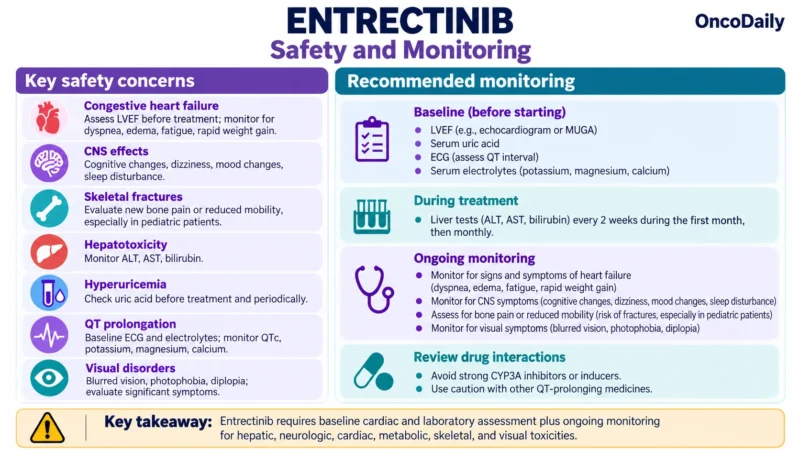
Monitoring during entrectinib therapy should include:
- LVEF before treatment
- Signs and symptoms of heart failure
- Neurologic and cognitive symptoms
- Mood changes
- Signs of skeletal fracture
- ALT
- AST
- Bilirubin
- Serum uric acid
- ECG
- QT interval
- Potassium
- Magnesium
- Calcium
- Visual symptoms
- Weight
- Edema
- CYP3A drug interactions
- Concomitant QT-prolonging medications
Liver tests should specifically be checked:
Every 2 weeks during the first month and monthly thereafter.
FAQ
What Is Entrectinib Used For?
What Is the Standard Adult Dose?
Can Entrectinib Be Taken With Food?
It may be taken:
With or without food.
What Are the Adult Dose Reductions?
Does Entrectinib Work in Brain Metastases?
Is Entrectinib Tumor-Agnostic?
NTRK fusion-positive solid tumors.
What Did the ROS1 Trials Show?
- ORR: 67.1%
- Median DoR: 15.7 months
- Median PFS: 15.7 months. PubMed
What Did the NTRK Trials Show?
- ORR: 61.2%
- Median DoR: 20.0 months
- Median PFS: 13.8 months.
What Are the Most Important Serious Side Effects?
Congestive heart failure, CNS toxicity, skeletal fractures, hepatotoxicity, hyperuricemia, QT prolongation, and visual disorders.
What Should Be Checked Before Starting Entrectinib?
- LVEF
- Serum uric acid
- QT interval
- Electrolytes. Access Data