


Encorafenib (Braftovi): Understanding Its Mechanism, Dosing, Clinical Uses, and Role in BRAF V600–Mutated Cancers
Key takeaways
- Encorafenib is an oral BRAF inhibitor targeting tumors with activating BRAF V600 mutations.
- It is primarily used in combination regimens, not as monotherapy.
- The dose is 450 mg once daily with binimetinib for melanoma and NSCLC.
- The dose is 300 mg once daily for BRAF V600E-mutated metastatic CRC with cetuximab-based therapy.
- Encorafenib may be taken with or without food.
- COLUMBUS demonstrated median PFS of 14.9 vs 7.3 months versus vemurafenib and median OS of 33.6 vs 16.9 months.
- Five-year OS with encorafenib/binimetinib was 35% in advanced melanoma. PubMed
- BEACON established encorafenib + cetuximab as a targeted standard after prior therapy in BRAF V600E mCRC.
- BREAKWATER expanded encorafenib into first-line BRAF V600E metastatic CRC, with ORR 60.9% vs 40.0% using encorafenib/cetuximab + mFOLFOX6.
- PHAROS showed an ORR of 75%, median DoR 40 months, and median PFS 30.2 months in treatment-naïve BRAF V600E NSCLC.
- Important safety priorities include secondary malignancies, cardiomyopathy, hepatotoxicity, hemorrhage, uveitis, and QT prolongation.
- In 2026, encorafenib has established roles across melanoma, colorectal cancer, and NSCLC.
Encorafenib (Braftovi) is an oral, selective inhibitor of mutant BRAF kinase, particularly tumors harboring BRAF V600E or V600K mutations. By suppressing constitutive MAPK-pathway activation, encorafenib reduces downstream MEK/ERK signaling and inhibits tumor-cell proliferation and survival.
In contemporary oncology, encorafenib is used almost entirely as part of combination therapy. In the United States, it is FDA approved with binimetinib for BRAF V600E/K-mutated unresectable or metastatic melanoma and BRAF V600E-mutated metastatic NSCLC, and with cetuximab-based therapy for BRAF V600E-mutated metastatic colorectal cancer. Importantly, the 2026 FDA label expanded first-line colorectal cancer treatment to include encorafenib plus cetuximab with fluorouracil-based chemotherapy.
Key Facts
- Generic name: Encorafenib
- Brand name: Braftovi
- Drug class: BRAF kinase inhibitor
- Route: Oral
- Initial US approval: 2018
- Primary target: Mutant BRAF
- Relevant mutations: BRAF V600E and V600K
- Melanoma dose: 450 mg orally once daily with binimetinib
- NSCLC dose: 450 mg orally once daily with binimetinib
- CRC dose: 300 mg orally once daily with cetuximab-based therapy
- Administration: With or without food
- Capsule strength: 75 mg
- Major metabolism: CYP3A4
- Half-life: Approximately 3.5 hours
- Major safety issues: New primary malignancies, cardiomyopathy, hepatotoxicity, hemorrhage, uveitis, QT prolongation
- Current US status: FDA approved for melanoma, colorectal cancer, and NSCLC.
What Is Encorafenib?
Encorafenib is a small-molecule inhibitor of mutant BRAF kinase.
BRAF is part of the:
RAS–RAF–MEK–ERK signaling pathway
which regulates:
- Cell proliferation
- Survival
- Differentiation
- Migration
- Growth
In cancers carrying an activating BRAF V600 mutation, BRAF kinase becomes constitutively active and drives persistent downstream MAPK signaling independently of normal growth-factor control.
The most clinically relevant alterations include:
- BRAF V600E
- BRAF V600K
Encorafenib selectively inhibits mutant BRAF and reduces this abnormal signaling.
What Is the Mechanism of Action of Encorafenib?
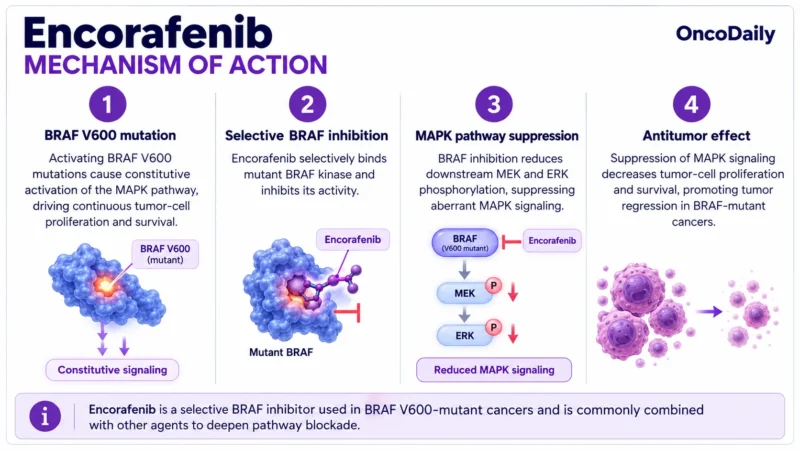
1. BRAF V600 Mutation Creates Constitutive Kinase Activation
Normally, BRAF signaling depends on upstream activation through RAS.
A BRAF V600 mutation causes BRAF to remain activated independently of normal regulatory signals.
2. MEK and ERK Become Continuously Activated
Mutant BRAF phosphorylates and activates:
MEK1/2
which activates:
ERK1/2.
Persistent MEK/ERK signaling promotes:
- Tumor-cell proliferation
- Survival
- Invasion
- Resistance to apoptosis
3. Encorafenib Inhibits Mutant BRAF
Encorafenib is an:
ATP-competitive BRAF kinase inhibitor.
It binds to the kinase domain of mutant BRAF and inhibits its catalytic activity.
4. MAPK Signaling Is Suppressed
BRAF inhibition reduces downstream:
- MEK phosphorylation
- ERK phosphorylation
and therefore suppresses MAPK-pathway activity.
5. Tumor Growth Is Reduced
The downstream effects include:
- Reduced tumor-cell proliferation
- Reduced survival signaling
- Increased apoptosis
- Tumor regression in BRAF-dependent cancers
The mechanism can be summarized as:
Encorafenib → mutant BRAF inhibition → reduced MEK/ERK signaling → decreased proliferation and survival → increased apoptosis.
Why Is Encorafenib Used in Combination Therapy?
BRAF inhibition alone can produce meaningful responses, but MAPK signaling can reactivate through multiple resistance mechanisms.
Combination therapy improves pathway suppression.
With Binimetinib
Binimetinib inhibits MEK1/2, directly downstream of BRAF.
Therefore:
Encorafenib + binimetinib
provides dual blockade of:
BRAF → MEK → ERK signaling.
This strategy:
- Improves response durability
- Prolongs progression-free survival
- Improves overall survival
- Reduces some paradoxical BRAF inhibitor toxicities
It is used in:
- BRAF V600E/K melanoma
- BRAF V600E NSCLC
With Cetuximab in Colorectal Cancer
BRAF inhibition alone is relatively ineffective in BRAF V600E-mutated colorectal cancer because blockade of BRAF triggers feedback activation of:
EGFR signaling.
Cetuximab inhibits EGFR and helps prevent this feedback reactivation.
Therefore:
Encorafenib + cetuximab
became an established targeted approach in BRAF V600E-mutated metastatic CRC.
The combination can now also be given with:
- mFOLFOX6
- FOLFIRI
in first-line metastatic disease.
What Is the Dose of Encorafenib?
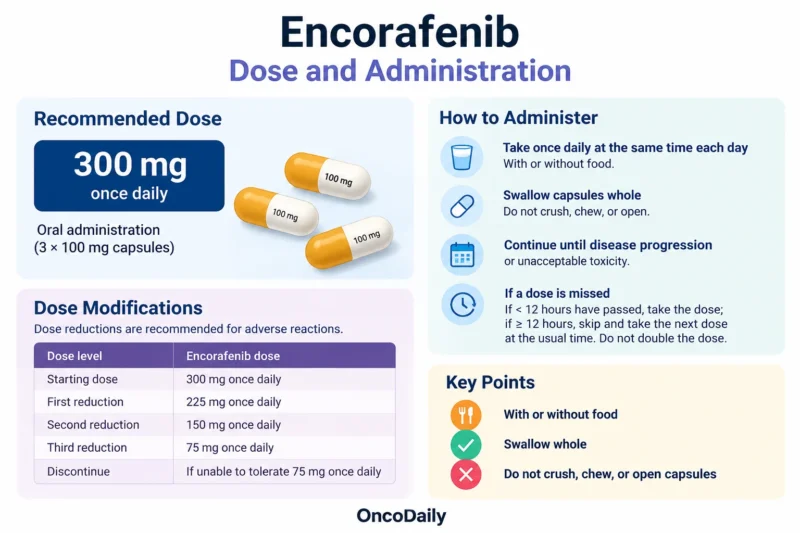
The recommended dose depends on the cancer type and combination partner.
Melanoma
For BRAF V600E- or V600K-mutated unresectable or metastatic melanoma:
450 mg orally once daily
in combination with binimetinib.
This equals:
Six 75 mg capsules once daily.
NSCLC
For BRAF V600E-mutated metastatic NSCLC:
450 mg orally once daily
with binimetinib.
Treatment continues until:
- Disease progression
- Unacceptable toxicity.
Colorectal Cancer
For BRAF V600E-mutated metastatic CRC:
300 mg orally once daily
in combination with cetuximab.
Current FDA-approved combinations include:
- Cetuximab alone after prior therapy
- Cetuximab + mFOLFOX6
- Cetuximab + FOLFIRI
The latter fluorouracil-based combinations can be used in metastatic CRC according to the 2026 label.
How Is Encorafenib Administered?
Encorafenib is available as:
75 mg capsules.
It may be taken:
With or without food.
A high-fat meal reduces peak concentration but does not meaningfully alter total exposure, which supports administration without food restrictions.
Capsules should be taken consistently once daily.
What If a Dose Is Missed?
If a dose is missed:
Take it when remembered unless the next dose is due within 12 hours.
If the next dose is due within 12 hours:
Skip the missed dose.
Do not make up the missed dose.
If vomiting occurs after taking encorafenib:
Do not take an additional dose.
Take the next scheduled dose at the usual time.
How Are Encorafenib Dose Reductions Made?
Dose reductions depend on the indication.
Melanoma or NSCLC
Starting dose:
450 mg once daily
First reduction:
300 mg once daily
Second reduction:
225 mg once daily
If the patient cannot tolerate:
225 mg once daily
encorafenib should generally be permanently discontinued.
If binimetinib is temporarily withheld:
Reduce encorafenib to a maximum of 300 mg once daily until binimetinib is resumed.
Dose Reductions in Colorectal Cancer
Starting dose:
300 mg once daily
First reduction:
225 mg once daily
Second reduction:
150 mg once daily
If the patient cannot tolerate:
150 mg once daily
treatment should generally be permanently discontinued.
What Are the Important Drug Interactions With Encorafenib?
Strong or Moderate CYP3A4 Inhibitors
Encorafenib is primarily metabolized by:
CYP3A4.
Strong or moderate CYP3A4 inhibitors can substantially increase encorafenib exposure.
For example:
- Posaconazole increased AUC by approximately 183%
- Diltiazem increased AUC by approximately 83%.
These combinations should generally be avoided.
If unavoidable:
Dose reduction is required according to the prescribing information.
CYP3A4 Inducers
Strong CYP3A4 inducers should generally be avoided because they may reduce encorafenib exposure.
Moderate induction also lowers exposure.
For example, modafinil reduced steady-state:
- AUC by approximately 24%
- Cmax by approximately 20%.
CYP3A4 Substrates
Encorafenib can act as a CYP3A4 inducer and substantially reduce exposure to sensitive CYP3A4 substrates.
In a drug-interaction study, midazolam exposure fell markedly during repeated encorafenib therapy.
This may be clinically important for:
- Hormonal contraceptives
- Other sensitive CYP3A4 substrates
Hormonal contraceptive effectiveness may therefore be reduced.
Transporter Interactions
Encorafenib inhibits transporters including:
- OATP1B1
- OATP1B3
- BCRP
Rosuvastatin exposure increased when administered with encorafenib/binimetinib.
Dose adjustment of sensitive transporter substrates may therefore be required.
Does Encorafenib Require Renal or Hepatic Dose Adjustment?
Renal Impairment
No dose adjustment is recommended for:
Mild-to-moderate renal impairment
defined approximately as:
CrCl 30 to <90 mL/min.
A recommended dose has not been established in:
Severe renal impairment, CrCl <30 mL/min.
Hepatic Impairment
No adjustment is recommended for:
Mild hepatic impairment — Child-Pugh A.
A recommended dose has not been established for:
- Child-Pugh B
- Child-Pugh C.
What Is the Pharmacokinetic Profile of Encorafenib?
Absorption
The median time to peak plasma concentration is approximately:
2 hours.
At least:
86%
of the administered dose is absorbed. Access Data FDA
Food Effect
A high-fat meal decreased Cmax by approximately:
36%
but did not affect AUC.
Therefore encorafenib can be administered:
With or without food.
Protein Binding
Encorafenib is approximately:
86% protein bound.
Volume of Distribution
Approximate apparent volume of distribution:
164 L.
Half-Life
The terminal half-life is approximately:
3.5 hours.
Metabolism
Encorafenib is metabolized primarily through:
- CYP3A4: ~83%
- CYP2C19: ~16%
- CYP2D6: ~1%.
Excretion
After radiolabeled dosing:
- Approximately 47% was recovered in feces
- Approximately 47% in urine
Only small fractions were recovered unchanged.
What Are the Clinical Uses of Encorafenib?
1. BRAF V600E/K-Mutated Unresectable or Metastatic Melanoma
Encorafenib is FDA approved:
In combination with binimetinib
for patients with unresectable or metastatic melanoma with:
- BRAF V600E
- BRAF V600K
mutations.
2. BRAF V600E-Mutated Metastatic Colorectal Cancer
Encorafenib is FDA approved:
With cetuximab
after prior therapy.
The 2026 label also includes:
Encorafenib + cetuximab + fluorouracil-based chemotherapy
for adults with BRAF V600E-mutated metastatic CRC.
Approved chemotherapy backbones include:
- mFOLFOX6
- FOLFIRI.
3. BRAF V600E-Mutated Metastatic NSCLC
Encorafenib is FDA approved:
In combination with binimetinib
for adults with metastatic NSCLC harboring:
BRAF V600E.
What Did Encorafenib Clinical Trials Show?
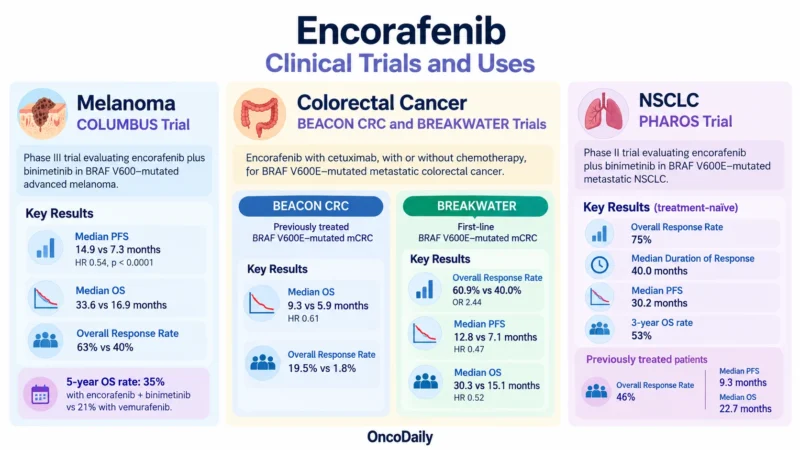
COLUMBUS — BRAF V600-Mutated Melanoma
The pivotal phase III COLUMBUS trial evaluated encorafenib plus binimetinib in patients with BRAF V600-mutated advanced melanoma.
A total of:
577 patients
were randomized to:
- Encorafenib 450 mg once daily + binimetinib 45 mg twice daily
- Encorafenib 300 mg once daily
- Vemurafenib 960 mg twice daily.
Progression-Free Survival
Median PFS was:
- 14.9 months with encorafenib + binimetinib
- 7.3 months with vemurafenib
Hazard ratio:
0.54
P < 0.0001.
Overall Survival
Median OS was:
- 33.6 months with encorafenib + binimetinib
- 16.9 months with vemurafenib.
Objective Response Rate
ORR was approximately:
- 63% with encorafenib + binimetinib
- 40% with vemurafenib.
Long-Term Outcomes
- PFS rate: 23%
- OS rate: 35%
with encorafenib + binimetinib.
For vemurafenib:
- 5-year PFS: 10%
- 5-year OS: 21%
BEACON CRC — Previously Treated BRAF V600E-Mutated mCRC
The phase III BEACON CRC study established encorafenib plus cetuximab as an important targeted therapy for previously treated BRAF V600E-mutant metastatic colorectal cancer.
Patients were randomized to:
- Encorafenib + binimetinib + cetuximab
- Encorafenib + cetuximab
- Control chemotherapy + cetuximab
Updated results showed:
Median Overall Survival
- Encorafenib + cetuximab: 9.3 months
- Control: 5.9 months
Hazard ratio:
0.61.
Objective Response Rate
- Encorafenib + cetuximab: 19.5%
- Control: 1.8%.
These findings established:
Encorafenib + cetuximab
as a standard targeted option after prior therapy.
BREAKWATER — First-Line BRAF V600E-Mutated mCRC
The phase III BREAKWATER trial moved encorafenib into the first-line metastatic colorectal cancer setting.
It evaluated:
Encorafenib + cetuximab + mFOLFOX6
versus standard chemotherapy.
Objective Response Rate
At the initial analysis:
- EC + mFOLFOX6: 60.9%
- Standard care: 40.0%
Odds ratio:
2.44.
Median duration of response was:
- 13.9 months
- 11.1 months, respectively.
Later analyses confirmed significant improvement in:
- Progression-free survival
- Overall survival
with first-line encorafenib/cetuximab plus chemotherapy.
The 2026 FDA label now includes encorafenib with cetuximab plus:
- mFOLFOX6
- FOLFIRI
for BRAF V600E-mutated metastatic CRC.
PHAROS — BRAF V600E-Mutated Metastatic NSCLC
The phase II PHAROS trial evaluated:
Encorafenib 450 mg once daily + binimetinib 45 mg twice daily
in BRAF V600E-mutated metastatic NSCLC.
The trial included:
- 59 treatment-naïve patients
- 39 previously treated patients.
Treatment-Naïve Patients
Updated 2025/2026 results showed:
Objective Response Rate
75%.
Median Duration of Response
40.0 months.
Median Progression-Free Survival
30.2 months.
3-Year Overall Survival Probability
53%.
Previously Treated Patients
ORR
46%.
Median Duration of Response
16.7 months.
Median PFS
9.3 months.
Median OS
22.7 months.
These results confirmed durable activity, especially in treatment-naïve disease.
What About Brain Metastases?
BRAF-mutated melanoma and NSCLC can both involve the central nervous system.
The pivotal COLUMBUS population included relatively few patients with baseline brain metastases, so the study was not designed as a dedicated intracranial-efficacy trial.
For NSCLC, encorafenib plus binimetinib is used as a systemic targeted option in BRAF V600E-mutated metastatic disease, including selected patients with CNS involvement, although the intracranial evidence base is less extensive than for some driver-specific agents such as modern ALK or EGFR inhibitors.
Is Encorafenib FDA Approved?
Yes.
Encorafenib received its initial US approval in:
2018.
Its current FDA-approved indications include:
Melanoma
Encorafenib + binimetinib for BRAF V600E/K-mutated unresectable or metastatic melanoma.
Colorectal Cancer
Encorafenib + cetuximab after prior therapy.
Encorafenib + cetuximab + fluorouracil-based chemotherapy for BRAF V600E-mutated metastatic CRC.
NSCLC
Encorafenib + binimetinib for BRAF V600E-mutated metastatic NSCLC.
What Is the Current Clinical Role of Encorafenib?
Melanoma
Encorafenib plus binimetinib is an established BRAF/MEK-targeted regimen for:
BRAF V600E/K-mutated advanced melanoma.
COLUMBUS demonstrated durable long-term disease control, with approximately:
35% of patients alive at 5 years.
Treatment selection between targeted therapy and immunotherapy depends on:
- Tumor burden
- Symptoms
- LDH
- CNS disease
- Prior immune checkpoint therapy
- Need for rapid tumor response
Colorectal Cancer
The role of encorafenib in colorectal cancer has expanded substantially.
Historically:
Encorafenib + cetuximab
was used after prior therapy based on BEACON CRC.
In 2026, the FDA label also supports first-line:
Encorafenib + cetuximab + fluorouracil-based chemotherapy
based on BREAKWATER.
This represents a major change in the management of:
BRAF V600E-mutated metastatic colorectal cancer.
NSCLC
Encorafenib plus binimetinib is a targeted treatment option for:
BRAF V600E-mutated metastatic NSCLC.
Longer follow-up from PHAROS showed particularly durable responses in treatment-naïve disease, with median PFS around:
30.2 months.
Read more: OncoDaily’s coverage of the ESMO 2026 metastatic colorectal cancer guideline, including first-line encorafenib + cetuximab + FOLFOX/FOLFIRI for BRAF V600E-mutated mCRC.
Watch more: Explore OncoDaily’s discussion on colorectal cancer and the evolving role of targeted therapy in molecularly defined disease.
What Are the Major Side Effects of Encorafenib?
The toxicity profile depends on the combination partner.
With Binimetinib
Common adverse effects in melanoma include:
- Fatigue
- Nausea
- Vomiting
- Abdominal pain
- Arthralgia
In NSCLC, common adverse effects include:
- Fatigue
- Nausea
- Diarrhea
- Musculoskeletal pain
- Vomiting
- Abdominal pain
- Visual impairment
- Constipation
- Dyspnea
- Rash
- Cough.
New Primary Malignancies
BRAF inhibitors can paradoxically stimulate MAPK signaling in:
BRAF wild-type cells
and can promote new malignancies.
These may include:
- Cutaneous squamous-cell carcinoma
- Keratoacanthoma
- New primary melanoma
- Noncutaneous malignancies
Patients require:
Dermatologic examination before treatment, during treatment, and after discontinuation.
Tumor Promotion in BRAF Wild-Type Tumors
Encorafenib should not be used in:
Wild-type BRAF melanoma, CRC, or NSCLC.
Paradoxical pathway activation can increase proliferation in certain BRAF wild-type cells.
Cardiomyopathy
When encorafenib is combined with binimetinib, cardiac dysfunction may occur.
LVEF should be assessed:
- Before treatment
- After approximately 1 month
- Every 2–3 months thereafter.
Clinically meaningful reductions in LVEF may require:
- Treatment interruption
- Dose reduction
- Permanent discontinuation
Hepatotoxicity
Encorafenib plus binimetinib can cause elevated:
- ALT
- AST
- Bilirubin
Liver function tests should be obtained:
- Before treatment
- During treatment
- As clinically indicated.
Hemorrhage
Major hemorrhagic events can occur, particularly with:
Encorafenib + binimetinib.
Patients should be monitored for:
- Gastrointestinal bleeding
- Intracranial hemorrhage
- Other significant bleeding.
Uveitis and Ocular Toxicity
Encorafenib can cause:
Uveitis.
Patients should have ophthalmologic evaluation:
- At regular intervals
- Whenever visual symptoms occur.
Symptoms requiring evaluation include:
- Eye pain
- Photophobia
- Blurred vision
- Visual disturbance
QT Prolongation
Encorafenib can prolong the:
QT interval.
Monitoring should include:
- Potassium
- Magnesium
- Calcium
- ECG in patients at increased risk
Electrolyte abnormalities should be corrected before and during treatment.
Encorafenib should be withheld for:
QTc ≥500 ms.
Embryo-Fetal Toxicity
Encorafenib can cause fetal harm.
Women of reproductive potential should use:
Effective nonhormonal contraception
because encorafenib may reduce the effectiveness of hormonal contraceptives.
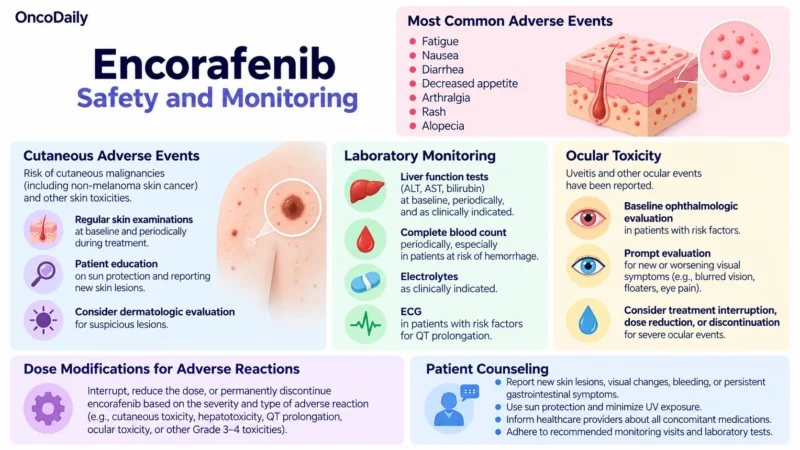
What Monitoring Is Required?
Monitoring should be individualized according to the combination regimen but generally includes:
- Confirm BRAF mutation before therapy
- Dermatologic examination
- LVEF when used with binimetinib
- ALT
- AST
- Bilirubin
- Signs of hemorrhage
- Visual symptoms
- Ophthalmologic review
- ECG when clinically indicated
- Potassium
- Magnesium
- Calcium
- Symptoms of secondary malignancies
- Drug-interaction review
- CYP3A4 inhibitors and inducers
- Concomitant medications affected by CYP3A4 induction
When combined with chemotherapy or cetuximab, additional monitoring should follow the safety profile of those agents.
FAQ
What Is Encorafenib Used For?
- Melanoma
- Metastatic colorectal cancer
- Metastatic NSCLC
What Is the Standard Dose?
450 mg once daily with binimetinib.
For colorectal cancer:
300 mg once daily with cetuximab-based therapy.
Can Encorafenib Be Taken With Food?
It can be taken:
With or without food.
What Are the Dose Reductions in Melanoma or NSCLC?
What Are the Dose Reductions in CRC?
Why Is Encorafenib Combined With Binimetinib?
Why Is Encorafenib Combined With Cetuximab in CRC?
What Did COLUMBUS Show?
- 14.9 months with encorafenib + binimetinib
- 7.3 months with vemurafenib
and median OS was:
- 33.6 months
- 16.9 months, respectively.
What Did PHAROS Show?
- ORR: 75%
- Median DoR: 40.0 months
- Median PFS: 30.2 months.
What Are the Most Important Safety Concerns?
New primary malignancies, cardiomyopathy, hepatotoxicity, hemorrhage, uveitis, and QT prolongation.