


Daratumumab (Darzalex, Darzalex Faspro): Mechanism of Action, Dosing, Clinical Uses, Trials, and Side Effects
Key takeaways
- Daratumumab is a fully human anti-CD38 IgG1κ monoclonal antibody.
- Its principal mechanisms include CDC, ADCC, ADCP, and immunomodulation.
- It was initially approved in 2015.
- Intravenous Darzalex is dosed at 16 mg/kg.
- Subcutaneous Darzalex Faspro contains 1,800 mg daratumumab and 30,000 units hyaluronidase.
- MAIA demonstrated a median OS of 90.3 versus 64.1 months with D-Rd versus Rd.
- PERSEUS established improved progression-free survival and MRD negativity with D-VRd in transplant-eligible myeloma.
- CEPHEUS supported the January 2026 transplant-ineligible D-VRd indication.
- ANDROMEDA established daratumumab–VCd in newly diagnosed AL amyloidosis.
- AQUILA supported treatment of high-risk smoldering myeloma.
- Key risks include infections, cytopenias, administration reactions, and cardiac complications in AL amyloidosis.
- Transfusion-test and immunofixation interference are particularly important practical considerations.
Daratumumab (Darzalex, Darzalex Faspro) is a human IgG1κ monoclonal antibody targeting CD38, a transmembrane glycoprotein highly expressed on malignant plasma cells. It induces tumor-cell death through complement activation, antibody-dependent cellular cytotoxicity, antibody-dependent cellular phagocytosis, and additional immune-mediated mechanisms.
First FDA-approved in November 2015, daratumumab transformed multiple myeloma treatment, evolving from a therapy for heavily pretreated disease into an essential component of frontline regimens for transplant-eligible and transplant-ineligible patients.
Daratumumab is available in two formulations: Darzalex, administered intravenously at 16 mg/kg, and Darzalex Faspro, a fixed-dose subcutaneous formulation containing 1,800 mg daratumumab and 30,000 units hyaluronidase.
Its indications have expanded to newly diagnosed light-chain (AL) amyloidosis and, in November 2025, high-risk smoldering multiple myeloma. On January 27, 2026, the FDA also approved subcutaneous daratumumab combined with bortezomib, lenalidomide, and dexamethasone for newly diagnosed transplant-ineligible multiple myeloma.
Key Facts
- Generic name: Daratumumab
- Brand names: Darzalex; Darzalex Faspro
- Drug class: CD38-directed monoclonal antibody
- Antibody type: Fully human IgG1κ
- Target: CD38
- Mechanism: Complement-dependent cytotoxicity, ADCC, ADCP, apoptosis-associated mechanisms, and immunomodulation
- Initial FDA approval: November 2015
- IV dose: 16 mg/kg
- Subcutaneous dose: 1,800 mg daratumumab plus 30,000 units hyaluronidase
- SC administration time: Approximately 3–5 minutes
- Main indications: Multiple myeloma, high-risk smoldering multiple myeloma (SC formulation), and newly diagnosed AL amyloidosis (SC formulation)
- Major combinations: VRd, Rd, VMP, VTd, Vd, Pd, Kd, and VCd, according to indication
- Pivotal trials: MAIA, PERSEUS, CEPHEUS, CASSIOPEIA, POLLUX, CASTOR, ANDROMEDA, AQUILA
- Major adverse reactions: Administration reactions, infections, cytopenias, fatigue, diarrhea
- Important precautions: Blood-bank testing interference, infection risk, hepatitis B reactivation, interference with myeloma response testing
- Monitoring: CBC, infection status, hepatitis B, serum immunoglobulins when indicated, and disease response
- Metabolism: Proteolytic catabolism
- Important distinction: The IV and SC formulations have different doses, routes, and product-specific indications.
What Is Daratumumab?
Daratumumab selectively recognizes CD38, a surface glycoprotein involved in cellular adhesion, signaling, and the metabolism of NAD⁺.
CD38 is strongly expressed on many malignant plasma cells, making it an effective treatment target in multiple myeloma.
It is also present on some normal hematopoietic and immune cells, including subsets of lymphocytes and regulatory immune cells.
Daratumumab works through both direct antibody-mediated cytotoxicity and alterations in the tumor immune microenvironment.
Unlike therapies requiring a specific oncogenic mutation, daratumumab generally does not require mutation-based selection. Its use is determined by disease indication, treatment line, and prior therapy.
What Is the Mechanism of Action of Daratumumab?
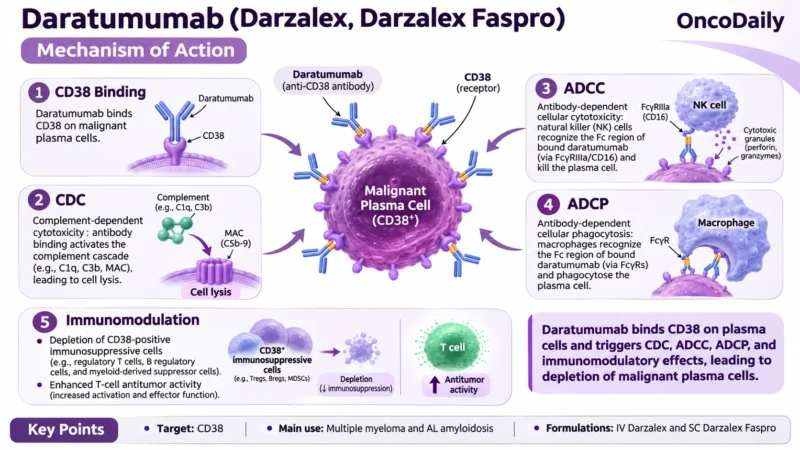
1. Daratumumab Binds CD38
Daratumumab recognizes CD38 on the surface of malignant plasma cells.
CD38 expression allows selective antibody binding, although expression levels vary among cells and during treatment.
2. Complement-Dependent Cytotoxicity Is Activated
Binding of the antibody recruits complement proteins.
This initiates the complement cascade, potentially leading to membrane attack complex formation and tumor-cell lysis.
3. Immune Effector Cells Are Recruited
The Fc region engages Fc receptors on immune cells, promoting:
- Antibody-dependent cellular cytotoxicity (ADCC), particularly involving natural killer cells
- Antibody-dependent cellular phagocytosis (ADCP), particularly involving macrophages
4. Direct Cell Death and Immunomodulation Occur
Fc receptor-mediated cross-linking may induce additional cell-death pathways.
Daratumumab can also deplete certain CD38-expressing immunosuppressive cell populations, contributing to enhanced antitumor T-cell responses.
5. Malignant Plasma-Cell Burden Is Reduced
These combined effects produce deeper treatment responses in multiple myeloma and suppress abnormal plasma cells responsible for pathogenic light-chain production in AL amyloidosis.
Overall mechanism:
Daratumumab → CD38 binding → CDC + ADCC + ADCP + immunomodulation → malignant plasma-cell depletion → antimyeloma activity.
What Is the Recommended Dose of Daratumumab?
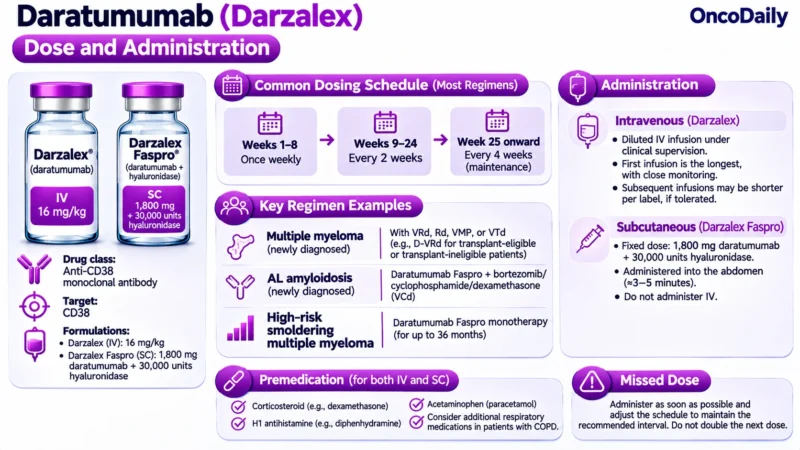
Intravenous Darzalex
16 mg/kg IV, calculated using actual body weight.
The administration schedule depends on the combination regimen.
Subcutaneous Darzalex Faspro
1,800 mg daratumumab + 30,000 units hyaluronidase SC, regardless of body weight.
Common Weekly-to-Monthly Schedule
For several myeloma regimens, including daratumumab with lenalidomide/dexamethasone:
- Weeks 1–8: Once weekly
- Weeks 9–24: Every two weeks
- Week 25 onward: Every four weeks
This schedule also applies to some monotherapy regimens, but not every daratumumab combination.
D-VRd for Transplant-Eligible Newly Diagnosed Multiple Myeloma
Daratumumab is administered with bortezomib, lenalidomide, and dexamethasone during induction and consolidation, with maintenance treatment determined by the protocol.
The PERSEUS approach includes subcutaneous daratumumab during induction and consolidation and daratumumab with lenalidomide during maintenance.
D-VRd for Transplant-Ineligible Newly Diagnosed Multiple Myeloma
The January 2026 FDA approval supports subcutaneous daratumumab with VRd.
The schedule follows the indication-specific labeling, with initial intensive dosing followed by less frequent administrations.
Newly Diagnosed AL Amyloidosis
Daratumumab Faspro is combined with:
- Bortezomib
- Cyclophosphamide
- Dexamethasone
The daratumumab schedule is:
- Weeks 1–8: Weekly
- Weeks 9–24: Every two weeks
- Week 25 onward: Every four weeks, for a maximum of approximately two years
High-Risk Smoldering Multiple Myeloma
Daratumumab Faspro monotherapy:
- Weeks 1–8: Weekly
- Weeks 9–24: Every two weeks
- Week 25 onward: Every four weeks
Treatment can continue for up to 36 months (39 cycles), unless progression to active multiple myeloma or unacceptable toxicity occurs.
This is specifically an approved subcutaneous indication.
How Should Daratumumab Be Administered?
Intravenous Administration
Darzalex must be diluted and administered as an IV infusion under healthcare supervision.
The first infusion requires the longest observation period because infusion-related reactions occur most frequently during initial administration.
For selected patients, the first 16-mg/kg dose may be divided into 8 mg/kg on two consecutive days.
Subsequent infusions may be administered more rapidly according to product-label protocols and tolerability.
Subcutaneous Administration
Darzalex Faspro is injected into the subcutaneous tissue of the abdomen over approximately 3–5 minutes.
It must not be administered intravenously.
The formulation contains hyaluronidase to facilitate subcutaneous absorption.
Premedication
Before treatment, administer:
- Corticosteroid
- Acetaminophen
- H1 antihistamine
Post-treatment corticosteroids may be necessary to reduce delayed administration-related reactions.
Patients with chronic obstructive pulmonary disease may require additional respiratory medications.
Infection Prophylaxis
Antiviral prophylaxis against herpes zoster reactivation is recommended.
Consider additional antimicrobial prophylaxis according to infection risk, immunoglobulin status, and the associated chemotherapy regimen.
What Should You Do If a Daratumumab Dose Is Missed?
Administer the missed dose as soon as possible.
Adjust the subsequent schedule to maintain the prescribed intervals between doses.
Do not double the next treatment dose.
Because daratumumab schedules vary substantially between combinations, the revised treatment calendar should follow the relevant regimen.
How Are Daratumumab Dose Modifications Managed?
Routine stepwise dose reductions are not recommended.
Severe Administration Reactions
For significant reactions, interrupt treatment and provide supportive care.
Severe or life-threatening reactions may require permanent discontinuation.
Neutropenia
Consider withholding daratumumab until neutrophil recovery.
Manage with infection assessment, growth-factor support when indicated, and appropriate adjustments to concomitant treatment.
Thrombocytopenia
Treatment may be delayed until platelet recovery.
Assess bleeding risk and concurrent myelosuppressive therapies.
Serious Infections
Consider treatment interruption during serious active infections.
The decision to restart depends on infection resolution and clinical condition.
What Drug Interactions Are Important With Daratumumab?
Immunosuppressive and Antimyeloma Agents
Daratumumab is commonly combined with proteasome inhibitors, immunomodulatory drugs, and corticosteroids.
These combinations may increase risks of:
- Infection
- Neutropenia
- Thrombocytopenia
- Fatigue
- Peripheral neuropathy
Blood Transfusion Compatibility Testing
Daratumumab binds CD38 on red blood cells, interfering with indirect antiglobulin testing and crossmatching.
It can cause a positive indirect Coombs test without necessarily indicating hemolysis.
Perform blood typing and antibody screening before the first dose and notify the transfusion service.
Dithiothreitol-treated reagent red cells or other validated methods may be needed for compatibility testing.
Because DTT destroys Kell antigens, appropriate Kell-negative blood considerations apply unless the patient’s Kell status is known.
Myeloma Response Testing
Daratumumab is itself an IgGκ monoclonal antibody.
It may appear on serum protein electrophoresis or immunofixation, potentially interfering with assessment of complete response.
A daratumumab-specific immunofixation reflex assay or mass spectrometry may help distinguish the drug from residual disease.
CYP450 Interactions
Daratumumab is not primarily metabolized by CYP450 enzymes, so conventional CYP-mediated drug interactions are not expected to be significant.
Does Daratumumab Require Dose Adjustment in Renal or Hepatic Impairment?
Renal Impairment
Routine dose adjustment is not required for patients with mild to severe renal impairment based on available pharmacokinetic evidence.
Clinical experience in dialysis-dependent patients is less extensive.
Renal impairment may nevertheless require dose changes to concomitant medicines, particularly lenalidomide.
Hepatic Impairment
No routine dose adjustment is established for mild hepatic impairment.
Data for severe hepatic impairment are limited.
What Is the Pharmacokinetic Profile of Daratumumab?
Distribution
Daratumumab distributes mainly within vascular and extracellular compartments.
Metabolism
As a monoclonal antibody, daratumumab undergoes proteolytic catabolism into peptides and amino acids.
Clearance
Clearance includes target-mediated elimination and nonspecific antibody catabolism.
As CD38-expressing tumor cells are depleted, target-mediated clearance decreases.
Half-Life
The terminal half-life varies with dose, route, treatment duration, and target burden.
After repeated administration, IV daratumumab has a terminal half-life of approximately 18 days, with longer estimates reported in some pharmacokinetic settings.
The fixed subcutaneous formulation has a pharmacokinetic profile that supports administration every four weeks during maintenance phases.
What Are the Clinical Uses of Daratumumab?
Newly Diagnosed Transplant-Eligible Multiple Myeloma
Daratumumab-containing quadruplet therapy, particularly D-VRd, has become an important treatment approach.
The PERSEUS study demonstrated improved depth of response, MRD negativity, and progression-free survival.
Newly Diagnosed Transplant-Ineligible Multiple Myeloma
Approved regimens include:
- Daratumumab + lenalidomide + dexamethasone
- Daratumumab + bortezomib + melphalan + prednisone
- Subcutaneous daratumumab + VRd, following the January 2026 expansion
Choice of regimen depends on frailty, neuropathy, renal function, thrombosis risk, and other comorbidities.
Relapsed or Refractory Multiple Myeloma
Daratumumab is used in combination with:
- Lenalidomide/dexamethasone
- Bortezomib/dexamethasone
- Pomalidomide/dexamethasone
- Carfilzomib/dexamethasone
It may also be used as monotherapy in heavily pretreated disease under the applicable indication.
Newly Diagnosed AL Amyloidosis
Subcutaneous daratumumab with VCd is an established regimen.
It improves hematologic disease control and reduces the risk of organ deterioration or hematologic progression.
High-Risk Smoldering Multiple Myeloma
Following the November 2025 FDA approval, Darzalex Faspro monotherapy is an option for adults with high-risksmoldering multiple myeloma.
This indication does not include all patients with smoldering disease.
Treatment requires careful risk classification and discussion of the benefits and risks of early intervention.
What Molecular and Diagnostic Testing Is Required Before Daratumumab?
Confirm Plasma-Cell Disease
Assessment may include:
- Bone marrow aspirate and biopsy
- Flow cytometry and immunophenotyping
- Serum protein electrophoresis and immunofixation
- Serum free light chains
- Quantitative immunoglobulins
- Urine studies
- Appropriate imaging
- Cytogenetics and FISH for myeloma risk stratification
CD38 Expression
CD38 is typically highly expressed on malignant plasma cells.
Routine quantitative CD38 testing is not required to prescribe daratumumab in established indications.
Hepatitis B Screening
Screen for HBV infection before treatment and monitor patients at risk for reactivation.
Blood Bank Preparation
Obtain baseline type and screen before initiating therapy.
AL Amyloidosis Assessment
Evaluate cardiac biomarkers, renal function, proteinuria, and organ involvement.
The drug is not recommended outside clinical trials for patients with specified advanced cardiac disease, including NYHA IIIB/IV or Mayo stage IIIB.
What Did the Pivotal Clinical Trials Show?
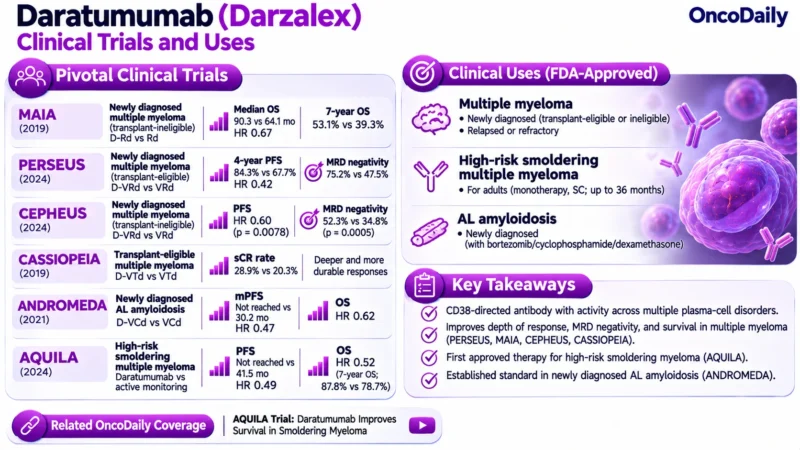
MAIA — Transplant-Ineligible Newly Diagnosed Multiple Myeloma
The phase III MAIA trial compared:
- Daratumumab + lenalidomide + dexamethasone (D-Rd)
- Lenalidomide + dexamethasone (Rd)
A total of 737 patients were randomized.
Final Median Overall Survival
- D-Rd: 90.3 months
- Rd: 64.1 months
HR: 0.67
Seven-Year Overall Survival
- D-Rd: 53.1%
- Rd: 39.3%
The final analysis, published in 2026, confirmed sustained survival benefit with frontline daratumumab.
PERSEUS — Transplant-Eligible Newly Diagnosed Multiple Myeloma
PERSEUS compared D-VRd with VRd in 709 transplant-eligible patients.
Four-Year Progression-Free Survival
- D-VRd: 84.3%
- VRd: 67.7%
HR: 0.42
MRD Negativity
- D-VRd: 75.2%
- VRd: 47.5%
The trial demonstrated significantly deeper responses and improved disease control with daratumumab-containing quadruplet therapy.
Watch More: Long-Term PERSEUS Results Confirm Sustained Benefit of Daratumumab-Based Therapy in Newly Diagnosed Multiple Myeloma.
CEPHEUS — Transplant-Ineligible Newly Diagnosed Multiple Myeloma
CEPHEUS evaluated subcutaneous daratumumab plus VRd versus VRd.
395 patients were randomized.
MRD Negativity
- D-VRd: 52.3%
- VRd: 34.8%
p = 0.0005
Progression-Free Survival
HR: 0.60
p = 0.0078
These results supported the January 2026 FDA approval of D-VRd for newly diagnosed transplant-ineligible multiple myeloma.
CASSIOPEIA — Transplant-Eligible Multiple Myeloma
CASSIOPEIA compared daratumumab–VTd with VTd during induction and consolidation around autologous stem cell transplantation.
Stringent Complete Response After Consolidation
- D-VTd: 28.9%
- VTd: 20.3%
Daratumumab improved the depth of response and subsequent disease-control outcomes.
ANDROMEDA — Newly Diagnosed AL Amyloidosis
ANDROMEDA compared:
- Daratumumab Faspro + bortezomib/cyclophosphamide/dexamethasone
- Bortezomib/cyclophosphamide/dexamethasone alone
The trial included 388 patients.
Major Organ Deterioration or Progression-Free Survival
- D-VCd: Median not reached
- VCd: 30.2 months
HR: 0.47
Overall Survival
HR: 0.62
The mature results supported traditional FDA approval in November 2025.
AQUILA — High-Risk Smoldering Multiple Myeloma
AQUILA compared subcutaneous daratumumab monotherapy with active monitoring in 390 patients.
Progression-Free Survival
The endpoint was progression to active multiple myeloma or death.
- Daratumumab: Median not reached
- Active monitoring: 41.5 months
HR: 0.49
p < 0.0001
This study supported FDA approval for high-risk smoldering multiple myeloma in November 2025.
Read More: Vincent Rajkumar to Present Landmark AQUILA Trial Overall Survival Results at ASH 2026 by OncoDaily.
Does Daratumumab Have CNS Activity?
Daratumumab is a large antibody with limited penetration across an intact blood–brain barrier.
Its role in CNS myeloma is not established through prospective randomized trials.
Individual case reports and small series describe its use in CNS-involved myeloma, often alongside other systemic or CNS-directed treatments.
However, daratumumab should not be considered a proven standalone CNS-directed treatment.
Is Daratumumab FDA Approved?
Yes.
Key milestones include:
- November 2015: Initial approval of intravenous Darzalex
- May 2020: Approval of subcutaneous Darzalex Faspro
- July 2024: D-VRd for induction and consolidation in transplant-eligible newly diagnosed myeloma
- November 6, 2025: Darzalex Faspro monotherapy for high-risk smoldering multiple myeloma
- November 19, 2025: Traditional approval of Darzalex Faspro–VCd for newly diagnosed AL amyloidosis
- January 27, 2026: Darzalex Faspro–VRd for transplant-ineligible newly diagnosed multiple myeloma
These additional indications are formulation-specific and should not automatically be applied to the intravenous product.
What Is the Current Clinical Role of Daratumumab in 2026?
Newly Diagnosed Multiple Myeloma
Daratumumab is a major component of modern treatment for both transplant-eligible and transplant-ineligible patients.
Quadruplet therapy has expanded particularly in fit patients, with treatment selection based on transplant strategy, frailty, risk, and other clinical characteristics.
Relapsed Multiple Myeloma
Daratumumab-containing triplets remain important for eligible patients who have not become refractory to CD38-directed treatment.
In patients already refractory to daratumumab, other therapies—including BCMA-directed and GPRC5D-directed approaches—may be more appropriate, depending on availability and treatment history.
AL Amyloidosis
Daratumumab–VCd is an established treatment for newly diagnosed AL amyloidosis, with careful cardiac risk assessment.
High-Risk Smoldering Myeloma
AQUILA has introduced an approved early-intervention strategy in a population previously managed predominantly through surveillance or clinical trials.
The decision to treat remains individualized because high-risk classification, treatment burden, adverse effects, and long-term consequences all matter.
What Are the Major Side Effects of Daratumumab?
Infusion and Administration-Related Reactions
These are more common with the intravenous formulation, especially during the first infusion.
Symptoms can include:
- Nasal congestion
- Cough
- Throat irritation
- Chills
- Dyspnea
- Bronchospasm
- Hypotension
Subcutaneous administration generally has a lower rate of systemic administration-related reactions, although reactions can still occur.
Life-threatening reactions require permanent discontinuation.
Infections
Daratumumab can increase susceptibility to infections, including:
- Upper respiratory tract infections
- Pneumonia
- Herpes zoster reactivation
- Opportunistic infections
- Serious bacterial and viral infections
Fatal infections have been reported.
Neutropenia
Neutropenia is particularly important in combinations containing lenalidomide, pomalidomide, or other myelosuppressive agents.
Monitor for febrile neutropenia and other infectious complications.
Thrombocytopenia
Thrombocytopenia may occur or worsen during combination therapy.
Severe thrombocytopenia can require treatment delays and supportive care.
Hypogammaglobulinemia
Daratumumab can reduce normal immunoglobulin levels.
This may contribute to recurrent or severe infections, particularly during prolonged treatment.
Fatigue and Gastrointestinal Effects
Common adverse reactions include:
- Fatigue
- Diarrhea
- Constipation
- Nausea
- Reduced appetite
These may also result from accompanying antimyeloma treatments.
Cardiac Toxicity in AL Amyloidosis
Patients with AL amyloidosis may have substantial underlying cardiac involvement.
Serious and fatal cardiac adverse events have been observed during daratumumab–VCd treatment.
Patients with advanced cardiac disease require particular caution.
Interference With Transfusion Testing
Daratumumab can produce panreactivity in indirect antiglobulin testing, complicating identification of clinically significant red-cell antibodies.
This interference may persist for months after treatment completion.
Embryo-Fetal Toxicity
Daratumumab may cause fetal harm.
Females of reproductive potential should use effective contraception during treatment and for three months after the final dose. Additional precautions apply to accompanying agents such as lenalidomide.
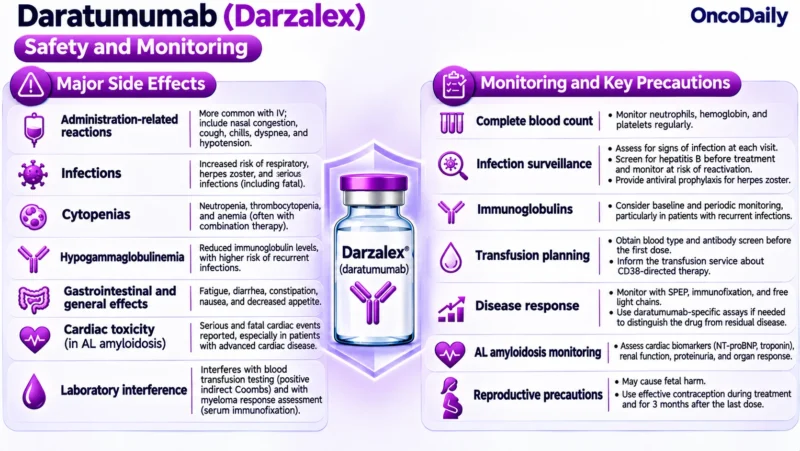
What Monitoring Is Required During Daratumumab Treatment?
Complete Blood Count
Monitor:
- Neutrophils
- Hemoglobin
- Platelets
- Other white blood cell counts
Frequency depends on the accompanying regimen, cytopenia severity, and treatment phase.
Infection Monitoring
At each treatment visit, assess for fever, respiratory symptoms, recurrent infections, and other signs of infection.
Review hepatitis B status before treatment and monitor patients at risk of reactivation.
Immunoglobulin Monitoring
Consider baseline and follow-up immunoglobulin assessment, particularly in patients with recurrent or serious infections.
Immunoglobulin replacement may be considered in appropriately selected patients.
Administration Reactions
Closely monitor during and after treatment, especially with the first IV infusion or first SC administration.
Patients should receive the appropriate premedications and post-treatment measures.
Disease Response Monitoring
In multiple myeloma, assess:
- Serum protein electrophoresis
- Serum immunofixation
- Serum free light chains
- Immunoglobulin concentrations
- Urine studies when indicated
- Bone marrow/MRD assessments when clinically appropriate
Consider daratumumab-related assay interference when interpreting complete response.
Blood Bank Compatibility
Before the first dose: Obtain baseline blood type and antibody screen.
Notify the transfusion service whenever daratumumab has been administered.
AL Amyloidosis Monitoring
Assess:
- NT-proBNP or BNP
- Cardiac troponin
- Renal function
- Proteinuria
- Clinical signs of heart failure
- Hematologic and organ response
Pregnancy and Reproductive Monitoring
Assess pregnancy status when appropriate and ensure relevant contraception counseling.