





Dacomitinib (Vizimpro): Understanding Its Mechanism, Dosing, and Clinical Role in EGFR-Mutated Lung Cancer
Key takeaways
- Dacomitinib is a second-generation irreversible EGFR/HER2/HER4 tyrosine kinase inhibitor.
- It is FDA-approved for first-line metastatic NSCLC with EGFR exon 19 deletion or L858R.
- The standard dose is 45 mg orally once daily.
- It can be taken with or without food.
- Dose reductions follow a 45 → 30 → 15 mg sequence.
- ARCHER 1050 demonstrated longer PFS and overall survival with dacomitinib than with gefitinib.
- Patients with CNS metastases were excluded from the pivotal phase III trial.
- Diarrhea and dermatologic toxicity are the principal treatment-limiting adverse effects.
- Proton pump inhibitors should generally be avoided.
- Modern 2026 first-line EGFR-mutated NSCLC therapy has shifted toward newer EGFR-directed strategies, so dacomitinib is used less frequently than when it was first approved.
Dacomitinib (Vizimpro) is an oral, second-generation, irreversible tyrosine kinase inhibitor targeting the ErbB/HER receptor family, including EGFR/HER1, HER2, and HER4. It is FDA-approved for the first-line treatment of metastatic non-small cell lung cancer (NSCLC) with EGFR exon 19 deletion or exon 21 L858R substitution mutations detected by an FDA-approved test.
Unlike first-generation EGFR inhibitors such as gefitinib and erlotinib, dacomitinib produces irreversible inhibition of several members of the HER family. The standard dose is 45 mg orally once daily, with stepwise reductions to 30 mg and 15 mg when clinically significant toxicity develops.
Key Facts
- Generic name: Dacomitinib
- Brand name: Vizimpro
- Drug class: Second-generation irreversible pan-HER/ErbB tyrosine kinase inhibitor
- Route: Oral
- Initial US approval: 2018
- FDA-approved indication: First-line metastatic NSCLC with EGFR exon 19 deletion or exon 21 L858R
- Standard dose: 45 mg orally once daily
- Dose reductions: 30 mg → 15 mg once daily
- Administration: With or without food
- Available strengths: 15 mg, 30 mg, and 45 mg tablets
- Major targets: EGFR/HER1, HER2, and HER4
- Major toxicities: Diarrhea, rash, paronychia, stomatitis, dry skin, decreased appetite, and weight loss
- Important serious toxicity: Interstitial lung disease
- Important interaction: Proton pump inhibitors should be avoided
- Half-life: Approximately 70 hours.
What Is Dacomitinib?
Dacomitinib is a small-molecule inhibitor of the human epidermal growth factor receptor family.
The HER/ErbB family includes:
- EGFR/HER1
- HER2
- HER3
- HER4
Dacomitinib directly inhibits the kinase activity of:
EGFR, HER2, and HER4.
Its activity includes clinically important activating EGFR mutations such as:
Exon 19 deletion
and
Exon 21 L858R.
Because dacomitinib forms an irreversible interaction with these kinases, receptor inhibition persists beyond the presence of free circulating drug.
What Is the Mechanism of Action of Dacomitinib?
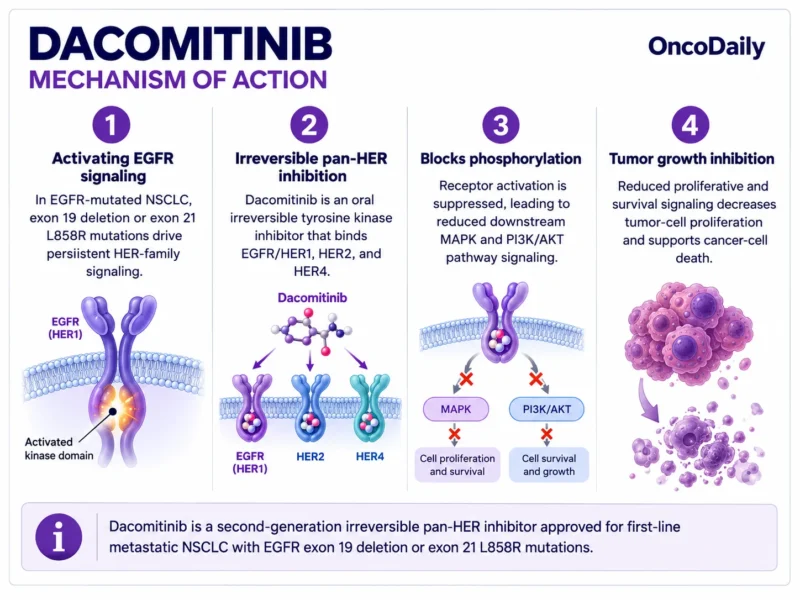
1. Activating EGFR Mutations Drive Tumor Signaling
EGFR exon 19 deletions and exon 21 L858R mutations can produce persistent activation of EGFR signaling.
This promotes:
- Tumor-cell proliferation
- Survival
- Growth
- Invasion
2. Dacomitinib Irreversibly Inhibits the HER Family
Dacomitinib binds irreversibly to the kinase domains of:
EGFR/HER1, HER2, and HER4.
This broader HER-family inhibition distinguishes it from reversible first-generation EGFR TKIs.
3. Receptor Autophosphorylation Is Suppressed
Blocking kinase activity inhibits phosphorylation of EGFR and HER2 and interferes with HER-family signaling.
4. Downstream Signaling Falls
Reduced receptor activity suppresses intracellular pathways involved in malignant-cell proliferation and survival, including:
RAS–RAF–MAPK
and
PI3K–AKT.
5. Tumor Growth Is Inhibited
Persistent inhibition of EGFR-dependent signaling decreases tumor-cell proliferation and survival.
The mechanism can be summarized as:
Dacomitinib → irreversible EGFR/HER2/HER4 inhibition → reduced receptor phosphorylation → suppression of downstream signaling → decreased tumor-cell proliferation and survival.
What Is the Dose of Dacomitinib?
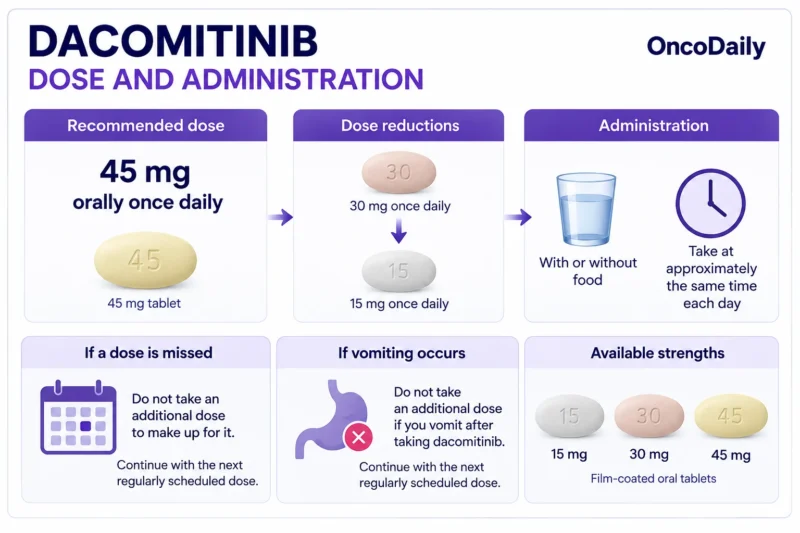
The recommended dose is:
45 mg orally once daily.
Treatment continues until:
- Disease progression
- Unacceptable toxicity
Dacomitinib may be taken:
With or without food.
It should preferably be taken at approximately the same time each day.
What If a Dose Is Missed?
If a dose is missed:
Do not take an additional dose to make up for it.
The patient should continue with the next regularly scheduled dose.
The same applies if the patient vomits after taking dacomitinib.
How Are Dacomitinib Dose Reductions Made?
Dacomitinib uses a simple stepwise dose-reduction strategy:
45 mg → 30 mg → 15 mg once daily.
Dose interruption or reduction may be needed for clinically important adverse effects, particularly:
- Diarrhea
- Rash
- Other dermatologic toxicity
- Stomatitis
- Other significant treatment-related adverse events.
The high frequency of dose modification is clinically important. In later analyses of ARCHER 1050, many patients required reductions, yet efficacy remained clinically meaningful after dose adjustment.
How Is Dacomitinib Administered?
Dacomitinib is supplied as film-coated oral tablets containing:
- 15 mg
- 30 mg
- 45 mg
It may be taken:
With or without food.
A high-fat meal does not produce a clinically meaningful change in dacomitinib exposure.
Unlike intravenous anticancer therapy, dacomitinib requires:
- No infusion preparation
- No IV access
- No in-line filter
- No routine infusion-related premedication
What Are the Important Drug Interactions With Dacomitinib?
Proton Pump Inhibitors
Dacomitinib absorption is affected by gastric pH.
Proton pump inhibitors should generally be:
Avoided.
In a pharmacokinetic study, rabeprazole reduced dacomitinib:
- Cmax by approximately 51%
- AUC by approximately 39%.
H2-Receptor Antagonists
If an H2-receptor antagonist is required, dacomitinib should be administered:
At least 6 hours before
or:
10 hours after
the H2-receptor antagonist.
Antacids
Locally acting antacids may be used when needed and have not demonstrated clinically important effects on dacomitinib exposure.
CYP2D6 Substrates
Dacomitinib can substantially increase exposure to medications metabolized by CYP2D6.
For example, coadministration increased dextromethorphan exposure approximately 9.6-fold.
Therefore, concomitant use should be avoided when even a small increase in the CYP2D6 substrate could cause serious or life-threatening toxicity.
Does Dacomitinib Require Renal or Hepatic Dose Adjustment?
Renal Impairment
No dose adjustment is recommended for:
Creatinine clearance 30–89 mL/min.
The recommended dose has not been established for:
CrCl <30 mL/min
or patients requiring hemodialysis.
Hepatic Impairment
No routine dosage adjustment is recommended for:
- Child-Pugh A
- Child-Pugh B
- Child-Pugh C hepatic impairment
because clinically meaningful differences in dacomitinib pharmacokinetics were not observed across these groups.
What Is the Pharmacokinetic Profile of Dacomitinib?
Absorption
Mean absolute oral bioavailability is approximately:
80%.
Peak plasma concentrations generally occur at approximately:
6 hours
after administration.
Distribution
Dacomitinib has extensive tissue distribution.
The apparent steady-state volume of distribution is approximately:
1,889 L.
Plasma protein binding is approximately:
98%.
Metabolism
Hepatic metabolism is the major route of clearance.
The major pathways include:
- Oxidation
- Glutathione conjugation
CYP2D6 is the principal enzyme involved in formation of the active metabolite O-desmethyl dacomitinib, while CYP3A4 contributes to minor oxidative metabolites.
Half-Life
The mean plasma half-life is approximately:
70 hours.
Elimination
Following radiolabeled administration, approximately:
- 79% of drug-related material was recovered in feces
- 3% was recovered in urine.
What Are the Clinical Uses of Dacomitinib?
EGFR-Mutated Metastatic NSCLC
The current FDA-approved indication is specifically:
First-line treatment of metastatic NSCLC with EGFR exon 19 deletion or exon 21 L858R substitution mutations.
Molecular confirmation using an FDA-approved test is required before treatment.
Dacomitinib should not automatically be extrapolated to all EGFR alterations. Its pivotal phase III evidence and US indication are centered on the two classical sensitizing mutations:
- Exon 19 deletion
- L858R
What Did Dacomitinib Clinical Trials Show?
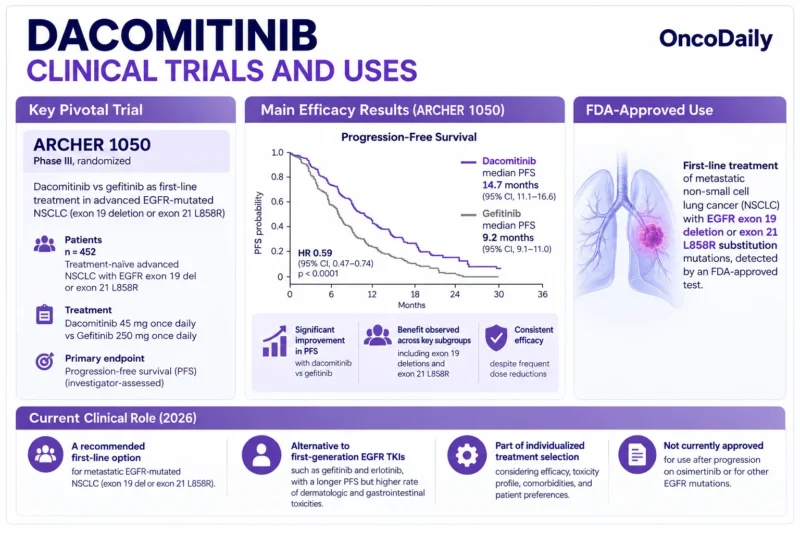
ARCHER 1050 — Dacomitinib Versus Gefitinib
The pivotal phase III ARCHER 1050 trial enrolled:
452 patients
with previously untreated advanced EGFR-mutated NSCLC.
Patients were randomized to:
- Dacomitinib 45 mg once daily
- Gefitinib 250 mg once daily
Eligible tumors carried:
- EGFR exon 19 deletion
- EGFR exon 21 L858R
Importantly, patients with a history of central nervous system metastases were excluded, which should be considered when interpreting the results.
Median Progression-Free Survival
- Dacomitinib: 14.7 months
- Gefitinib: 9.2 months
Hazard ratio:
0.59.
This represented a significant reduction in the risk of disease progression or death.
Objective Response Rate
- Dacomitinib: 75%
- Gefitinib: 72%
The response rates were similar, but responses lasted longer with dacomitinib.
Median Duration of Response
Dacomitinib: 14.8 months
Gefitinib: 8.3 months.
Overall Survival
In the mature survival analysis:
Median overall survival:
- Dacomitinib: 34.1 months
- Gefitinib: 26.8 months
with a hazard ratio of approximately:
0.76.
With longer follow-up, the overall-survival benefit remained evident:
- Dacomitinib: 34.1 months
- Gefitinib: 27.0 months
Hazard ratio:
0.748.
Effect of Dose Reduction
Dose modification was frequent with dacomitinib because of EGFR-related toxicity.
However, patients requiring dose reductions continued to demonstrate meaningful outcomes, supporting active toxicity management rather than unnecessarily abandoning treatment when adverse effects can be controlled.
What About Brain Metastases?
A major limitation of ARCHER 1050 was the exclusion of patients with known CNS metastases.
Later prospective and real-world studies have reported intracranial activity.
A small phase II study of 30 treatment-naive patients with EGFR-mutated NSCLC and untreated brain metastases reported a confirmed intracranial response rate of:
96.7%
including intracranial complete responses in approximately:
63% of patients.
These findings suggest CNS activity, but they do not provide the same level of randomized evidence available for contemporary third-generation EGFR inhibitors.
Is Dacomitinib FDA Approved?
Yes.
Dacomitinib received FDA approval on:
September 27, 2018
for first-line treatment of metastatic NSCLC with:
- EGFR exon 19 deletion
- EGFR exon 21 L858R substitution mutation.
The current US prescribing information continues to carry this indication.
What Is the Current Clinical Role of Dacomitinib?
Dacomitinib demonstrated clear efficacy over gefitinib and remains an FDA-approved EGFR-targeted treatment.
However, the first-line EGFR-mutated NSCLC landscape has changed substantially.
Current 2026 ASCO guidance for metastatic NSCLC with classical exon 19 deletion or L858R emphasizes:
- Osimertinib + platinum/pemetrexed
- Amivantamab + lazertinib
- Osimertinib monotherapy for patients not pursuing combination therapy.
Dacomitinib therefore has a considerably smaller role in contemporary practice than when ARCHER 1050 was published.
Its use may still depend on:
- Regional availability
- Reimbursement
- Previous treatment
- Patient preference
- Toxicity considerations
- Access to newer EGFR-directed therapies
Its clinical importance remains significant historically because ARCHER 1050 established that intensified irreversible EGFR inhibition could improve both PFS and overall survival compared with a first-generation EGFR TKI.
Dacomitinib remains part of the broader EGFR-targeted treatment landscape in metastatic NSCLC. Learn more about how EGFR-mutant NSCLC treatment is evolving on OncoDaily.
Watch more: Targeted Therapies in Lung Cancer — Bruce Johnson, MD, discussing EGFR-mutated NSCLC and the evolution of EGFR-targeted therapy.
What Are the Major Side Effects of Dacomitinib?
The most common adverse effects include:
- Diarrhea
- Rash
- Paronychia
- Stomatitis
- Dry skin
- Decreased appetite
- Weight loss
- Alopecia
- Cough
- Pruritus.
Diarrhea
Diarrhea is the most characteristic treatment-limiting toxicity.
In the extended ARCHER 1050 analysis, diarrhea occurred in approximately:
88% of dacomitinib-treated patients.
Severe diarrhea can lead to:
- Dehydration
- Electrolyte abnormalities
- Renal dysfunction
- Treatment interruption or dose reduction
Patients should be instructed to begin appropriate antidiarrheal therapy promptly when symptoms occur.
Rash and Acneiform Dermatitis
EGFR inhibition commonly causes dermatologic toxicity.
Manifestations include:
- Acneiform rash
- Erythema
- Dry skin
- Pruritus
- Skin fissures
In ARCHER 1050, Grade 3–4 acneiform dermatitis occurred more frequently with dacomitinib than with gefitinib.
Paronychia
Inflammation around the nails is common and may become painful or infected.
Approximately:
62%
of patients experienced paronychia in the extended ARCHER 1050 analysis.
Stomatitis
Oral mucosal toxicity can include:
- Mouth soreness
- Ulceration
- Difficulty eating
- Reduced oral intake
Stomatitis occurred in approximately:
44%
of patients in extended follow-up.
Interstitial Lung Disease
ILD is an uncommon but potentially serious toxicity.
Patients developing:
- New or worsening dyspnea
- Cough
- Fever
- Pulmonary infiltrates
should undergo prompt evaluation.
If ILD is confirmed:
Dacomitinib should be permanently discontinued.
Embryo-Fetal Toxicity
Dacomitinib can cause fetal harm.
Females of reproductive potential should use effective contraception during therapy and for at least:
17 days after the final dose.
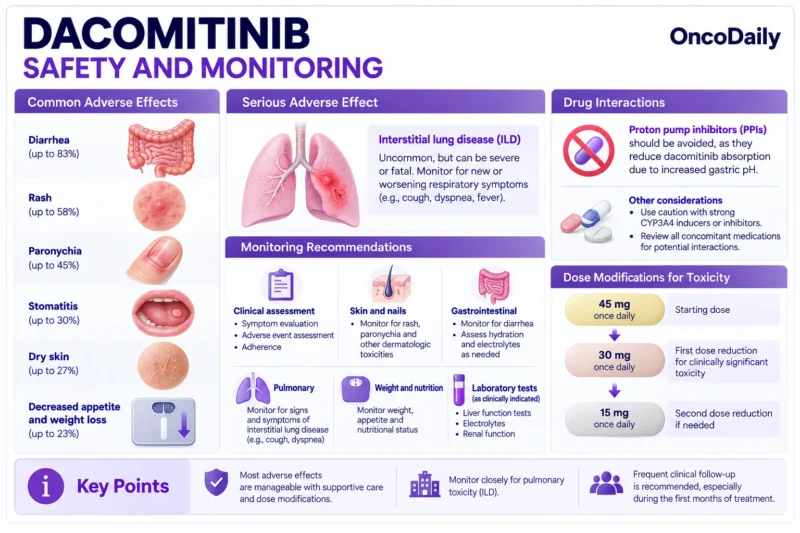
What Monitoring Is Required?
Monitoring during treatment should include:
- Severity and frequency of diarrhea
- Hydration status
- Electrolytes when clinically indicated
- Renal function, particularly with significant diarrhea
- Skin toxicity
- Nail changes and paronychia
- Oral mucosa and stomatitis
- Respiratory symptoms suggesting ILD
- Weight and nutritional status
- Concomitant acid-suppressing medications
- Concomitant CYP2D6 substrates
Early management of diarrhea and dermatologic toxicity is particularly important because these adverse effects commonly determine whether dose interruption or reduction is required.