





Crizotinib (Xalkori): Understanding Its Mechanism, Dosing, Clinical Uses, and Role in ALK- and ROS1-Positive Cancers
Key takeaways
- Crizotinib is an oral tyrosine kinase inhibitor targeting ALK, ROS1, and MET.
- The standard adult dose for metastatic ALK- or ROS1-positive NSCLC is 250 mg orally twice daily.
- Adult dose reductions are 200 mg twice daily → 250 mg once daily.
- Crizotinib was initially FDA approved for ALK-positive NSCLC in 2011 and later for ROS1-positive NSCLC, ALK-positive ALCL, and ALK-positive IMT.
- PROFILE 1007 demonstrated superior PFS versus chemotherapy in previously treated ALK-positive NSCLC: 7.7 vs 3.0 months.
- PROFILE 1014 established crizotinib as superior to chemotherapy in previously untreated ALK-positive NSCLC.
- PROFILE 1001 demonstrated an ORR of 72% and median PFS of 19.3 months in ROS1-positive NSCLC.
- CNS control is an important limitation of crizotinib compared with newer-generation ALK inhibitors.
- Important serious toxicities include hepatotoxicity, ILD/pneumonitis, QT prolongation, bradycardia, and severe visual loss.
- In 2026, newer-generation ALK inhibitors are preferred for first-line ALK-positive metastatic NSCLC, while crizotinib remains an important option for ROS1-positive disease and ALK-driven ALCL and IMT.
Crizotinib (Xalkori) is an oral, multitargeted tyrosine kinase inhibitor that inhibits ALK, ROS1, and MET signaling. It was one of the first precision oncology drugs to transform the treatment of molecularly defined non-small cell lung cancer (NSCLC), initially establishing the clinical value of targeting ALK rearrangements and later becoming the first FDA-approved therapy for ROS1-positive metastatic NSCLC.
Crizotinib is also FDA approved outside lung cancer, including relapsed or refractory systemic ALK-positive anaplastic large cell lymphoma (ALCL) in pediatric patients and young adults and unresectable, recurrent, or refractory ALK-positive inflammatory myofibroblastic tumor (IMT) in adults and pediatric patients aged 1 year and older. Although newer-generation ALK inhibitors have largely replaced crizotinib as preferred first-line therapy for ALK-positive metastatic NSCLC, crizotinib remains an important treatment option in selected settings, particularly for ROS1-positive NSCLC and ALK-driven ALCL and IMT.
Key Facts
- Generic name: Crizotinib
- Brand name: Xalkori
- Drug class: Multitargeted tyrosine kinase inhibitor
- Route: Oral
- Initial US approval: August 26, 2011
- Major targets: ALK, ROS1, MET/HGFR
- Adult NSCLC dose: 250 mg orally twice daily
- Adult IMT dose: 250 mg orally twice daily
- Pediatric/young adult ALCL dose: 280 mg/m² orally twice daily
- Pediatric IMT dose: 280 mg/m² orally twice daily
- Administration: With or without food
- Adult capsule strengths: 200 mg and 250 mg
- Oral pellet strengths: 20 mg, 50 mg, and 150 mg
- Adult dose reductions: 200 mg twice daily → 250 mg once daily
- Major toxicities: Visual disorders, nausea, diarrhea, vomiting, edema, constipation, elevated transaminases, fatigue, decreased appetite, dizziness, and neuropathy
- Important serious toxicities: Hepatotoxicity, interstitial lung disease/pneumonitis, QT prolongation, bradycardia, and severe visual loss
- Major interaction: Strong CYP3A inhibitors and inducers should generally be avoided
- Half-life: Approximately 42 hours.
What Is Crizotinib?
Crizotinib is a small-molecule kinase inhibitor that targets several receptor tyrosine kinases involved in oncogenic signaling.
Its principal clinically relevant targets include:
- ALK
- ROS1
- MET/HGFR
Crizotinib was initially developed as a MET inhibitor, but its activity against ALK became particularly important after the discovery of ALK rearrangements in NSCLC.
ALK fusions, most commonly involving EML4-ALK, generate constitutively active fusion proteins that continuously stimulate signaling pathways involved in malignant-cell proliferation and survival.
Similarly, ROS1 rearrangements create oncogenic fusion proteins that activate downstream signaling independently of normal regulatory control.
By inhibiting these abnormal kinases, crizotinib can suppress oncogenic signaling and induce tumor regression.
What Is the Mechanism of Action of Crizotinib?
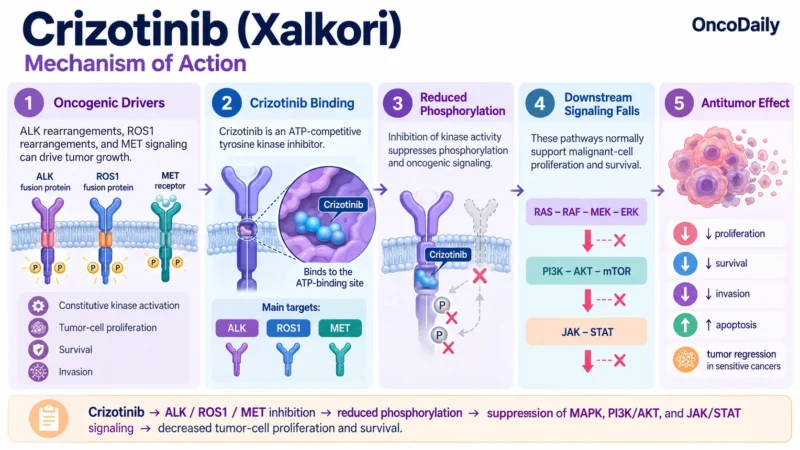
1. Oncogenic Kinase Fusions Drive Tumor Growth
ALK and ROS1 rearrangements generate fusion proteins with constitutively active kinase domains.
These activated proteins stimulate intracellular signaling pathways that promote:
- Cell proliferation
- Survival
- Migration
- Invasion
- Resistance to apoptosis
2. Crizotinib Binds the ATP-Binding Site
Crizotinib is an:
ATP-competitive tyrosine kinase inhibitor.
It binds to the kinase domains of:
ALK, ROS1, and MET.
This prevents ATP-dependent phosphorylation and blocks kinase activation.
3. Receptor and Fusion-Protein Phosphorylation Falls
Inhibition of kinase activity suppresses autophosphorylation and signaling from abnormal ALK or ROS1 fusion proteins.
4. Downstream Signaling Is Suppressed
Important pathways affected include:
RAS–RAF–MEK–ERK
PI3K–AKT–mTOR
and
JAK–STAT.
These pathways normally support cancer-cell proliferation and survival.
5. Tumor-Cell Growth Is Inhibited
Reduced oncogenic signaling leads to:
- Decreased tumor-cell proliferation
- Reduced survival
- Increased apoptosis
- Tumor regression in sensitive cancers
The mechanism can therefore be summarized as:
Crizotinib → inhibition of ALK/ROS1/MET kinase activity → reduced phosphorylation → suppression of MAPK, PI3K/AKT, and JAK/STAT signaling → decreased tumor-cell proliferation and survival.
What Is the Dose of Crizotinib?
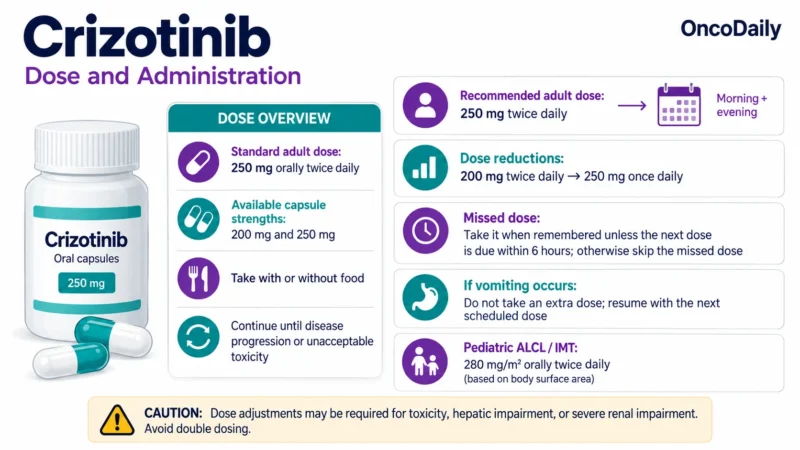
Adult ALK- or ROS1-Positive Metastatic NSCLC
The recommended dose is:
250 mg orally twice daily.
Treatment continues until:
- Disease progression
- Unacceptable toxicity
Crizotinib may be taken:
With or without food.
Adult ALK-Positive Inflammatory Myofibroblastic Tumor
The recommended adult dose is:
250 mg orally twice daily.
Pediatric and Young Adult ALK-Positive ALCL
The recommended dose is:
280 mg/m² orally twice daily
with the actual dose selected according to body surface area.
Pediatric ALK-Positive IMT
The recommended dose is also:
280 mg/m² orally twice daily
based on body surface area.
What If a Dose Is Missed?
If a dose is missed, it may be taken when remembered unless the next scheduled dose is due within approximately:
6 hours.
If less than 6 hours remain before the next dose:
Skip the missed dose.
Patients should not take two doses at the same time.
If vomiting occurs after taking crizotinib:
Do not take an additional dose.
Continue with the next regularly scheduled dose.
How Are Crizotinib Dose Reductions Made?
For adults with NSCLC or IMT, the standard dose is:
250 mg twice daily.
The first dose reduction is:
200 mg twice daily.
The second dose reduction is:
250 mg once daily.
If the patient cannot tolerate:
250 mg once daily
crizotinib should generally be permanently discontinued.
Dose interruption or reduction may be required for clinically important toxicities including:
- Hepatotoxicity
- Neutropenia
- QT prolongation
- Bradycardia
- Visual toxicity
- Severe gastrointestinal adverse effects
- Other clinically significant treatment-related adverse events
How Is Crizotinib Administered?
Crizotinib can be administered as:
- Capsules
- Oral pellets
Adult capsule strengths include:
200 mg
and
250 mg.
Oral pellet strengths include:
20 mg
50 mg
and
150 mg.
Crizotinib can be taken:
With or without food.
Unlike intravenous therapy, it requires:
- No IV access
- No infusion preparation
- No infusion-related premedication
For pediatric ALCL and IMT, dose selection is based on body surface area.
What Are the Important Drug Interactions With Crizotinib?
Strong CYP3A Inhibitors
Crizotinib is primarily metabolized by:
CYP3A.
Strong CYP3A inhibitors can increase crizotinib exposure and increase toxicity.
These should generally be:
Avoided.
If unavoidable, dose reduction may be required.
Strong CYP3A Inducers
Strong CYP3A inducers can substantially lower crizotinib exposure and potentially reduce efficacy.
Concomitant use should generally be:
Avoided.
CYP3A Substrates
Crizotinib can affect exposure to certain CYP3A substrates.
Particular caution is required when even small changes in substrate concentration could lead to serious toxicity.
QT-Prolonging Drugs
Crizotinib can prolong the QT interval.
Concomitant QT-prolonging medications should therefore be used cautiously or avoided when possible.
Drugs That Cause Bradycardia
Crizotinib can reduce heart rate.
Concurrent use of medications that cause bradycardia may increase this effect and requires clinical monitoring.
Does Crizotinib Require Renal or Hepatic Dose Adjustment?
Renal Impairment
No routine dose adjustment is recommended for:
Mild or moderate renal impairment
with creatinine clearance approximately:
30–89 mL/min.
In severe renal impairment:
CrCl <30 mL/min
not requiring dialysis, crizotinib exposure increases substantially.
The recommended adult dose is therefore reduced to the:
Second dose-reduction level — 250 mg once daily.
Following a single 250 mg dose, severe renal impairment increased:
- AUC by approximately 79%
- Cmax by approximately 34%.
Hepatic Impairment
No dose adjustment is recommended for:
Mild hepatic impairment.
For moderate hepatic impairment, the adult dose is reduced to:
200 mg twice daily.
For severe hepatic impairment, the adult dose is reduced to:
250 mg once daily.
What Is the Pharmacokinetic Profile of Crizotinib?
Absorption
Crizotinib is orally absorbed after administration.
It may be administered:
With or without food.
Peak plasma concentrations are generally reached within several hours after administration.
Distribution
Crizotinib demonstrates extensive tissue distribution.
Plasma protein binding is high.
Metabolism
Crizotinib is predominantly metabolized by:
CYP3A.
Drug interactions affecting CYP3A activity can therefore meaningfully alter systemic exposure.
Half-Life
The mean apparent terminal plasma half-life is approximately:
42 hours.
Elimination
Elimination occurs mainly through:
Fecal excretion
with a smaller proportion excreted in urine.
What Are the Clinical Uses of Crizotinib?
Crizotinib currently has several FDA-approved oncology indications.
ALK-Positive Metastatic NSCLC
Crizotinib is approved for adults with:
Metastatic NSCLC whose tumors are ALK-positive, detected by an FDA-approved test.
ROS1-Positive Metastatic NSCLC
Crizotinib is also approved for:
Metastatic ROS1-positive NSCLC.
This indication was approved in:
March 2016.
ALK-Positive Anaplastic Large Cell Lymphoma
Crizotinib is approved for:
Pediatric patients aged 1 year and older and young adults with relapsed or refractory systemic ALK-positive ALCL.
This indication was approved in:
January 2021.
ALK-Positive Inflammatory Myofibroblastic Tumor
Crizotinib is approved for:
Adult and pediatric patients aged 1 year and older with unresectable, recurrent, or refractory ALK-positive IMT.
This indication was approved in:
July 2022.
What Did Crizotinib Clinical Trials Show?
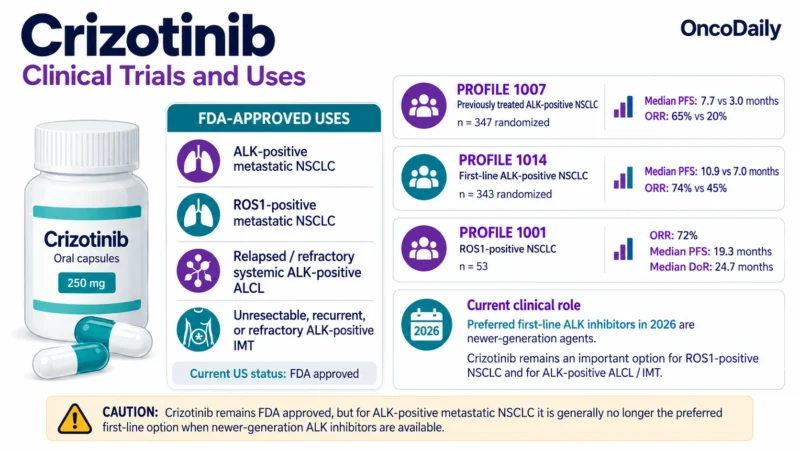
PROFILE 1007 — Previously Treated ALK-Positive NSCLC
PROFILE 1007 was a phase III study comparing crizotinib with chemotherapy in patients with advanced ALK-positive NSCLC who had previously received platinum-based chemotherapy.
A total of:
347 patients
were randomized to:
- Crizotinib 250 mg twice daily
- Pemetrexed or docetaxel chemotherapy
Median Progression-Free Survival
Median PFS was:
- Crizotinib: 7.7 months
- Chemotherapy: 3.0 months
Hazard ratio:
0.49
P < 0.001.
Objective Response Rate
ORR was:
- Crizotinib: 65%
- Chemotherapy: 20%
P < 0.001.
These findings established superior disease control with crizotinib compared with conventional chemotherapy.
PROFILE 1014 — First-Line ALK-Positive NSCLC
PROFILE 1014 evaluated crizotinib as first-line treatment for advanced ALK-positive nonsquamous NSCLC.
A total of:
343 patients
were randomized to:
- Crizotinib 250 mg twice daily
- Pemetrexed plus cisplatin or carboplatin
Median Progression-Free Survival
Crizotinib produced a median PFS of approximately:
10.9 months
compared with:
7.0 months
with chemotherapy.
The hazard ratio for progression or death was approximately:
0.45.
Objective Response Rate
Response rates were approximately:
- Crizotinib: 74%
- Chemotherapy: 45%.
Crizotinib also improved lung-cancer symptoms and quality of life compared with chemotherapy.
What About Overall Survival in PROFILE 1014?
At final analysis:
Median OS was:
- Not reached with crizotinib
- 47.5 months with chemotherapy
The unadjusted hazard ratio was:
0.76
with substantial crossover from chemotherapy to crizotinib complicating interpretation.
Approximately:
84%
of chemotherapy-treated patients later received crizotinib.
Four-year survival was:
- 56.6% with crizotinib
- 49.1% with chemotherapy.
What About Brain Metastases?
The central nervous system represents an important limitation of crizotinib in ALK-positive NSCLC.
Crizotinib has intracranial activity, but its CNS penetration and durability are inferior to those of newer-generation ALK inhibitors.
In PROFILE 1014:
23%
of patients had treated brain metastases at baseline.
The CNS became a frequent site of progression during crizotinib treatment, contributing to development of newer ALK inhibitors with stronger intracranial activity.
This is one of the major reasons crizotinib is no longer the preferred first-line ALK inhibitor when more CNS-active drugs are available.
What Did Crizotinib Show in ROS1-Positive NSCLC?
PROFILE 1001
Crizotinib demonstrated substantial activity in patients with ROS1-rearranged advanced NSCLC.
In an updated analysis of:
53 patients
treated with crizotinib 250 mg twice daily:
Objective Response Rate
ORR was:
72%
95% CI:
58%–83%.
Median Duration of Response
Median DoR was:
24.7 months.
Median Progression-Free Survival
Median PFS was:
19.3 months.
These results established crizotinib as an effective targeted therapy for ROS1-positive metastatic NSCLC.
Is Crizotinib FDA Approved?
Yes.
Crizotinib received its initial accelerated FDA approval on:
August 26, 2011
for ALK-positive advanced NSCLC.
Regular approval followed in:
November 2013
after randomized evidence confirmed clinical benefit.
Subsequent FDA approvals expanded its use to:
- ROS1-positive metastatic NSCLC — 2016
- ALK-positive relapsed/refractory systemic ALCL — 2021
- ALK-positive unresectable, recurrent, or refractory IMT — 2022.
What Is the Current Clinical Role of Crizotinib?
Crizotinib remains FDA approved, but its role differs substantially by molecular subtype.
ALK-Positive NSCLC
In 2026, current ASCO guidance recommends:
- Alectinib
- Brigatinib
- Lorlatinib
as preferred first-line options for metastatic ALK-positive NSCLC.
If these agents are unavailable, ASCO recommends:
- Ceritinib
- Crizotinib
as alternatives.
The reduced first-line role of crizotinib largely reflects the superior systemic and intracranial efficacy of later-generation ALK inhibitors.
ROS1-Positive NSCLC
Crizotinib remains a recognized treatment option for ROS1-positive metastatic NSCLC.
Current ASCO guidance lists:
- Crizotinib
- Entrectinib
- Repotrectinib
- Taletrectinib
as treatment options for ROS1-positive metastatic disease.
ALCL and IMT
Crizotinib continues to have a clinically important role in:
- Relapsed or refractory systemic ALK-positive ALCL
- Unresectable, recurrent, or refractory ALK-positive IMT
where its use is supported by dedicated FDA indications.
Read more about how targeted therapy is evolving across molecularly defined NSCLC in OncoDaily’s overview of Targeted Therapy in Advanced NSCLC: From Driver Matching to Adaptive Precision Oncology.
Watch more: Explore this discussion on targeted therapy in lung cancer and the evolving treatment landscape for oncogene-driven NSCLC.
What Are the Major Side Effects of Crizotinib?
The most common adverse effects in adults with NSCLC include:
- Visual disorders
- Nausea
- Diarrhea
- Vomiting
- Edema
- Constipation
- Elevated transaminases
- Fatigue
- Decreased appetite
- Upper respiratory infection
- Dizziness
- Neuropathy.
Visual Disorders
Visual disturbances are one of the characteristic adverse effects of crizotinib.
They may include:
- Photopsia
- Blurred vision
- Diplopia
- Floaters
- Reduced visual acuity
- Visual impairment
Most are mild, but severe visual loss has been reported.
Patients with new severe visual symptoms require prompt ophthalmologic evaluation.
Hepatotoxicity
Crizotinib can cause clinically significant hepatotoxicity.
Monitoring should include:
- ALT
- AST
- Bilirubin
particularly during the first months of therapy.
Severe liver injury and rare fatal hepatic failure have been reported.
Dose interruption, reduction, or permanent discontinuation may be required depending on severity.
Interstitial Lung Disease/Pneumonitis
Crizotinib can cause:
Interstitial lung disease or pneumonitis.
Symptoms may include:
- Dyspnea
- Cough
- Fever
- Hypoxia
- New pulmonary infiltrates
Patients with suspected treatment-related ILD should have crizotinib withheld while the diagnosis is evaluated.
Confirmed drug-related ILD may require permanent discontinuation.
QT Interval Prolongation
Crizotinib can prolong the:
QTc interval.
Risk may be greater in patients with:
- Baseline QT prolongation
- Electrolyte abnormalities
- Bradyarrhythmias
- Concomitant QT-prolonging drugs
ECG and electrolyte monitoring should be considered in at-risk patients.
Bradycardia
Crizotinib can reduce heart rate.
Clinically important bradycardia may present with:
- Dizziness
- Syncope
- Fatigue
- Hypotension
Other medications that lower heart rate should be reviewed carefully.
Gastrointestinal Toxicity
Common gastrointestinal adverse effects include:
- Nausea
- Vomiting
- Diarrhea
- Constipation
GI toxicity is particularly important in pediatric and young adult patients receiving crizotinib for ALCL or IMT.
Appropriate:
- Antiemetic therapy
- Hydration
- Nutritional support
may be required.
Embryo-Fetal Toxicity
Crizotinib can cause fetal harm.
Patients of reproductive potential should receive counseling regarding appropriate contraception.
Breastfeeding is not recommended during crizotinib treatment.
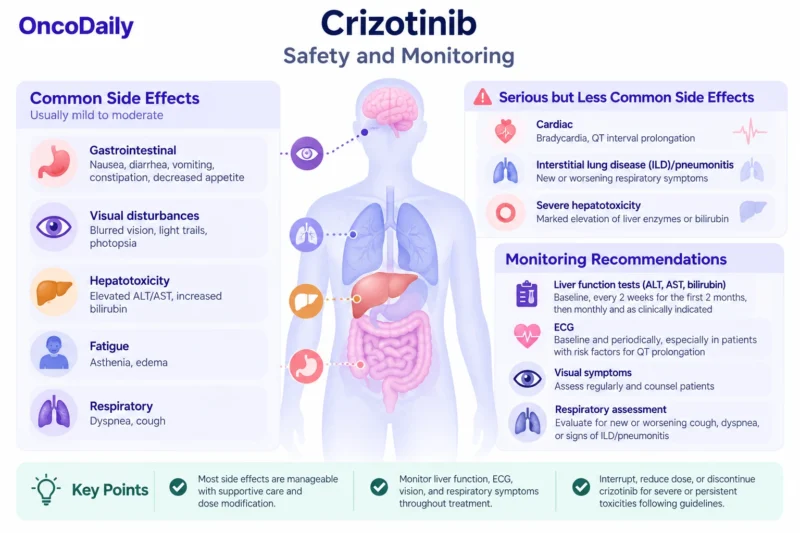
What Monitoring Is Required?
Monitoring during crizotinib therapy should include:
- Liver function tests
- ALT and AST
- Bilirubin
- CBC when clinically appropriate
- ECG in patients at risk for QT prolongation
- Potassium
- Magnesium
- Calcium
- Heart rate and blood pressure
- Respiratory symptoms suggesting ILD
- Visual symptoms
- Gastrointestinal toxicity
- Hydration and nutritional status
- Renal function
- Concomitant CYP3A inhibitors
- Concomitant CYP3A inducers
- QT-prolonging medications
- Drugs that cause bradycardia
Patients receiving crizotinib for pediatric ALCL or IMT may require particularly close monitoring for gastrointestinal toxicity and hematologic abnormalities.
FAQ
What Is Crizotinib Used For?
How Does Crizotinib Work?
What Is the Standard Crizotinib Dose?
Can Crizotinib Be Taken With Food?
Crizotinib may be taken: With or without food.