





Carmustine: An Established Nitrosourea Chemotherapy for Brain Tumors and Hematologic Malignancies
Key takeaways
- Carmustine is a nitrosourea chemotherapy that damages DNA and interferes with cancer-cell replication.
- Its high lipid solubility allows penetration into the central nervous system, contributing to its historical role in brain tumors.
- Carmustine can be given systemically by IV infusion or locally as a GLIADEL intracranial wafer placed during brain-tumor surgery.
- GLIADEL delivers carmustine directly into the surgical cavity and is approved for newly diagnosed high-grade glioma and recurrent glioblastoma.
- Intravenous carmustine is also used in hematologic malignancies and as part of established transplant-conditioning regimens.
- Delayed cumulative bone-marrow suppression is one of the most important systemic toxicities and may appear several weeks after treatment.
- Pulmonary toxicity can be serious and may become more likely with increasing cumulative exposure.
Carmustine, also known as BCNU, is an alkylating nitrosourea chemotherapy available as an intravenous formulation and as a biodegradable intracranial implant called GLIADEL Wafer. Intravenous carmustine is used in selected brain tumors and hematologic malignancies, while GLIADEL is FDA approved for newly diagnosed high-grade glioma as an adjunct to surgery and radiation and for recurrent glioblastoma as an adjunct to surgery.
This article aims to review carmustine’s mechanism of action, clinical dosing concepts, routes of administration, pharmacokinetics, clinical evidence, safety profile, approval status, and current role in oncology. Exact preparation and administration are handled by trained oncology or neurosurgical teams because carmustine is a cytotoxic medicine.
Carmustine Key Facts
- Generic name: Carmustine
- Abbreviation: BCNU
- Drug class: Nitrosourea alkylating agent
- Administration: Intravenous infusion or intracranial implant
- Intracranial formulation: GLIADEL Wafer
- Main clinical settings: Brain tumors, Hodgkin lymphoma, non-Hodgkin lymphoma, multiple myeloma, and transplant-conditioning regimens
- GLIADEL indications: Newly diagnosed high-grade glioma and recurrent glioblastoma
- Approval status: FDA approved
- Important toxicities: Delayed myelosuppression, pulmonary toxicity, nausea and vomiting, hepatic and renal toxicity, infusion reactions, and embryo-fetal toxicity.
What Is Carmustine?
Carmustine is a lipid-soluble nitrosourea alkylating chemotherapy that damages DNA and can penetrate the central nervous system.
It has historically been used in:
- Primary and metastatic brain tumors
- Hodgkin lymphoma
- Non-Hodgkin lymphoma
- Multiple myeloma
- High-dose conditioning before hematopoietic stem-cell transplantation
NCI describes carmustine, or BiCNU, as an alkylating nitrosourea used alone or with other medicines in selected brain tumors, lymphomas, and multiple myeloma.
Read more: Glioblastoma: Causes, Symptoms, Diagnosis, Treatment and Latest Advances on OncoDaily.
Carmustine Mechanism of Action
Carmustine produces reactive metabolites that interact with cellular DNA.
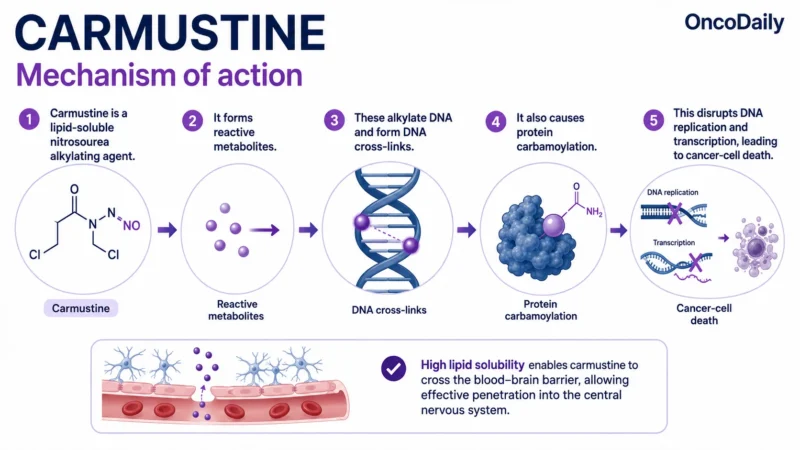
Its antitumor effects include:
- DNA alkylation
- Formation of DNA cross-links
- Interference with DNA replication and transcription
- Damage to cellular proteins through carbamoylation
- Accumulation of lethal cellular injury
- Cancer-cell death
Because carmustine is highly lipid soluble, it can cross the blood–brain barrier more readily than many conventional chemotherapy drugs, which contributed to its development for brain tumors.
What Is the Dose of Carmustine?
There is no single universal carmustine dose. Systemic IV therapy, transplant conditioning, and intracranial GLIADEL treatment use very different approaches.
For IV carmustine, dosing is determined by the specific disease and combination regimen under specialist oncology protocols.
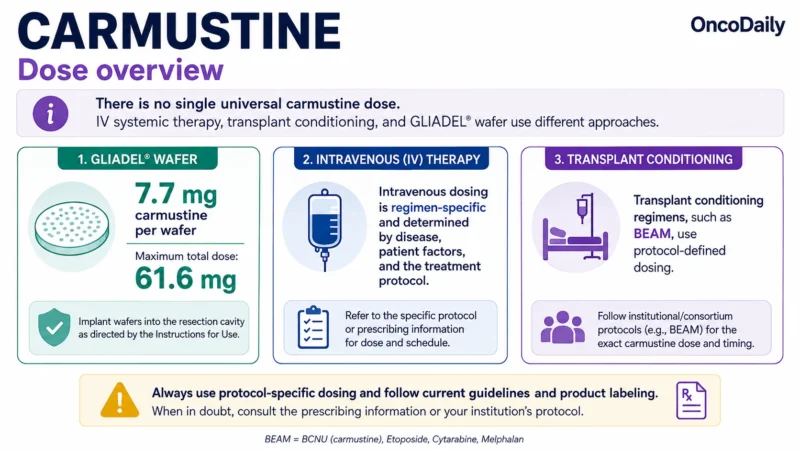
For GLIADEL, the FDA-approved formulation contains 7.7 mg of carmustine per wafer, with a labeled maximum total of 61.6 mg placed locally during surgery.
These should not be considered interchangeable treatment forms.
How Is Carmustine Administered?
Carmustine has two major administration routes.
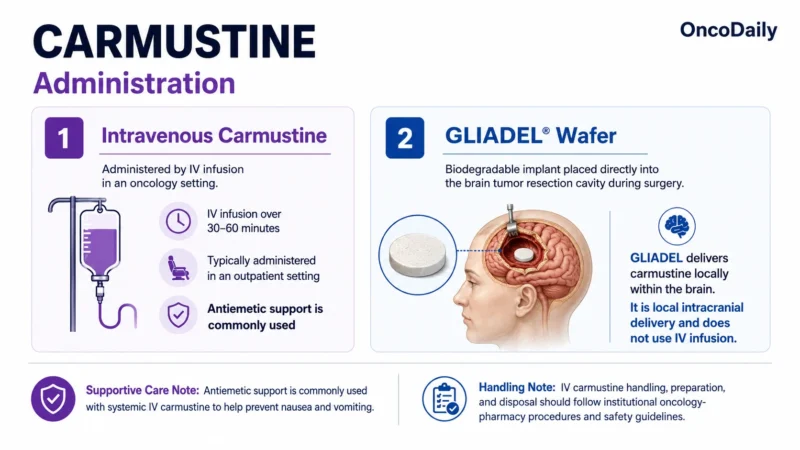
Intravenous Carmustine
Systemic carmustine is administered by intravenous infusion in an oncology setting. The currently marketed injectable formulation is supplied as a prescription cytotoxic product for IV use.
GLIADEL Wafer
GLIADEL is a biodegradable implant placed directly into the surgical cavity after removal of a brain tumor.
This local-delivery approach exposes residual tumor cells near the resection site to carmustine while limiting systemic exposure compared with conventional IV administration. GLIADEL is intended for use by a neurosurgical team during tumor resection.
Does Carmustine Require an In-Line Filter?
There is no single filter rule that applies to every carmustine product or clinical setting.
IV administration should follow the specific product labeling and institutional oncology-pharmacy procedures. GLIADEL is a surgical implant and therefore does not involve IV filtration.
Is Premedication Required?
Supportive treatment depends on the regimen.
Systemic carmustine can cause significant nausea and vomiting, so antiemetic prophylaxis is commonly incorporated into oncology protocols.
GLIADEL implantation does not use a conventional chemotherapy premedication strategy because it is placed surgically rather than infused systemically.
Are Dose Reductions Used?
Yes. Systemic carmustine may be delayed or modified for significant toxicity, particularly:
- Neutropenia
- Thrombocytopenia
- Previous cumulative marrow suppression
- Significant pulmonary toxicity
- Renal dysfunction
- Hepatic dysfunction
- Severe infection
A particularly important feature is delayed myelosuppression, which typically develops several weeks after systemic treatment and can accumulate over repeated courses.
GLIADEL is different because it is implanted during surgery rather than administered as repeated systemic cycles.
What Is Known About Carmustine Pharmacokinetics?
Carmustine is highly lipid soluble and distributes rapidly into tissues, including the central nervous system.
Systemic carmustine undergoes rapid spontaneous and metabolic decomposition, producing several active intermediates responsible for DNA alkylation and protein carbamoylation.
The pharmacokinetic profile of GLIADEL is different. The biodegradable polymer is designed to release carmustine locally within the brain-tumor resection cavity rather than produce sustained high systemic concentrations.
Are Renal or Hepatic Dose Adjustments Required?
There is no single validated adjustment schedule that applies across every carmustine regimen.
Kidney and liver function are clinically important because carmustine and its metabolites are processed and eliminated systemically, and impaired organ function may increase toxicity.
For high-dose conditioning, eligibility and dose selection are determined by the transplant protocol, organ function, previous treatment, and cumulative exposure.
What Did Carmustine Clinical Trials Show?
GLIADEL in Newly Diagnosed High-Grade Glioma
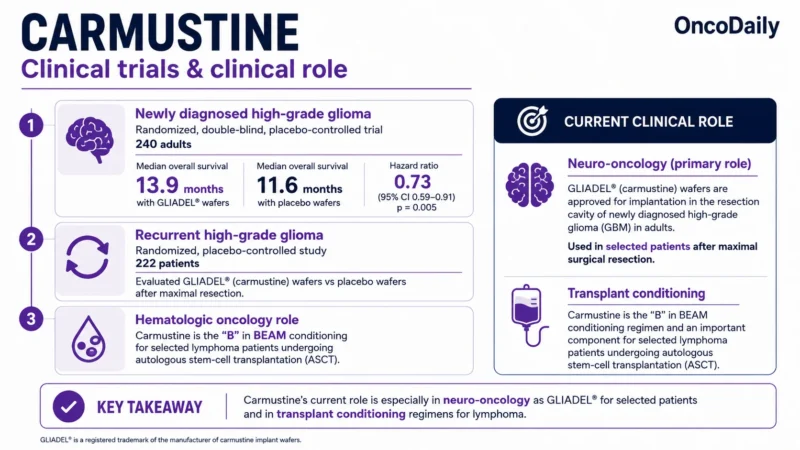
A randomized, double-blind, placebo-controlled trial enrolled 240 adults with newly diagnosed high-grade glioma undergoing maximal tumor resection.
Median overall survival was:
- 13.9 months with GLIADEL
- 11.6 months with placebo wafers
The reported hazard ratio was 0.73, supporting a survival benefit in the overall high-grade glioma population. However, the glioblastoma-only subgroup did not show a statistically significant survival improvement.
Trial publication: Phase 3 Trial of Local Chemotherapy With Biodegradable Carmustine (BCNU) Wafers in Newly Diagnosed Malignant Glioma
GLIADEL in Recurrent High-Grade Glioma
A second randomized placebo-controlled study enrolled 222 patients with recurrent high-grade glioma who had previously received radiation therapy.
GLIADEL wafers were implanted after maximal surgical resection and evaluated as a local chemotherapy strategy.
Trial publication: Placebo-Controlled Trial of Safety and Efficacy of Intraoperative Controlled Delivery by Biodegradable Polymers of Chemotherapy for Recurrent Gliomas — the pivotal study enrolled 222 patients.
Carmustine in Stem-Cell Transplantation
Carmustine is also used in several high-dose conditioning regimens before autologous transplantation.
One familiar example is BEAM, which combines:
- Carmustine
- Etoposide
- Cytarabine
- Melphalan
BEAM remains an important conditioning platform for selected patients with lymphoma undergoing autologous stem-cell transplantation.
Clinical trial: NCT00329030 — Rituximab/BEAM vs Bexxar/BEAM Before Autologous Stem-Cell Transplantation
Is Carmustine Approved?
Yes.
Intravenous Carmustine
Carmustine injection is an FDA-approved systemic chemotherapy with established uses in selected brain tumors and hematologic malignancies.
GLIADEL Wafer
GLIADEL is specifically FDA approved for:
Newly diagnosed high-grade glioma, as an adjunct to surgery and radiation
Recurrent glioblastoma, as an adjunct to surgery.
What Is the Current Role of Carmustine?
Carmustine remains clinically relevant in two particularly distinct areas.
In neuro-oncology, systemic carmustine has a smaller role than historically because newer treatments such as temozolomide and modern multimodal strategies have changed glioma management. GLIADEL remains a locally delivered option for selected surgically treated patients.
In hematologic oncology, carmustine remains important as part of high-dose transplant-conditioning regimens, particularly BEAM for lymphoma.
Watch more: GLIADEL Wafer Mechanism of Action
What Are the Side Effects of Carmustine?
Systemic carmustine can cause:
- Neutropenia
- Thrombocytopenia
- Anemia
- Infection
- Nausea
- Vomiting
- Fatigue
- Reduced appetite
- Liver abnormalities
- Kidney toxicity
- Pulmonary toxicity
- Infusion-site reactions
- Reproductive toxicity
Delayed Myelosuppression
Delayed bone-marrow suppression is a characteristic toxicity of systemic carmustine.
The current labeling notes that marrow suppression commonly develops approximately 4–6 weeks after treatment and can be cumulative.
Pulmonary Toxicity
Carmustine may cause:
- Interstitial pneumonitis
- Pulmonary fibrosis
- Progressive shortness of breath
- Dry cough
- Reduced pulmonary function
Pulmonary injury can be serious and may occur during treatment or later.
GLIADEL-Specific Risks
GLIADEL carries different local risks because it is implanted in the brain.
Important adverse events include:
- Cerebral edema
- Increased intracranial pressure
- Seizures
- Wound-healing complications
- Meningitis
- Wafer migration
- Obstructive hydrocephalus.
Written by Mirna Antabian, MD