





Capecitabine: Understanding Its Mechanism, Dosing, and Clinical Role
Key takeaways
- Capecitabine is an oral prodrug of 5-FU used across multiple solid tumors.
- It is particularly important in colorectal cancer, breast cancer, and gastrointestinal malignancies.
- Capecitabine is converted through several enzymatic steps to 5-FU, which inhibits thymidylate synthase and disrupts RNA and DNA synthesis.
- The standard monotherapy dose is 1,250 mg/m² orally twice daily for 14 days followed by 7 days off.
- Hand-foot syndrome and diarrhea are characteristic toxicities.
- Renal impairment requires dose modification, and severe renal impairment is a contraindication.
- DPD deficiency can cause severe or fatal fluoropyrimidine toxicity.
- Capecitabine is an important component of CAPOX/XELOX for colorectal cancer.
- The CREATE-X trial established an important role for adjuvant capecitabine in selected patients with residual HER2-negative breast cancer after neoadjuvant therapy.
- Its oral administration provides a practical alternative to some IV 5-FU-based treatment approaches.
Capecitabine is an oral fluoropyrimidine antimetabolite and a prodrug that is converted enzymatically to 5-fluorouracil (5-FU), particularly within tumor tissue. It is widely used in the treatment of colorectal cancer, breast cancer, and several gastrointestinal malignancies, either as monotherapy or in combination with other anticancer agents.
This article aims to review capecitabine’s mechanism of action, dose, administration, clinical uses, clinical-trial evidence, pharmacokinetics, safety profile, and current approval status, including its role as an oral alternative to intravenous 5-FU and its use in modern combination treatment strategies.
Key Facts
- Generic name: Capecitabine
- Brand name: Xeloda
- Drug class: Fluoropyrimidine antimetabolite
- Route: Oral
- Prodrug: Converted to 5-fluorouracil (5-FU)
- Major cancers: Colorectal cancer, breast cancer, gastric/gastroesophageal cancers, and other gastrointestinal malignancies
- Standard monotherapy dose: 1,250 mg/m² orally twice daily
- Typical schedule: Days 1–14 of a 21-day cycle
- Key mechanism: Conversion to 5-FU followed by inhibition of thymidylate synthase and incorporation into RNA and DNA
- Major toxicities: Hand-foot syndrome, diarrhea, nausea, stomatitis, fatigue, and myelosuppression
- Important warning: Severe toxicity can occur in patients with DPD deficiency
- Renal consideration: Dose reduction is recommended for moderate renal impairment
- FDA status: FDA approved for colorectal cancer and breast cancer indications
What Is Capecitabine?
Capecitabine is an orally administered prodrug of 5-fluorouracil (5-FU).
Unlike intravenous 5-FU, capecitabine undergoes a series of enzymatic conversions after oral administration. The final conversion to 5-FU is mediated by thymidine phosphorylase, an enzyme that is often expressed at higher levels in tumor tissue.
This tumor-associated activation was designed to provide a more selective delivery of fluoropyrimidine activity while allowing treatment to be administered orally.
Capecitabine is widely used in gastrointestinal oncology and breast cancer and can be incorporated into combination regimens with chemotherapy, targeted therapy, and immunotherapy.
What Is the Mechanism of Action of Capecitabine?
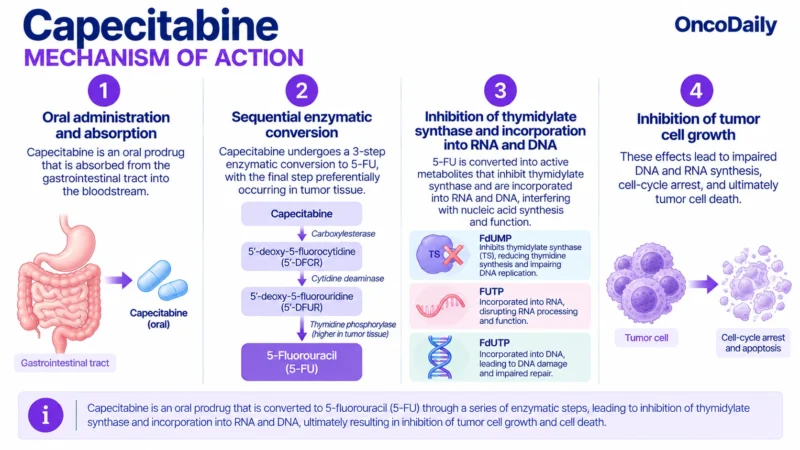
Capecitabine itself has relatively little direct cytotoxic activity. Its antitumor effect results from sequential conversion to 5-FU.
1. Oral Absorption
Capecitabine is absorbed from the gastrointestinal tract after oral administration.
2. Conversion to 5′-DFCR
Capecitabine is converted by carboxylesterase to 5′-deoxy-5-fluorocytidine (5′-DFCR).
3. Conversion to 5′-DFUR
5′-DFCR is subsequently converted to 5′-deoxy-5-fluorouridine (5′-DFUR) by cytidine deaminase.
4. Conversion to 5-FU
Thymidine phosphorylase converts 5′-DFUR into 5-fluorouracil.
5-FU then produces its antitumor effects through several active metabolites:
- FdUMP inhibits thymidylate synthase, reducing thymidine production and impairing DNA synthesis.
- FUTP becomes incorporated into RNA and disrupts RNA processing and function.
- FdUTP and related metabolites can contribute to DNA damage.
The overall pathway can be summarized as:
Capecitabine → 5′-DFCR → 5′-DFUR → 5-FU → thymidylate synthase inhibition + RNA/DNA disruption → impaired tumor-cell proliferation
What Is the Dose of Capecitabine?
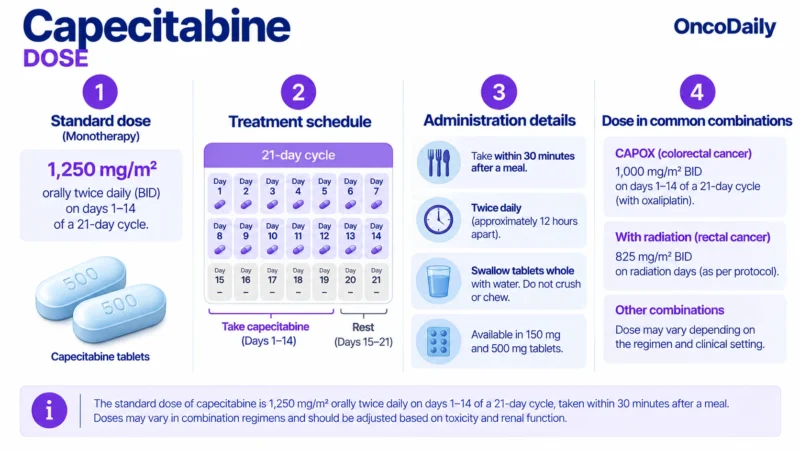
The recommended dose depends on the indication and whether capecitabine is being used alone or in combination.
For monotherapy in metastatic colorectal or breast cancer, the standard starting dose is:
1,250 mg/m² orally twice daily
for:
14 days followed by 7 days without treatment
This creates a 21-day treatment cycle.
Capecitabine should generally be taken approximately 12 hours apart and within 30 minutes after a meal.
Combination regimens frequently use lower doses, such as 1,000 mg/m² twice daily, depending on the treatment protocol.
Dose modifications are commonly required for:
- Hand-foot syndrome
- Diarrhea
- Neutropenia
- Thrombocytopenia
- Mucositis
- Renal impairment
- Other clinically significant toxicity.
How Is Capecitabine Administered?
Capecitabine is administered orally as tablets.
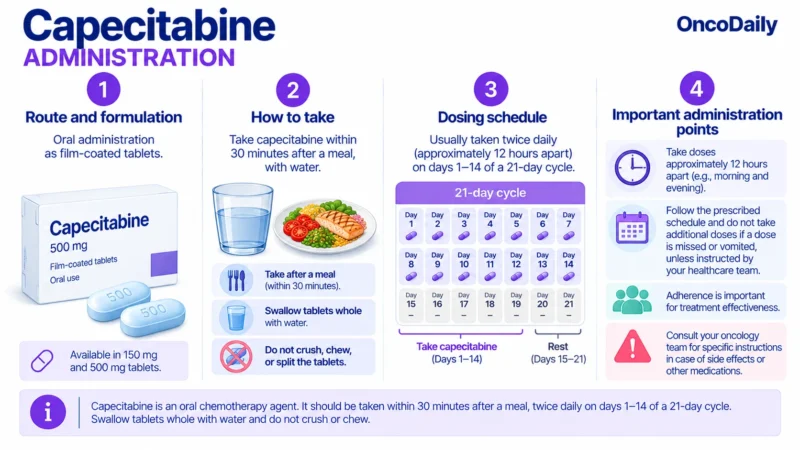
Patients should take the tablets:
- Twice daily when prescribed on a twice-daily schedule
- Approximately 12 hours apart
- Within 30 minutes after eating
- With water
- Without crushing or chewing the tablets.
If a dose is missed or vomited, the patient should not take an additional dose to compensate unless specifically instructed by the treating team.
Because capecitabine is oral chemotherapy, adherence and patient education are particularly important.
Does Capecitabine Require an In-Line Filter?
No.
Capecitabine is administered orally and therefore does not require an IV line or in-line filter.
Does Capecitabine Require Premedication?
There is no routine mandatory premedication specifically required before capecitabine.
Supportive treatment is individualized according to the patient’s symptoms and combination regimen.
Antiemetics may be used for nausea, while antidiarrheal therapy and proactive management of hand-foot syndrome may be required when clinically indicated.
Patients should also receive education regarding:
Skin care
Hydration
Diarrhea management
Recognition of mucositis
Adherence to the treatment schedule.
Are Dose Reductions Used?
Yes.
Capecitabine dose modifications are common and are based primarily on treatment-related toxicity.
Dose interruption and reduction may be required for:
- Grade 2–4 hand-foot syndrome
- Grade 2–4 diarrhea
- Severe nausea or vomiting
- Neutropenia
- Thrombocytopenia
- Mucositis
- Other clinically significant adverse reactions.
Patients should generally stop treatment temporarily when significant toxicity develops and resume at a reduced dose once toxicity improves according to the applicable treatment protocol.
DPD Deficiency
Capecitabine can cause severe, life-threatening, or fatal toxicity in patients with complete or near-complete deficiency of dihydropyrimidine dehydrogenase (DPD).
DPD is responsible for the metabolism of 5-FU and related fluoropyrimidines.
Patients with complete DPD deficiency should generally not receive capecitabine.
Testing for DPYD variants or DPD activity may be considered according to local regulatory requirements and clinical practice.
What Is the Pharmacokinetic Profile of Capecitabine?
Capecitabine is rapidly absorbed after oral administration.
It undergoes extensive enzymatic conversion through several metabolites before generating 5-FU.
The major metabolic pathway is:
Capecitabine → 5′-DFCR → 5′-DFUR → 5-FU
Capecitabine and its metabolites undergo hepatic and tissue metabolism, while subsequent fluoropyrimidine metabolites are eliminated primarily through the kidneys.
Food affects the pharmacokinetics of capecitabine. Therefore, administration with food is recommended and helps maintain consistency in drug exposure.
Does Capecitabine Require Renal or Hepatic Dose Adjustment?
Renal Impairment
Yes.
For patients with moderate renal impairment (creatinine clearance 30–50 mL/min), the recommended starting dose is generally reduced to:
75% of the usual starting dose
For a standard 1,250 mg/m² twice-daily regimen, this corresponds to approximately:
950 mg/m² twice daily
Capecitabine is contraindicated in patients with severe renal impairment, generally defined as creatinine clearance below 30 mL/min.
Hepatic Impairment
Patients with mild-to-moderate hepatic dysfunction related to liver metastases should be monitored carefully.
If treatment-related bilirubin or liver enzyme abnormalities become significant, treatment interruption may be necessary.
There is insufficient evidence to establish a standardized dose recommendation for severe hepatic impairment.
What Are the Clinical Uses of Capecitabine?
Colorectal Cancer
Capecitabine is widely used in colorectal cancer.
Read more: Oxaliplatin: An Established Platinum Chemotherapy for Colorectal and Gastrointestinal Cancers on OncoDaily.
It can be administered as:
- Monotherapy
- With oxaliplatin as CAPOX/XELOX
- With radiation therapy in selected rectal cancer settings
- As part of perioperative treatment strategies.
CAPOX combines:
Capecitabine + Oxaliplatin
and is an important fluoropyrimidine-based regimen in colorectal cancer.
Breast Cancer
Capecitabine has an established role in metastatic breast cancer, particularly after progression following anthracycline- and taxane-containing chemotherapy when appropriate.
It can be administered alone or in combination with other agents.
Capecitabine also has an important role in selected patients with residual HER2-negative early breast cancer after neoadjuvant chemotherapy.
Gastric and Gastroesophageal Cancer
Capecitabine can be used as the fluoropyrimidine component of combination chemotherapy for gastric and gastroesophageal junction cancers.
Pancreatic Cancer
Capecitabine has also been investigated and used in selected pancreatic cancer treatment strategies, including combinations with radiation and other chemotherapy agents.
Cholangiocarcinoma and Other GI Malignancies
Fluoropyrimidine-based approaches incorporating capecitabine may be used in selected gastrointestinal malignancies depending on disease setting and treatment strategy.
Watch more: CAPOX (XELOX) Regimen – Capecitabine and Oxaliplatin
What Did Capecitabine Clinical Trials Show?
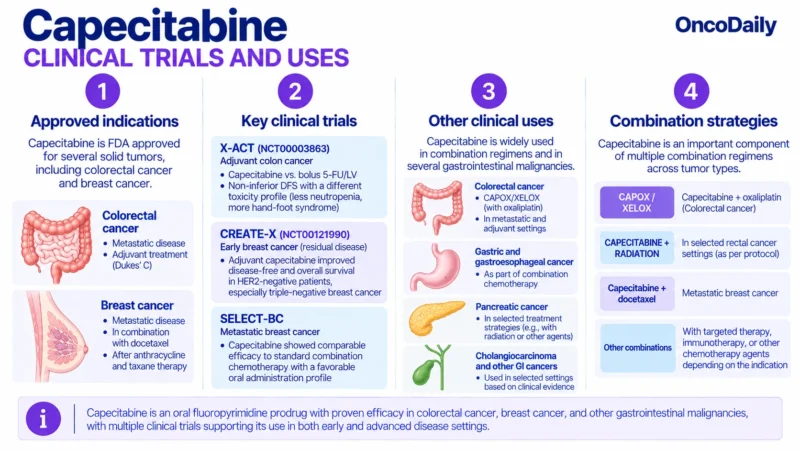
X-ACT Trial in Colon Cancer
The phase III X-ACT trial compared oral capecitabine with bolus 5-FU/leucovorin as adjuvant treatment for patients with stage III colon cancer.
The study demonstrated that capecitabine was non-inferior to bolus 5-FU/leucovorin for disease-free survival.
Capecitabine was also associated with a different toxicity profile, with less severe neutropenia but more hand-foot syndrome.
The study established oral capecitabine as an effective fluoropyrimidine option in the adjuvant treatment of colon cancer.
XELOX/CAPOX in Colorectal Cancer
Multiple phase III studies established capecitabine plus oxaliplatin (CAPOX/XELOX) as an effective alternative to infusional 5-FU-based oxaliplatin regimens.
This combination became an important backbone for:
- Adjuvant colon cancer
- Metastatic colorectal cancer
- Selected perioperative treatment strategies.
CREATE-X Trial in Breast Cancer
The phase III CREATE-X trial evaluated adjuvant capecitabine in patients with HER2-negative breast cancer who had residual invasive disease after neoadjuvant chemotherapy.
Among patients with HER2-negative disease, capecitabine significantly improved:
- Disease-free survival
- Overall survival.
The greatest clinical interest was seen in patients with triple-negative breast cancer, helping establish an important role for postoperative capecitabine in selected patients with residual disease.
SELECT-BC Trial
The SELECT-BC phase III study compared oral capecitabine with standard combination chemotherapy in patients with metastatic breast cancer.
The study demonstrated that capecitabine provided a reasonable treatment alternative, supporting its use as an oral chemotherapy option in appropriately selected patients.
Is Capecitabine FDA Approved?
Yes.
Capecitabine is FDA approved for several oncology indications, including:
- Metastatic colorectal cancer
- Adjuvant treatment of Dukes’ C colon cancer
- Metastatic breast cancer
- Combination treatment with docetaxel for metastatic breast cancer after prior anthracycline-containing therapy
- Monotherapy for metastatic breast cancer resistant to both paclitaxel and anthracycline-containing chemotherapy, or when further anthracycline therapy is not indicated.
The FDA-approved indications have evolved over time, and capecitabine is also widely incorporated into treatment regimens based on clinical evidence and guideline recommendations.
What Is the Current Clinical Role of Capecitabine?
Capecitabine remains one of the most widely used oral cytotoxic chemotherapy agents in modern oncology.
Its principal advantages include:
- Oral administration
- Conversion to the active fluoropyrimidine 5-FU
- Established activity across multiple solid tumors
- Compatibility with combination treatment
- Avoidance of continuous IV infusion in many treatment settings.
Its most important modern applications include colorectal cancer and breast cancer, with additional use across gastrointestinal malignancies.
However, oral administration does not eliminate chemotherapy-related toxicity. Hand-foot syndrome and diarrhea can substantially affect quality of life and frequently require dose modification.
The increasing availability of targeted therapies and immunotherapy has changed where capecitabine is used, but it remains an important chemotherapy backbone in many treatment algorithms.
What Are the Major Side Effects of Capecitabine?
Hand-Foot Syndrome
Palmar-plantar erythrodysesthesia is one of the characteristic toxicities of capecitabine.
Patients may develop:
- Redness
- Swelling
- Tingling
- Burning
- Pain
- Peeling of the palms and soles.
Early recognition and treatment interruption or dose reduction can prevent progression to severe toxicity.
Diarrhea
Diarrhea is another important dose-limiting toxicity.
Patients with persistent or severe diarrhea should be assessed promptly for dehydration, electrolyte abnormalities, and other complications.
Nausea and Vomiting
Gastrointestinal symptoms including:
Nausea
Vomiting
Abdominal discomfort
Anorexia
may occur.
Myelosuppression
Capecitabine can cause:
- Neutropenia
- Anemia
- Thrombocytopenia
although the degree of myelosuppression varies according to dose and treatment combination.
Stomatitis
Oral mucositis and stomatitis may develop during treatment.
Fatigue
Fatigue is common and may become more pronounced with repeated treatment cycles.
Cardiotoxicity
Fluoropyrimidines, including capecitabine, can cause cardiotoxicity.
Potential manifestations include:
- Angina
- Coronary vasospasm
- Myocardial ischemia
- Arrhythmias
- Myocardial infarction.
Patients with significant cardiovascular risk factors should be evaluated carefully before treatment.
Severe DPD-Deficiency Toxicity
Patients with severe DPD deficiency can develop early-onset, severe, and potentially fatal fluoropyrimidine toxicity, including profound diarrhea, mucositis, neutropenia, neurotoxicity, and other complications.
What Monitoring Is Required?
Monitoring during capecitabine therapy should include:
- CBC with differential
- Renal function
- Liver function
- Assessment for diarrhea
- Assessment for hand-foot syndrome
- Oral examination for mucositis
- Assessment of hydration status
- Evaluation for cardiac symptoms when clinically appropriate.
Patients should also be educated to report early symptoms rather than waiting until toxicity becomes severe.