





Oxaliplatin: An Established Platinum Chemotherapy for Colorectal and Gastrointestinal Cancers
Key takeaways
- Oxaliplatin is a platinum compound that forms DNA adducts and cross-links, disrupting DNA replication and transcription.
- The FDA-labeled colorectal cancer dose is 85 mg/m² IV over 2 hours every 14 days, given with fluorouracil and leucovorin.
- For adjuvant stage III colon cancer, treatment may continue for up to 12 cycles, approximately 6 months, unless unacceptable toxicity occurs.
- Oxaliplatin must be diluted in 5% dextrose rather than sodium chloride or another chloride-containing solution.
- Peripheral neuropathy is the characteristic dose-limiting toxicity. Acute symptoms are often triggered or worsened by cold exposure.
- The pivotal MOSAIC trial established oxaliplatin-containing FOLFOX as an important adjuvant treatment for stage III colon cancer.
- Oxaliplatin remains a major component of modern gastrointestinal oncology despite the development of targeted therapies and immunotherapy.
Oxaliplatin is an intravenous platinum-based chemotherapy used primarily in colorectal cancer. In the United States, it is FDA approved in combination with infusional fluorouracil and leucovorin for adjuvant treatment of completely resected stage III colon cancer and for advanced colorectal cancer. It is also incorporated into widely used regimens for other gastrointestinal malignancies, including gastric, pancreatic, and biliary tract cancers.
This article aims to review oxaliplatin’s mechanism of action, dose, administration, preparation requirements, pharmacokinetics, clinical-trial findings, safety profile, approval status, and current role in oncology.
Oxaliplatin Key Facts
- Generic name: Oxaliplatin
- Brand name: Eloxatin
- Drug class: Platinum-based cytotoxic chemotherapy
- Administration: Intravenous infusion
- FDA-labeled dose: 85 mg/m² IV every 2 weeks with fluorouracil and leucovorin
- Infusion duration: 120 minutes
- Main FDA-approved indications: Stage III colon cancer after complete resection and advanced colorectal cancer
- Common regimens: FOLFOX, CAPOX/XELOX, FOLFIRINOX, FLOT, GEMOX
- Dose in severe renal impairment: 65 mg/m² when creatinine clearance is below 30 mL/min
- Important toxicities: Acute and cumulative peripheral sensory neuropathy, myelosuppression, nausea, diarrhea, hypersensitivity reactions, hepatotoxicity, and pulmonary toxicity
- Approval status: FDA approved.
What Is Oxaliplatin?
Oxaliplatin is a third-generation platinum-based chemotherapy that damages cancer-cell DNA and prevents normal replication.
Its chemical structure contains a platinum atom complexed with 1,2-diaminocyclohexane, or DACH, and an oxalate leaving group. After entering cells, oxaliplatin undergoes transformation into reactive platinum compounds that bind DNA.
Oxaliplatin is most strongly associated with colorectal cancer and is a central component of:
- FOLFOX: Oxaliplatin, leucovorin, and fluorouracil
- CAPOX/XELOX: Oxaliplatin and capecitabine
- FOLFIRINOX: Oxaliplatin, irinotecan, leucovorin, and fluorouracil
- FLOT: Fluorouracil, leucovorin, oxaliplatin, and docetaxel
- GEMOX: Gemcitabine and oxaliplatin
Its FDA-approved indication specifically covers use with infusional fluorouracil and leucovorin in stage III colon cancer and advanced colorectal cancer.
Oxaliplatin Mechanism of Action
Oxaliplatin becomes transformed intracellularly into reactive platinum complexes that bind to DNA.
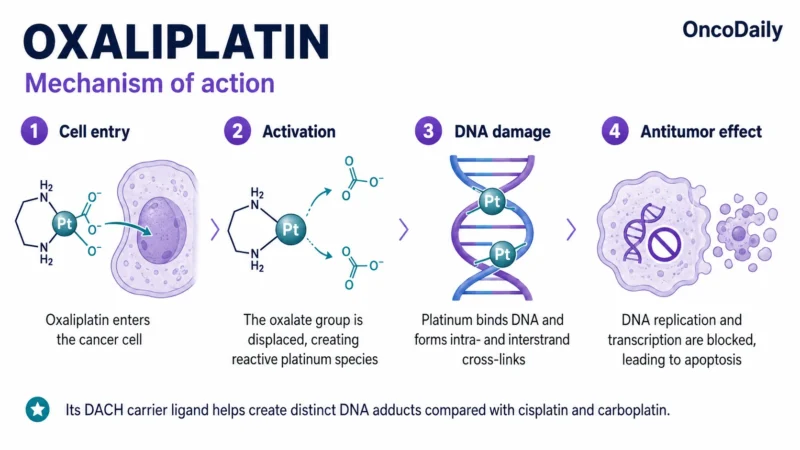
Its mechanism includes:
- Cellular uptake: Oxaliplatin enters the cancer cell.
- Activation: The oxalate group is displaced, generating reactive platinum species.
- DNA binding: Platinum binds primarily to nucleophilic sites on DNA.
- DNA cross-linking: Intrastrand and interstrand platinum-DNA adducts form.
- Replication and transcription inhibition: The altered DNA structure cannot be copied or transcribed normally.
- Cancer-cell death: Persistent DNA damage activates cellular stress and apoptotic pathways.
Oxaliplatin differs structurally from cisplatin and carboplatin because of its DACH carrier ligand, which produces distinct DNA adducts and contributes to differences in activity and resistance patterns.
What Is the Dose of Oxaliplatin?
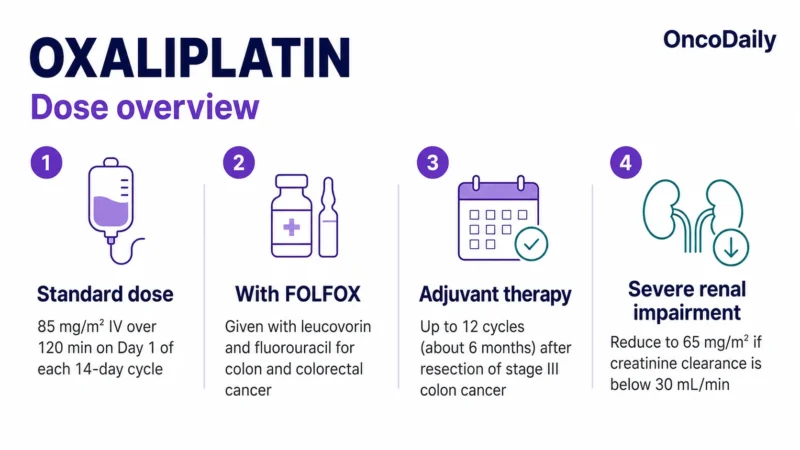
FDA-Labeled Colorectal Cancer Dose
The recommended dose is:
Oxaliplatin 85 mg/m² intravenously over 120 minutes on Day 1 of each 14-day cycle.
It is administered concurrently with leucovorin in separate infusion bags, followed by fluorouracil.
Adjuvant Stage III Colon Cancer
The FDA-labeled schedule is:
Oxaliplatin 85 mg/m² IV every 2 weeks for up to 12 cycles.
This corresponds to approximately 6 months of treatment when all planned cycles are delivered.
Advanced Colorectal Cancer
The labeled dose remains:
85 mg/m² IV every 2 weeks, with treatment continued until disease progression or unacceptable toxicity.
Other Regimens
Other validated oncology regimens may use different schedules. For example, CAPOX commonly uses a higher oxaliplatin dose on a 3-week schedule, while FOLFIRINOX and FLOT use protocol-specific oxaliplatin dosing.
These doses should not be interchanged across regimens.
How Is Oxaliplatin Administered?
Oxaliplatin is administered by intravenous infusion.
For the FDA-labeled colorectal cancer regimen:
- Oxaliplatin is infused over 120 minutes
- Leucovorin is administered concurrently over 120 minutes in a separate bag
- Fluorouracil follows
- The treatment cycle repeats every 14 days.
If clinically appropriate, extending the infusion from 2 hours to 6 hours may help mitigate selected acute non-life-threatening infusion-related toxicities.
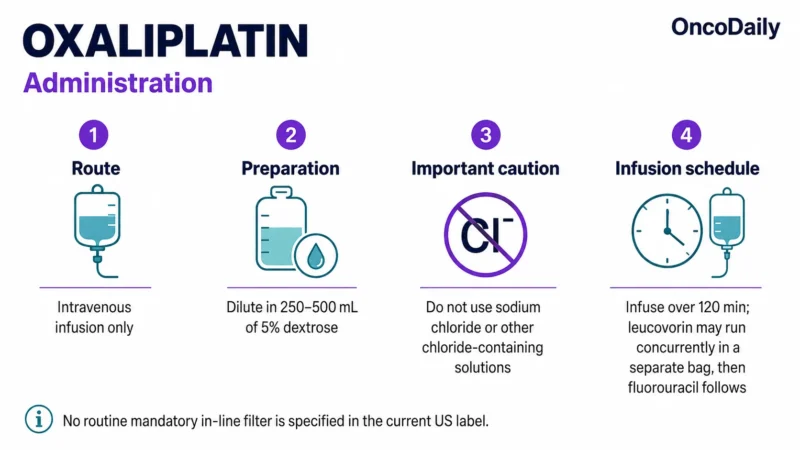
Preparation
The current US label specifies:
- Dilute oxaliplatin with 250–500 mL of 5% Dextrose Injection
- Do not use sodium chloride or other chloride-containing solutions
- Do not mix with alkaline medicines or solutions
- Flush the infusion line with 5% dextrose before administering incompatible concomitant medicines
- Do not use needles or administration sets containing aluminum components.
The diluted preparation may be stored for up to 6 hours at room temperature or 24 hours refrigerated, according to the referenced formulation label.
Does Oxaliplatin Require an In-Line Filter?
The current US prescribing information does not specify a routine mandatory in-line filter for oxaliplatin.
The infusion solution should be visually inspected for particulate matter and discoloration before administration. Product-specific pharmacy instructions and institutional policy should be followed.
Is Premedication Required?
Oxaliplatin-containing regimens generally require antiemetic prophylaxis because nausea and vomiting can occur with treatment.
Premedication may include:
- A 5-HT3 receptor antagonist
- Dexamethasone
- Additional antiemetics depending on the full regimen and patient risk
Routine prophylactic antihistamines or corticosteroids specifically to prevent platinum hypersensitivity are not universally required before every first oxaliplatin treatment.
However, serious hypersensitivity reactions, including anaphylaxis, can occur within minutes and at any treatment cycle. The US label carries a boxed warning for this risk.
Are Dose Reductions Used?
Yes. Oxaliplatin has clearly defined dose modifications for neuropathy, myelosuppression, and severe gastrointestinal toxicity.
Adjuvant Stage III Colon Cancer
For persistent grade 2 neuropathy, consider reducing oxaliplatin to:
75 mg/m².
For persistent grade 3 neuropathy, discontinuation should be considered. Grade 4 neuropathy requires discontinuation.
After grade 4 neutropenia, febrile neutropenia, or grade 3–4 thrombocytopenia, delay treatment until:
- Neutrophils are ≥1.5 × 10⁹/L
- Platelets are ≥75 × 10⁹/L
Then reduce oxaliplatin to 75 mg/m².
Advanced Colorectal Cancer
For persistent grade 2 neuropathy, consider reducing to:
65 mg/m².
For significant hematologic or grade 3–4 gastrointestinal toxicity after recovery, the label also recommends reduction to 65 mg/m².
Oxaliplatin should be permanently discontinued for severe hypersensitivity reactions, PRES, confirmed interstitial lung disease or pulmonary fibrosis, and rhabdomyolysis.
What Is Known About Oxaliplatin Pharmacokinetics?
After IV administration, oxaliplatin is rapidly converted into reactive platinum-containing compounds.
Platinum distributes among:
- Plasma
- Plasma ultrafiltrate
- Red blood cells
- Peripheral tissues
Unlike many conventional drugs, pharmacokinetic measurements frequently describe total or ultrafilterable platinum rather than unchanged oxaliplatin because the parent compound rapidly undergoes nonenzymatic transformation.
Renal elimination contributes substantially to platinum clearance, which explains the increased exposure observed in patients with renal impairment.
Are Renal or Hepatic Dose Adjustments Required?
Renal Impairment
For mild renal impairment with creatinine clearance 50–79 mL/min and moderate impairment with creatinine clearance 30–49 mL/min:
No initial dose reduction is recommended.
For severe renal impairment, defined as creatinine clearance below 30 mL/min:
Reduce oxaliplatin to 65 mg/m².
Hepatic Impairment
The US prescribing information does not provide a standardized hepatic-impairment dose-reduction table.
Liver-function tests should be monitored:
- At baseline
- Before each subsequent cycle
- As clinically indicated
Oxaliplatin has been associated with hepatic vascular disorders and other hepatotoxic effects.
What Did Oxaliplatin Clinical Trials Show?
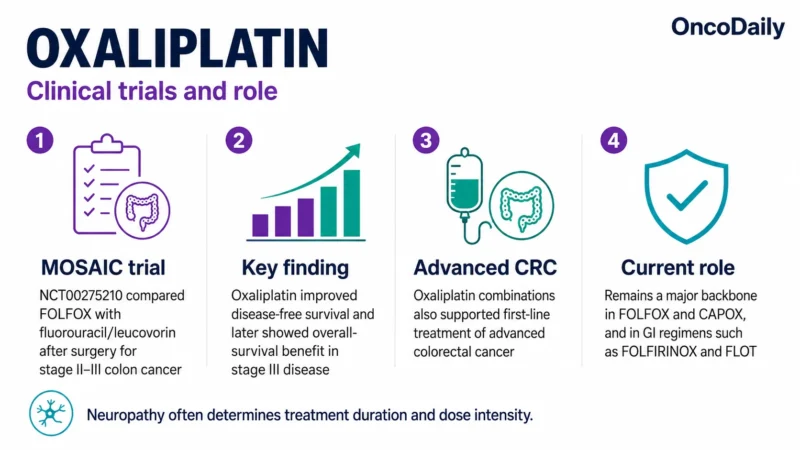
MOSAIC Trial — Adjuvant Colon Cancer
The pivotal MOSAIC trial, NCT00275210, compared FOLFOX with fluorouracil/leucovorin alone after surgery for stage II or III colon cancer.
The addition of oxaliplatin significantly improved disease-free survival and established FOLFOX as a major adjuvant treatment strategy, particularly for stage III disease. Long-term follow-up confirmed an overall-survival benefit in patients with stage III colon cancer.
Watch more: Adjuvant Treatment for Stage III Colon Cancer — the video discusses the survival benefit of combining oxaliplatin with 5-FU in stage III colon cancer.
Previously Untreated Advanced Colorectal Cancer
FDA-supporting studies also evaluated oxaliplatin with fluorouracil/leucovorin as first-line treatment for advanced colorectal cancer.
The oxaliplatin-containing combination improved response and progression outcomes compared with fluorouracil/leucovorin alone, supporting its role in metastatic disease.
Modern First-Line Metastatic Colorectal Cancer
Oxaliplatin remains incorporated into modern combinations such as FOLFOX and CAPOX, frequently combined with biologic therapies selected according to tumor molecular characteristics.
The ongoing evolution of colorectal cancer treatment includes BRAF-targeted combinations, immunotherapy for mismatch-repair-deficient tumors, and other biomarker-guided treatments, but oxaliplatin remains an important chemotherapy backbone for many patients. One contemporary example is BREAKWATER, NCT04607421, which has evaluated encorafenib plus cetuximab with chemotherapy in BRAF V600E–mutated metastatic colorectal cancer.
Is Oxaliplatin Approved?
Yes.
Oxaliplatin is FDA approved in combination with infusional fluorouracil and leucovorin for:
- Adjuvant treatment of stage III colon cancer after complete surgical resection
- Advanced colorectal cancer.
Its use in several other gastrointestinal cancers is based on disease-specific treatment protocols rather than these specific FDA-labeled indications.
What Is the Current Role of Oxaliplatin?
Oxaliplatin remains one of the most important cytotoxic agents in gastrointestinal oncology.
Its major roles include:
- Adjuvant stage III colon cancer treatment
- First-line and later-line metastatic colorectal cancer combinations
- Perioperative gastric and gastroesophageal cancer treatment
- Pancreatic cancer combinations such as FOLFIRINOX
- Selected biliary tract cancer regimens
- Other gastrointestinal malignancies where an oxaliplatin-containing combination is clinically appropriate
Its continued usefulness is balanced against cumulative sensory neuropathy, which frequently determines treatment duration and dose intensity.
Read more: Explore the role of FOLFOX and CAPOX in colorectal cancer treatment on OncoDaily.
What Are the Side Effects of Oxaliplatin?
Common or clinically important adverse effects include:
- Peripheral sensory neuropathy
- Neutropenia
- Thrombocytopenia
- Anemia
- Nausea
- Vomiting
- Diarrhea
- Fatigue
- Stomatitis
- Reduced appetite
- Abdominal symptoms
- Liver-test abnormalities
- Hypersensitivity reactions.
Acute Peripheral Neuropathy
Acute neuropathy may begin within hours or up to 2 days after treatment and usually resolves within approximately 14 days.
Symptoms may include:
- Tingling
- Numbness
- Dysesthesia
- Jaw spasm
- Abnormal tongue sensation
- Throat discomfort
- Difficulty swallowing or breathing sensations without true airway obstruction
Cold temperature or cold objects may trigger or worsen symptoms. The label specifically advises avoiding topical ice because cold exposure can exacerbate acute neurologic symptoms.
Cumulative Peripheral Neuropathy
Delayed neuropathy may persist for more than 14 days and can interfere with:
- Writing
- Buttoning clothing
- Walking
- Swallowing
- Fine motor activities
Persistent neuropathy may require dose reduction or discontinuation.
Hypersensitivity
Serious and fatal hypersensitivity reactions, including anaphylaxis, may occur during any cycle. Grade 3–4 reactions have been reported in approximately 2%–3% of patients with colon cancer receiving oxaliplatin.
Myelosuppression
Oxaliplatin can cause severe neutropenia, thrombocytopenia, and infection. Treatment should be delayed until adequate neutrophil and platelet recovery when severe cytopenias occur.
Written by Mirna Antabian, MD