





Brigatinib (Alunbrig): Understanding Its Mechanism, Dosing, Clinical Uses, and Role in ALK-Positive Lung Cancer
Key takeaways
- Brigatinib is a next-generation ALK tyrosine kinase inhibitor used for metastatic ALK-positive NSCLC.
- The standard regimen is 90 mg once daily for 7 days, followed by 180 mg once daily.
- It may be taken with or without food.
- Dose reductions from 180 mg follow the sequence 120 mg → 90 mg → 60 mg once daily.
- ALTA established activity after crizotinib, while ALTA-1L demonstrated superior first-line efficacy compared with crizotinib.
- In ALTA-1L, median PFS was 24.0 months with brigatinib versus 11.1 months with crizotinib.
- Brigatinib has strong CNS activity, with a confirmed intracranial ORR of 78% versus 26% with crizotinib in patients with measurable brain metastases.
- Important toxicities include early pulmonary toxicity/ILD, hypertension, CPK elevation, pancreatic enzyme elevation, hepatotoxicity, hyperglycemia, bradycardia, and visual disturbances.
- Strong or moderate CYP3A inhibitors and inducers should generally be avoided.
- In 2026, brigatinib remains one of the ASCO-recommended first-line options for metastatic ALK-positive NSCLC.
Brigatinib (Alunbrig) is an oral, next-generation anaplastic lymphoma kinase (ALK) tyrosine kinase inhibitor developed for ALK-positive metastatic non-small cell lung cancer (NSCLC). It inhibits ALK signaling, including several ALK resistance mutations, and has meaningful intracranial activity in patients with brain metastases. Brigatinib was initially FDA approved in 2017 for patients whose disease had progressed on or who were intolerant to crizotinib, and its indication was expanded in 2020 to include adults with ALK-positive metastatic NSCLC regardless of prior ALK inhibitor exposure.
Brigatinib is distinguished clinically by its 7-day 90 mg lead-in period followed by 180 mg once daily, a strategy designed in part to mitigate the risk of early-onset pulmonary events. In the phase III ALTA-1L trial, brigatinib significantly improved progression-free survival and intracranial outcomes compared with crizotinib. Current 2026 ASCO guidance continues to recommend brigatinib, alectinib, or lorlatinib as first-line treatment options for metastatic ALK-positive NSCLC.
Key Facts
- Generic name: Brigatinib
- Brand name: Alunbrig
- Drug class: Next-generation ALK tyrosine kinase inhibitor
- Route: Oral
- Initial US approval: April 28, 2017
- Expanded first-line approval: May 22, 2020
- FDA-approved indication: ALK-positive metastatic NSCLC in adults
- Starting dose: 90 mg orally once daily for 7 days
- Maintenance dose: 180 mg orally once daily
- Administration: With or without food
- Dose reductions from 180 mg: 120 mg → 90 mg → 60 mg once daily
- Available strengths: 30 mg, 90 mg, and 180 mg tablets
- Major target: ALK
- Other kinase activity: ROS1, IGF-1R, FLT3, and selected EGFR alterations in preclinical studies
- Major toxicities: Diarrhea, fatigue, nausea, rash, cough, myalgia, headache, hypertension, vomiting, and dyspnea
- Important serious toxicities: ILD/pneumonitis, hypertension, bradycardia, visual disturbances, CPK elevation, pancreatic enzyme elevation, hepatotoxicity, hyperglycemia, and photosensitivity
- Major interaction: Strong or moderate CYP3A inhibitors and inducers
- Half-life: Approximately 25 hours
- Current US status: FDA approved.
What Is Brigatinib?
Brigatinib is a small-molecule tyrosine kinase inhibitor designed primarily to inhibit:
ALK.
ALK rearrangements produce constitutively active fusion proteins, most commonly:
EML4–ALK
in NSCLC.
These fusion proteins continuously activate intracellular signaling pathways that support:
- Tumor-cell proliferation
- Survival
- Growth
- Migration
- Invasion
Brigatinib also retains activity against several ALK resistance mutations that can emerge after treatment with earlier-generation ALK inhibitors.
Preclinical studies demonstrated activity against multiple mutant forms of ALK, including:
- G1202R
- L1196M
which are associated with resistance to other ALK inhibitors.
What Is the Mechanism of Action of Brigatinib?
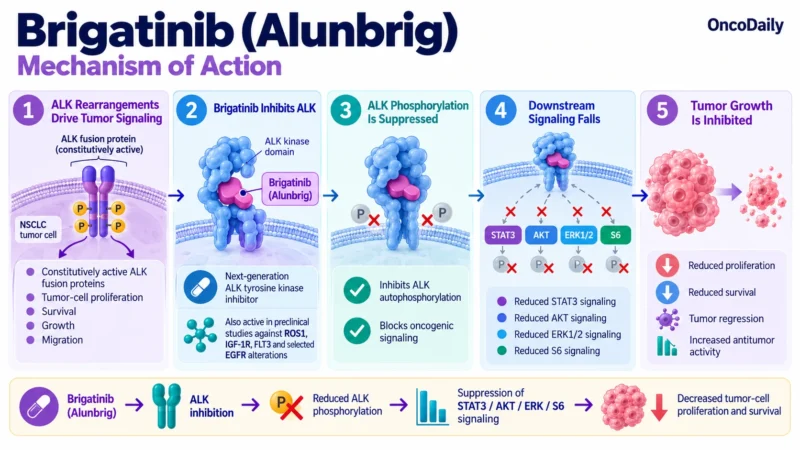
1. ALK Rearrangements Drive Persistent Tumor Signaling
ALK fusion proteins contain a constitutively active kinase domain.
This continuously stimulates downstream pathways that promote:
- Proliferation
- Survival
- Growth
- Migration
- Resistance to apoptosis
2. Brigatinib Inhibits ALK Kinase Activity
Brigatinib is an:
ATP-competitive tyrosine kinase inhibitor.
At clinically achievable concentrations, it inhibits ALK and several other kinases in vitro, including:
- ROS1
- IGF-1R
- FLT3
as well as selected EGFR alterations.
3. ALK Autophosphorylation Is Suppressed
Brigatinib inhibits:
ALK autophosphorylation
and therefore blocks activation of ALK-dependent signaling.
4. Downstream Signaling Falls
Brigatinib suppresses phosphorylation of downstream proteins including:
- STAT3
- AKT
- ERK1/2
- S6
These pathways are important for malignant-cell proliferation and survival.
5. Tumor-Cell Growth Is Inhibited
Reduced ALK signaling leads to:
- Reduced proliferation
- Decreased survival
- Tumor regression
- Increased antitumor activity in ALK-driven cancers
The mechanism can be summarized as:
Brigatinib → ALK inhibition → reduced ALK phosphorylation → suppression of STAT3/AKT/ERK/S6 signaling → decreased tumor-cell proliferation and survival.
What Is the Dose of Brigatinib?
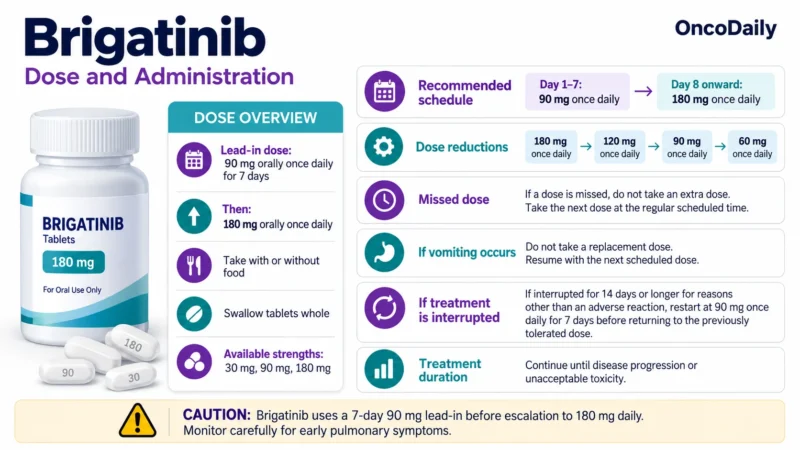
Brigatinib has a characteristic lead-in dosing strategy.
Days 1–7
90 mg orally once daily.
Day 8 onward
If tolerated:
180 mg orally once daily.
Treatment continues until:
- Disease progression
- Unacceptable toxicity
Brigatinib may be taken:
With or without food.
What If a Dose Is Missed?
If a dose is missed:
Do not take an additional dose.
Take the next dose at the regularly scheduled time.
The same recommendation applies if vomiting occurs after taking brigatinib:
Do not take a replacement dose.
Continue with the next scheduled dose.
What Happens If Brigatinib Is Interrupted?
If brigatinib is interrupted for:
14 days or longer
for reasons other than an adverse reaction, treatment should generally be restarted at:
90 mg once daily for 7 days
before returning to the previously tolerated dose.
This is clinically important because the lead-in period is intended to reduce the risk of early pulmonary toxicity.
How Are Brigatinib Dose Reductions Made?
For patients receiving:
180 mg once daily
the dose-reduction sequence is:
180 mg → 120 mg → 90 mg → 60 mg once daily.
If the patient cannot tolerate:
60 mg once daily
brigatinib should generally be permanently discontinued.
For patients receiving 90 mg once daily, the first reduction is:
60 mg once daily.
Dose interruption or reduction may be required for:
- ILD/pneumonitis
- Hypertension
- Bradycardia
- Visual toxicity
- CPK elevation
- Pancreatic enzyme elevation
- Hepatotoxicity
- Hyperglycemia
- Other clinically significant adverse events
Once a dose has been reduced because of toxicity, the label recommends not subsequently increasing it.
How Is Brigatinib Administered?
Brigatinib is supplied as film-coated oral tablets containing:
- 30 mg
- 90 mg
- 180 mg
The tablets should be:
Swallowed whole.
They should not be:
- Crushed
- Chewed
Brigatinib may be taken:
With or without food.
A high-fat meal reduced Cmax modestly but had no meaningful effect on overall AUC.
What Are the Important Drug Interactions With Brigatinib?
Strong or Moderate CYP3A Inhibitors
Strong or moderate CYP3A inhibitors increase brigatinib exposure.
For example, itraconazole increased brigatinib:
- Cmax by approximately 21%
- AUC by approximately 101%.
These combinations should generally be:
Avoided.
If a strong CYP3A inhibitor cannot be avoided, brigatinib should be reduced by approximately:
50%.
For example:
180 mg → 90 mg
or:
90 mg → 60 mg.
If a moderate inhibitor cannot be avoided, dose reduction of approximately:
40%
is recommended.
Strong or Moderate CYP3A Inducers
Strong CYP3A inducers can markedly reduce brigatinib exposure.
Rifampin decreased:
- Cmax by approximately 60%
- AUC by approximately 80%.
Strong or moderate CYP3A inducers should therefore generally be avoided.
If a moderate inducer cannot be avoided, dose escalation in:
30 mg increments
may be considered according to the prescribing information.
Effect of Brigatinib on Other Drugs
Brigatinib is considered a:
Weak CYP3A inducer.
In a clinical interaction study, it reduced midazolam AUC by approximately:
26%.
Does Brigatinib Require Renal or Hepatic Dose Adjustment?
Renal Impairment
No dose adjustment is recommended for:
Mild or moderate renal impairment
with creatinine clearance:
30–89 mL/min.
For severe renal impairment:
CrCl 15–29 mL/min
brigatinib exposure increases significantly.
The dose should be reduced by approximately:
50%.
For example:
180 mg → 90 mg
or:
90 mg → 60 mg.
Hepatic Impairment
No dose adjustment is recommended for:
- Child-Pugh A
- Child-Pugh B
For severe hepatic impairment:
Child-Pugh C
the dose should be reduced by approximately:
40%.
For example:
180 mg → 120 mg.
What Is the Pharmacokinetic Profile of Brigatinib?
Absorption
Brigatinib is rapidly absorbed after oral administration.
Median time to peak plasma concentration is approximately:
1–4 hours.
Systemic exposure is approximately dose proportional across clinically relevant dosing ranges.
Food Effect
A high-fat meal reduces Cmax by approximately:
13%
but has:
No meaningful effect on AUC.
Brigatinib may therefore be taken:
With or without food.
Distribution
Plasma protein binding is approximately:
91%.
The apparent volume of distribution at steady state is approximately:
307 L.
Metabolism
Brigatinib is primarily metabolized by:
- CYP2C8
- CYP3A4
However, unchanged brigatinib remains the major circulating drug-related component.
Half-Life
The mean plasma elimination half-life is approximately:
25 hours.
Elimination
Following radiolabeled administration:
- 65% of the dose was recovered in feces
- 25% was recovered in urine.
What Are the Clinical Uses of Brigatinib?
ALK-Positive Metastatic NSCLC
Brigatinib is FDA approved for:
Adult patients with ALK-positive metastatic NSCLC detected by an FDA-approved test.
The current indication is not limited to patients previously treated with crizotinib.
Its initial 2017 accelerated approval was specifically for patients who had:
- Progressed on crizotinib
- Or were intolerant to crizotinib
and that indication was subsequently expanded in 2020 to the broader metastatic ALK-positive population.
What Did Brigatinib Clinical Trials Show?
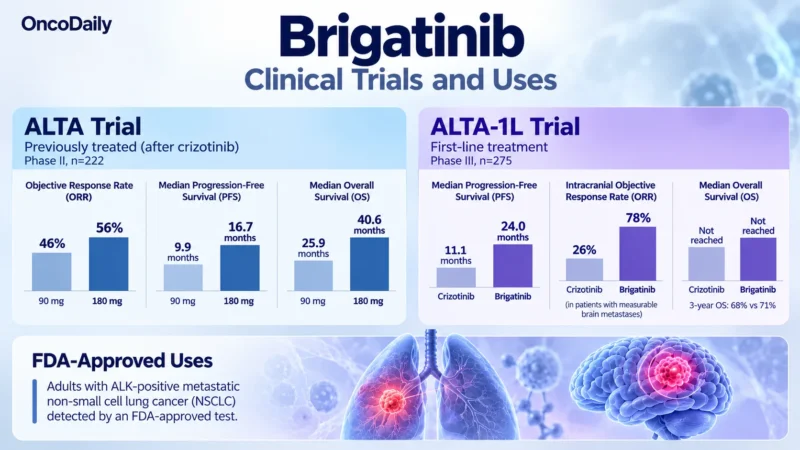
ALTA — Brigatinib After Crizotinib
The randomized phase II ALTA trial enrolled:
222 patients
with crizotinib-refractory ALK-positive NSCLC.
Patients were randomized to:
- 90 mg once daily
- 180 mg once daily after a 7-day lead-in at 90 mg
The higher-dose regimen became the standard approved dosing strategy.
Objective Response Rate
Investigator-assessed ORR was approximately:
- 90 mg arm: 46%
- 180 mg arm: 56%
Median Progression-Free Survival
IRC-assessed median PFS was:
- 90 mg arm: 9.9 months
- 180 mg arm: 16.7 months
Overall Survival
Final median OS was:
- 90 mg arm: 25.9 months
- 180 mg arm: 40.6 months.
These results established the 180 mg regimen after the 90 mg lead-in.
What About Brain Metastases in ALTA?
Brigatinib demonstrated clinically meaningful intracranial activity.
Among patients with measurable baseline brain metastases, intracranial ORR was:
- 50% with 90 mg
- 67% with 180 mg after the lead-in
Median intracranial PFS in patients with any baseline brain metastases was:
- 90 mg arm: 12.8 months
- 180 mg arm: 18.4 months.
This early CNS activity provided an important rationale for studying brigatinib in the first-line setting.
ALTA-1L — Brigatinib Versus Crizotinib
The pivotal phase III ALTA-1L trial enrolled:
275 patients
with advanced ALK-positive NSCLC who had not previously received an ALK inhibitor.
Patients were randomized to:
- Brigatinib 180 mg once daily after a 7-day lead-in at 90 mg
- Crizotinib 250 mg twice daily.
Progression-Free Survival
At final analysis, blinded independent review showed:
- Brigatinib: 24.0 months
- Crizotinib: 11.1 months
Hazard ratio:
0.48
95% CI:
0.35–0.66.
Three-year PFS rates were:
- Brigatinib: 43%
- Crizotinib: 19%.
Objective Response Rate
At the first interim analysis:
- Brigatinib: 71%
- Crizotinib: 60%.
Duration of Response
At final analysis, median duration of response by BIRC was approximately:
- Brigatinib: 33 months
- Crizotinib: 14 months.
What About Brain Metastases in ALTA-1L?
CNS activity is one of brigatinib’s major clinical strengths.
Among patients with measurable brain metastases, confirmed intracranial ORR was:
- Brigatinib: 78%
- Crizotinib: 26%.
For patients with baseline brain metastases, brigatinib substantially improved intracranial PFS.
In one analysis, the hazard ratio for intracranial progression or death was approximately:
0.31.
These findings support brigatinib as a CNS-active ALK inhibitor.
What About Overall Survival in ALTA-1L?
At the final ALTA-1L analysis, median overall survival had not been reached in either treatment group.
The OS hazard ratio was:
0.81
95% CI:
0.53–1.22.
Three-year OS was approximately:
- Brigatinib: 71%
- Crizotinib: 68%.
In patients with baseline brain metastases, an exploratory analysis suggested a more favorable OS effect:
HR 0.43
95% CI:
0.21–0.89.
Is Brigatinib FDA Approved?
Yes.
Brigatinib received initial FDA approval on:
April 28, 2017
for patients with ALK-positive metastatic NSCLC who had progressed on or were intolerant to crizotinib.
On:
May 22, 2020
its indication was expanded to:
Adults with ALK-positive metastatic NSCLC detected by an FDA-approved test.
Brigatinib remains FDA approved in 2026.
What Is the Current Clinical Role of Brigatinib?
Brigatinib remains a major first-line option for metastatic ALK-positive NSCLC.
Current 2026 ASCO living guidance recommends:
- Alectinib
- Brigatinib
- Lorlatinib
as first-line therapies for stage IV ALK-positive NSCLC.
Brigatinib is particularly relevant because of:
- Durable systemic activity
- Strong intracranial efficacy
- Activity after crizotinib
- Activity against several ALK resistance mutations
- Once-daily administration
Its main practical distinction is the need for a:
90 mg 7-day lead-in
before escalation to:
180 mg once daily.
This schedule is particularly important because early-onset pulmonary events can occur shortly after treatment initiation.
Read more about the evolving role of ALK-targeted therapy and CNS control in OncoDaily’s overview of Targeted Therapy in Advanced NSCLC: From Driver Matching to Adaptive Precision Oncology.
Watch more: Explore OncoDaily’s discussion on targeted therapies in lung cancer and the evolving treatment landscape for oncogene-driven NSCLC.
What Are the Major Side Effects of Brigatinib?
The most common adverse reactions occurring in at least 25% of patients include:
- Diarrhea
- Fatigue
- Nausea
- Rash
- Cough
- Myalgia
- Headache
- Hypertension
- Vomiting
- Dyspnea.
Interstitial Lung Disease/Pneumonitis
One of the most distinctive toxicities of brigatinib is:
ILD/pneumonitis.
Importantly, some pulmonary events occur:
Early after treatment initiation.
This is one reason brigatinib begins with a:
90 mg 7-day lead-in period.
Patients should be evaluated promptly for:
- New dyspnea
- Cough
- Hypoxia
- Fever
- New pulmonary infiltrates
Grade 3 or 4 ILD/pneumonitis requires:
Permanent discontinuation.
Hypertension
Hypertension is a common clinically relevant toxicity.
Blood pressure should be monitored:
- Before treatment
- Regularly during treatment
Grade 3 hypertension may require:
- Treatment interruption
- Intensification of antihypertensive therapy
- Dose reduction if recurrent
Grade 4 or recurrent severe hypertension may require permanent discontinuation.
Bradycardia
Brigatinib can decrease heart rate.
In ALTA-1L, heart rates below:
50 beats per minute
occurred in approximately:
8.1%
of patients.
Monitoring should include:
- Heart rate
- Blood pressure
- Review of concomitant bradycardia-producing medications
Visual Disturbances
Visual adverse effects may include:
- Blurred vision
- Photophobia
- Photopsia
- Reduced visual acuity
Patients should report new or worsening visual symptoms.
Grade ≥2 visual toxicity may require treatment interruption and ophthalmologic assessment.
CPK Elevation and Muscle Toxicity
CPK elevation is particularly common with brigatinib.
In ALTA-1L:
81%
of patients had CPK elevations.
Grade 3–4 CPK elevation occurred in approximately:
24%.
Patients should report:
- Muscle pain
- Tenderness
- Weakness
CPK should be monitored during treatment.
Pancreatic Enzyme Elevation
Brigatinib can cause increases in:
- Amylase
- Lipase
In ALTA-1L:
- Amylase elevation occurred in approximately 52%
- Lipase elevation occurred in approximately 59%
Grade 3–4 lipase elevation occurred in approximately:
17%.
Amylase and lipase should be monitored during treatment.
Hepatotoxicity
Brigatinib can cause elevations in:
- AST
- ALT
- Bilirubin
In ALTA-1L:
- AST elevation occurred in approximately 72%
- ALT elevation occurred in approximately 52%
Grade 3–4 abnormalities were less common. DailyMed
Liver tests should be monitored:
Especially during the first 3 months.
Hyperglycemia
Brigatinib can cause new or worsening hyperglycemia.
In ALTA-1L:
56%
of patients experienced new or worsening hyperglycemia.
Grade 3 hyperglycemia occurred in approximately:
7.5%.
Fasting serum glucose should be assessed:
- Before treatment
- Periodically during therapy
Antihyperglycemic medications may require adjustment.
Photosensitivity
Photosensitivity can occur during brigatinib treatment.
Patients should:
- Limit sun exposure
- Wear protective clothing
- Use broad-spectrum UVA/UVB sunscreen
- Use SPF ≥30
These precautions should continue for at least:
5 days after the final dose.
Embryo-Fetal Toxicity
Brigatinib can cause fetal harm.
Females of reproductive potential should use effective contraception during treatment and for at least:
4 months after the final dose.
Males with female partners of reproductive potential should use contraception during treatment and for at least:
3 months after the final dose.
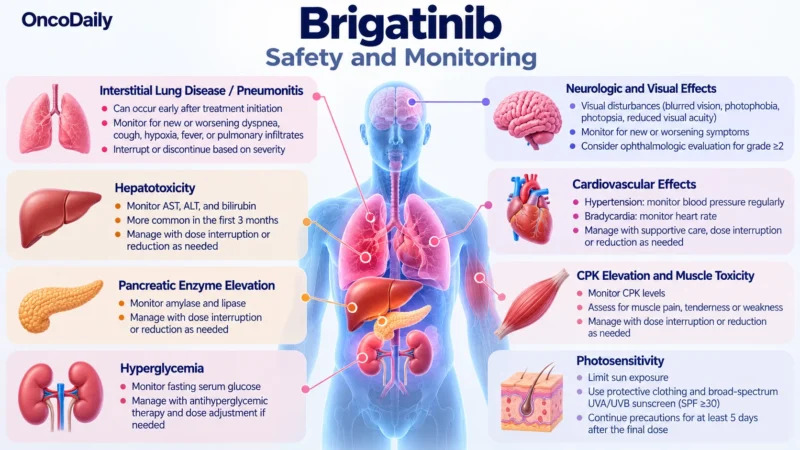
What Monitoring Is Required?
Monitoring during brigatinib treatment should include:
- Respiratory symptoms for ILD/pneumonitis
- Blood pressure
- Heart rate
- CPK
- Muscle pain and weakness
- Amylase
- Lipase
- ALT
- AST
- Total bilirubin
- Fasting glucose
- Visual symptoms
- Signs of photosensitivity
- Concomitant CYP3A inhibitors
- Concomitant CYP3A inducers
- Concomitant drugs that can cause bradycardia
Particular attention is required during the:
First week of treatment
because early pulmonary events can occur during the lead-in period.
FAQ
What Is Brigatinib Used For?
How Does Brigatinib Work?
What Is the Standard Brigatinib Dose?
Why Does Brigatinib Start at 90 mg?
Can Brigatinib Be Taken With Food?
Brigatinib may be taken: With or without food.
What Are the Dose Reductions?
180 mg → 120 mg → 90 mg → 60 mg once daily.