


Bosutinib (Bosulif): Understanding Its Mechanism, Dosing, Clinical Uses, and Role in Chronic Myeloid Leukemia
Key takeaways
- Bosutinib is an oral BCR::ABL1/SRC-family TKI used in Ph+ CML.
- First-line adult dose: 400 mg once daily with food.
- Resistant/intolerant adult CML dose: 500 mg once daily with food.
- Doses can be escalated to a maximum of 600 mg daily in selected patients with inadequate response and acceptable tolerability.
- Bosutinib should always be taken with food.
- Diarrhea is its most characteristic toxicity and often begins within the first few days of treatment.
- Hepatic toxicity commonly occurs early, particularly within the first 3 months.
- Bosutinib can also cause myelosuppression, renal dysfunction, fluid retention, and cardiovascular toxicity.
- Strong/moderate CYP3A inhibitors and strong CYP3A inducers should generally be avoided.
- PPIs can reduce bosutinib absorption; short-acting antacids or H2 blockers separated by >2 hours are preferred.
- BFORE established bosutinib as an effective first-line therapy, with 5-year cumulative MMR of 73.9% versus 64.6% with imatinib.
- BYOND confirmed durable efficacy after previous TKI treatment, with MMR achieved or maintained in 71.8% of evaluable chronic-phase patients.
- Bosutinib does not adequately inhibit T315I or V299L.
Bosutinib (Bosulif) is an oral BCR::ABL1 and SRC-family tyrosine kinase inhibitor (TKI) used for the treatment of Philadelphia chromosome-positive chronic myeloid leukemia (Ph+ CML). It is approved for newly diagnosed chronic-phase CML and for patients with chronic, accelerated, or blast-phase disease that is resistant or intolerant to prior therapy. As of the current U.S. prescribing information revised in March 2026, bosutinib is also approved for children aged 1 year and older with chronic-phase Ph+ CML.
Unlike some other second-generation TKIs, bosutinib has a toxicity profile dominated by gastrointestinal adverse effects, particularly diarrhea, and hepatic toxicity, while clinically significant arterial vascular toxicity and pleural effusion are generally less prominent than with some alternative TKIs. Its selection in CML is therefore strongly influenced by the patient’s prior TKI exposure, comorbidities, treatment goals, and tolerance profile.
Key Facts
- Generic name: Bosutinib
- Brand name: Bosulif
- Drug class: BCR::ABL1/SRC-family tyrosine kinase inhibitor
- Major targets: BCR::ABL1, SRC, Lyn, Hck
- Route: Oral
- Initial U.S. approval: 2012
- Newly diagnosed adult CP-CML dose: 400 mg once daily
- Resistant/intolerant adult CML dose: 500 mg once daily
- Administration: With food
- Pediatric newly diagnosed CP-CML: 300 mg/m² once daily
- Pediatric resistant/intolerant CP-CML: 400 mg/m² once daily
- Maximum adult/pediatric dose after escalation: 600 mg once daily
- Most characteristic toxicity: Diarrhea
- Other important risks: Hepatotoxicity, myelosuppression, cardiovascular toxicity, fluid retention, renal toxicity
- Major interaction pathway: CYP3A4
- Important absorption interaction: Proton-pump inhibitors can reduce bosutinib exposure.
What Is Bosutinib?
Bosutinib is an orally administered small-molecule kinase inhibitor designed primarily to suppress signaling from the abnormal:
BCR::ABL1 fusion tyrosine kinase
that drives Philadelphia chromosome-positive CML.
The Philadelphia chromosome results from:
t(9;22) → BCR::ABL1
The constitutively active BCR::ABL1 kinase promotes:
- Leukemic-cell proliferation
- Survival
- Reduced apoptosis
- Expansion of the malignant myeloid clone
Bosutinib also inhibits several SRC-family kinases, including:
- SRC
- Lyn
- Hck
In preclinical testing, bosutinib inhibited 16 of 18 imatinib-resistant BCR::ABL1 variants, but it does not adequately inhibit:
- T315I
- V299L.
What Is the Mechanism of Action of Bosutinib?
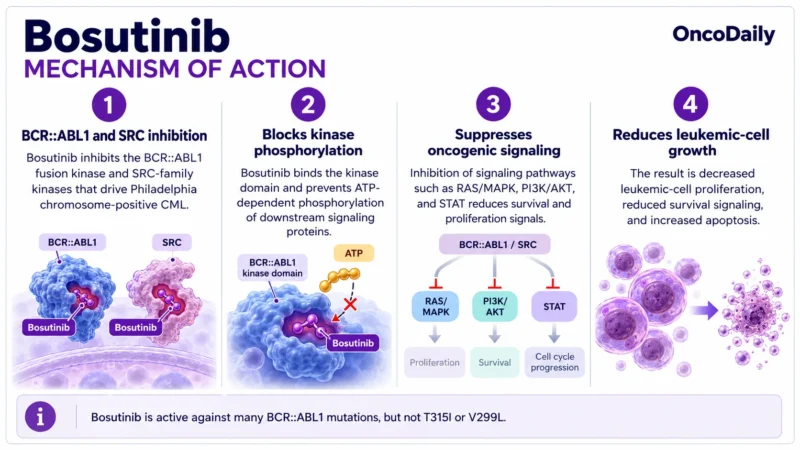
1. Constitutive BCR::ABL1 Signaling
The Philadelphia chromosome generates the BCR::ABL1 fusion protein, which has continuously active tyrosine kinase activity.
This drives downstream pathways such as:
- RAS–RAF–MEK–ERK
- PI3K–AKT
- JAK/STAT-associated signaling
These pathways support leukemic-cell proliferation and survival.
2. Bosutinib Binds the BCR::ABL1 Kinase
Bosutinib binds to and inhibits the BCR::ABL1 kinase domain.
It also inhibits SRC-family kinases, particularly:
- SRC
- Lyn
- Hck.
3. Kinase Phosphorylation Is Suppressed
Blocking kinase activity prevents phosphorylation of downstream signaling proteins.
4. Oncogenic Signaling Declines
The inhibition of BCR::ABL1 and SRC-family signaling reduces:
- Proliferative signaling
- Leukemic-cell survival
- Malignant clone expansion
5. Leukemic-Cell Growth Is Suppressed
Overall:
Bosutinib → BCR::ABL1 + SRC inhibition → ↓ oncogenic phosphorylation → ↓ proliferation and survival → increased leukemic-cell death
Bosutinib retains activity against many imatinib-resistant mutations but is not effective against T315I or V299L.
What Is the Recommended Dose of Bosutinib?
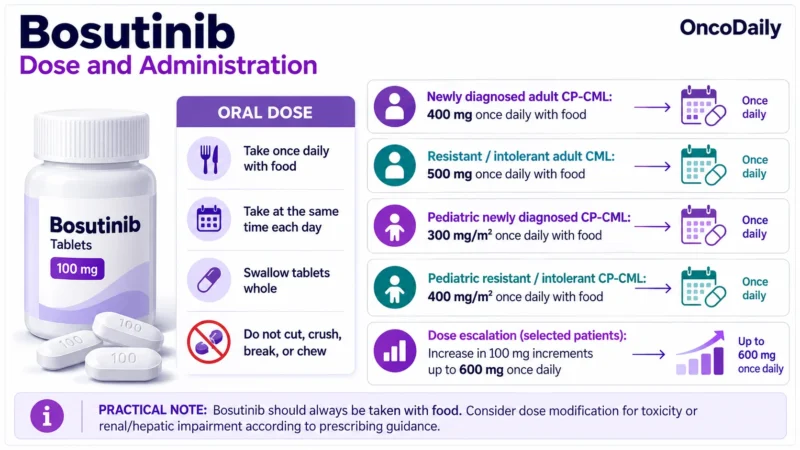
Newly Diagnosed Adult Chronic-Phase Ph+ CML
The recommended starting dose is:
400 mg orally once daily with food.
Resistant or Intolerant Adult Ph+ CML
For adult patients with:
- Chronic-phase CML
- Accelerated-phase CML
- Blast-phase CML
that is resistant or intolerant to prior therapy:
500 mg orally once daily with food.
Pediatric Newly Diagnosed Chronic-Phase CML
For children aged ≥1 year:
300 mg/m² orally once daily with food.
Pediatric Resistant or Intolerant Chronic-Phase CML
Recommended dose:
400 mg/m² orally once daily with food.
Pediatric doses are adjusted according to body surface area, with the approved label providing specific dose bands.
Can the Dose Be Increased?
Yes.
For adults who do not achieve or maintain an adequate:
- Hematologic response
- Cytogenetic response
- Molecular response
and who do not have Grade ≥3 adverse reactions, dose escalation may be considered in:
100 mg increments
to a maximum of:
600 mg once daily.
Pediatric dose escalation may also be considered after insufficient response, using smaller increments depending on body surface area.
How Should Bosutinib Be Taken?
Bosutinib should be taken:
- Once daily
- With food
- At approximately the same time each day
Bosutinib tablets should be swallowed whole.
Do not:
- Cut
- Crush
- Break
- Chew
the tablets.
Bosulif capsules can be swallowed whole.
For patients who cannot swallow capsules, the capsule contents may be mixed with:
- Applesauce
- Yogurt
and consumed immediately without chewing.
Importantly, mixing the capsule with applesauce or yogurt does not replace the requirement to take bosutinib with a proper meal.
What Should You Do If You Miss a Dose of Bosutinib?
If the missed dose is remembered within approximately 12 hours, follow the prescribed schedule.
If the dose has been missed by more than 12 hours:
- Skip the missed dose
- Take the normal prescribed dose the following day
- Do not double the dose.
How Are Bosutinib Dose Reductions Managed?
Dose interruption or reduction may be necessary for:
- Diarrhea
- Hepatotoxicity
- Neutropenia
- Thrombocytopenia
- Other clinically significant toxicities
Severe Diarrhea
For Grade 3–4 diarrhea:
- Withhold bosutinib until recovery to Grade ≤1
- Treatment may then be resumed at 400 mg once daily.
Hepatic Toxicity
If ALT or AST rises to:
>5 × ULN
bosutinib should be withheld until recovery to ≤2.5 × ULN.
Treatment may then be resumed at:
400 mg once daily.
If recovery takes more than 4 weeks, discontinuation is recommended.
Bosutinib should be discontinued for laboratory findings compatible with Hy’s law.
Other Nonhematologic Toxicities
For clinically significant moderate or severe toxicity:
- Withhold bosutinib
- Allow recovery
- Consider restarting at a dose reduced by 100 mg once daily
Re-escalation may be considered if clinically appropriate.
Myelosuppression
If:
ANC <1,000 × 10⁶/L
or:
platelets <50,000 × 10⁶/L
withhold treatment until recovery.
If recovery occurs within 2 weeks, treatment may resume at the same dose.
If cytopenia persists for >2 weeks:
reduce the dose by 100 mg.
If cytopenia recurs, reduce by another:
100 mg.
What Drug Interactions Are Important With Bosutinib?
Strong or Moderate CYP3A Inhibitors
Bosutinib is a:
CYP3A substrate.
Strong or moderate CYP3A inhibitors can significantly increase bosutinib exposure.
Examples include:
- Ketoconazole
- Itraconazole
- Clarithromycin
- Ritonavir
- Certain azole antifungals and antivirals
Concomitant use should generally be avoided.
Ketoconazole increased bosutinib:
- Cmax approximately 5.2-fold
- AUC approximately 8.6-fold.
Strong CYP3A Inducers
Strong CYP3A inducers can markedly reduce bosutinib exposure.
Examples include:
- Rifampin
- Carbamazepine
- Phenytoin
- Phenobarbital
- St. John’s wort
Rifampin reduced:
- Cmax by 86%
- AUC by 94%.
These combinations should generally be avoided.
Proton-Pump Inhibitors
Bosutinib has pH-dependent solubility.
PPIs can therefore decrease bosutinib absorption.
Lansoprazole reduced bosutinib:
- Cmax by 46%
- AUC by 26%.
Instead of PPIs, consider:
- Short-acting antacids
- H2 blockers
These should be separated from bosutinib by:
more than 2 hours.
Does Bosutinib Require Dose Adjustment in Renal or Hepatic Impairment?
Renal Impairment
For newly diagnosed chronic-phase CML:
- CrCl 30–50 mL/min: 300 mg once daily
- CrCl <30 mL/min: 200 mg once daily
For resistant/intolerant CML:
- CrCl 30–50 mL/min: 400 mg once daily
- CrCl <30 mL/min: 300 mg once daily.
Bosutinib has not been adequately studied in patients undergoing hemodialysis.
Hepatic Impairment
For patients with:
- Child-Pugh A
- Child-Pugh B
- Child-Pugh C
the recommended starting dose is:
200 mg once daily
for both newly diagnosed and resistant/intolerant adult CML.
What Is the Pharmacokinetic Profile of Bosutinib?
Absorption
After oral administration with food, median time to maximum concentration is approximately:
6 hours.
Absolute bioavailability is approximately:
34%.
Effect of Food
Food substantially increases bosutinib exposure.
With a high-fat meal, bosutinib tablets showed approximately:
- 1.8-fold higher Cmax
- 1.7-fold higher AUC
compared with fasting administration.
This is why Bosulif should be taken:
with food.
Protein Binding
Bosutinib is highly protein bound:
- Approximately 94% in vitro
- Approximately 96% ex vivo.
Half-Life
The mean terminal elimination half-life is approximately:
22.5 hours.
This supports once-daily dosing.
Metabolism
Bosutinib is primarily metabolized by:
CYP3A4.
Excretion
Following radiolabeled administration:
- Approximately 91.3% was recovered in feces
- Approximately 3.3% was recovered in urine.
What Are the Clinical Uses of Bosutinib?
Newly Diagnosed Chronic-Phase Ph+ CML
Bosutinib is FDA approved for adults and children aged ≥1 year with:
newly diagnosed chronic-phase Philadelphia chromosome-positive CML.
Chronic-Phase CML Resistant or Intolerant to Prior Therapy
Bosutinib is also approved for:
chronic-phase Ph+ CML after resistance or intolerance to prior therapy.
This applies to both adults and pediatric patients aged ≥1 year.
Advanced-Phase CML
In adults, bosutinib is approved for:
- Accelerated-phase Ph+ CML
- Blast-phase Ph+ CML
after resistance or intolerance to previous therapy.
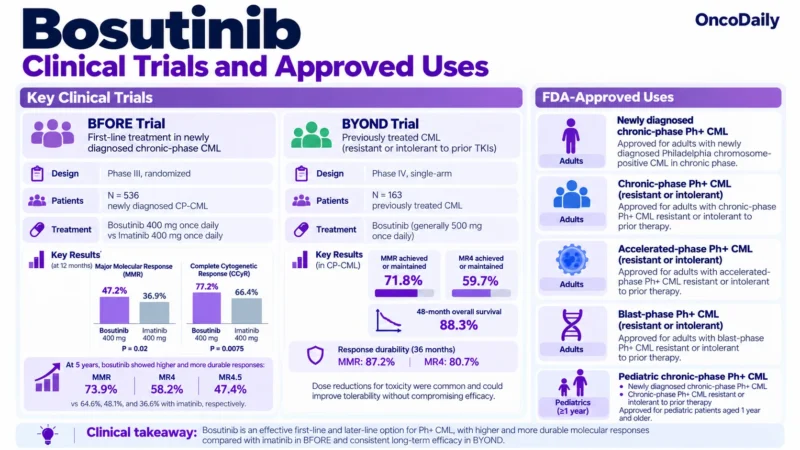
What Did the Pivotal Clinical Trials Show?
BFORE
The phase III BFORE trial established bosutinib as a first-line treatment for newly diagnosed chronic-phase CML.
A total of:
536 patients
were randomized to:
- Bosutinib 400 mg once daily
- Imatinib 400 mg once daily.
At 12 months:
Major Molecular Response
- Bosutinib: 47.2%
- Imatinib: 36.9%
P = 0.02
Complete Cytogenetic Response
- Bosutinib: 77.2%
- Imatinib: 66.4%
P = 0.0075.
Bosutinib therefore produced faster and deeper molecular responses than imatinib.
Five-Year BFORE Results
At 5 years, cumulative:
MMR
- Bosutinib: 73.9%
- Imatinib: 64.6%
MR4
- Bosutinib: 58.2%
- Imatinib: 48.1%
MR4.5
- Bosutinib: 47.4%
- Imatinib: 36.6%.
These final results confirmed the durability of bosutinib as a first-line CML treatment.
BYOND
The phase IV BYOND trial evaluated bosutinib in patients who were resistant or intolerant to previous TKIs.
A total of:
163 patients
with previously treated CML received bosutinib, generally beginning at:
500 mg once daily.
At final analysis, among evaluable patients with Ph+ chronic-phase CML:
- MMR achieved or maintained: 71.8%
- MR4 achieved or maintained: 59.7%
- 48-month overall survival: 88.3%.
The probability of maintaining response at 36 months was:
- MMR: 87.2%
- MR4: 80.7%
Importantly, dose reduction for toxicity could improve tolerability without necessarily compromising efficacy.
Long-Term Second-Line Bosutinib Study
A 2026 final analysis provides the longest follow-up yet reported for bosutinib after imatinib failure.
Among:
284 patients
with chronic-phase CML receiving second-line bosutinib, cumulative:
- Complete cytogenetic response: 49.6%
- MMR: 42.1%
- MR4: 37.1%
At year 11:
- Overall survival was 70.5%
- No new long-term safety signals emerged.
This mature dataset supports durable efficacy of bosutinib as a long-term second-line therapy.
Is Bosutinib FDA Approved?
Yes.
Current FDA-approved indications include:
Adults
- Newly diagnosed chronic-phase Ph+ CML
- Chronic-phase Ph+ CML resistant or intolerant to prior therapy
- Accelerated-phase Ph+ CML resistant or intolerant to prior therapy
- Blast-phase Ph+ CML resistant or intolerant to prior therapy
Pediatrics ≥1 Year
- Newly diagnosed chronic-phase Ph+ CML
- Chronic-phase Ph+ CML resistant or intolerant to prior therapy.
What Is the Current Clinical Role of Bosutinib in 2026?
First-Line Chronic-Phase CML
Bosutinib remains an established second-generation TKI for newly diagnosed chronic-phase CML.
Compared with imatinib, BFORE demonstrated:
- Faster molecular responses
- Higher cumulative MMR
- Higher MR4 and MR4.5 rates.
Its selection should take into account:
- CML risk
- Comorbidities
- Molecular response goals
- Mutation profile
- Prior gastrointestinal disease
- Liver function
- Renal function
- Cardiovascular risk
- Previous TKI intolerance
Read more: Choice of Frontline TKI for CML-CP by OncoDaily reviews the approved frontline TKIs, including bosutinib, and highlights treatment selection based on molecular goals, comorbidities, and toxicity patterns such as diarrhea, renal dysfunction, and liver dysfunction.
Watch more: Bosutinib: a new, safer TKI for frontline CML — Michael Mauro, MD, discusses bosutinib as a frontline option for chronic myeloid leukemia and the BFORE trial.
After Prior TKI Therapy
Bosutinib is particularly valuable after intolerance or resistance to:
- Imatinib
- Dasatinib
- Nilotinib
and can provide durable molecular responses after multiple prior TKIs.
Mutation Considerations
Bosutinib retains activity against many BCR::ABL1 mutations.
However, it should not be relied upon for:
- T315I
- V299L.
Treatment-Free Remission
Compared with imatinib, nilotinib, and dasatinib, prospective treatment-free remission data for bosutinib remain comparatively limited.
Small datasets suggest that TFR after bosutinib can be feasible in selected patients with sustained deep molecular response, but this is not yet the defining clinical role of bosutinib.
What Are the Major Side Effects of Bosutinib?
Common adverse reactions include:
- Diarrhea
- Abdominal pain
- Nausea
- Vomiting
- Rash
- Fatigue
- Headache
- Pyrexia
- Decreased appetite
- Hepatic dysfunction
- Respiratory tract infections
- Constipation.
Important clinically significant toxicities include:
- Severe diarrhea
- Hepatotoxicity
- Myelosuppression
- Cardiovascular toxicity
- Fluid retention
- Pleural effusion
- Renal toxicity
- Pancreatic enzyme elevations
- Rare pancreatitis
Gastrointestinal Toxicity
Diarrhea is the characteristic toxicity of bosutinib.
In BFORE, diarrhea occurred in approximately:
75%
of bosutinib-treated patients, compared with 40% receiving imatinib.
Grade 3/4 diarrhea occurred in approximately:
9% versus 1%, respectively.
In newly diagnosed patients, the median time to onset was only:
4 days
and individual episodes typically lasted approximately:
3 days.
Management includes:
- Antidiarrheal therapy
- Oral or IV fluid replacement when needed
- Treatment interruption
- Dose reduction for severe toxicity
Hepatotoxicity
Bosutinib frequently causes elevations in:
- ALT
- AST
In newly diagnosed patients:
- ALT elevation occurred in approximately 68%
- AST elevation in approximately 56%.
Most first elevations occurred within the first:
3 months.
Liver enzymes should therefore be monitored closely early in therapy.
Myelosuppression
Bosutinib may cause:
- Thrombocytopenia
- Neutropenia
- Anemia
CBC should be performed:
- Weekly during the first month
- Then monthly
- Or more frequently when clinically indicated.
Cardiovascular Toxicity
Bosutinib can cause:
- Cardiac failure
- Left ventricular dysfunction
- Cardiac ischemic events
In the first-line randomized study:
- Cardiac failure: 1.9%
- Cardiac ischemic events: 4.9%.
Patients with established cardiovascular disease or risk factors should be monitored closely.
Fluid Retention
Bosutinib can cause:
- Peripheral edema
- Pleural effusion
- Pericardial effusion
- Pulmonary edema
Severe fluid retention was uncommon in newly diagnosed patients but occurred more often in previously treated populations.
Renal Toxicity
A progressive reduction in:
eGFR
has been observed during bosutinib therapy.
Renal function should therefore be assessed:
- At baseline
- Periodically during treatment
- More frequently in patients with pre-existing renal impairment or renal risk factors.
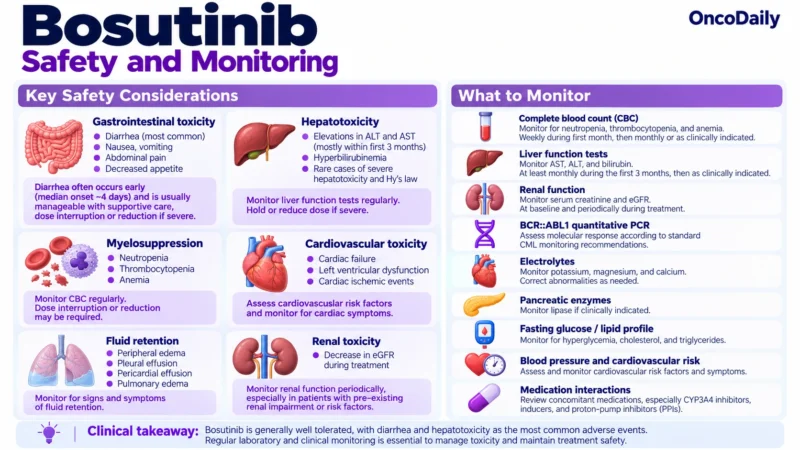
What Monitoring Is Required During Bosutinib Treatment?
Monitoring should include:
- CBC
- BCR::ABL1 quantitative PCR
- ALT
- AST
- Bilirubin
- Serum creatinine
- eGFR
- Electrolytes
- Lipase when clinically indicated
- Gastrointestinal symptoms
- Hydration status
- Fluid retention
- Cardiac symptoms
- Blood pressure
- Medication interactions
- Use of CYP3A inhibitors or inducers
- Use of proton-pump inhibitors
- Pregnancy status when relevant
CBC
- Weekly during the first month
- Monthly thereafter
Liver Function
- At least monthly during the first 3 months
- Then as clinically indicated.
Molecular Monitoring
Serial:
BCR::ABL1 quantitative PCR
should be performed according to standard CML molecular monitoring recommendations.
FAQ
What is bosutinib used for?
What is the standard first-line dose?
What is the dose after resistance or intolerance to prior therapy?
Does bosutinib need to be taken with food?
Food substantially increases bosutinib absorption.
What is the most common side effect?
How soon can bosutinib-associated diarrhea begin?
4 days.
Can bosutinib be taken with a proton-pump inhibitor?
Short-acting antacids or H2 blockers may be used instead, separated from bosutinib by more than:
2 hours.
Does bosutinib require renal dose adjustment?
Starting-dose reductions are recommended for moderate or severe renal impairment.
Is bosutinib active against T315I?
Bosutinib does not adequately inhibit BCR::ABL1 T315I.