


Axitinib (Inlyta): Understanding Its Mechanism, Dosing, Clinical Uses, and Role in Advanced Renal Cell Carcinoma
Key takeaways
- Axitinib is an oral, relatively selective VEGFR-1/2/3 inhibitor used in advanced RCC.
- The standard starting dose is 5 mg twice daily, approximately 12 hours apart.
- It can be taken with or without food.
- Selected patients may be escalated to 7 mg twice daily, then 10 mg twice daily.
- Dose reductions proceed to 3 mg twice daily, then 2 mg twice daily.
- Axitinib is FDA approved with pembrolizumab and avelumab as first-line advanced RCC treatment and as monotherapy after one prior systemic therapy.
- In AXIS, median PFS was 6.7 vs 4.7 months versus sorafenib, HR 0.665.
- Five-year KEYNOTE-426 follow-up showed median OS 47.2 vs 40.8 months, PFS 15.7 vs 11.1 months, and ORR 60.6% vs 39.6% for pembrolizumab + axitinib versus sunitinib.
- JAVELIN Renal 101 showed durable PFS and response benefit with avelumab + axitinib, although final OS did not reach statistical significance. PubMed
- Hypertension is one of the most characteristic toxicities and may occur within days of starting treatment.
- Other important risks include thrombosis, hemorrhage, cardiac failure, proteinuria, hepatotoxicity, thyroid dysfunction, and PRES/RPLS.
- In 2026, pembrolizumab + axitinib remains an established first-line RCC regimen supported by long-term survival data.
Axitinib (Inlyta) is an oral, potent and relatively selective vascular endothelial growth factor receptor (VEGFR) tyrosine kinase inhibitor. It primarily inhibits VEGFR-1, VEGFR-2, and VEGFR-3, thereby suppressing VEGF-driven angiogenesis, vascular permeability, and tumor blood-vessel formation. Unlike broader multikinase inhibitors such as sunitinib or sorafenib, axitinib is more specifically focused on the VEGF pathway.
In the United States, axitinib is FDA approved for advanced renal cell carcinoma (RCC) in three settings: with pembrolizumab as first-line therapy, with avelumab as first-line therapy, and as single-agent treatment after failure of one prior systemic therapy.
Key Facts
- Generic name: Axitinib
- Brand name: Inlyta
- Drug class: VEGFR tyrosine kinase inhibitor
- Major targets: VEGFR-1, VEGFR-2, VEGFR-3
- Route: Oral
- Initial US approval: 2012
- Tablet strengths: 1 mg and 5 mg
- Standard starting dose: 5 mg twice daily
- Administration: Approximately 12 hours apart
- Food: With or without food
- Potential dose escalation: 7 mg twice daily, then 10 mg twice daily in selected patients
- Dose reductions: 3 mg twice daily, then 2 mg twice daily
- First-line combinations: Pembrolizumab or avelumab
- Monotherapy indication: Advanced RCC after one prior systemic therapy
- Major toxicities: Hypertension, diarrhea, thromboembolism, hemorrhage, cardiac failure, proteinuria, hepatotoxicity, thyroid dysfunction
- Important interaction pathway: CYP3A4/5.
What Is Axitinib?
Axitinib is a small-molecule inhibitor designed to suppress signaling through the:
VEGF–VEGFR pathway.
Clear-cell RCC is strongly associated with dysregulation of angiogenesis. Loss of normal VHL signaling can lead to increased production of proangiogenic factors such as VEGF, allowing tumors to develop an extensive vascular network.
Axitinib inhibits the intracellular kinase activity of:
- VEGFR-1
- VEGFR-2
- VEGFR-3
and thereby reduces downstream signaling required for:
- Endothelial-cell proliferation
- Migration
- Vascular survival
- New blood-vessel formation
- Tumor vascularization.
What Is the Mechanism of Action of Axitinib?
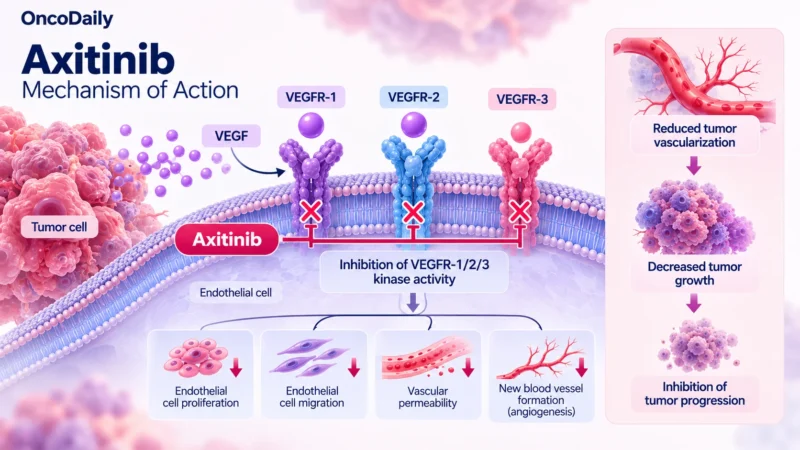
1. Tumor Cells Produce VEGF
Renal cancers, particularly clear-cell RCC, may produce high levels of:
VEGF
which binds VEGF receptors on vascular endothelial cells.
2. VEGF Activates VEGFR-1, VEGFR-2, and VEGFR-3
Activation of these receptor tyrosine kinases stimulates intracellular pathways responsible for:
- Endothelial proliferation
- Migration
- Survival
- Vascular permeability
- Angiogenesis
3. Axitinib Inhibits VEGFR Kinase Activity
Axitinib binds to and inhibits the intracellular kinase domains of:
VEGFR-1, VEGFR-2, and VEGFR-3.
This prevents receptor phosphorylation and downstream VEGF signaling.
4. Angiogenesis Is Suppressed
As VEGFR signaling decreases:
- Endothelial-cell proliferation falls
- New vessel formation decreases
- Tumor vascularization is reduced
5. Tumor Growth Is Restricted
The reduction in blood supply and angiogenesis ultimately contributes to:
- Reduced tumor growth
- Reduced metastatic progression
- Tumor regression in responsive patients
The mechanism can be summarized as:
Axitinib → VEGFR-1/2/3 inhibition → reduced VEGF signaling → ↓angiogenesis and vascular support → reduced tumor growth.
What Is the Dose of Axitinib?
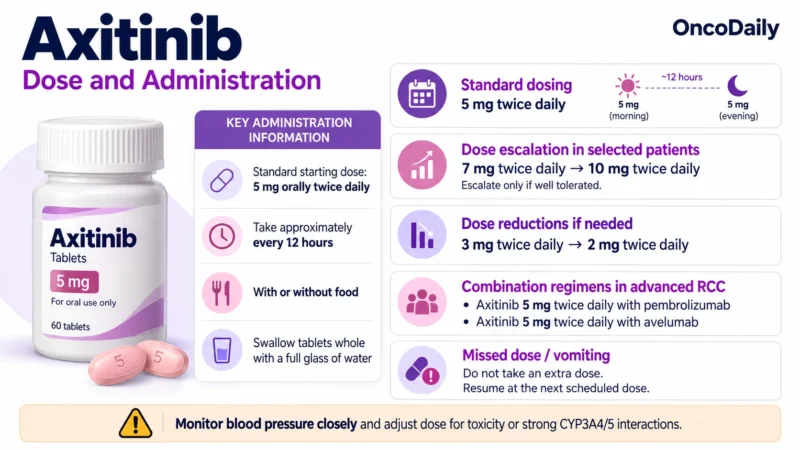
The recommended starting dose is:
5 mg orally twice daily
with doses administered approximately:
12 hours apart.
Axitinib may be given:
With or without food.
Treatment generally continues until:
- Disease progression
- Unacceptable toxicity.
Axitinib With Pembrolizumab
For first-line advanced RCC:
Axitinib 5 mg orally twice daily
plus:
Pembrolizumab 200 mg intravenously every 3 weeks
or:
Pembrolizumab 400 mg intravenously every 6 weeks.
When used with pembrolizumab, axitinib dose escalation above 5 mg twice daily may be considered at intervals of:
6 weeks or longer
in appropriately selected patients.
Axitinib With Avelumab
For first-line advanced RCC:
Axitinib 5 mg orally twice daily
plus:
Avelumab 800 mg intravenously every 2 weeks.
When used with avelumab, axitinib dose escalation may be considered at intervals of:
2 weeks or longer.
Axitinib as Monotherapy
For advanced RCC after failure of one prior systemic treatment:
Axitinib 5 mg orally twice daily.
How Should Axitinib Be Taken?
Axitinib should be taken:
- Approximately 12 hours apart
- At approximately the same times each day
- With or without food
Tablets should be:
Swallowed whole with a full glass of water.
What If a Dose Is Missed?
If a dose is missed:
Do not take an additional replacement dose.
Take the next dose at the:
Usual scheduled time.
If vomiting occurs after taking axitinib:
Do not take another dose to replace it.
How Are Axitinib Dose Adjustments Made?
Unlike many TKIs, axitinib can be both:
- Dose reduced
- Dose escalated
depending on tolerability.
Standard Dose
- 5 mg twice daily
Dose Escalation
For selected patients who have tolerated axitinib for at least 2 consecutive weeks without Grade >2 toxicity, remain normotensive, and are not receiving antihypertensive medication:
- First increase: 7 mg twice daily
- Second increase: 10 mg twice daily.
Dose Reduction
If toxicity requires reduction:
- First reduction: 3 mg twice daily
- Second reduction: 2 mg twice daily.
Dose Modification for Hypertension
For persistent blood pressure:
>150/100 mmHg despite antihypertensive therapy
reduce axitinib by:
One dose level.
For:
SBP >160 mmHg or DBP >105 mmHg
- Withhold axitinib
- Resume when BP is below 150/100 mmHg
- Restart at a reduced dose.
For:
Grade 4 hypertension or hypertensive crisis
axitinib should be:
Permanently discontinued.
What Are the Important Drug Interactions With Axitinib?
Axitinib is primarily metabolized through:
CYP3A4/5.
Strong CYP3A4/5 Inhibitors
Strong inhibitors can increase axitinib exposure.
Examples include:
- Ketoconazole
- Itraconazole
- Clarithromycin
- Ritonavir
These combinations should generally be:
Avoided if possible.
If unavoidable, axitinib should be reduced by approximately:
50%.
After the inhibitor is discontinued, the prior axitinib dose may generally be resumed after approximately:
3–5 inhibitor half-lives.
Strong CYP3A4/5 Inducers
Strong CYP3A4/5 inducers may reduce axitinib exposure.
Examples include:
- Rifampin
- Carbamazepine
- Phenytoin
- Phenobarbital
- St. John’s wort
Concomitant use should generally be:
Avoided.
Does Axitinib Require Renal Dose Adjustment?
Population pharmacokinetic analyses indicate that:
Mild, moderate, and severe renal impairment did not meaningfully alter axitinib pharmacokinetics.
Therefore routine starting-dose modification based solely on renal impairment is generally not required.
However, data in:
End-stage renal disease
are extremely limited.
Does Axitinib Require Hepatic Dose Adjustment?
Mild Hepatic Impairment
Child-Pugh A:
No starting-dose adjustment is required.
Moderate Hepatic Impairment
Child-Pugh B:
Reduce the starting dose by approximately:
50%.
For example:
5 mg twice daily → approximately 2 mg twice daily, with subsequent adjustment according to tolerability.
Severe Hepatic Impairment
Child-Pugh C:
Axitinib has:
Not been adequately studied.
What Is the Pharmacokinetic Profile of Axitinib?
Absorption
After a single oral dose:
Median Tmax is approximately:
2.5–4.1 hours.
Bioavailability
Mean absolute oral bioavailability is approximately:
58%.
Food Effect
Compared with overnight fasting:
- Moderate-fat meal produced about 10% lower AUC
- High-fat/high-calorie meal produced about 19% higher AUC
These changes are not considered clinically important enough to require fasting administration.
Therefore axitinib can be taken:
With or without food.
Protein Binding
Axitinib is:
>99% protein bound
primarily to:
- Albumin
- α1-acid glycoprotein.
Half-Life
The plasma half-life is approximately:
2.5–6.1 hours.
Steady state is generally expected within:
2–3 days.
Metabolism
Axitinib is metabolized predominantly by:
CYP3A4/5
with smaller contributions from:
- CYP1A2
- CYP2C19
- UGT1A1.
Elimination
Following a radiolabeled dose:
- Approximately 41% is recovered in feces
- Approximately 23% is recovered in urine.
Unchanged axitinib is not detected in urine to a meaningful degree.
What Are the Clinical Uses of Axitinib?
1. First-Line Advanced RCC With Pembrolizumab
Axitinib is FDA approved with:
Pembrolizumab
for first-line treatment of:
Advanced renal cell carcinoma.
This combination has become one of the major immunotherapy–VEGFR TKI approaches in advanced RCC.
2. First-Line Advanced RCC With Avelumab
Axitinib is FDA approved with:
Avelumab
for first-line treatment of advanced RCC.
3. Previously Treated Advanced RCC
Axitinib is also FDA approved as:
Single-agent therapy
after failure of:
One prior systemic treatment.
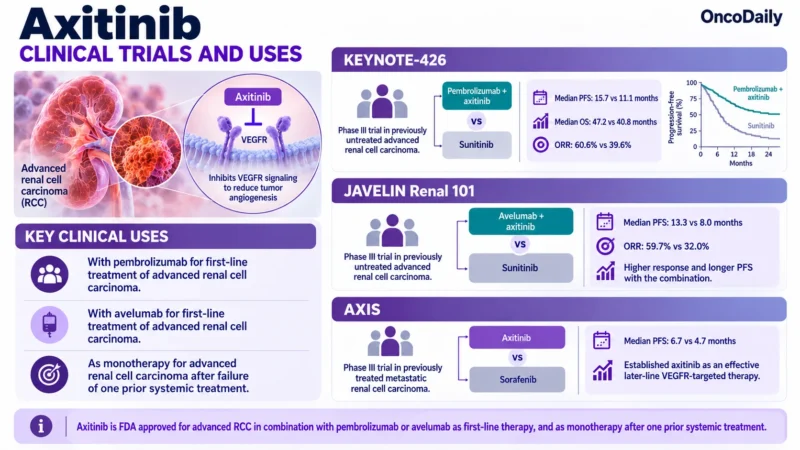
What Did the AXIS Trial Show?
The pivotal phase III AXIS trial compared:
Axitinib
with:
Sorafenib
in patients with previously treated metastatic RCC.
A total of:
723 patients
were randomized:
- Axitinib: 361
- Sorafenib: 362.
Progression-Free Survival
Median PFS:
- 6.7 months with axitinib
- 4.7 months with sorafenib
Hazard ratio:
0.665
95% CI:
0.544–0.812
P < 0.0001.
These results established axitinib as an effective second-line VEGFR-targeted therapy.
Overall Survival in AXIS
Updated analysis showed median OS:
- 20.1 months with axitinib
- 19.2 months with sorafenib
Hazard ratio:
0.969
P = 0.3744.
The OS difference was not statistically significant.
What Did KEYNOTE-426 Show?
The phase III KEYNOTE-426 trial established:
Pembrolizumab + axitinib
as a major first-line treatment strategy for advanced RCC.
A total of:
861 patients
were randomized to:
- Pembrolizumab + axitinib
- Sunitinib.
Initial KEYNOTE-426 Results
Median PFS was:
- 15.1 months with pembrolizumab + axitinib
- 11.1 months with sunitinib
Hazard ratio:
0.69
P < 0.001.
Objective response rate:
- 59.3%
- 35.7%.
Five-Year KEYNOTE-426 Results
Long-term follow-up confirmed durable benefit.
Median OS:
- 47.2 months with pembrolizumab + axitinib
- 40.8 months with sunitinib
Hazard ratio:
0.84
95% CI:
0.71–0.99.
Median PFS:
- 15.7 months
- 11.1 months
Hazard ratio:
0.69.
Confirmed ORR:
- 60.6%
- 39.6%.
Median duration of response:
- 23.6 months
- 15.3 months.
These long-term findings continue to support pembrolizumab + axitinib as an established first-line regimen for advanced clear-cell RCC.
What Did JAVELIN Renal 101 Show?
The phase III JAVELIN Renal 101 trial compared:
Avelumab + axitinib
with:
Sunitinib
in previously untreated advanced RCC.
A total of:
886 patients
were randomized.
Progression-Free Survival
In the overall population, updated analysis showed median PFS:
- 13.3 months with avelumab + axitinib
- 8.0 months with sunitinib
Hazard ratio:
0.69
P < 0.0001.
Final JAVELIN Renal 101 Results
With a minimum follow-up of approximately:
68 months
median OS in the overall population was:
- 44.8 months with avelumab + axitinib
- 38.9 months with sunitinib
Hazard ratio:
0.88
P = 0.0669.
The OS difference did not reach statistical significance.
However, objective response rate remained substantially higher:
- 59.7% with avelumab + axitinib
- 32.0% with sunitinib.
Is Axitinib FDA Approved?
Yes.
FDA-approved indications include:
Pembrolizumab + Axitinib
First-line treatment of:
Advanced RCC
Avelumab + Axitinib
First-line treatment of:
Advanced RCC
Axitinib Monotherapy
Treatment of advanced RCC after:
Failure of one prior systemic therapy.
What Is the Current Clinical Role of Axitinib in 2026?
Axitinib remains an important VEGFR inhibitor in advanced RCC, particularly because it can be combined effectively with immune-checkpoint inhibition.
Pembrolizumab + Axitinib
This remains an established first-line option for advanced clear-cell RCC.
The ≥5-year KEYNOTE-426 results continue to demonstrate:
- Overall-survival benefit
- Progression-free-survival benefit
- Higher response rates
- Durable responses
compared with sunitinib.
Read more: Metastatic Renal Cell Carcinoma in 2026: Frontline Combinations, Post-IO Sequencing, and the Emergence of HIF-2α Inhibition — OncoDaily’s contemporary review of RCC treatment, including axitinib + pembrolizumab and the role of axitinib after prior therapy.
Watch more: OncoDaily discussion on first-line treatment strategies in advanced renal cell carcinoma, including VEGFR-TKI and immunotherapy combinations relevant to axitinib.
Avelumab + Axitinib
The combination remains FDA approved and produces substantial:
- PFS improvement
- Response-rate improvement
compared with sunitinib.
However, final JAVELIN Renal 101 follow-up did not demonstrate a statistically significant OS advantage.
Axitinib Monotherapy
Axitinib monotherapy retains an FDA-approved role after one prior systemic treatment, based principally on the AXIS trial.
In contemporary practice, its exact placement depends on:
- Prior immunotherapy
- Prior VEGF-targeted therapy
- Tolerability
- Patient comorbidities
- Treatment availability
- Subsequent-line sequencing considerations.
What Are the Major Side Effects of Axitinib?
Common adverse effects with axitinib monotherapy include:
- Diarrhea
- Hypertension
- Fatigue
- Reduced appetite
- Nausea
- Dysphonia
- Hand-foot syndrome
- Weight loss
- Vomiting
- Asthenia
- Constipation.
Important serious toxicities include:
- Hypertension
- Arterial thromboembolic events
- Venous thromboembolism
- Hemorrhage
- Cardiac failure
- GI perforation or fistula
- Thyroid dysfunction
- Proteinuria
- Hepatotoxicity
- Reversible posterior leukoencephalopathy syndrome
- Impaired wound healing
- Embryo-fetal toxicity.
Hypertension
Hypertension is one of the most characteristic axitinib toxicities.
In the AXIS safety population:
- Any-grade hypertension: 40%
- Grade 3–4 hypertension: 16%
- Hypertensive crisis: <1%.
Blood pressure increases may occur:
As early as 4 days after starting treatment.
Median onset was within:
The first month.
Blood pressure should be controlled before treatment begins and monitored regularly during therapy.
Arterial and Venous Thromboembolism
Axitinib has been associated with:
- Cerebrovascular events
- Myocardial infarction
- Transient ischemic attack
- Deep-vein thrombosis
- Pulmonary embolism
Patients should be monitored for symptoms suggesting arterial or venous thrombosis.
Hemorrhage
Axitinib can cause clinically significant bleeding.
Monitor for:
- Hematuria
- GI bleeding
- Epistaxis
- Hemoptysis
- Intracranial bleeding where clinically relevant.
Grade 3–4 hemorrhage generally requires:
- Treatment interruption
- Subsequent dose reduction or discontinuation depending on severity.
Cardiac Failure
Axitinib can cause:
- Reduced LVEF
- Cardiomyopathy
- Clinical heart failure
Monitor patients for:
- Dyspnea
- Peripheral edema
- Exercise intolerance
- Other signs of cardiac dysfunction.
In selected patients, LVEF assessment may be appropriate.
Proteinuria
In the controlled RCC study:
- Proteinuria occurred in 11%
- Grade 3 proteinuria occurred in 3%.
Proteinuria should be assessed:
- Before treatment
- Periodically during treatment.
For:
≥2 g protein per 24 hours
withhold axitinib until proteinuria falls below 2 g/24 hours, then resume at a reduced dose.
Hepatotoxicity
Axitinib can cause elevated liver enzymes.
As monotherapy, Grade 3–4 ALT elevations were uncommon, but hepatotoxicity becomes particularly important when axitinib is combined with:
- Pembrolizumab
- Avelumab
because Grade 3–4 ALT and AST elevations occur more frequently than with either drug alone.
Monitor:
- ALT
- AST
- Bilirubin
before treatment and periodically thereafter.
More frequent monitoring should be considered with immunotherapy combinations.
Thyroid Dysfunction
Axitinib can cause:
- Hypothyroidism
- Hyperthyroidism
Monitor thyroid function:
- Before treatment
- Periodically during treatment
- As clinically indicated.
Reversible Posterior Leukoencephalopathy Syndrome
RPLS/PRES is rare but serious.
Possible symptoms include:
- Headache
- Seizures
- Confusion
- Lethargy
- Visual disturbance
- Hypertension.
If RPLS develops:
Permanently discontinue axitinib.
Impaired Wound Healing
VEGF-pathway inhibition may impair wound healing.
Axitinib should be managed carefully around:
- Major surgery
- Significant wounds
- Procedures requiring tissue healing.
Treatment interruption may be necessary.
Embryo-Fetal Toxicity
Axitinib can cause fetal harm.
Patients of reproductive potential should receive counseling regarding:
- Pregnancy risk
- Effective contraception.
Breastfeeding is not recommended during therapy according to prescribing information.
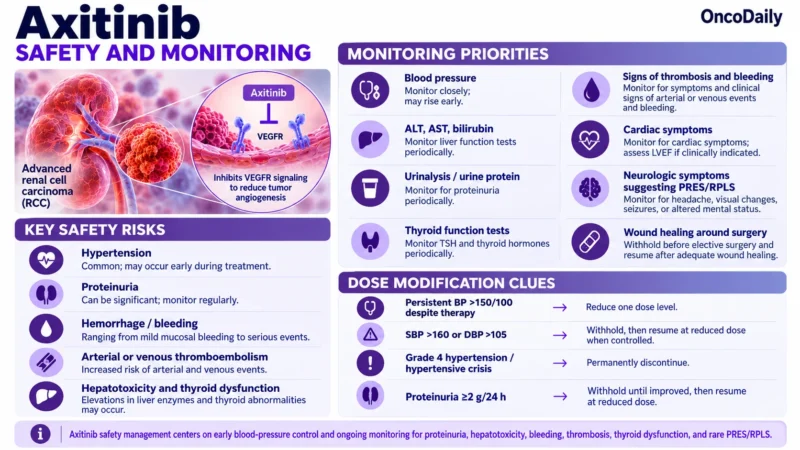
What Monitoring Is Required?
Monitoring during axitinib therapy should include:
- Blood pressure
- ALT
- AST
- Bilirubin
- Urinalysis / urine protein
- Thyroid function
- Signs of arterial thrombosis
- Signs of venous thrombosis
- Bleeding symptoms
- Cardiac symptoms
- LVEF when clinically indicated
- Gastrointestinal symptoms suggesting perforation or fistula
- Neurologic symptoms suggesting PRES/RPLS
- Wound healing
- CYP3A4/5 drug interactions
- Pregnancy status when appropriate
- Immune-related toxicity when combined with pembrolizumab or avelumab.
FAQ
What Is Axitinib Used For?
- With pembrolizumab first line
- With avelumab first line
- As monotherapy after failure of one prior systemic therapy.
What Is the Standard Axitinib Dose?
Can Axitinib Be Taken With Food?
It may be taken:
With or without food.
Can the Axitinib Dose Be Increased?
Selected patients may increase from:
5 mg BID → 7 mg BID → 10 mg BID. DailyMed
What Are the Axitinib Dose Reductions?
How Does Axitinib Work?
VEGFR-1, VEGFR-2 and VEGFR-3
thereby reducing VEGF-mediated angiogenesis and tumor vascularization.
What Did AXIS Show?
- 6.7 months with axitinib
- 4.7 months with sorafenib
HR 0.665.
What Did KEYNOTE-426 Show?
- OS
- PFS
- ORR
with pembrolizumab + axitinib versus sunitinib.
What Is the Most Characteristic Toxicity?
Any-grade hypertension occurred in approximately:
40%
of patients receiving axitinib in the controlled monotherapy RCC study.