





Alectinib (Alecensa): Understanding Its Mechanism, Dosing, Clinical Uses, and Role in ALK-Positive Lung Cancer
Key takeaways
- Alectinib is a next-generation ALK inhibitor with strong systemic and CNS activity.
- The standard dose is 600 mg orally twice daily with food.
- Dose reductions follow a 600 → 450 → 300 mg twice-daily sequence.
- Alectinib is FDA approved for both metastatic ALK-positive NSCLC and adjuvant treatment after resection of selected ALK-positive NSCLC.
- In ALEX, median PFS was 34.8 months with alectinib versus 10.9 months with crizotinib.
- Alectinib provides strong CNS control and substantially reduces the risk of intracranial progression.
- In ALINA, the hazard ratio for disease recurrence or death was 0.24 versus platinum chemotherapy.
- Important toxicities include hepatotoxicity, CPK elevation/myalgia, bradycardia, renal impairment, ILD/pneumonitis, hemolytic anemia, and severe hypertriglyceridemia.
- Liver tests and CPK require structured monitoring.
- In 2026, alectinib remains a major guideline-recommended first-line option for metastatic ALK-positive NSCLC. ASCO Publications
Alectinib (Alecensa) is an oral, next-generation tyrosine kinase inhibitor that targets anaplastic lymphoma kinase (ALK) and has strong activity against ALK-driven non-small cell lung cancer (NSCLC), including disease involving the central nervous system. It is FDA approved for both metastatic ALK-positive NSCLC and, since 2024, adjuvant treatment after complete tumor resection for selected ALK-positive NSCLC.
Alectinib became a major standard of care after the phase III ALEX trial demonstrated substantially longer progression-free survival and better CNS control than crizotinib in previously untreated metastatic ALK-positive NSCLC. Its role expanded further with the ALINA trial, which showed a major disease-free survival benefit in resected ALK-positive NSCLC compared with platinum-based chemotherapy.
Key Facts
- Generic name: Alectinib
- Brand name: Alecensa
- Drug class: Next-generation ALK tyrosine kinase inhibitor
- Route: Oral
- Initial US approval: December 11, 2015
- Major target: ALK; also inhibits RET in nonclinical studies
- Metastatic NSCLC dose: 600 mg orally twice daily
- Adjuvant NSCLC dose: 600 mg orally twice daily
- Administration: Must be taken with food
- Adjuvant duration: 2 years or until recurrence or unacceptable toxicity
- Metastatic duration: Until progression or unacceptable toxicity
- Dose reductions: 600 mg twice daily → 450 mg twice daily → 300 mg twice daily
- Dosage form: 150 mg capsules
- Active metabolite: M4
- Half-life: Approximately 33 hours; M4 approximately 31 hours
- Major toxicities: Hepatotoxicity, constipation, fatigue, myalgia, edema, rash, and cough
- Important serious toxicities: ILD/pneumonitis, renal impairment, bradycardia, severe CPK elevation/myalgia, hemolytic anemia, and severe hypertriglyceridemia with pancreatitis
- Current US status: FDA approved.
What Is Alectinib?
Alectinib is a small-molecule tyrosine kinase inhibitor developed specifically for cancers driven by abnormal ALK signaling.
ALK rearrangements create oncogenic fusion proteins, most commonly:
EML4–ALK
in NSCLC.
These fusion proteins possess constitutively active kinase activity and continuously activate intracellular signaling pathways that promote:
- Tumor-cell proliferation
- Survival
- Growth
- Invasion
- Resistance to apoptosis
Alectinib also has activity against several ALK resistance mutations that can emerge during treatment with earlier ALK inhibitors such as crizotinib.
A major clinical advantage of alectinib is its CNS penetration, which allows it to treat and prevent progression of ALK-positive disease in the brain. The FDA label notes that cerebrospinal-fluid concentrations approximate estimated free alectinib concentrations in plasma.
What Is the Mechanism of Action of Alectinib?
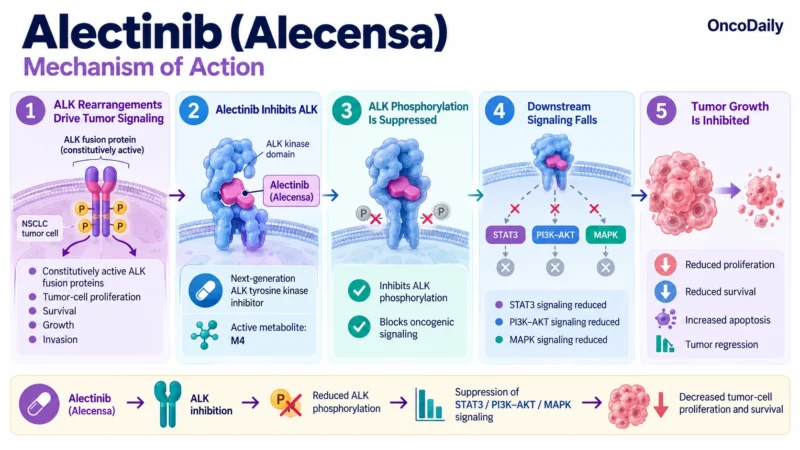
1. ALK Rearrangements Drive Persistent Signaling
ALK fusion proteins possess constitutively active tyrosine kinase activity.
This continuously stimulates downstream pathways involved in:
- Tumor-cell proliferation
- Survival
- Migration
- Invasion
2. Alectinib Inhibits ALK Kinase Activity
Alectinib directly inhibits:
ALK
and also demonstrates activity against:
RET
in nonclinical studies.
Its major active metabolite:
M4
has similar pharmacologic potency. FDA Access Data
3. ALK Phosphorylation Is Suppressed
Alectinib inhibits ALK phosphorylation and therefore reduces activation of downstream signaling proteins.
4. Downstream Signaling Falls
Important pathways affected include:
STAT3
and
PI3K–AKT.
ALK inhibition also interferes with broader mitogenic signaling, including the MAPK pathway.
5. Tumor-Cell Viability Decreases
By suppressing ALK-dependent signaling, alectinib reduces tumor-cell proliferation and survival.
Alectinib and M4 also retain activity against several mutant forms of ALK associated with acquired resistance to crizotinib.
The mechanism can be summarized as:
Alectinib → ALK inhibition → reduced ALK phosphorylation → suppression of STAT3/PI3K-AKT and other downstream signaling → decreased tumor-cell proliferation and survival.
What Is the Dose of Alectinib?
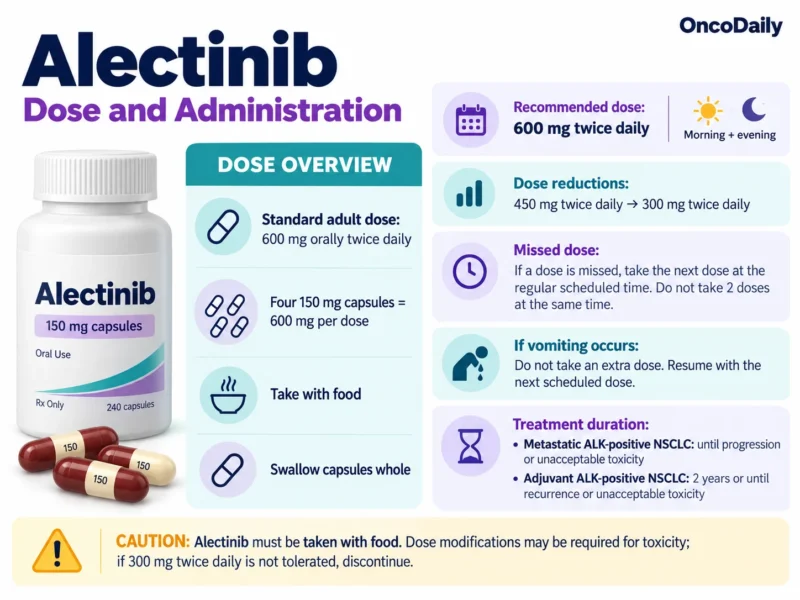
The standard recommended adult dose is:
600 mg orally twice daily with food.
Metastatic ALK-Positive NSCLC
Treatment continues until:
- Disease progression
- Unacceptable toxicity
Adjuvant ALK-Positive NSCLC
Treatment continues for:
2 years
or until:
- Disease recurrence
- Unacceptable toxicity
whichever occurs first.
What If a Dose Is Missed?
If a dose is missed:
Do not take an additional dose to make up for it.
The patient should take the next dose at the regularly scheduled time.
If vomiting occurs after taking alectinib:
Do not take a replacement dose.
Continue with the next scheduled dose. FDA Access Data
How Are Alectinib Dose Reductions Made?
The standard dose-reduction sequence is:
600 mg twice daily → 450 mg twice daily → 300 mg twice daily.
If the patient cannot tolerate:
300 mg twice daily
alectinib should generally be discontinued.
Dose interruption or reduction may be required for clinically important toxicities including:
- Hepatotoxicity
- Renal impairment
- Symptomatic bradycardia
- Severe CPK elevation
- Myalgia
- Hemolytic anemia
- Severe hypertriglyceridemia
Confirmed treatment-related ILD/pneumonitis generally requires permanent discontinuation.
How Is Alectinib Administered?
Alectinib is supplied as:
150 mg oral capsules.
The usual 600 mg dose therefore consists of:
Four 150 mg capsules twice daily.
The capsules should be:
Swallowed whole.
They should not be:
- Opened
- Dissolved
Alectinib must be taken:
With food.
Food is clinically important because exposure increases substantially under fed conditions.
A high-fat, high-calorie meal increased combined alectinib plus M4 exposure by approximately:
3.1-fold.
What Are the Important Drug Interactions With Alectinib?
Alectinib is metabolized primarily by:
CYP3A4.
However, its interaction profile differs from several other TKIs.
Strong CYP3A Inhibitors
Clinical studies with the strong CYP3A inhibitor:
Posaconazole
did not produce a clinically meaningful change in the combined exposure of alectinib plus M4.
Strong CYP3A Inducers
Similarly, coadministration with:
Rifampin
did not meaningfully alter combined exposure.
Acid-Reducing Agents
Coadministration with:
Esomeprazole
did not produce a clinically meaningful exposure change.
Therefore, unlike several other oral TKIs, routine dose modification is generally not required solely because of strong CYP3A inhibition, induction, or gastric acid suppression.
Effect on Other Drugs
Alectinib did not meaningfully alter exposure to:
- Midazolam
- Repaglinide
In vitro, alectinib and M4 can inhibit:
- P-glycoprotein
- BCRP
so caution may still be appropriate with sensitive transporter substrates.
Does Alectinib Require Renal or Hepatic Dose Adjustment?
Renal Impairment
No dose adjustment is recommended for:
Mild or moderate renal impairment
with creatinine clearance approximately:
30–89 mL/min.
The pharmacokinetics of alectinib have not been adequately studied in:
Severe renal impairment
or:
End-stage renal disease.
Alectinib itself can also cause renal toxicity.
For Grade 3 renal toxicity:
- Withhold treatment
- Resume at a reduced dose after recovery
For Grade 4 renal toxicity:
Permanently discontinue alectinib.
Hepatic Impairment
No dose adjustment is recommended for:
- Child-Pugh A
- Child-Pugh B
For:
Child-Pugh C
the recommended dose is:
450 mg orally twice daily.
What Is the Pharmacokinetic Profile of Alectinib?
Absorption
Peak plasma concentrations are reached at approximately:
4 hours
after a 600 mg dose under fed conditions.
Absolute oral bioavailability is approximately:
37%.
Steady state is generally achieved by:
Day 7.
Food Effect
Food has a major effect on absorption.
A high-fat, high-calorie meal increases combined exposure to alectinib and M4 by approximately:
3.1-fold.
This explains why alectinib should consistently be administered:
With food.
Distribution
The apparent volume of distribution is approximately:
4,016 L
for alectinib.
For M4:
10,093 L.
Both alectinib and M4 are:
>99% protein bound.
Importantly, alectinib reaches the CNS, with CSF concentrations approximating estimated free plasma concentrations.
Metabolism
Alectinib is metabolized mainly by:
CYP3A4
to the major active metabolite:
M4.
M4 is subsequently also metabolized by CYP3A4.
Half-Life
The geometric mean elimination half-life is approximately:
33 hours for alectinib
and:
31 hours for M4.
Elimination
Following radiolabeled administration:
98%
of radioactivity was recovered in feces.
Approximately:
84%
of the dose was recovered as unchanged alectinib.
Urinary excretion was:
<0.5%.
What Are the Clinical Uses of Alectinib?
Alectinib currently has two major FDA-approved NSCLC indications.
Metastatic ALK-Positive NSCLC
Alectinib is approved for:
Adults with ALK-positive metastatic NSCLC detected by an FDA-approved test.
Adjuvant Treatment of Resected ALK-Positive NSCLC
Alectinib is also approved after complete tumor resection for adults with:
ALK-positive NSCLC with tumors ≥4 cm or node-positive disease.
The adjuvant approval was granted on:
April 18, 2024. U.S.
What Did Alectinib Clinical Trials Show?
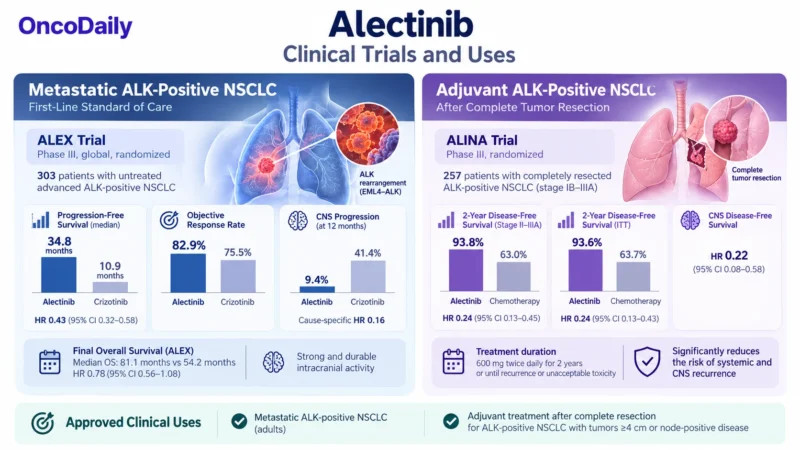
ALEX — Alectinib Versus Crizotinib
The pivotal global phase III ALEX study enrolled:
303 patients
with previously untreated advanced ALK-positive NSCLC.
Patients were randomized to:
- Alectinib 600 mg twice daily
- Crizotinib 250 mg twice daily
Patients with asymptomatic CNS metastases were allowed.
Progression-Free Survival
With mature follow-up, median investigator-assessed PFS was:
- Alectinib: 34.8 months
- Crizotinib: 10.9 months
Hazard ratio:
0.43
95% CI:
0.32–0.58.
This represented a substantial reduction in the risk of disease progression or death.
Objective Response Rate
In the primary analysis:
- Alectinib: 82.9%
- Crizotinib: 75.5%.
Duration of Response
In the final OS update, median duration of response among confirmed responders was:
- Alectinib: 42.3 months
- Crizotinib: 11.1 months.
What About Overall Survival in ALEX?
The final ALEX overall-survival analysis reported:
Median OS:
- Alectinib: 81.1 months
- Crizotinib: 54.2 months
Hazard ratio:
0.78
95% CI:
0.56–1.08.
The confidence interval crossed 1, but the long-term data demonstrated sustained systemic and intracranial disease control with alectinib.
Earlier analyses also showed a:
5-year OS rate of 62.5%
with alectinib compared with:
45.5%
with crizotinib.
What About Brain Metastases?
CNS activity is one of the defining strengths of alectinib.
In the primary ALEX analysis:
CNS progression occurred in:
- 12% of patients receiving alectinib
- 45% receiving crizotinib
The cause-specific hazard ratio was:
0.16.
At 12 months, cumulative CNS progression was approximately:
- 9.4% with alectinib
- 41.4% with crizotinib.
This strong intracranial activity is one of the main reasons alectinib became a preferred first-line treatment for ALK-positive metastatic NSCLC.
What Did ALINA Show?
The phase III ALINA trial established alectinib as adjuvant therapy after surgery.
A total of:
257 patients
with completely resected ALK-positive stage IB–IIIA NSCLC were randomized to:
- Alectinib 600 mg twice daily
- Platinum-based chemotherapy
Alectinib was given for up to:
2 years.
Disease-Free Survival in Stage II–IIIA Disease
At 2 years:
- Alectinib: 93.8%
- Chemotherapy: 63.0%
Hazard ratio for recurrence or death:
0.24
95% CI:
0.13–0.45.
Intention-to-Treat Population
Two-year disease-free survival was:
- Alectinib: 93.6%
- Chemotherapy: 63.7%
Hazard ratio:
0.24
95% CI:
0.13–0.43.
CNS Disease-Free Survival
Alectinib also reduced the risk of CNS recurrence or death.
Hazard ratio:
0.22
95% CI:
0.08–0.58.
Overall survival data were immature at the original analysis.
Is Alectinib FDA Approved?
Yes.
Alectinib received its initial FDA approval on:
December 11, 2015
for metastatic ALK-positive NSCLC after progression on or intolerance to crizotinib.
Its indication was expanded in:
November 2017
to broader treatment of metastatic ALK-positive NSCLC.
On:
April 18, 2024
the FDA approved alectinib as adjuvant treatment following tumor resection for ALK-positive NSCLC with:
- Tumors ≥4 cm
- Or node-positive disease.
What Is the Current Clinical Role of Alectinib?
Alectinib remains one of the major first-line standards for metastatic ALK-positive NSCLC.
The current 2026 ASCO living guideline recommends:
- Alectinib
- Brigatinib
- Lorlatinib
as first-line treatment options for stage IV ALK-positive NSCLC.
Alectinib is particularly attractive because of its combination of:
- Durable systemic efficacy
- Strong CNS penetration
- Established long-term survival data
- Extensive clinical experience
- Generally manageable toxicity
Its role has also expanded into curative-intent early-stage disease because ALINA demonstrated a marked reduction in recurrence risk following complete tumor resection.
Thus, alectinib now spans two major settings:
Adjuvant treatment after surgery
and:
First-line metastatic treatment.
Read more about how targeted therapy is evolving across molecularly defined NSCLC in OncoDaily’s overview of Targeted Therapy in Advanced NSCLC: From Driver Matching to Adaptive Precision Oncology.
Watch more: Explore OncoDaily’s discussion on targeted therapies in lung cancer and the evolving treatment landscape for oncogene-driven NSCLC.
What Are the Major Side Effects of Alectinib?
The most common adverse reactions include:
- Hepatotoxicity
- Constipation
- Fatigue
- Myalgia
- Edema
- Rash
- Cough.
Hepatotoxicity
Liver toxicity is one of the major clinically important adverse effects.
In the pooled safety population, hepatotoxicity occurred in approximately:
41%
of patients.
Grade ≥3 hepatotoxicity occurred in approximately:
8%.
In ALINA, hepatotoxicity occurred in:
61%
with Grade ≥3 events in:
4.7%.
Most elevated transaminases occur during the first few months of therapy.
Liver tests should therefore be monitored closely.
Interstitial Lung Disease/Pneumonitis
ILD/pneumonitis is uncommon but potentially serious.
In the pooled safety population:
1.3%
of patients developed ILD/pneumonitis.
Grade 3 events occurred in approximately:
0.4%.
Patients with:
- New dyspnea
- Cough
- Fever
- Pulmonary infiltrates
require prompt evaluation.
Confirmed treatment-related ILD generally requires:
Permanent discontinuation.
Renal Toxicity
Renal impairment occurred in approximately:
12%
of patients in the pooled safety population.
Grade ≥3 renal toxicity occurred in:
1.7%.
Rare fatal renal events have been reported. FDA Access Data
Grade 3 renal toxicity generally requires treatment interruption followed by dose reduction after recovery.
Grade 4 renal toxicity requires:
Permanent discontinuation.
Bradycardia
Alectinib can cause clinically significant bradycardia.
In the pooled safety population:
11%
of patients experienced bradycardia.
Among patients with serial ECG measurements:
20%
had post-dose heart rates below:
50 beats/minute.
Patients should have:
- Heart rate
- Blood pressure
monitored regularly.
Myalgia and CPK Elevation
Muscle toxicity is characteristic of alectinib.
Myalgia occurred in approximately:
31%
of patients in the pooled safety population.
Elevated CPK occurred in approximately:
56%
with Grade ≥3 elevations in around:
6%.
In ALINA, CPK elevations occurred in:
77%
of patients with available laboratory data.
Patients should report:
- Muscle pain
- Tenderness
- Weakness
promptly.
Hemolytic Anemia
Hemolytic anemia has been reported with alectinib.
If suspected:
Withhold alectinib.
If confirmed, treatment may be:
- Resumed at a reduced dose after resolution
- Or permanently discontinued.
Severe Hypertriglyceridemia and Pancreatitis
The 2026 prescribing information includes an important warning regarding:
Severe hypertriglyceridemia leading to pancreatitis.
Serum triglycerides should be measured:
- Before treatment
- Periodically during therapy
If severe or life-threatening hypertriglyceridemia occurs, treatment should be withheld until improvement.
Patients should also be evaluated for risk factors and signs of acute pancreatitis.
Embryo-Fetal Toxicity
Alectinib can cause fetal harm.
Patients of reproductive potential should use effective contraception during treatment.
Breastfeeding is not recommended during alectinib therapy.
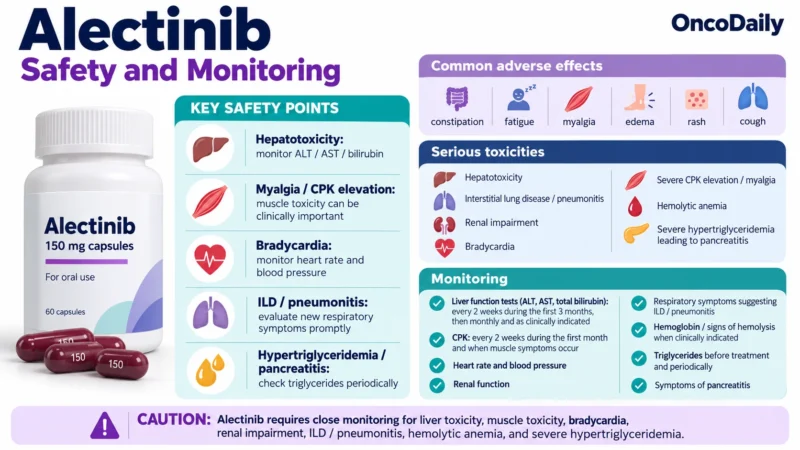
What Monitoring Is Required?
Monitoring during alectinib therapy should include:
- ALT
- AST
- Total bilirubin
- Liver function tests every 2 weeks during the first 3 months
- Monthly liver testing thereafter
- CPK every 2 weeks during the first month
- CPK when muscle symptoms occur
- Heart rate
- Blood pressure
- Renal function
- Respiratory symptoms suggesting ILD/pneumonitis
- Hemoglobin and evidence of hemolysis when clinically indicated
- Triglycerides before treatment and periodically
- Symptoms of pancreatitis
- Muscle pain, weakness, or tenderness
Concomitant medications that may contribute to bradycardia
Liver toxicity, muscle toxicity, renal impairment, bradycardia, and pulmonary symptoms are particularly important to identify early because they may require interruption or dose modification.
FAQ
What Is Alectinib Used For?
How Does Alectinib Work?
What Is the Standard Alectinib Dose?
Should Alectinib Be Taken With Food?
Alectinib should be taken: With food.
What Are the Dose Reductions?
How Long Is Adjuvant Alectinib Given?
or until disease recurrence or unacceptable toxicity.