





Afatinib (Gilotrif): Understanding Its Mechanism, Dosing, and Clinical Role in EGFR-Mutated Lung Cancer
Key takeaways
- Afatinib is an irreversible ErbB-family inhibitor targeting EGFR, HER2, and HER4.
- The usual dose is 40 mg orally once daily, taken at least 1 hour before or 2 hours after food.
- It is FDA-approved for metastatic NSCLC with non-resistant EGFR mutations and for metastatic squamous NSCLC after platinum chemotherapy.
- Its clinical importance in 2026 is particularly notable for uncommon activating EGFR mutations such as G719X, L861Q, and S768I.
- The pivotal LUX-Lung program demonstrated superior progression-free survival compared with chemotherapy and supported the drug's regulatory indications.
- The most important treatment-limiting toxicities are diarrhea and skin toxicity, while serious risks include ILD, hepatotoxicity, GI perforation, and keratitis.
Afatinib (Gilotrif) is an oral, second-generation ErbB-family tyrosine kinase inhibitor used in selected patients with non-small cell lung cancer (NSCLC). Unlike first-generation EGFR inhibitors such as gefitinib and erlotinib, afatinib forms an irreversible covalent bond with the kinase domains of EGFR, HER2, and HER4, producing sustained suppression of ErbB signaling.
In the United States, afatinib is approved for first-line treatment of metastatic NSCLC with non-resistant EGFR mutations detected by an FDA-approved test, as well as for metastatic squamous NSCLC progressing after platinum-based chemotherapy. The FDA approved the first generic versions of afatinib in July 2026.
Key Facts
- Generic name: Afatinib
- Brand name: Gilotrif
- Drug class: Irreversible ErbB-family tyrosine kinase inhibitor
- Route: Oral
- Initial US approval: 2013
- Standard starting dose: 40 mg orally once daily
- Severe renal impairment starting dose: 30 mg once daily
- Administration: At least 1 hour before or 2 hours after food
- Available strengths: 20 mg, 30 mg, and 40 mg
- Major targets: EGFR/ErbB1, HER2/ErbB2, and HER4/ErbB4
- Important EGFR mutations: Exon 19 deletion, L858R, G719X, L861Q, and S768I
- Major toxicities: Diarrhea, rash/acneiform dermatitis, stomatitis, paronychia, dry skin, and decreased appetite
- Important serious risks: Interstitial lung disease, severe skin reactions, hepatotoxicity, gastrointestinal perforation, and keratitis
- Important interactions: P-glycoprotein inhibitors and inducers.
What Is Afatinib?
Afatinib is a small-molecule pan-ErbB inhibitor.
The ErbB receptor family includes:
- EGFR/ErbB1
- HER2/ErbB2
- HER3/ErbB3
- HER4/ErbB4
Afatinib directly and irreversibly inhibits the kinase activity of EGFR, HER2, and HER4. HER3 does not have substantial intrinsic kinase activity, but signaling through HER3-containing heterodimers is indirectly suppressed when its ErbB partners are inhibited.
Certain activating EGFR mutations can cause persistent receptor signaling even without ligand stimulation, driving tumor-cell proliferation and survival. Afatinib was developed to produce broader and more durable ErbB pathway inhibition than reversible first-generation EGFR inhibitors.
What Is the Mechanism of Action of Afatinib?
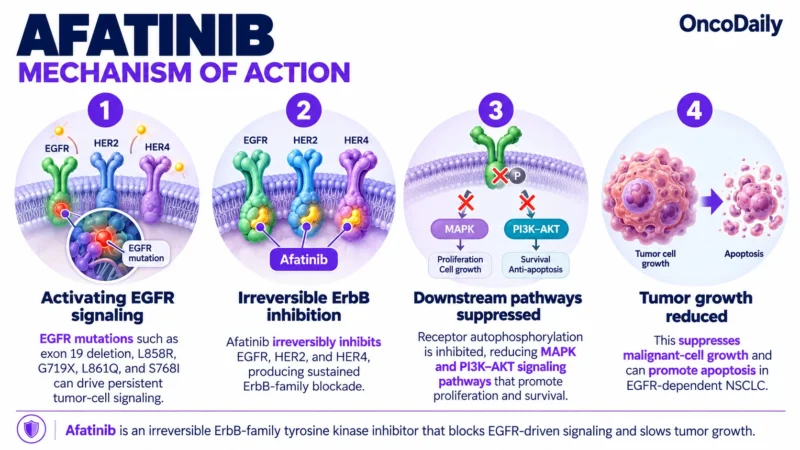
1. Activating EGFR Signaling
Mutations such as:
EGFR exon 19 deletion
and
EGFR exon 21 L858R
increase receptor activation and downstream signaling.
Other clinically relevant activating mutations include:
G719X, L861Q, and S768I.
2. Irreversible Binding to ErbB Receptors
Afatinib covalently binds to the intracellular kinase domains of:
EGFR, HER2, and HER4.
This distinguishes afatinib from gefitinib and erlotinib, which are reversible EGFR inhibitors.
3. Receptor Autophosphorylation Is Blocked
Afatinib prevents tyrosine kinase autophosphorylation and suppresses signaling from ErbB receptor homo- and heterodimers.
4. Downstream Signaling Falls
Inhibition of ErbB activity reduces proliferative and survival signaling through pathways including:
RAS–RAF–MAPK
and
PI3K–AKT.
5. Tumor Growth Is Suppressed
Reduced downstream signaling limits malignant-cell proliferation and survival and can promote apoptosis.
The mechanism can be summarized as:
Afatinib → irreversible EGFR/HER2/HER4 inhibition → reduced receptor phosphorylation → suppression of downstream signaling → reduced proliferation and survival → tumor-cell death.
What Is the Dose of Afatinib?
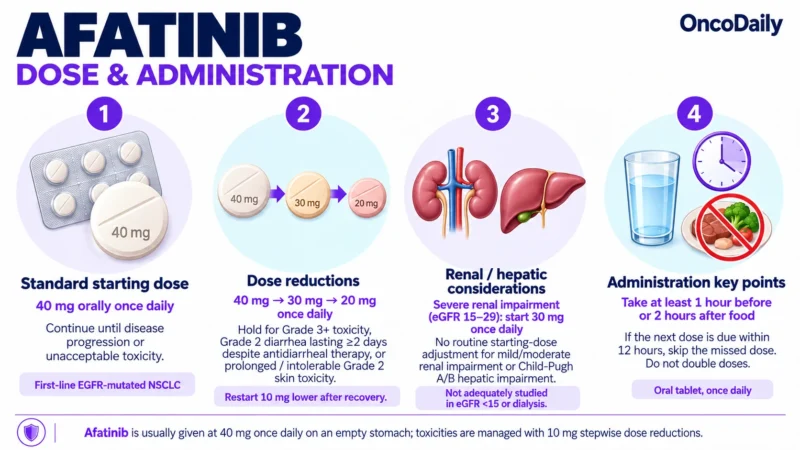
The standard recommended dose is:
40 mg orally once daily.
Treatment is continued until:
Disease progression or unacceptable toxicity.
Afatinib should be taken:
At least 1 hour before or 2 hours after a meal.
Food significantly decreases afatinib exposure, so consistent fasting administration is important.
What If a Dose Is Missed?
If the next scheduled dose is within:
12 hours
the missed dose should be skipped.
Two doses should not be taken at the same time.
How Are Afatinib Dose Reductions Made?
Afatinib uses a structured 10 mg dose-reduction strategy.
A common sequence is:
40 mg → 30 mg → 20 mg once daily.
Treatment should be withheld for clinically important toxicity, including:
- Grade 3 or higher adverse reactions
- Grade 2 diarrhea lasting at least 2 consecutive days despite antidiarrheal therapy
- Prolonged or intolerable Grade 2 skin toxicity.
When toxicity resolves to baseline or Grade 1, afatinib can generally be restarted at:
10 mg/day below the previous dose.
Treatment should be permanently discontinued if severe toxicity persists even at 20 mg/day, or for specific serious events such as confirmed ILD, gastrointestinal perforation, severe drug-induced hepatic impairment, persistent ulcerative keratitis, or life-threatening bullous skin disease.
Does Afatinib Require Renal Dose Adjustment?
Yes, in severe renal impairment.
For patients with:
eGFR 15–29 mL/min/1.73 m²
the recommended starting dose is:
30 mg orally once daily.
No initial dose adjustment is required for mild or moderate renal impairment:
eGFR 30–89 mL/min/1.73 m².
Afatinib has not been adequately studied in patients with:
eGFR <15 mL/min/1.73 m² or dialysis.
Does Afatinib Require Hepatic Dose Adjustment?
No routine starting-dose adjustment is required for:
- Child-Pugh A
- Child-Pugh B hepatic impairment.
Afatinib has not been adequately studied in Child-Pugh C hepatic impairment, and patients with severe hepatic dysfunction require close monitoring.
What Are the Important Drug Interactions With Afatinib?
Afatinib is strongly influenced by P-glycoprotein transport rather than extensive CYP metabolism.
P-glycoprotein Inhibitors
Drugs such as:
- Ritonavir
- Cyclosporine
- Ketoconazole
- Itraconazole
- Erythromycin
- Verapamil
- Quinidine
- Tacrolimus
- Amiodarone
may increase afatinib exposure.
If the combination is necessary and not tolerated, the afatinib dose can be reduced by:
10 mg/day.
P-glycoprotein Inducers
Agents such as:
- Rifampicin
- Carbamazepine
- Phenytoin
- Phenobarbital
- St John’s wort
may reduce afatinib exposure.
When chronic use cannot be avoided, the label permits increasing afatinib by:
10 mg/day as tolerated.
The previous dose should generally be resumed 2–3 days after the inducer is discontinued.
What Is the Pharmacokinetic Profile of Afatinib?
Absorption
Peak plasma concentrations occur approximately:
2–5 hours after dosing.
Steady-state exposure is reached within approximately:
8 days.
A high-fat meal decreases:
- Cmax by approximately 50%
- AUC by approximately 39%
which explains the fasting requirement.
Distribution
Afatinib is approximately:
95% plasma protein bound.
Metabolism
Enzymatic metabolism is relatively limited.
Unlike many TKIs, afatinib is not extensively metabolized through CYP3A4.
Half-Life
The terminal elimination half-life is approximately:
37 hours.
Elimination
Afatinib is eliminated predominantly through the gastrointestinal tract.
Approximately:
- 85% is recovered in feces
- 4% is recovered in urine.
What Are the Clinical Uses of Afatinib?
EGFR-Mutated Metastatic NSCLC
Afatinib is FDA-approved as first-line therapy for metastatic NSCLC with non-resistant EGFR mutations.
The strongest historical evidence includes:
- Exon 19 deletion
- Exon 21 L858R
Afatinib also has specific clinical evidence and FDA labeling supporting uncommon activating mutations such as:
- G719X
- L861Q
- S768I.
Uncommon EGFR Mutations
This remains one of the areas where afatinib is particularly relevant.
The 2026 ASCO living guideline states that for activating G719X, L861Q, or S768I mutations, afatinib may be offered as a treatment option. This recommendation does not apply to resistant alterations such as EGFR exon 20 insertions or T790M.
Metastatic Squamous NSCLC
Afatinib is also FDA-approved for patients with:
Metastatic squamous NSCLC progressing after platinum-based chemotherapy.
This indication came from LUX-Lung 8, although modern treatment sequencing in squamous NSCLC has changed considerably with immunotherapy and newer systemic options.
What Did Afatinib Clinical Trials Show?
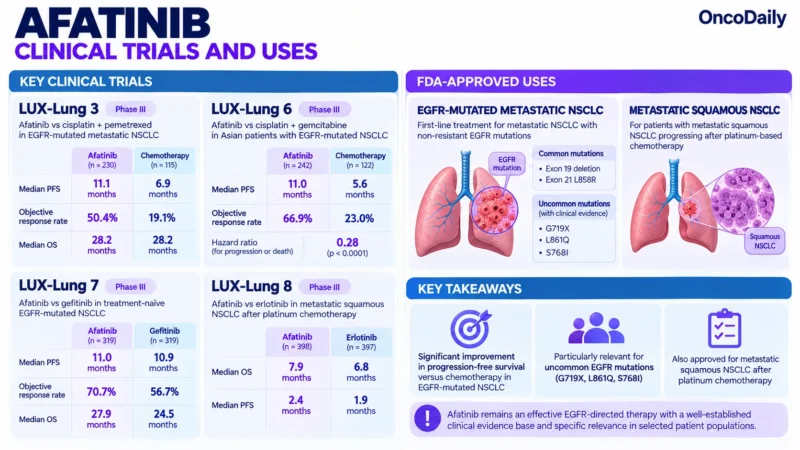
LUX-Lung 3: Afatinib Versus Cisplatin/Pemetrexed
LUX-Lung 3 was a pivotal phase III study in patients with EGFR-mutated metastatic lung adenocarcinoma.
Patients received:
Afatinib 40 mg daily
or:
Cisplatin + pemetrexed.
Median Progression-Free Survival
- Afatinib: 11.1 months
- Chemotherapy: 6.9 months
Objective Response Rate
- Afatinib: 50.4%
- Chemotherapy: 19.1%
Median response duration was:
Afatinib: 12.5 months
Chemotherapy: 6.7 months
Overall survival in the full study population was similar at 28.2 months in both groups, although later analyses demonstrated a substantial OS advantage in the exon 19 deletion subgroup.
LUX-Lung 6
LUX-Lung 6 evaluated afatinib versus cisplatin/gemcitabine in Asian patients with EGFR-mutated advanced NSCLC.
Median Progression-Free Survival
- Afatinib: 11.0 months
- Cisplatin/gemcitabine: 5.6 months
The hazard ratio for progression or death was:
0.28.
The study reinforced the superiority of biomarker-selected EGFR inhibition over conventional first-line chemotherapy for disease control.
Overall Survival in Exon 19 Deletion
A pooled survival analysis of LUX-Lung 3 and LUX-Lung 6 demonstrated an important difference according to EGFR mutation subtype.
For patients with exon 19 deletion:
LUX-Lung 3
- Afatinib: 33.3 months
- Chemotherapy: 21.1 months
LUX-Lung 6
- Afatinib: 31.4 months
- Chemotherapy: 18.4 months
This survival advantage was not similarly demonstrated in patients with L858R disease.
LUX-Lung 7: Afatinib Versus Gefitinib
LUX-Lung 7 directly compared afatinib with gefitinib in previously untreated EGFR-mutated advanced NSCLC.
Median Progression-Free Survival
- Afatinib: 11.0 months
- Gefitinib: 10.9 months
Afatinib significantly improved PFS, time to treatment failure, and objective response rate.
However, final overall survival was:
- Afatinib: 27.9 months
- Gefitinib: 24.5 months
and the difference was not statistically significant.
LUX-Lung 8: Squamous NSCLC
LUX-Lung 8 compared afatinib with erlotinib after platinum chemotherapy in metastatic squamous NSCLC.
The study enrolled:
795 patients.
Median Overall Survival
- Afatinib: 7.9 months
- Erlotinib: 6.8 months
Median Progression-Free Survival
Afatinib: 2.4 months
Erlotinib: 1.9 months
The trial established the regulatory indication for previously treated metastatic squamous NSCLC.
Watch more: Frontline Afatinib in EGFR-Mutant NSCLC — Lecia Sequist, MD, MPH, and Corey J. Langer, MD, discussing the phase III LUX-Lung 3 and LUX-Lung 6 trials and the role of afatinib in EGFR-mutated NSCLC.
Is Afatinib FDA Approved?
Yes.
Afatinib received its initial FDA approval in:
2013
for EGFR-mutated metastatic NSCLC.
The indication was expanded in:
2016 to metastatic squamous NSCLC after platinum chemotherapy.
In:
2018
the EGFR-mutated indication was broadened to include other non-resistant EGFR mutations, supported particularly by data for G719X, L861Q, and S768I.
On July 14, 2026, the FDA approved the first generic versions of afatinib tablets in the United States.
What Is the Current Clinical Role of Afatinib?
Afatinib remains an effective EGFR-directed therapy, although its role differs according to mutation subtype.
For the common exon 19 deletion and L858R mutations, the 2026 treatment landscape has moved toward newer strategies including osimertinib-based therapy and amivantamab plus lazertinib.
Afatinib remains particularly relevant in uncommon activating EGFR mutations, especially G719X, L861Q, and S768I, for which it has specific clinical evidence, FDA labeling, and continued support in the 2026 ASCO living guideline.
Its approved role in previously treated metastatic squamous NSCLC remains part of the US label, although modern treatment options have substantially changed since LUX-Lung 8 was conducted.
Afatinib remains particularly relevant in selected uncommon EGFR-mutated NSCLC, including G719X, L861Q, and S768I. Learn more about EGFR-mutant NSCLC and the evolving treatment landscape on OncoDaily.
What Are the Major Side Effects of Afatinib?
Diarrhea
Diarrhea is the most characteristic toxicity of afatinib.
In LUX-Lung 3:
- Any-grade diarrhea: 96%
- Grade 3 diarrhea: 15%
Severe diarrhea can cause:
- Dehydration
- Electrolyte abnormalities
- Renal impairment
- Rarely fatal complications.
Patients should have access to antidiarrheal therapy such as loperamide and begin treatment promptly when diarrhea develops.
Rash and Acneiform Dermatitis
Skin toxicity is also extremely common.
In LUX-Lung 3:
- Rash/acneiform dermatitis: 90%
- Grade 3 reactions: 16%
Skin toxicity may include:
- Acneiform rash
- Erythema
- Dry skin
- Pruritus
- Skin fissures
- Palmar-plantar erythrodysesthesia.
Severe or persistent reactions may require treatment interruption and dose reduction.
Stomatitis
Stomatitis and mucosal inflammation occurred in approximately:
71%
of afatinib-treated patients in LUX-Lung 3.
Symptoms may include oral pain, mucosal ulceration, and difficulty eating.
Paronychia
Inflammation around the nails is another characteristic EGFR-inhibition toxicity.
In LUX-Lung 3, paronychia occurred in approximately:
58% of patients.
Interstitial Lung Disease
ILD is uncommon but potentially fatal.
Across the afatinib clinical-trial program:
ILD or ILD-like reactions occurred in approximately 1.6% of patients, with fatal events reported in approximately 0.4%.
New or worsening:
- Dyspnea
- Cough
- Fever
- Pulmonary infiltrates
should prompt immediate evaluation.
Confirmed ILD requires permanent discontinuation.
Hepatotoxicity
Abnormal liver tests occurred in approximately:
9.7%
of patients across the clinical-development program.
Periodic liver-function testing is recommended, and severe drug-induced hepatic impairment requires discontinuation.
Gastrointestinal Perforation
GI perforation occurred in approximately:
0.2% of patients.
Risk may be greater in patients receiving:
- Corticosteroids
- NSAIDs
- Antiangiogenic therapy
or those with gastrointestinal ulceration, diverticular disease, bowel metastases, or advanced age.
Confirmed perforation requires permanent discontinuation.
Keratitis
Keratitis occurred in approximately:
0.7% of patients.
Symptoms requiring evaluation include:
- Eye pain
- Redness
- Photophobia
- Lacrimation
- Blurred vision.
Persistent ulcerative keratitis may require permanent discontinuation.
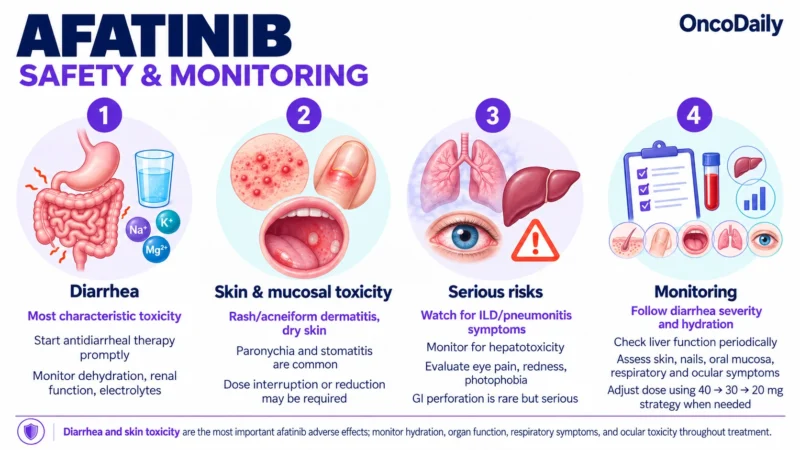
What Monitoring Is Required?
Monitoring during afatinib therapy should include:
- Diarrhea severity and hydration
- Renal function and electrolytes when diarrhea is significant
- Skin and nail toxicity
- Oral mucosa
- Respiratory symptoms suggestive of ILD
- Periodic liver-function tests
- Ocular symptoms
- Severe abdominal pain suggestive of GI perforation
- Concomitant P-glycoprotein inhibitors or inducers
- Cardiac symptoms when clinically indicated.
Dose modification should occur early when toxicity becomes clinically significant because afatinib exposure can often be individualized through the 40 → 30 → 20 mg reduction strategy.
FAQ
What Is Afatinib Used For?
How Does Afatinib Work?
What Is the Standard Dose of Afatinib?
Should Afatinib Be Taken With Food?
What Happens if Afatinib Causes Toxicity?
What Is the Lowest Usual Afatinib Dose?
Severe or intolerable toxicity at 20 mg generally requires permanent discontinuation.