Key takeaways
- Approval is only the first step. Real access also depends on reimbursement, biomarker testing, infrastructure, workforce, and delivery capacity.
- Access works like a chain. If authorization, coverage, identification, or capacity fails, the patient may still be unable to receive the treatment.
- The same cancer breakthrough can reach patients at very different speeds across Europe
- Success should be measured by when the first eligible patient is actually treated, not simply when a drug is approved or listed.
At the Community Oncology Global Congress (COGC 2026), Yüksel Ürün, medical oncologist at Ankara University in Türkiye, examined what has to happen after a cancer breakthrough is announced before it becomes part of routine care.
His presentation followed that journey through authorization, reimbursement, biomarker testing, infrastructure, supply chains, and national health-system decisions, showing how each step can determine whether an innovation actually reaches the patient.
He summed up the problem in one line:
“Scientific innovation that cannot reach patients remains unfinished innovation.”
When a Breakthrough Is Still Out of Reach
A recent example came from daraxonrasib in pancreatic cancer.
The ASCO presentation of daraxonrasib was one of those moments when the promise of a new treatment felt immediate. In pancreatic cancer, where RAS alterations are present in the vast majority of tumors and have historically been among the hardest targets to treat, the data marked a major shift. The standing ovation reflected that sense of breakthrough.
Within weeks of the presentation, patients were already asking about the treatment. The regulatory process also moved quickly, with FDA approval following less than two months after the data were presented.
But the enthusiasm in the room and the reality for patients are two different things. The science can move fast; access rarely does.
“Approval makes treatment possible, access makes it real.”
Some patients may be able to enter early-access or expanded-access programs. Others may live in health systems where the required molecular testing is not routinely available, meaning clinicians cannot even identify which patients are eligible. Even when testing is available, reimbursement may take much longer than regulatory approval, and local hospitals still need the infrastructure and resources to provide the treatment.
So the same breakthrough can arrive very differently depending on the health system. And that is where the real work begins: making sure the pathway from approval to treatment does not break along the way.
Access Depends on an Unbroken Chain
That pathway can be thought of as a chain, with several links that have to hold at the same time.
“For access, we need an unbroken chain. We need at least four things to happen together: authorization, coverage, identification, and capacity. When one of these links breaks, the patient will not be able to get access to that treatment.”
The first link is authorization: the treatment has to be approved as safe and effective.
Then comes coverage. Approval has little practical value if the treatment is too expensive for patients to pay for themselves and the health system does not reimburse it.
The third link is identification. Precision oncology depends on knowing which patient is actually eligible, so biomarker and genomic testing have to be available and affordable enough to use in routine practice.
Finally, there is capacity. A hospital may have an approved and reimbursed treatment but still lack the trained staff, infrastructure, or specialist services needed to deliver it safely.
CAR T-cell therapy is a clear example. An approved and funded therapy still cannot reach patients if the center does not have the infrastructure and expertise required to provide it. So if one link in that chain breaks, access breaks with it.
Why the Chain Breaks Differently Across Europe
Those links are not equally strong across Europe.
The time between regulatory approval and routine patient access varies widely. In some countries, reimbursement can follow within months. In others, patients may wait two or three years.
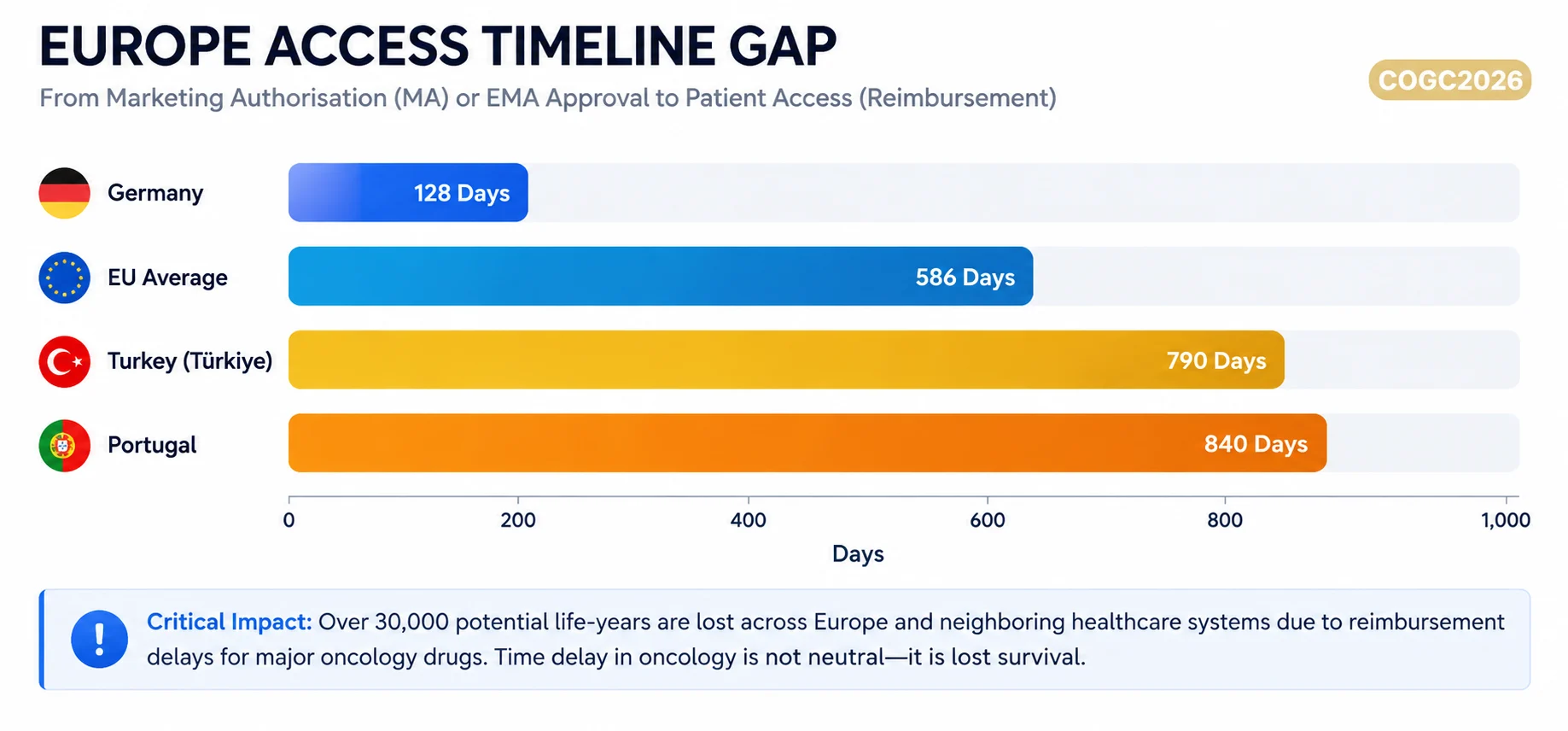
Germany may move comparatively quickly, while patients in Türkiye, parts of Eastern Europe, Portugal, and other health systems can face much longer delays.
A European approval therefore does not create the same reality for every patient.
Part of the difference comes down to money. Each country has its own budget, reimbursement rules, and thresholds for deciding whether a treatment offers enough value to justify its cost. A therapy that one health system is prepared to fund may be considered unaffordable in another.
The evidence behind the treatment can make those decisions harder. Some approvals are based on single-arm studies, surrogate endpoints, or relatively small patient populations, while standards of care may be changing at the same time.
European initiatives are trying to make part of the process more consistent by harmonizing clinical assessment. A shared assessment can reduce duplication and allow countries to work from the same scientific evidence. But the decisions that determine whether a patient actually receives the treatment remain national.
Each health system still has to decide whether the therapy will be funded, what impact it will have on the budget, and whether the diagnostic and clinical infrastructure is ready to support it.
That is why access cannot be planned only after a drug is approved. The treatment, biomarker testing, reimbursement, workforce, infrastructure, and delivery pathway all have to be considered together.
Europe may share the science, but patients can still wait very different lengths of time for the same treatment depending on where they live and how prepared their health system is to deliver it.
When Infrastructure Becomes Part of the Treatment
Prostate cancer shows what this looks like in practice.
Radioligand therapies such as lutetium-based treatments require much more than access to the drug itself.
Patients first need appropriate imaging, including PSMA PET/CT, and in some cases additional imaging to determine whether they are suitable candidates. The radiopharmaceuticals themselves have short half-lives, so the supply chain has to be tightly coordinated.
Treatment also depends on close collaboration between urology, nuclear medicine, and medical oncology.
In this setting, diagnostics, logistics, and multidisciplinary expertise are not separate from access to the treatment. They are part of what makes the treatment possible in the first place.
The same principle applies across oncology. A new therapy may be approved and reimbursed, but if the system around it is not ready, the patient still cannot receive it.
Beyond Approval: Did the Patient Actually Get Treated?
That leads to a different way of measuring progress.
Listing a drug as approved or reimbursed does not necessarily tell us whether patients are actually receiving it. A more meaningful measure is the time between approval and the first eligible patient treated in routine practice.
That shifts the focus away from what exists on paper and toward what happens in real cancer care.
Other measures matter too: time to reimbursement, how quickly the health system responds after approval, whether the necessary diagnostics are available, and how soon community centers can begin treating eligible patients.
And the work continues after access begins. Real-world data can show whether different populations experience different responses, toxicities, or practical barriers once a treatment moves beyond clinical trials.
“Approval is the possibility, but real impact will be by access to those treatments.”
Written by Eliz Baloyan, MD, Features Writer and Editor at OncoDaily and CancerWorld
Watch the full video on YouTube.