
Key takeaways
- AI could transform how cancer patients are identified for clinical trials, shifting from time-consuming manual screening to proactive identification of potential opportunities.
- Many patients miss clinical trial opportunities before they can even consider participation, highlighting the importance of improving patient identification, particularly for advanced therapies such as CAR T-cell therapy.
- Combining AI with the mCODE framework makes oncology data more accessible and interoperable, allowing fragmented medical records to become structured information that can support multiple clinical applications.
- AI-assisted clinical data extraction demonstrated promising accuracy, achieving strong agreement with expert chart reviews in identifying key patient characteristics relevant to trial eligibility.
- Physician oversight remains essential, with AI identifying potential trial candidates while clinicians retain responsibility for interpreting eligibility and making clinical decisions.
At LeukO 2026: Global Virtual Congress on Leukemias, organized by OncoDaily, Yan Leyfman, Medical Correspondent at OncLive, Freelance, Co-Founder and Executive Director of MedNews Week, explored how artificial intelligence (AI), oncology data standardization, and the Minimal Common Oncology Data Elements (mCODE) framework could transform clinical trial matching, particularly for patients being considered for CAR T-cell therapy and other advanced cellular treatments.
As CAR T-cell therapies, bispecific antibodies, and other innovative treatments continue to expand, identifying eligible patients for clinical trials has become increasingly complex. The problem is not always a lack of available trials or patients willing to participate. Sometimes, the right opportunity is simply never identified.
Leyfman presented research examining whether AI could help address this challenge by extracting clinically relevant information from electronic health records (EHRs), organizing it into standardized oncology data, and identifying potential trial candidates for physician review.
The larger question was whether this approach could make clinical trial opportunities more accessible, regardless of where a patient receives care.
The Clinical Trials Patients Never Get to Consider
Clinical trials are essential to advancing cancer treatment, particularly in rapidly evolving fields such as cellular immunotherapy. Yet participation remains limited.
Leyfman cited estimates suggesting that only about 7% of adults with cancer in the United States enroll in clinical trials, despite the increasing number of experimental therapies and research opportunities.
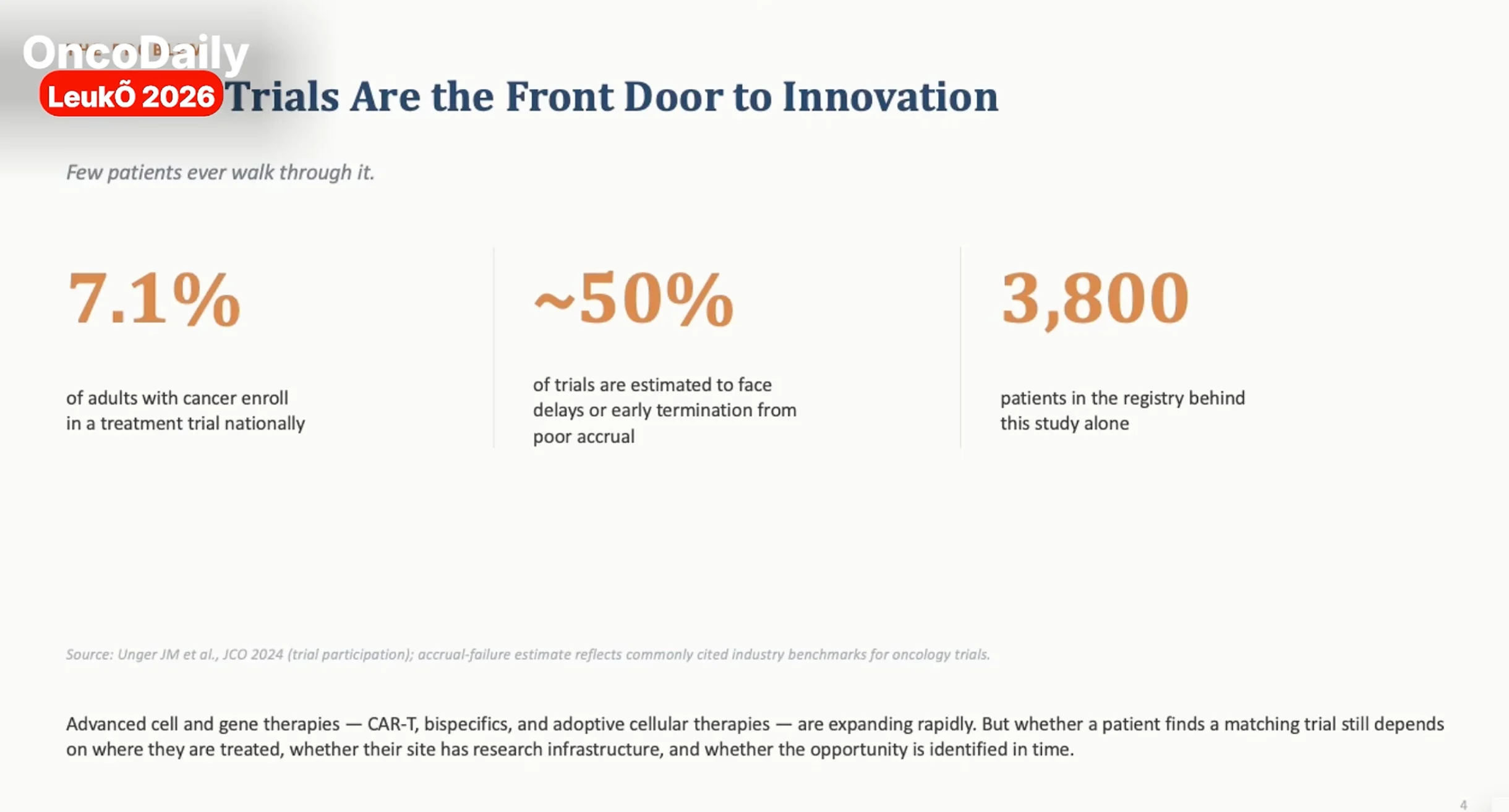
A major part of the problem occurs before patients can even consider enrollment.
“Many patients never even reach that point where they can make that decision because the right opportunity is never truly identified.”
Finding an appropriate trial often depends on whether a patient receives care at an institution with dedicated research infrastructure, whether someone recognizes a potential opportunity, and whether the necessary clinical information is available at the right moment.
For patients being considered for CAR T-cell therapy, these limitations are particularly consequential.
Eligibility may depend on numerous factors, including prior lines of treatment, performance status, organ function, central nervous system involvement, previous transplantation, molecular characteristics, and the timing of treatment or referral.
A patient who might qualify for a cellular therapy trial today may no longer meet its criteria after further disease progression or changes in clinical condition.
Yet traditional trial screening is largely manual.
Research coordinators and clinicians must review extensive medical records, identify relevant details, and compare them against complex eligibility criteria. According to Leyfman, a detailed review can require approximately 30 to 60 minutes per patient.
And the work rarely ends there.
Whenever a new trial opens or a patient’s disease changes, the screening process may need to be repeated.
For well-resourced academic centers, this process can be supported by dedicated research teams. In smaller institutions, the same level of screening may be difficult to sustain.
The result is a disparity in how patients are identified for research opportunities, even when their clinical characteristics might make them equally suitable candidates.
For Leyfman, improving trial matching therefore begins with addressing the infrastructure behind patient identification.
The Information Exists. The Challenge Is Finding It.
Modern oncology generates enormous amounts of clinical information, but much of it is not organized in a format that computers can easily interpret.
A patient’s medical history may be distributed across physician notes, pathology reports, radiology findings, genomic testing results, laboratory data, and treatment records.
While individual pieces of information may be available, understanding the complete clinical picture requires bringing them together.
For example, determining eligibility for a CAR T-cell trial may require identifying not only a patient’s diagnosis but also the exact treatments previously received, the number of prior treatment lines, evidence of relapse, organ function, and relevant molecular findings.
Some of these details are recorded in structured fields. Others appear only in narrative clinical documentation.
Leyfman described how this fragmentation creates a major obstacle to automated trial screening.
The challenge is not necessarily collecting more information. It is transforming information that already exists into a structured, clinically useful patient profile.
To investigate this, his research examined an oncology-specific AI pipeline based on GPT-4o, designed to extract information from structured and unstructured electronic medical records.
The system processes clinical documentation and identifies variables relevant to trial eligibility, including disease characteristics, treatment history, functional status, laboratory findings, and molecular markers.
But extracting the information is only the first step.
Without a common structure, an AI system might produce useful outputs for one institution while creating an entirely different format for another.
That would limit the ability to share data, compare patients across institutions, or apply the same information to multiple research workflows.
As Leyfman explained:
“If every system extracts information differently, then we just created another silo.”
This is where mCODE becomes particularly important.
Why mCODE Could Change How Oncology Data Are Used
The Minimal Common Oncology Data Elements (mCODE) framework provides a standardized approach to representing essential clinical information in oncology.
Built on the HL7 Fast Healthcare Interoperability Resources (FHIR) standard, mCODE is intended to support consistent organization and exchange of cancer-related data across different healthcare systems.
Leyfman’s research used mCODE 3.0 to normalize information extracted from patient records.
The AI pipeline identifies clinically relevant details and maps them into standardized categories, including cancer disease status, tumor characteristics, and genomic profiles.
The result is a structured representation of a patient’s cancer history that can potentially be used across different clinical and research applications.
For example, a patient’s diagnosis, previous treatments, molecular findings, and current disease status could be extracted from the medical record and organized into a standardized profile.
That profile could then be compared with eligibility criteria from active clinical trials.
When a potentially relevant match is identified, the system can flag the opportunity for review by the treating team.
Importantly, the system is designed to identify potential candidates, not independently determine whether patients are eligible for enrollment.
“The goal is not for AI to decide clinical eligibility.”
The physician remains responsible for reviewing the information, interpreting the clinical context, and determining whether further evaluation or referral is appropriate.
The value of mCODE also extends beyond clinical trial matching.
Once patient information has been standardized, the same data could support biomarker-based screening, referral coordination, outcomes tracking, real-world evidence generation, and quality reporting.
Rather than reconstructing a patient’s medical history each time a new clinical question arises, healthcare systems could potentially reuse the same structured information.
“Structuring the data once creates value repeatedly.”
This distinction is central to the proposed approach.
The goal is not simply to develop an AI tool that reads medical records faster. It is to establish a common data foundation that can support multiple aspects of cancer care.
How Accurately Can AI Interpret a Cancer Patient’s History?
The potential benefits of automated screening depend on whether the extracted information is reliable enough to support clinical review.
To evaluate performance, Leyfman and colleagues compared AI-generated, mCODE-aligned patient profiles against independent expert chart reviews.
The evaluation examined how accurately the system captured clinical variables relevant to oncology trial eligibility, as well as the completeness and interoperability of the resulting data.
Performance was particularly strong in several foundational domains.
Tumor type was identified with 98% accuracy, while the extent of disease reached 90% accuracy. Tumor staging showed 86% concordance with expert assessment, and demographic information demonstrated essentially complete agreement.
These findings are important because diagnosis, disease extent, and stage frequently serve as the initial filters in determining whether a patient might qualify for a study.
Across the evaluated clinical variables, Leyfman reported an overall F1 score of 0.82, with recall of 0.84 and specificity of 0.83.
The F1 score balances precision and recall, providing a measure of how well the system identifies relevant information while limiting incorrect classifications.
However, performance was not equally strong across every category.
Determining relapse status and resectability proved more challenging, partly because these variables often require interpreting multiple clinical notes over time.
Complex genomic reports also presented difficulties, particularly when multiple alterations were documented within the same molecular panel.
For CAR T-cell and other cellular therapy trials, these limitations are significant because a patient’s complete treatment history and disease status can determine whether an otherwise promising trial is appropriate.
The results therefore demonstrated both the potential of AI-assisted chart abstraction and the need for continued improvement in more complex clinical domains.
Leyfman did not present the findings as evidence that AI can independently establish trial eligibility.
Instead, they suggested that a substantial portion of the information traditionally collected through manual review could be extracted and organized automatically, allowing clinicians to concentrate on interpretation and decision-making.
From Hours of Screening to Continuous Patient Identification
Beyond accuracy, one of the most important findings concerned the potential effect on clinical workflows.
Manual trial screening requires substantial time and personnel, particularly when patient records extend across multiple years of treatment.
In the evaluation discussed by Leyfman, the AI-assisted approach produced an approximately fourfold reduction in manual abstraction time.
That efficiency could have implications for institutions where research teams must review large numbers of patients or repeatedly reassess eligibility as new studies become available.
But the more significant possibility is changing when screening takes place.
Under the traditional approach, a patient may be evaluated for research opportunities only when a clinician or coordinator initiates a search.
Leyfman described a different model in which trial screening could become a continuous process.
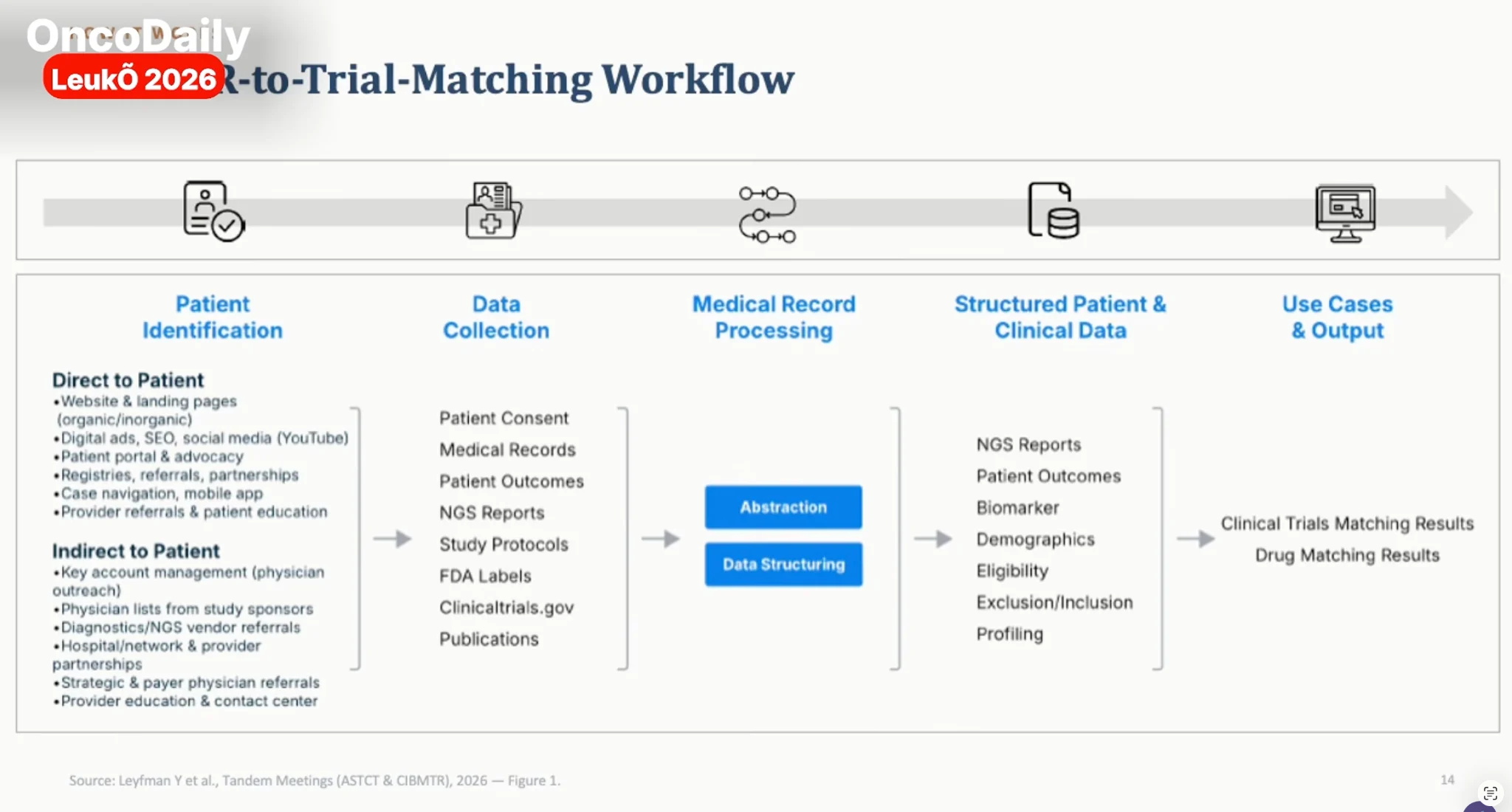
As new information enters the electronic health record, an AI-assisted system could update the patient’s structured profile and identify potentially relevant opportunities.
If a new CAR T-cell study opens, or if a patient’s disease status changes, the system could flag a possible match without requiring someone to reconstruct the entire medical history.
The alert would then prompt clinical review.
This approach could be especially valuable in diseases where treatment eligibility changes rapidly, because delays in recognizing an opportunity may affect whether a patient can be referred or enrolled.
However, faster information extraction does not automatically translate into higher trial enrollment. Whether these systems improve referrals, screening completion, and actual participation will require prospective evaluation.
The intended model also keeps clinicians at the center.
“Ultimately, the safest implementation is a human-in-the-loop model, where AI extends our ability to see opportunities, but clinicians remain at the center.”
In this framework, AI helps identify and organize relevant information, while clinicians verify potential matches, consider patient-specific factors, and discuss available options with the patient.
The objective is to reduce the burden of searching without removing the judgment required to make safe clinical decisions.
The Next Challenge Is Trust, Not Just Technology
Although the validation findings were encouraging, Leyfman acknowledged that reliable implementation requires further research.
AI performance depends heavily on the quality of the underlying medical records.
Incomplete documentation, inconsistent terminology, conflicting reports, and missing clinical details can all affect the accuracy of extracted information.
Some variables, particularly relapse status, surgical decisions, and complex molecular findings, may require interpretation that extends beyond identifying information within a single document.
The research was also based on retrospective validation, making prospective testing across different institutions and electronic health record systems an important next step.
A system that performs well on one dataset may encounter different challenges when applied to hospitals with other documentation practices, patient populations, and technical infrastructure.
Leyfman outlined several priorities for continued development, including improved extraction of complex clinical variables, integration of additional data types, and prospective evaluation in real clinical workflows.
Clinical governance will be equally important.
Healthcare institutions need clear procedures for validating AI outputs, monitoring performance, protecting patient information, and defining responsibility when recommendations are incorrect or incomplete.
Even expert chart review, the reference standard used in the evaluation, can involve differences in clinical interpretation.
The objective is therefore not to eliminate uncertainty entirely, but to develop systems that make relevant information easier to access while remaining transparent about their limitations.
For Leyfman, the future of clinical AI depends less on generating increasingly sophisticated outputs than on creating tools that clinicians can safely incorporate into everyday practice.
A Future Where Trial Opportunities Find the Patient
The longer-term vision extends beyond using AI to assist with individual screening decisions.
Leyfman described a healthcare environment in which clinical information could be continuously organized within the electronic health record, allowing potential research opportunities to be identified as a patient’s condition evolves.
When an oncologist documents a new diagnosis, treatment response, molecular result, or relapse, the relevant information could update the patient’s standardized profile.
As trials open or eligibility criteria become relevant, the system could bring potential matches to the attention of the clinical team.
This would not remove the need for specialist assessment, trial-specific screening, or patient consent.
It would instead create a more systematic way to recognize opportunities that might otherwise go unnoticed.
The implications could be particularly meaningful for patients receiving care outside major academic centers, where the availability of dedicated trial-screening teams may be limited.
But achieving that goal will require more than technical accuracy. Interoperability, clinical validation, data governance, and integration into existing workflows will determine whether AI-assisted matching can function effectively across different healthcare environments.
At LeukO 2026, Leyfman’s presentation offered an important perspective on the relationship between medical innovation and access.
As cellular therapies become more sophisticated, identifying the patients who could benefit from relevant clinical trials is becoming an increasingly demanding task.
AI and standardized oncology data offer a way to make that process more systematic, potentially allowing clinicians to identify opportunities earlier and devote more time to evaluating their clinical relevance.
“The goal is not for AI to replace oncologists.”
The greater ambition is to ensure that clinicians have the information they need when treatment and research decisions must be made.
Because developing innovative cancer therapies is only part of advancing oncology. The next challenge is ensuring that patients who may benefit from those advances are actually identified in time to consider them.
Written by Eliz Baloyan, MD, Features Writer and Editor at OncoDaily and CancerWorld