Key takeaways
- Approval does not guarantee access. New cancer therapies still have to move through pricing, reimbursement, local stocking, and service capacity before they reach patients.
- District hospitals deliver much of day-to-day cancer care, but access to molecular profiling, clinical trials, and specialized expertise can still be more limited than at major cancer centers.
- Precision oncology is still unevenly distributed, with advanced testing more concentrated in specialist centers.
- Technology cannot remove all of the barriers, but it can help narrow some of them by bringing more information and decision-making capacity into district and community hospitals.
- The wider goal is to reduce postcode privilege, so that where a patient lives has less influence on the cancer care and innovation they can access.
At the Community Oncology Global Congress (COGC 2026), organized by OncoDaily, Sola Adeleke, clinical oncologist and Academic Clinical Fellow at King’s College London, focused on the gap between approving a new cancer treatment and making sure patients can actually access it.
His presentation, “Access Beyond Approval: Community Oncology in Western Europe – Advancing Quality, Innovation and Integrated Care,” looked at how reimbursement, local infrastructure, molecular testing, workforce capacity, and geography can shape what happens after a therapy receives regulatory approval.
A cancer drug can be approved in Europe and still take years to reach a patient in a district hospital. Adeleke’s talk focused on everything that happens in that gap – from pricing and reimbursement to staffing, molecular testing, local infrastructure, and the postcode privilege that can still shape who gets access to innovation.
Cancer Care Happens Where Policy Is Not Written
Across Western Europe, much of cancer care happens outside major comprehensive cancer centers. Patients may receive their first diagnosis, imaging, systemic treatment, toxicity management, or hospital admission in district and community hospitals.
Yet many of the decisions that shape access to care are made elsewhere.
A patient treated in a comprehensive cancer center may have access to broad molecular profiling, clinical trials, and highly specialized multidisciplinary teams. Another patient, treated in a district hospital, may have access to standard pathology, more limited molecular panels, and a more generalist MDT, with additional delays if referral to a specialist center is needed.
That difference creates an important gap between what exists within a health system and what an individual patient can actually reach.
From Drug Approval to Real Patient Access
Regulatory approval is only the beginning of the pathway.
Once a new therapy or indication receives approval from the European Medicines Agency, it still has to move through national pricing and health technology assessment processes within individual countries.
The presentation highlighted an average of around 655 days between approval and pricing and assessment at the national level. Even after that, reimbursement may remain limited or come with restrictions.
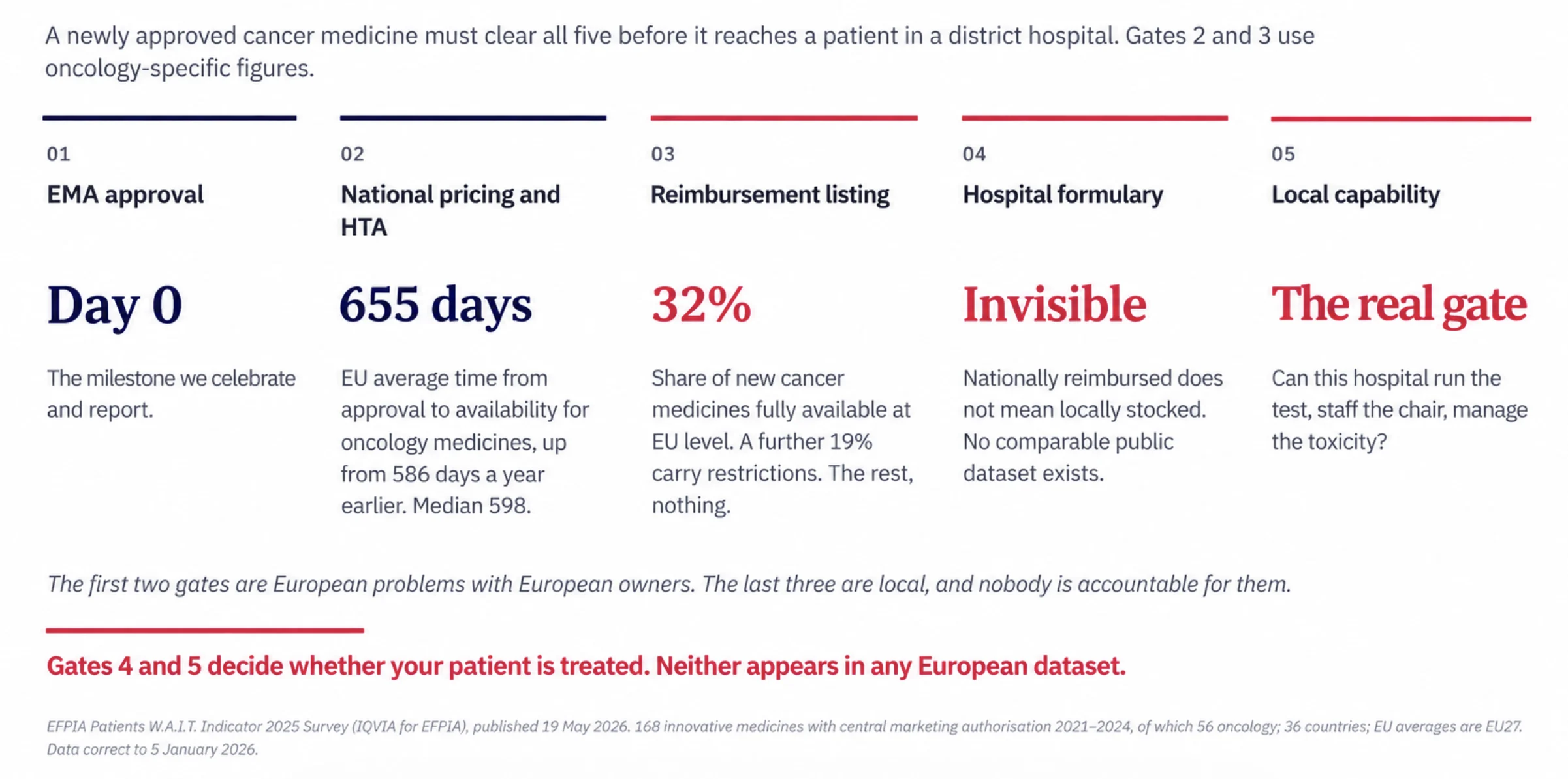
Then comes another practical step: the treatment has to reach the local hospital. Pharmacies need to stock it, services need the staff to deliver it, and clinicians need the capacity to manage patients receiving it.
By the time all of those steps are completed, the distance between regulatory approval and routine access in a district hospital can become substantial.
One attempt to reduce some of that duplication is the EU Joint Clinical Assessment. Introduced under the new European framework in January 2025, it allows the clinical assessment of new technologies to take place jointly at the European level rather than being repeated independently in every country.
“An example of this is tovorafenib, which is a pediatric low-grade glioma drug. It was endorsed on the 30th of April, published on the 19th of June that same year, and by the end of June a joint assessment had already been initiated. So this is really a triumph for making medications more accessible for European patients across the continent.”
The change can make the clinical evaluation of new therapies more coordinated, but it does not remove every barrier. Individual countries still have to consider economic value, pricing, and reimbursement. So a joint clinical assessment may speed up one part of the process without guaranteeing that the treatment becomes equally available everywhere.
More Patients, Wider Gaps in Precision Oncology
At the same time, demand for cancer care continues to grow.
The presentation projected a 21% increase in new cancer cases and a 32% increase in cancer deaths by 2040. Much of that increase reflects population ageing, but the additional demand will still fall on the same hospitals, oncology teams, diagnostic services, and treatment infrastructure.
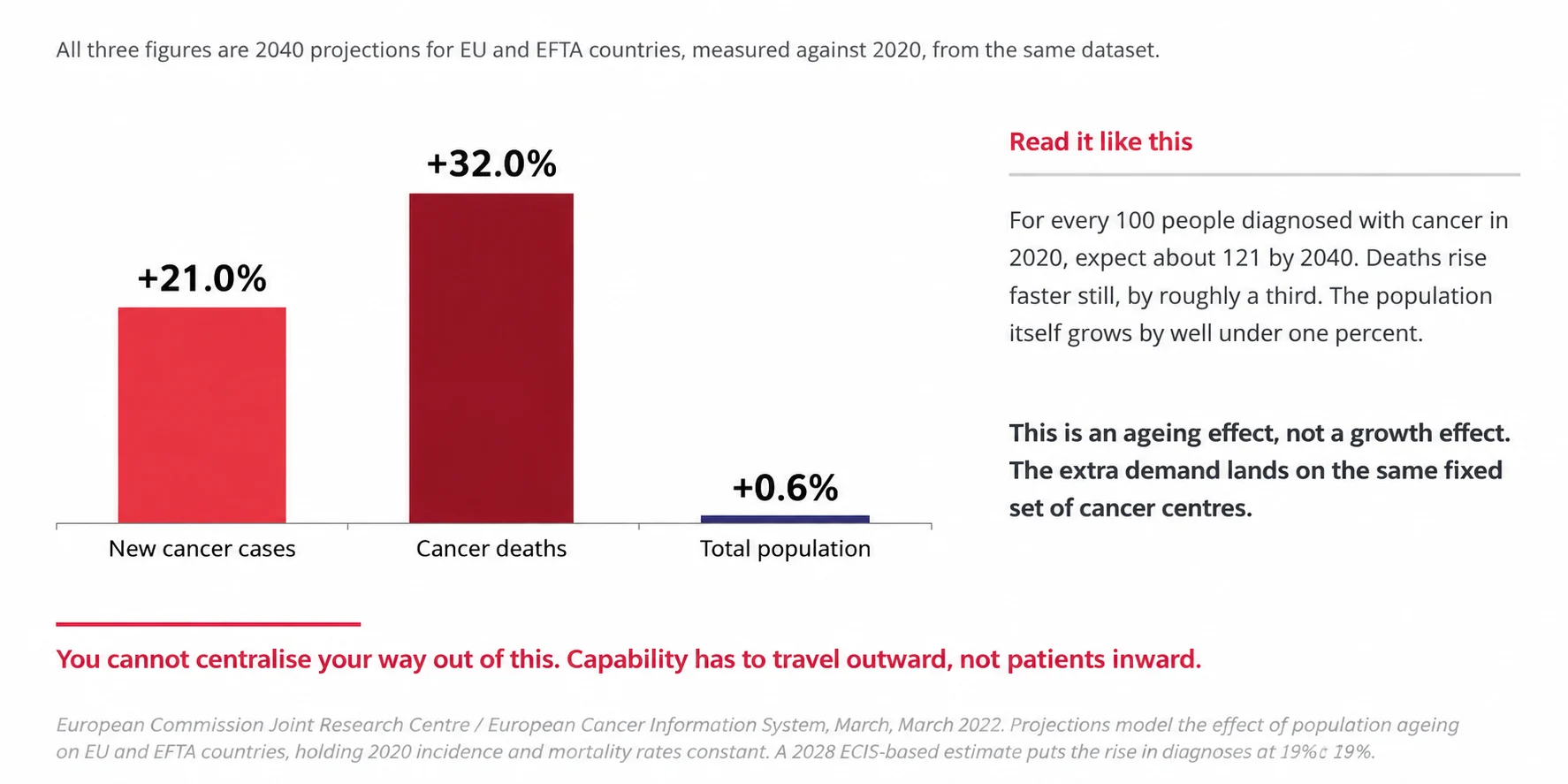
Comprehensive cancer centers are becoming busier, and so are the district hospitals where large numbers of patients receive day-to-day cancer care.
That pressure becomes especially visible in precision oncology.
Established tests such as immunohistochemistry, PCR, FISH, and MSI testing may be widely available. More advanced approaches – including multigene sequencing, whole-genome sequencing, RNA sequencing, and liquid biopsy – may be much harder to access outside specialist centers.
This creates a difficult situation: many patients are being treated in district hospitals, while some of the testing that could help refine treatment decisions remains concentrated elsewhere. And the challenge is getting these tools into the hospitals where patients are actually being treated, rather than keeping them concentrated in a small number of specialist centers.
Bringing Precision Oncology Closer to the Patient
One example presented was Cure-IO, a software-based decision-support platform designed to help predict response and toxicity from immunotherapy.
Rather than depending entirely on new tissue samples or additional specialist equipment, the system can work with information that is already being generated during routine care, including imaging, pathology, clinical laboratory records, and genomic data when available.
The aim is to estimate which patients may be more likely to benefit from immunotherapy, which may have primary resistance, and which may require closer monitoring for toxicity.
For a district hospital, the practical advantage is that no new machine is required, no new sample necessarily has to be collected, and data does not always need to be sent away to another center. The model can run locally within the hospital and feed information into the multidisciplinary discussion.
Just as importantly, the tool is meant to support the clinician, not replace the clinician.
Its output can add another layer of information to the treatment discussion, but the final decision remains with the treating team. It should not authorize treatment, deny funding, or become another barrier between the patient and care.
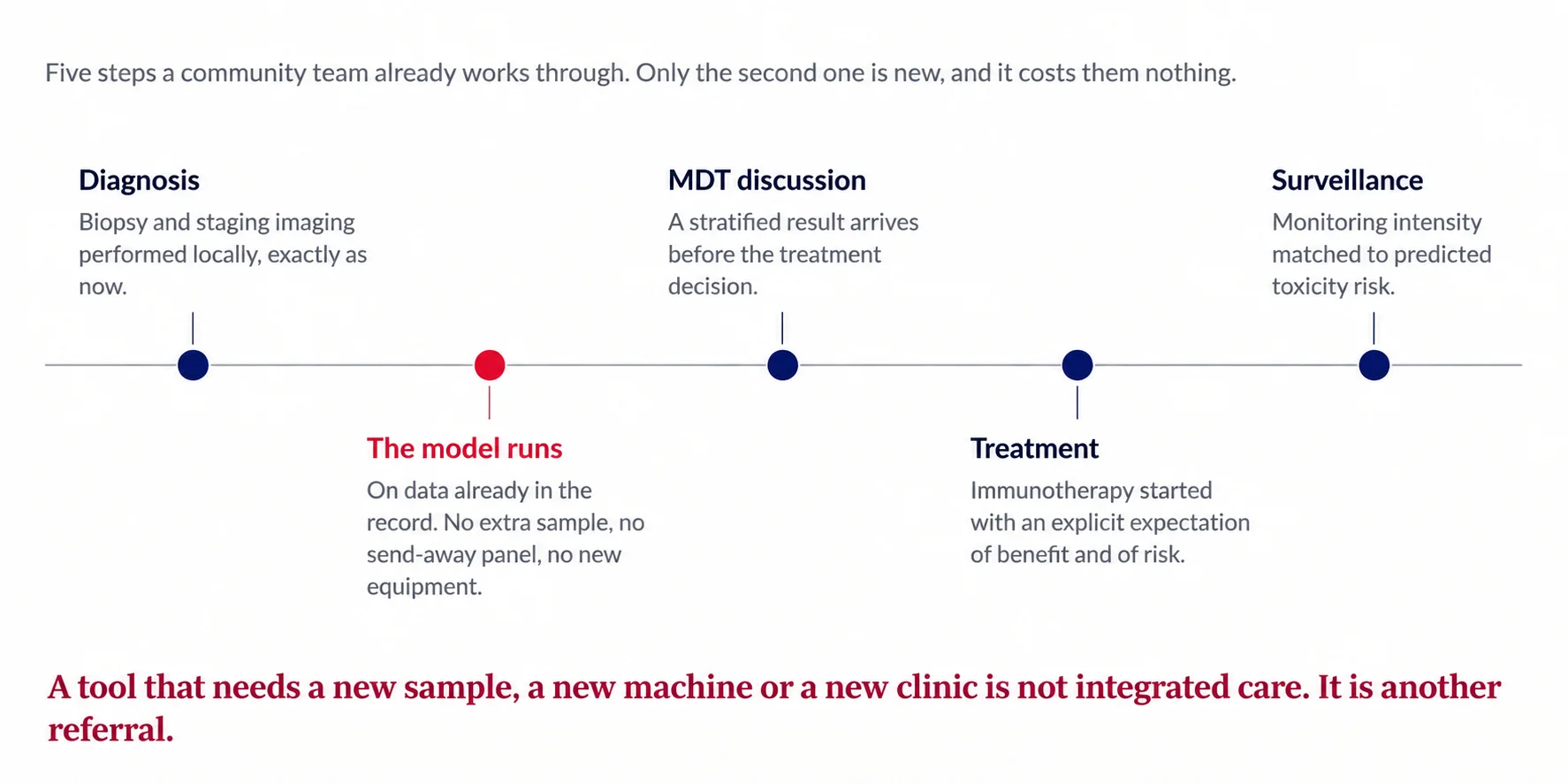
The broader point is that community oncology should not always have to look toward major urban centers for every advanced decision. Some diagnostic and decision-support capabilities can be brought closer to the hospitals where patients are already being treated.
That can shorten turnaround times, strengthen MDT discussions, and make it easier to identify patients for new treatments or clinical trials.
Moving Beyond Postcode Privilege
Across Europe, approval alone does not guarantee access.
The path from regulatory authorization to the patient still passes through pricing, reimbursement, local infrastructure, workforce capacity, diagnostics, and geography.
Technology cannot remove all of those barriers, but it can help narrow some of them by bringing more information and decision-making capacity into district and community hospitals.
For patients, that means reducing the extent to which the care they receive depends on where they happen to live.
The goal is to move away from postcode privilege and toward a system where innovation is not only approved, but actually reaches the patients it was meant to help.
Written by Eliz Baloyan, MD, Features Writer and Editor at OncoDaily and CancerWorld