Key takeaways
- Rural patients need more cancer services close to home, especially when travel and workforce shortages make referral difficult.
- New programs should start with unmet needs and strong relationships. At Self Regional, this approach led to high-risk breast, cardio-oncology, exercise oncology, and supportive-care services.
- Community outreach and health literacy are part of cancer care, not extras. Patients need understandable information, screening, and support where they live.
- The goal is to reduce the impact of geography on access.
At the Community Oncology Global Congress (COGC 2026), organized by OncoDaily, Ruiling Yuan, Hematologist/Oncologist and Dyad Director of Cancer Services at Self Regional Healthcare in South Carolina, shared the experience of building a more comprehensive cancer-care system in rural settings, where geography, workforce shortages, transportation, financial pressure, and limited access to specialized services can all shape a patient’s cancer journey.
In a cancer center serving roughly 300,000 people across seven counties, where reaching an academic center can mean hours of travel and oncology workforce shortages are expected to deepen, the challenge is not simply delivering treatment with limited resources. It is building enough care around that treatment so patients can access more of what they need close to home.
The process starts with something deceptively simple:
“Everything begins with relationships.”
Rural Oncology Beyond Treatment
A patient entering a cancer center brings much more than a diagnosis. There may be questions about hereditary risk, cardiovascular health, transportation, finances, caregiver burden, treatment symptoms, sleep, survivorship, and, in advanced disease, goals of care and end-of-life needs.
That became the starting point for developing local programs:
- Identify which needs repeatedly appear in the clinic,
- Determine what can realistically be addressed locally,
- Build relationships with the people and organizations capable of filling the remaining gaps.
Over several years, that approach led to the creation of a high-risk breast clinic in 2019, a cardio-oncology service in 2020, and an exercise oncology program in 2023. Work has also expanded toward sleep oncology, while genetics, palliative care, hospice, and survivorship remain part of the wider care model.
These programs did not begin with abundant staffing or newly built infrastructure. They grew by using the expertise already present in the health system, educating leadership about unmet needs, and bringing in outside partners when local capacity was insufficient.
Making Specialized Care Local
The high-risk breast clinic grew from the need for better cancer risk assessment, prevention, and early detection.
Patients with a strong family history of cancer often need more than routine screening. The program therefore incorporated risk assessment, education, genetic evaluation, personalized screening, and information about measures patients could take to reduce their risk.
Limited access to genetic counseling could easily have become a reason to send patients elsewhere. Instead, the cancer center partnered with the Greenwood Genetic Center, bringing its expertise into local care and involving genetic specialists in tumor board discussions so that hereditary risk could be assessed more efficiently.
Cardio-oncology developed from another recurring problem. Patients may enter treatment with cardiovascular disease, while some cancer therapies can create cardiovascular complications during treatment or even years afterward.
Dedicated cardio-oncology services are often located at larger academic institutions, creating another access problem for rural patients. The local team therefore worked with hospital leadership and cardiology to establish a service that could identify cardiovascular risks and support patients throughout treatment without routinely requiring long-distance travel.
Exercise oncology followed a different path. The idea emerged in 2019, but limited resources made immediate implementation difficult. Rather than waiting for a fully funded program, the oncology team worked with existing rehabilitation staff and began collecting experience and patient feedback around structured exercise.
That local evidence helped demonstrate the value of the service to leadership, and an exercise oncology program was eventually established in 2023 using rehabilitation resources that were already available within the system.
The experience illustrates an important principle for resource-limited centers: expanding cancer care does not always require creating a completely new service from the ground up. Sometimes it means finding an existing resource, adapting it to oncology, demonstrating its value, and gradually building institutional support around it.
Palliative Care Beyond End-of-Life
Sleep disturbance is another problem that can easily be overlooked during cancer treatment.
Anxiety and uncertainty may disrupt sleep even before therapy begins. Treatment-related toxicities, depression, fatigue, and poor sleep can then reinforce one another, creating a cycle that affects how patients feel and how well they tolerate treatment.
Medication may help, but it does not address every cause. Recognizing that gap led to engagement with sleep medicine and efforts to develop a more dedicated sleep oncology pathway.
Health literacy became equally important.
“Knowledge is part of access.”
Patients who understand their diagnosis, available treatments, expected toxicities, and when to seek help are better prepared to participate in their care. Clear information can also support safer treatment and potentially reduce avoidable emergency visits and hospitalizations.
That led to involvement with Oncology101.org, which provides short, plain-language educational videos intended to help patients and families understand cancer and its treatment. The aim is not simply to provide more information, but to make that information understandable enough to be useful.
Palliative care along with hospice care revealed another barrier: terminology itself can influence whether patients accept support.
Some patients in the community were reluctant to engage with palliative or hospice services because they associated them primarily with dying or giving up treatment. Reframing the service as supportive care helped make it more approachable while preserving its core purpose: symptom management, quality of life, caregiver support, and conversations about goals of care.
Listening to families also identified a gap near the end of life. Caregivers often felt unprepared for what would happen, uncertain about what they should be doing, and overwhelmed by the responsibility of caring for someone with advanced cancer.
An end-of-life Doula program was developed with hospice and community partners to provide families with practical guidance, connect them with professional resources, advocate for patients, and help them navigate the final stage of care.
The broader lesson was that supportive care does not always have to come from traditional medical structures. Community-based resources can add forms of support that oncology teams alone may not have the capacity to provide.
Partnerships Extend the Reach of Rural Oncology
Financial hardship and transportation remain major barriers for rural patients.
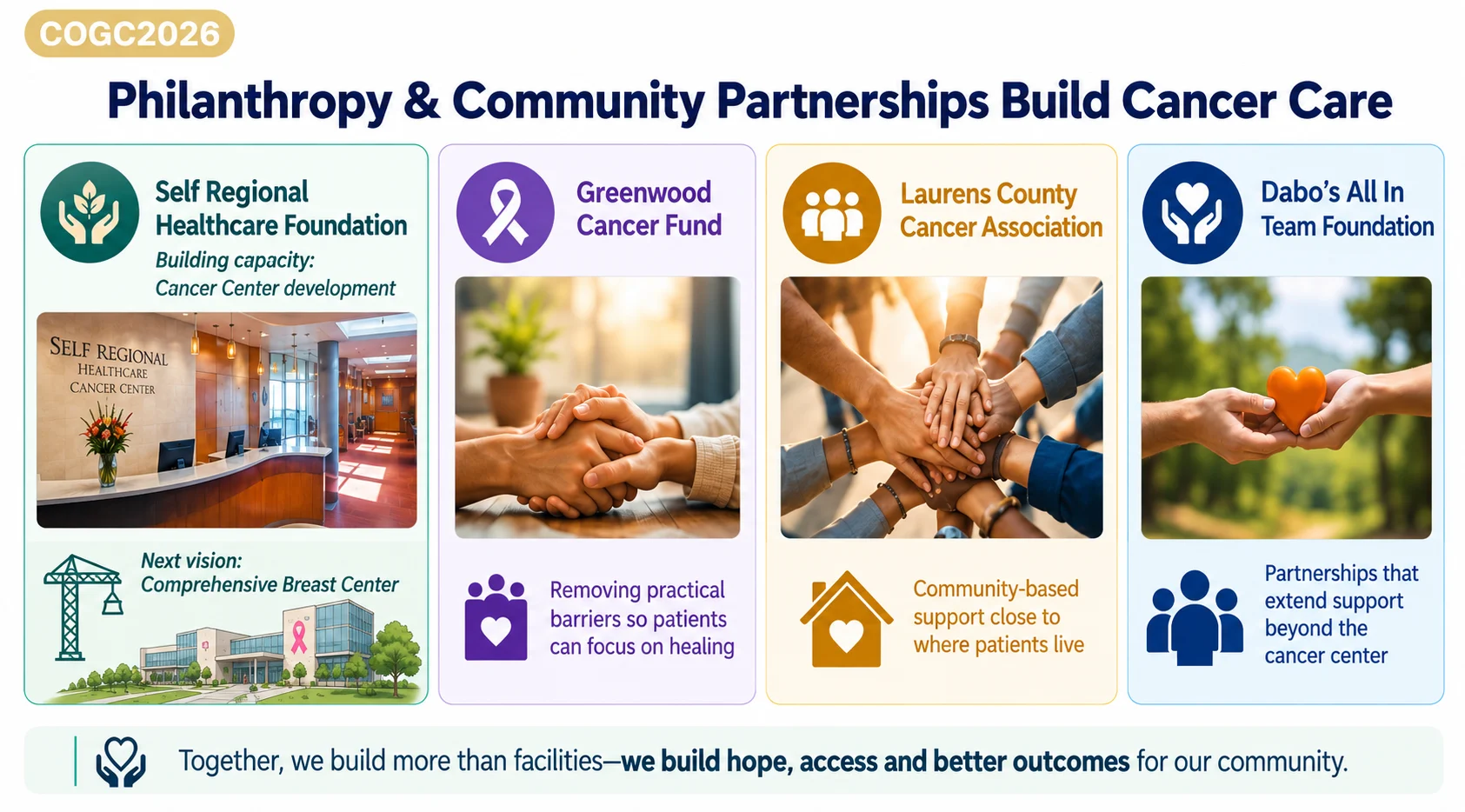
Some may struggle to afford medication copays. Others may not have enough money for fuel to reach appointments. Local foundations and community organizations therefore become part of the care infrastructure, helping address needs that sit outside the usual clinical encounter but directly affect whether treatment can continue.
Partnerships with organizations including the Greenwood Cancer Foundation and Laurens County Cancer Association have helped support patients facing these practical barriers. Collaboration with Dabo’s All In Team Foundation also helped bring a mobile 3D mammography unit into the region, expanding access to breast cancer screening and early detection.
But improving access also means going beyond the cancer center itself.
Community outreach has included cancer education, screening, risk-reduction information, health literacy, and information about clinical trials. Meeting people where they live can also strengthen something that is harder to measure but essential in rural healthcare: trust.
“When we show up, the trust grows. And when the trust grows, outcomes improve.”
Rather than assuming patients will always find their way into the healthcare system, the model brings parts of that system into the community.
Bringing Research and Innovation Home
The same philosophy applies to newer cancer treatments.
Advances in oncology are rapidly moving therapies that were once reserved for later lines of treatment into earlier stages of care. Yet specialized therapies are often introduced first at academic centers, which can leave rural patients facing another geographic barrier.
Lung cancer is particularly important in the region because of substantial tobacco exposure and the high burden of disease. Strengthening screening and early detection has therefore become a priority, including collaboration with industry partners to expand local prevention and detection efforts.
Clinical research presents a similar challenge. A patient may technically be eligible for a clinical trial, but repeated travel to an academic center can make participation unrealistic.
The local research program has therefore worked with academic institutions and research networks, including MUSC and NCORP, to expand trial availability closer to home.
Preparation is also underway for increasingly complex treatments such as bispecific antibodies and BiTE therapies.
Delivering these therapies in the community requires more than simply obtaining the drug. Teams need experience with patient selection, monitoring, toxicity recognition, escalation pathways, and the operational requirements surrounding treatment. Outside expertise has therefore been brought into the local setting to help build readiness before attempting to introduce these therapies more broadly.
The aim is not to reproduce every capability of a major academic cancer center. It is to determine which innovations can be safely transferred into community practice and what expertise, partnerships, and infrastructure are needed to make that possible.
When Better Care Requires System Change
Even a highly engaged cancer center cannot solve every rural oncology problem on its own.
Transportation, telehealth access, workforce shortages, prior authorization, clinical trial availability, and rural oncology training are shaped by policies and systems extending far beyond a single clinic.
That is where advocacy becomes part of cancer care.
The team became involved in advocacy at both the state and national levels, using patient experiences to explain how policy decisions affect access in rural communities. The goal is to make problems that may appear abstract at the policy level visible through what patients actually experience: delayed care, long travel, limited trial access, financial strain, and difficulty reaching specialists.
Across all of these programs, the same practical sequence repeatedly appears:
- Listen to patients,
- Identify the unmet need,
- Engage leadership,
- Educate the team,
- Use the resources already available,
- Bring in partners when local expertise is not enough.
The common purpose is to reduce the number of times geography determines what care a patient can realistically receive.
“Where you live should not determine the cancer care you receive.”
Cancer care, in that sense, does not end with delivering the right treatment. It also means creating systems that give patients the opportunity to live, and live well, throughout the cancer journey.
Written by Eliz Baloyan, MD, Features Writer and Editor at OncoDaily and CancerWorld