For a long time, Rohini Singh Sisodia’s life was organized around the next urgent thing.
The next scan. The next treatment decision. The next hospital. The next question that did not yet have an answer.
She had already experienced cancer from the side of a caregiver. In 2018, her younger brother was diagnosed with a rare sarcoma. Rohini became his primary caregiver, and within a year, her family lost him at 27.
Three years later, she had moved from India to Belgium, left behind a career in law and was preparing for a new life with her husband.
Rohini was pregnant. She was in the final trimester when sudden abdominal pain brought her to the hospital. Doctors initially suspected cholangitis and began preparing her for an endoscopic retrograde cholangiopancreatography (ERCP).
During that hospitalization, Rohini and her husband lost their baby. She gave birth to a stillborn son, a devastating loss that was soon followed by further uncertainty about her own health.
Seeking clearer answers, the couple transferred her care to a specialized university hospital. There, a repeat procedure revealed a tumor and led to a diagnosis of cholangiocarcinoma, a cancer of the bile ducts.
“When I heard that word cancer again… I just could not believe it, because when we lost my brother, I thought that’s the worst that life could give.”
More than five years later, Rohini is in remission. The former lawyer is now a health and wellness coach, yoga teacher and patient advocate, and the founder of RSS Heals, where she works with people affected by cancer through the whole-person approach she once found missing from her own care.
Her experience changed not only the direction of her life, but also her understanding of what recovery can mean: surviving the disease is one part of the journey; learning how to live again is another.
A Detail From Childhood Suddenly Mattered
The diagnosis brought an old piece of Rohini’s medical history back into focus.
She had been born with a choledochal cyst, a congenital abnormality involving the bile ducts, and had undergone surgery when she was about a year old. She had lived with digestive problems for much of her life, but says no one had previously discussed with her the possibility that her history could, in rare circumstances, be associated with cancer.
That childhood surgery became important when doctors in Belgium were trying to understand what was happening.
“It was because of that history that the doctor here decided to redo that ERCP, just because I remembered to mention it.”
The repeat procedure led to the discovery of the tumor.
For Rohini, looking back at that sequence still produces an uncomfortable series of what-ifs.
“I don’t even know what would happen if I did not.”
With the diagnosis confirmed, she soon underwent a Whipple procedure. Still recovering from childbirth, she now faced the physical demands of major abdominal surgery. The operation marked the beginning of a lengthy recovery, during which even ordinary activities, such as sitting down for a meal, posed new challenges.
“Coming back to eating normal or coming back to gaining that physical strength took a very, very long time.”
The Loneliness of Being a Patient Abroad
Rohini had moved to Belgium in 2020, leaving behind her parents, extended family, friends and the legal career she had built in India. Although her husband was Flemish, she was still finding her feet in a country with an unfamiliar language and culture.
The COVID-19 pandemic made settling in particularly difficult. Travel restrictions kept her apart from family at a time when she would soon need their support.
These circumstances took on a different significance when she entered the healthcare system as a cancer patient.
One night after surgery, while in intensive care, Rohini was experiencing severe pain and asked for stronger pain relief. When she called for assistance again, she recalls, her call button was moved out of reach.
She could hear staff talking and laughing in Dutch in the corridor but struggled to get anyone’s attention. When someone eventually came to her bedside, Rohini asked for help repositioning her pillows to relieve the pressure around her surgical wound. Instead, the adjustment intensified her pain.
Rohini tells the story without trying to turn the people involved into villains. She remembers that the staff seemed exhausted and overstretched. She also recognizes that she was medicated and may not have been communicating as clearly as she normally would.
But she was a patient in severe pain, trying to explain herself in a healthcare environment where language had become another obstacle.
The experience stayed with her.
“I really hope that nobody has to go through something like this again.”
What is striking is the guilt that still accompanies telling it.
“Why am I a little bit guilty around it? I should just be grateful and thankful and not talk about this.”
Rohini is clear that she is grateful for the medical care she received in Belgium. She also believes gratitude should not require silence about the moments when care falls short.
“Both of these, we have to make space for both these conversations existing simultaneously.”
For her, better support for migrant patients does not always require an elaborate intervention. Sometimes it means recognizing that somebody cannot communicate what they need, finding an interpreter or simply bringing in another person who can understand them.
“If you cannot understand, just bringing somebody else in who can understand.”
Years later, that experience would influence her efforts to create more English-language support for international patients in Brussels.
When the Treatment Path Wasn’t Clear
The Whipple procedure had not resolved all the questions surrounding Rohini’s cancer. Interpretations of the surgical findings differed, and within two months, scans began showing lesions in multiple locations.
Chemotherapy was now part of the treatment plan, but Rohini and her husband wanted to understand what other possibilities might be available.
“At that point, it became: what life-saving options do we have?”
Her husband began researching clinical studies and therapies that might be relevant to her diagnosis. Together, they brought their findings to her oncologist, only to discover that some of the treatments they had identified were not yet authorized in Belgium.
Rohini understood that access to new therapies could be limited. What troubled her was having to discover those possibilities on her own.
“I wish we were at least told of them, even if they weren’t [authorized], and we weren’t made to look for it ourselves.”
The couple eventually transferred her care to another university hospital, where an oncologist helped Rohini gain access to a therapy on compassionate grounds.
Yet finding a new medical team did not put an end to the uncertainty. Different hospitals offered different opinions, and each new scan could raise questions about whether the current treatment remained the right course. Rohini and her husband found themselves increasingly involved in decisions they had once expected to leave largely to medical professionals.
“You are making those life-changing decisions for yourself somewhere, which can be very hard throughout with all of that that was going on.”
The physical demands of treatment complicated those choices further. Adverse effects and infections eventually made chemotherapy too difficult for Rohini to tolerate. She asked to take a break and later continued with immunotherapy alone.
Her oncologists supported her decisions, allowing her a greater role in determining what she could manage and how she wanted to proceed.
“I chose to become an active participant in my own recovery process.”
But taking an active role in treatment did not make the uncertainty any easier to live with. Appointments and scans continued to dictate the rhythm of everyday life, while the possibility of new findings made it difficult to plan for the future.
“You are living from scan to scan and not knowing what the next result is going to be.”
For Rohini and her husband, focusing on the immediate demands of treatment became a way of managing circumstances that often felt beyond their control.
“We were living in survival. We were living day to day. We were like, ‘Okay, let’s just deal with cancer at the moment.’”
That focus came at a personal cost. Rohini was still grieving her brother and her son, adjusting to life in a new country and recovering from major surgery. Yet amid the decisions about chemotherapy, immunotherapy and the next scan, her psychological well-being rarely received the same attention as her physical condition.
“Let’s not think about the fact that you are still depressed with whatever happened. You’re still grappling with emotional, mental wellness and all of those aspects.”
Looking back, Rohini wishes there had been more room in her cancer care for everything she was carrying beyond the diagnosis itself.
The Things Nobody Knew How to Say
Some of that emotional burden was being carried quietly inside her family.
Rohini sees cancer stigma differently now, having experienced it across different countries and communities. The details may vary, but one reaction feels familiar.
“The moment you hear the word ‘C,’ it’s still a death sentence.”
Cancer can change the tone of a room.
People become uncomfortable. The conversation moves elsewhere. Everyone may be trying to protect everyone else.
Rohini did that with her parents.
After they had already lost her brother, she felt enormous pressure to survive for them.
“I was desperate to live. I was clinging to life and being like, ‘I have to make it because my parents can’t have the same story.’”
But that made it harder to tell them how frightened she was.
Her parents, meanwhile, were trying to protect her from their fear.
For some time, her father did not even know that she had undergone surgery for cancer. When the family eventually told him, he became ill himself.
The silence continued until Rohini felt she could no longer carry it.
Then the family began talking more openly.
“It was such a release. It was such a feeling of freedom and lightness and ease and peace with everything.”
The experience changed how Rohini understands isolation.
A patient can have people all around them and still feel alone if nobody knows how to talk about what is happening.
“They are surrounded by people, [but] they are not able to communicate their needs to them. And they are surrounded by people who don’t know how to react.”
Breaking that silence would later become one of the principles behind her work with other patients.
“So Now That You’re Fine, When Are You Having a Child?”
There were other conversations that became difficult for different reasons.
For Rohini, fertility is one of them.
Family members would ask a question that, in another life, might have sounded ordinary:
“So now that you’re fine, when are you having a child?”
But Rohini had given birth to a stillborn son and then undergone cancer treatment.
There was no simple answer.
She found that many people asking the question had never really heard what she had lived through. Cancer itself was uncomfortable to discuss, and the consequences for fertility even more so.
Over time, Rohini tried to understand those questions as a product of limited awareness rather than deliberate cruelty.
“They simply don’t understand. They are only acting on the basis of what they know.”
Compassion, however, does not mean abandoning boundaries.
Some conversations are worth having. Others cost too much.
“You don’t want more fights. You don’t want more conflicts. You just want ease and peace.”
Learning when to explain, when to step away and when to protect herself became part of living beyond treatment.
What Remission Did Not Resolve
More than five years after her diagnosis, Rohini is in remission.
Getting there was anything but straightforward.
And remission did not return her to the body or life she had before cancer.
After the Whipple procedure and treatment, she continued dealing with digestive changes, malnutrition and malabsorption, chronic pain, fatigue, hormonal changes and nutritional problems.
Much of the practical guidance she needed for living with those consequences, she says, came through her own research and from integrative specialists she sought outside the hospital.
Then there were the effects no scan could measure.
The grief.
The anxiety.
The disruption to identity.
The changes in relationships.
Questions about whether she could have children.
Questions about whether her marriage would survive.
Questions about mortality, purpose and what a meaningful future could still look like.
Medical care had addressed the disease.
Rohini began wondering who was supposed to help with everything surrounding it.
That question eventually changed Rohini’s understanding of recovery.
“That gap is what made me really understand the difference between being cured and being healed.”
For her, a scan result could never capture the whole experience.
“It’s not just about the cure. It’s about healing the whole.”
She began looking at recovery across several connected parts of life.
There was the physical: treatment side effects, nutrition, sleep, movement, exercise and long-term survivorship.
There was the emotional and mental: anxiety, fear, distress, hope and the work of making sense of what had happened.
There was the social: family, relationships, community and isolation.
There were practical realities, including work, navigating healthcare and financial toxicity.
And there were spiritual and existential questions around meaning, purpose, identity, mortality and connection to life.
Rohini does not see these as alternatives to medical treatment.
They are parts of a person’s life that continue alongside it.
“The clinical outcomes and all the evidence are not capturing what the people are living through behind all these scans and treatment.”
That realization became the foundation of what she now calls whole-person care.
When Personal Experience Became Advocacy
Before cancer, Rohini had practiced law for almost 15 years.
Her next profession began much less formally.
During the long periods she spent in hospitals, she started talking to other patients. She shared some of the things she was using herself: yoga, breathing techniques, lifestyle changes and other supportive practices.
People began reaching out.
Sometimes they would call later and tell her that something had helped.
Those conversations gave Rohini a sense of meaning she had been struggling to find.
“One day I just put down this call and I was like, that’s it. If I make it, this is what I want to do for the rest of my life.”
She wanted to help people navigate cancer with less fear and more support.
But lived experience, she felt, was only the beginning.
“I had the lived experience, but I did not have the tool. I did not have the structure. I did not have the training to do it.”
Rohini began pursuing formal training in health and wellness coaching and yoga, eventually becoming a certified health and wellness coach and yoga teacher.
She went on to establish RSS Heals, bringing together her professional training and a broader understanding of recovery shaped by her own experience with cancer.
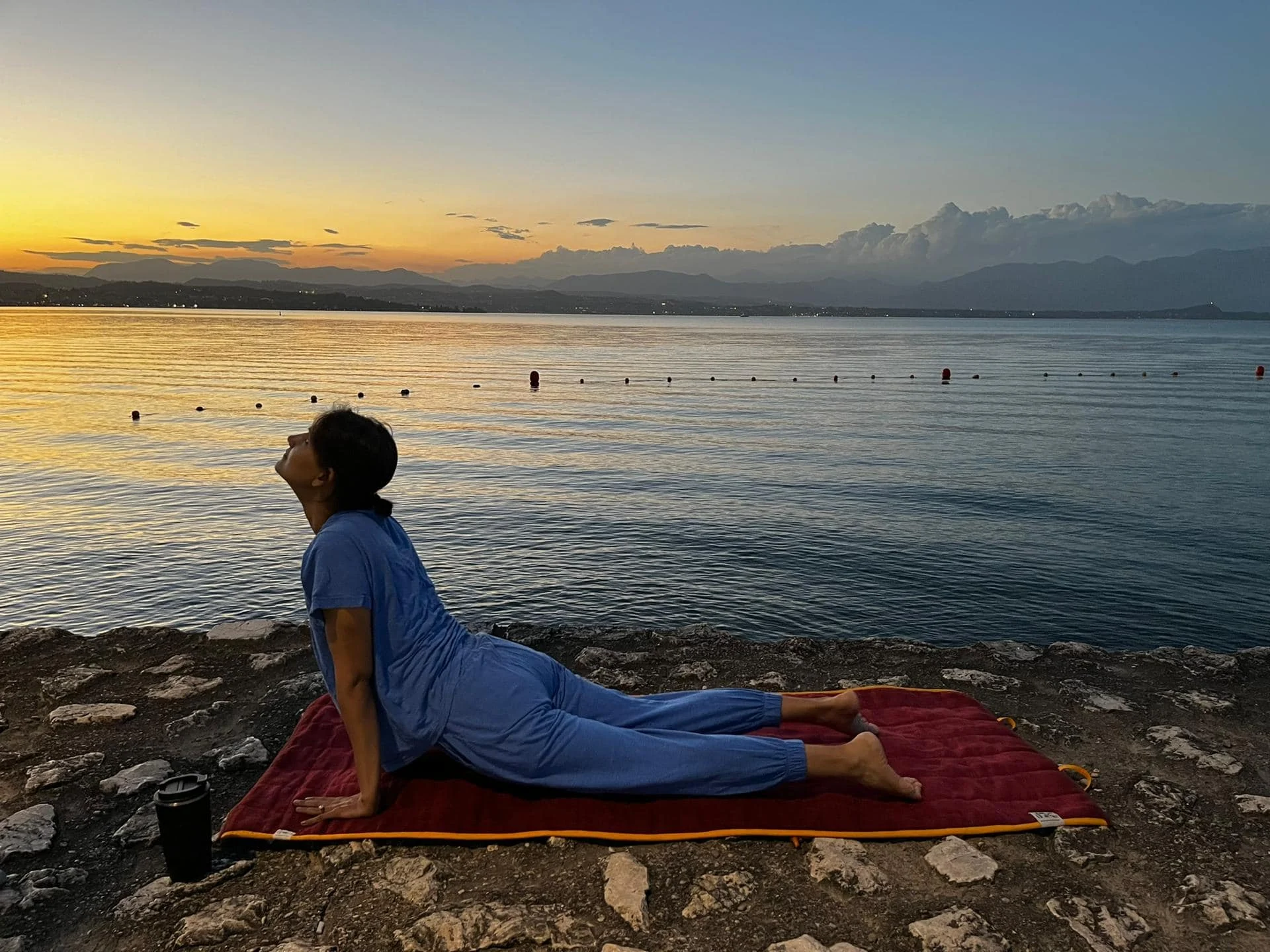
Photo: Digestive Cancers Europe/Rohini Singh Sisodia
At the heart of her approach is a philosophy she describes as:
“Blending science and soul to heal the whole.”
The work starts with the person rather than a predetermined program.
“We start from their story, seeing them as a person behind being the patient.”
Rohini maps which parts of someone’s life have been affected and what matters most to them at that moment. Her role, as she describes it, is to walk alongside rather than decide the direction.
The patient retains agency.
That matters to someone who remembers how often her own cancer journey involved being forced to make enormous decisions while everything around her felt uncertain.
Whole-Person Care Is Not Equally Available
Her experience also made Rohini increasingly conscious of who gets access to the kind of support she now advocates for.
She is careful not to pretend that every patient has the same needs – or the same capacity to prioritize them.
In some settings, she says, talking about emotional, social or spiritual well-being can sound remote when a patient is trying to answer much more immediate questions.
Can I afford treatment today?
Will my family have food?
Can I work?
Do I have somewhere to live?
“They are living in survival.”
For Rohini, whole-person care has to acknowledge that reality too.
The “whole person” includes financial circumstances, geography, health literacy, social support and the practical conditions in which somebody is trying to survive cancer.
Her experience in India and Belgium has made health equity an increasingly important part of how she thinks about advocacy, particularly around rare cancers and younger patients.
Care cannot be truly person-centered, in her view, if it assumes every patient begins from the same place.
A Life That Became Different
Rohini does not try to find a larger purpose in her cancer diagnosis or the losses that preceded it. Nor does she believe that the work she has gone on to do somehow justifies what she endured.
Still, she recognizes how profoundly those years have shaped her. The life she has built since looks very different from the one she knew as a lawyer in India, and her understanding of herself has changed along with it.
“It changes you as a person.”
She began asking herself questions that had become impossible to ignore.
Who am I now?
What matters?
How do I want to live?
How can I be useful to somebody else?
Over time, the answers to those questions helped Rohini find a new professional direction, one rooted in patient advocacy and the experiences that had reshaped her own life.
They also broadened her understanding of healing. Rather than seeing it as something achieved once treatment ends or a scan shows no evidence of disease, Rohini now considers it a continuing process that extends beyond physical recovery. Emotional well-being, relationships, grief and the task of rebuilding a sense of identity all have a place in what it means to live after cancer.
Sharing that publicly still does not come naturally.
She sometimes finds herself preparing for interviews and thinking about how strange it is that she now speaks openly about experiences she once struggled to discuss even with the people closest to her.
But that openness has acquired a purpose.
“If my story and my work can give people – or one person – hope, or help them truly feel heard or be seen, then it’s all worth it.”
Written by Eliz Baloyan, MD, Features Writer and Editor at OncoDaily and CancerWorld
Interview by Carmen Monge-Montero, Lead of the OncoDaily Lived Experience Advocacy Hub