
Key takeaways
- Targeted therapies are improving CLL outcomes, with BTK and BCL-2 inhibitors providing more effective treatment options.
- Genetic testing guides treatment decisions, but its high cost limits access in Nepal.
- The Max Foundation is expanding access to zanubrutinib, providing free treatment to eligible patients in Nepal.
- Financial barriers remain a major challenge, forcing many patients to rely on older, more affordable therapies.
- Personalized CLL care requires balancing genetic risk, patient health, treatment toxicity, and affordability.
At LeukO 2026: Global Virtual Congress on Leukemias, organized by OncoDaily, Ramila Shilpakar, Associate Professor and Chief Consultant Medical Oncologist in the Department of Clinical Oncology at the National Academy of Medical Sciences (NAMS), discussed advances in chronic lymphocytic leukemia (CLL) treatment and the challenges of delivering modern therapies in lower-middle-income countries.
Her presentation examined how Bruton tyrosine kinase (BTK) inhibitors, BCL-2 inhibitors, and increasingly personalized treatment strategies have improved CLL outcomes over the past decade. However, she also described a situation familiar to clinicians in resource-constrained settings: knowing which treatment is most appropriate does not always mean being able to provide it.
In Nepal, where many patients pay for cancer treatment out of pocket, the availability of newer medicines, molecular testing, and patient assistance programs can have a direct influence on clinical decisions.
For Shilpakar, treating CLL therefore requires balancing three considerations: the biology of the disease, the patient’s clinical condition, and the financial realities of accessing treatment.
When Does a Patient With CLL Actually Need Treatment?
Unlike acute leukemias, chronic lymphocytic leukemia does not always require immediate treatment after diagnosis.
Some patients remain asymptomatic for years and can be safely monitored without therapy.
Shilpakar began by reviewing the importance of assessing disease burden, clinical stage, and evidence of progression before initiating treatment.
The modified Rai and Binet staging systems remain useful for evaluating CLL, but treatment decisions must also follow the International Workshop on Chronic Lymphocytic Leukemia (iwCLL) criteria for active disease.
These include:
- Progressive marrow failure,
- Symptomatic or enlarging lymph nodes,
- Significant splenomegaly,
- Rapid lymphocyte proliferation,
- Poorly controlled autoimmune complications,
- Disease-related constitutional symptoms.
Examples of constitutional symptoms include:
- Unintentional weight loss,
- Significant fatigue affecting daily activities,
- Unexplained fever,
- Persistent night sweats.
Progressive anemia and thrombocytopenia may also indicate that treatment is necessary. Under the iwCLL criteria, hemoglobin below approximately 10 g/dL or platelet counts below 100,000/µL are generally important thresholds, although the overall clinical picture and progression of the abnormalities must be considered.
A stable low platelet count, for example, does not automatically require immediate treatment.
The distinction is particularly relevant in Nepal, where starting therapy can create a substantial financial commitment for patients and their families.
For individuals who do not yet meet treatment criteria, careful surveillance can avoid unnecessary treatment exposure and expense while preserving the opportunity to begin therapy when clinically indicated.
How Targeted Therapies Have Changed CLL Outcomes
Over the past decade, CLL treatment has moved away from traditional chemotherapy toward therapies directed against specific mechanisms supporting malignant B-cell survival.
Shilpakar reviewed the development of anti-CD20 monoclonal antibodies, including rituximab, followed by the introduction of BTK and BCL-2 inhibitors.
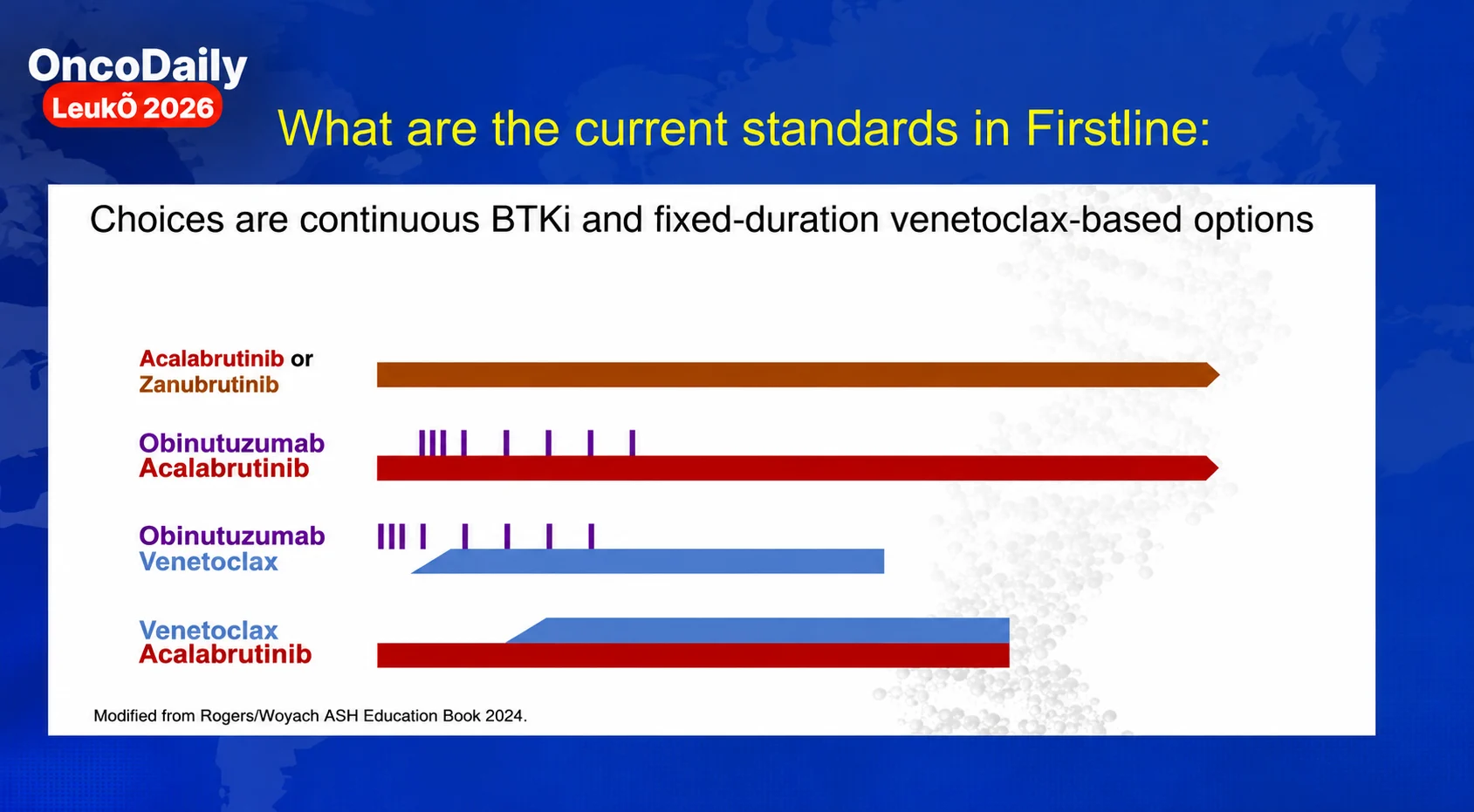
Ibrutinib was one of the first BTK inhibitors to substantially change CLL treatment, with later-generation agents such as acalabrutinib and zanubrutinib expanding treatment choices.
The noncovalent BTK inhibitor pirtobrutinib has provided another option for selected patients with previously treated disease.
Meanwhile, venetoclax, which inhibits the anti-apoptotic protein BCL-2, has made fixed-duration treatment an important part of modern CLL care.
These developments have produced substantial improvements in progression-free survival compared with older chemotherapy regimens.
One example presented by Shilpakar was the phase III RESONATE-2 trial, which compared first-line ibrutinib with chlorambucil in older patients with CLL.
In the final analysis, with nearly a decade of follow-up, median progression-free survival was 8.9 years with ibrutinib, compared with 1.3 years with chlorambucil.
The difference illustrates how profoundly targeted therapy has changed the expected duration of disease control in eligible patients.
However, the growing number of treatments has also made treatment selection more complex.
Continuous BTK inhibition, fixed-duration venetoclax combinations, and newer targeted combinations offer different benefits and limitations.
Choosing between them requires understanding the patient’s disease characteristics, cardiovascular and renal health, tolerance for treatment-related risks, and preference for continuous versus time-limited therapy.
In countries where medicines are expensive or difficult to obtain, availability becomes an additional consideration that can outweigh some of these preferences.
Genetic Testing Is Essential, but Not Always Affordable
Shilpakar emphasized that molecular risk stratification should be performed before initiating CLL treatment.
Important investigations include fluorescence in situ hybridization (FISH) for chromosomal abnormalities, particularly deletion 17p, along with TP53 mutation testing and IGHV mutation status.
Assessment of complex karyotype may provide additional prognostic information.
These findings help clinicians identify patients who may respond poorly to certain treatment approaches.
For example, del(17p) and TP53 mutations are associated with resistance to conventional chemoimmunotherapy and an increased risk of disease progression.
Such patients often benefit from targeted treatment strategies, with second-generation BTK inhibitors representing important options.
IGHV mutation status also contributes to prognosis.
Patients with mutated IGHV generally have a more favorable disease course than those with unmutated IGHV, although it is only one of several factors influencing treatment decisions.
For patients without TP53 abnormalities, continuous BTK inhibition and fixed-duration venetoclax-based regimens are among the principal modern treatment options.
Shilpakar noted that these molecular investigations are available in Nepal, but affordability remains a major obstacle.
Patients who are already facing substantial treatment expenses may also have to pay for genetic tests that are essential to selecting therapy.
Consequently, clinicians sometimes need to make treatment decisions without a complete molecular risk profile.
This creates a difficult situation: the science increasingly supports personalized treatment, but the diagnostic tools needed to personalize care are not equally accessible.
Continuous Treatment or a Fixed-Duration Regimen?
One of the central decisions in contemporary CLL management is whether to use continuous BTK inhibition or a time-limited treatment combination.
Shilpakar reviewed the growing preference for second-generation BTK inhibitors such as acalabrutinib and zanubrutinib over first-generation ibrutinib in many clinical situations, particularly because of differences in safety profiles.
Continuous BTK inhibition can provide prolonged disease control, including for patients with high-risk molecular features.
However, treatment generally continues until disease progression or unacceptable toxicity. This requires ongoing access to medication and regular monitoring.
Fixed-duration regimens offer an alternative.
These include venetoclax plus obinutuzumab, BTK inhibitor-venetoclax combinations, and selected triplet strategies incorporating an anti-CD20 antibody.
In February 2026, the FDA approved acalabrutinib plus venetoclax for adults with CLL or small lymphocytic lymphoma, adding another fixed-duration option to the treatment landscape.
For some patients, time-limited therapy offers the advantage of a planned treatment-free period.
This may reduce the burden of continuous medication and allow patients to return to everyday life without ongoing anticancer treatment.
However, fixed-duration regimens also have risks, monitoring requirements, and substantial upfront costs.
Shilpakar explained that the ideal choice depends on genetics, disease characteristics, patient preference, and comorbidities.
For patients with significant cardiovascular disease, BTK inhibitors require particular caution because of adverse events such as atrial fibrillation, hypertension, and bleeding.
Venetoclax-based treatment may be an alternative, but it requires careful assessment of tumor lysis syndrome risk, especially in patients with impaired renal function or substantial disease burden.
The choice is therefore not simply between long and short treatment.
It involves assessing which regimen is appropriate, safe, affordable, and realistically deliverable for the individual patient.
Zanubrutinib in Nepal: The Role of The Max Foundation
One of the most important parts of Shilpakar’s presentation concerned access to zanubrutinib through The Max Foundation.
Although second-generation BTK inhibitors have become widely used in many high-income countries, their availability remains limited in Nepal.
Shilpakar explained that eligible patients in Nepal have been able to receive zanubrutinib free of charge through an international access program involving The Max Foundation and BeiGene, now known as BeOne Medicines.
The program began providing treatment to patients in Nepal and Armenia in early 2024, creating an important source of access to a therapy that would otherwise be unaffordable for many patients.
At the time of her presentation, Shilpakar reported that:
- 54 patients were actively enrolled in the zanubrutinib access program in Nepal.
- 21 patients were awaiting access through the program.
These figures were provided by the program coordinator, according to Shilpakar, and reflect the situation she described at the congress.
For clinicians, the program has provided an opportunity to offer modern targeted therapy to patients who would otherwise face substantial financial barriers.
The collaboration has also continued to expand.
In August 2026, The Max Foundation, BeOne Medicines, and the BeOne Care Foundation announced an extension of their partnership through 2028.
By then, the program had supported more than 300 patients with CLL across Nepal, Armenia, and Ethiopia, with plans to expand access further.
The importance of this initiative becomes particularly clear when considering the evidence supporting zanubrutinib.
SEQUOIA: Why Access to Zanubrutinib Matters
Shilpakar reviewed the phase III SEQUOIA trial, which compared zanubrutinib with bendamustine plus rituximab in previously untreated CLL patients without del(17p).
At five years, estimated progression-free survival was:
- 75.8% with zanubrutinib.
- 40.1% with bendamustine plus rituximab.
These findings demonstrated a substantial progression-free survival advantage with zanubrutinib over the chemotherapy-based comparator.
The benefit was observed in patients with both mutated and unmutated IGHV, although outcomes and treatment decisions still vary according to individual risk factors.
Patients with del(17p) were evaluated separately in SEQUOIA, so the randomized comparison should not be generalized directly to that population.
For Shilpakar, the results explain why access to zanubrutinib has become so important in Nepal.
When patients can receive a treatment with demonstrated efficacy across several molecular risk groups, it can be especially valuable in a setting where comprehensive genetic testing may not always be affordable.
However, targeted therapy does not eliminate the need for molecular testing.
Identifying TP53 abnormalities and other clinically relevant features remains important for prognosis, treatment planning, and the selection of subsequent therapy.
When Cost Determines the Treatment Choice
Despite the availability of zanubrutinib through an access program, not every patient in Nepal can receive it immediately.
Shilpakar described the challenges of managing patients who are awaiting access or who require another treatment option.
Other BTK inhibitors, including ibrutinib and acalabrutinib, are not consistently available through affordable local supply channels.
She described the use of generic products sourced from neighboring countries in selected circumstances, particularly while patients await zanubrutinib.
Venetoclax is also used in Nepal, including through generic supply arrangements described in her clinical practice.
However, availability does not necessarily mean affordability.
For many patients, venetoclax remains an out-of-pocket expense.
Obinutuzumab presents additional logistical difficulties. Although it is registered in Nepal, Shilpakar explained that clinicians may need to obtain it from India on an individual prescription basis.
These arrangements can make timely treatment initiation difficult.
Even when a clinician identifies an appropriate fixed-duration regimen, securing both medicines may create delays or financial burdens that make the option impractical.
Shilpakar described this reality in particularly direct terms when discussing treatment selection.
“For us, it’s not much of a choice in terms of continuous BTK inhibitors because zanubrutinib is available.”
Her point was that the treatments available through assistance programs or affordable supply channels can determine the practical choices in routine care.
In a well-resourced setting, the discussion might focus on whether a patient prefers continuous therapy or a fixed-duration regimen.
In Nepal, that discussion may begin with whether the medicines can be obtained at all.
Why Chemoimmunotherapy Still Has a Role in Nepal
Although targeted therapies have largely replaced chemoimmunotherapy as preferred treatment in many contemporary CLL guidelines, Shilpakar explained that older regimens continue to play an important role in Nepal.
When modern targeted combinations are unaffordable, clinicians may rely on bendamustine plus rituximab (BR).
For younger, medically fit patients, fludarabine, cyclophosphamide, and rituximab (FCR) may also be considered in selected circumstances.
Even chlorambucil, a drug that has largely fallen out of favor in modern CLL treatment, remains in use because of its lower cost and availability.
These approaches can provide treatment when better-supported targeted options cannot be accessed.
However, their continued use in a resource-constrained setting should not be interpreted as evidence that they are equivalent to modern targeted regimens.
This distinction is particularly important for patients with del(17p) or TP53 mutations, for whom conventional chemoimmunotherapy generally produces inferior outcomes.
Shilpakar also discussed the practical advantages that some time-limited chemotherapy regimens may offer, including periods without treatment and relief from the financial burden of continuous medication.
Nevertheless, the balance between cost, effectiveness, toxicity, and relapse risk differs considerably between regimens and patient populations.
A less expensive treatment may reduce immediate expenditure but still involve hospitalization, infection risk, or the need for additional therapy after relapse.
For clinicians working under financial constraints, these considerations must be evaluated alongside the treatment’s expected clinical benefit.
Relapsed CLL: Fewer Options After Frontline Treatment
Access difficulties become even more pronounced when CLL relapses or progresses after initial therapy.
Modern treatment options for relapsed/refractory CLL include switching between BTK- and venetoclax-based approaches, with noncovalent BTK inhibitors such as pirtobrutinib available for appropriately selected patients in some countries.
However, Shilpakar explained that these newer agents are not consistently accessible in Nepal.
Without reliable access to the medicines recommended for subsequent treatment, clinicians sometimes turn to older or lower-cost approaches.
She discussed the use of metronomic chemotherapy, in which low-dose anticancer treatment is administered over an extended period.
In her clinical setting, this has included oral cyclophosphamide, chlorambucil, and selected other agents such as lenalidomide.
These approaches may be used for patients with limited options or as temporary treatment while awaiting access to a preferred therapy.
However, they are not equivalent to guideline-preferred targeted salvage regimens and have limited supporting evidence in contemporary CLL practice.
Their use reflects the practical challenges of managing relapsed disease when newer medicines are difficult to obtain.
For patients who have already received multiple treatments, affordability becomes particularly important because the remaining therapeutic options may be both more complex and more expensive.
Shilpakar emphasized that improving access to newer drugs is therefore relevant throughout the course of CLL, not only at initial diagnosis.
What Does Progress in CLL Mean for Patients in Nepal?
The development of BTK and BCL-2 inhibitors has fundamentally changed the treatment of chronic lymphocytic leukemia.
Patients who once depended largely on chemotherapy can now achieve prolonged disease control with targeted therapies, while fixed-duration regimens offer opportunities for treatment-free periods.
Yet Shilpakar’s experience in Nepal illustrates how unevenly these advances can translate into clinical practice.
Molecular testing may be available but too expensive for some patients. A treatment may be internationally recommended but difficult to obtain locally. And the availability of an assistance program can determine whether a patient receives a newer therapy or must rely on older alternatives.
The Max Foundation’s zanubrutinib access initiative demonstrates how international collaboration can help address some of these barriers.
At the same time, the number of patients awaiting access shows why expanding and sustaining such programs remains important.
Shilpakar returned to the importance of considering the individual patient rather than focusing exclusively on the growing list of available drugs.
Age, fitness, comorbidities, molecular risk, treatment toxicity, and financial circumstances all influence the clinical decision.
She concluded by emphasizing the goals that should guide CLL treatment:
“The goals of our therapy are to improve the quality of life of our patients and to prolong survival.”
In Nepal, achieving those goals requires both modern clinical knowledge and practical solutions to the costs and supply barriers that affect cancer treatment.
The advances in CLL therapy have created new opportunities for longer survival and better disease control. Ensuring that patients can benefit from those advances, regardless of their ability to pay, remains a central challenge for healthcare systems such as Nepal’s.
Written by Eliz Baloyan, MD, Features Writer and Editor at OncoDaily and CancerWorld