Key takeaways
- Guidelines should support clinical judgment, not replace it.
- Treatment decisions must account for the evidence, the patient, the healthcare system, and the physician’s clinical context.
- Deviation from a guideline is not always poor-quality care when patient factors, access barriers, or newer evidence justify adaptation.
- The same guideline can lead to very different care depending on where a patient is treated and what resources are available.
- Evidence-based care is only complete when it is accessible, timely, and realistic for the patient.
At the Community Oncology Global Congress (COGC 2026), organized by OncoDaily, Otávio Al-Alam, medical oncologist at Hospital Moinhos de Vento in Porto Alegre, Brazil, focused on the distance that can exist between what clinical guidelines recommend and what can actually be delivered to the patient.
Guidelines synthesize evidence and define standards of care, but treatment decisions do not happen on paper. They happen within the realities of molecular testing, reimbursement, geography, available infrastructure, patient preferences, comorbidities, and the healthcare system itself.
The focus in his presentation was on the point where guidelines stop being straightforward: when strong evidence meets the realities of the patient, the clinic, and the healthcare system.
Guidelines Are a Framework, Not an Algorithm
“Clinical guidelines are essential. They synthesize evidence, define standards of care, and help us make better and more consistent decisions.
But there is an important distinction.
Clinical guidelines tell us what should be done. Community oncology tells us what can actually be done.
And between those two things, there is often a gap.
The challenge is not only generating evidence or publishing recommendations. The real challenge is making those recommendations possible for the patient sitting in front of us.
Why is implementation so difficult? Because a treatment decision is never based on evidence alone.
There are at least four dimensions involved.
First is the evidence itself. Oncology is changing extremely fast, and recommendations are becoming increasingly complex.
Second is the patient. Comorbidities, performance status, preferences, and social context all matter.
Third is the healthcare system. Drug access, molecular testing, surgery, radiation therapy, and multidisciplinary care are not equally available everywhere.
And finally, there is the physician. Experience, time, familiarity with the guideline, and local practice patterns can all influence what ultimately happens.
So even when the evidence is clear, implementation may not be.
That is why guidelines should be a framework, not an algorithm.
The process is not simply guideline equals treatment. Evidence becomes a guideline, but then we have to interpret that recommendation within the clinical context, incorporate patient preferences and shared decision-making, and only then arrive at care.
Guideline-concordant care is not about replacing clinical judgment. It is about supporting better clinical judgment.”
The process can be reduced to five practical questions clinicians can ask before applying a recommendation:
- Is this recommendation supported by meaningful evidence?
- Does that evidence actually apply to this patient?
- Can we safely deliver the treatment in our setting?
- Do we have the diagnostic infrastructure required to make the decision correctly?
- And does the patient understand the benefits, risks, and alternatives?
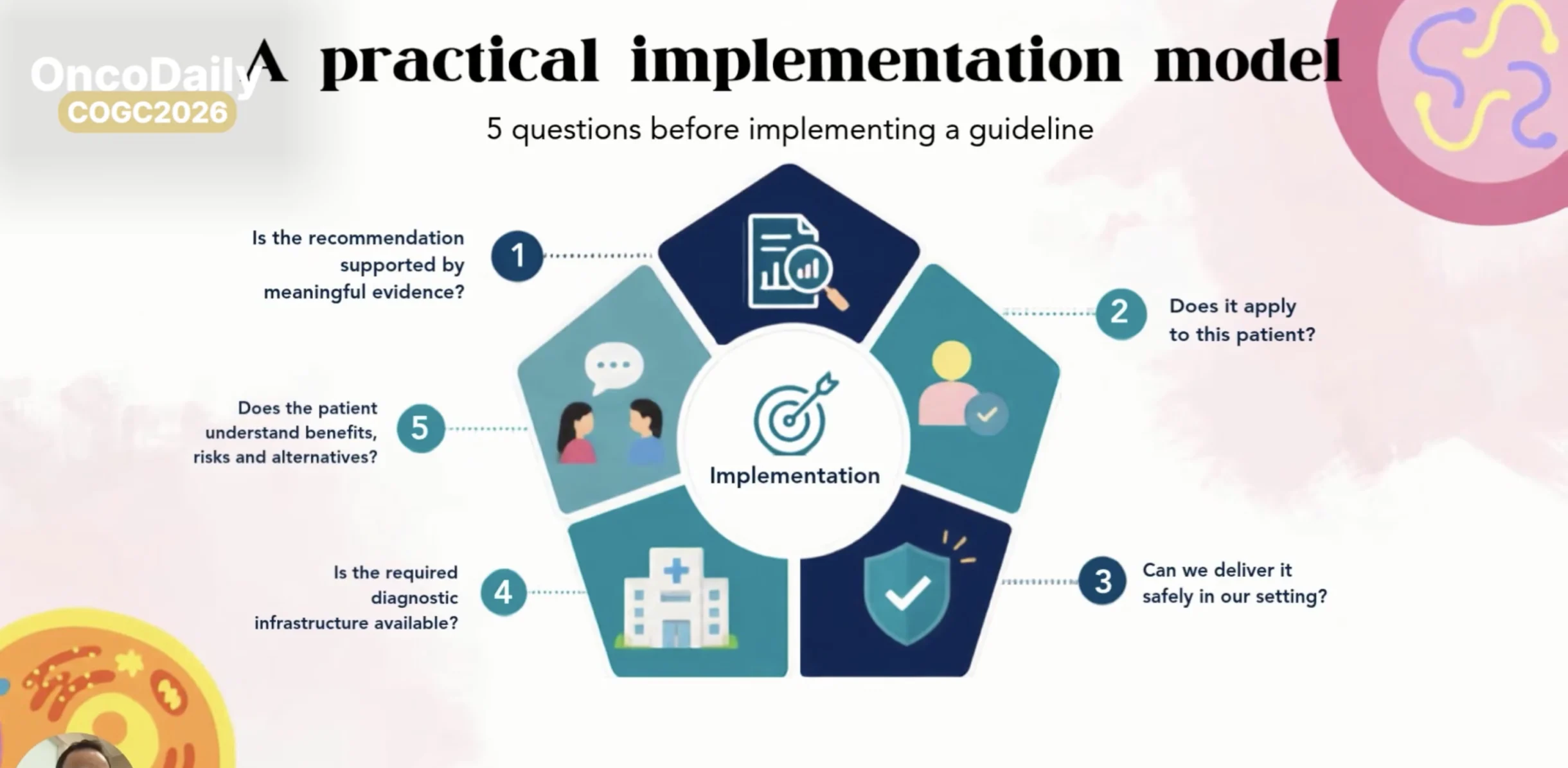
These questions move us away from guideline adherence for its own sake and toward the real goal: evidence-based care adapted to the patient and to the healthcare system.”
When the Evidence Is Clear but the Pathway Is Not
“Imagine a 67-year-old woman with newly diagnosed advanced endometrial cancer.
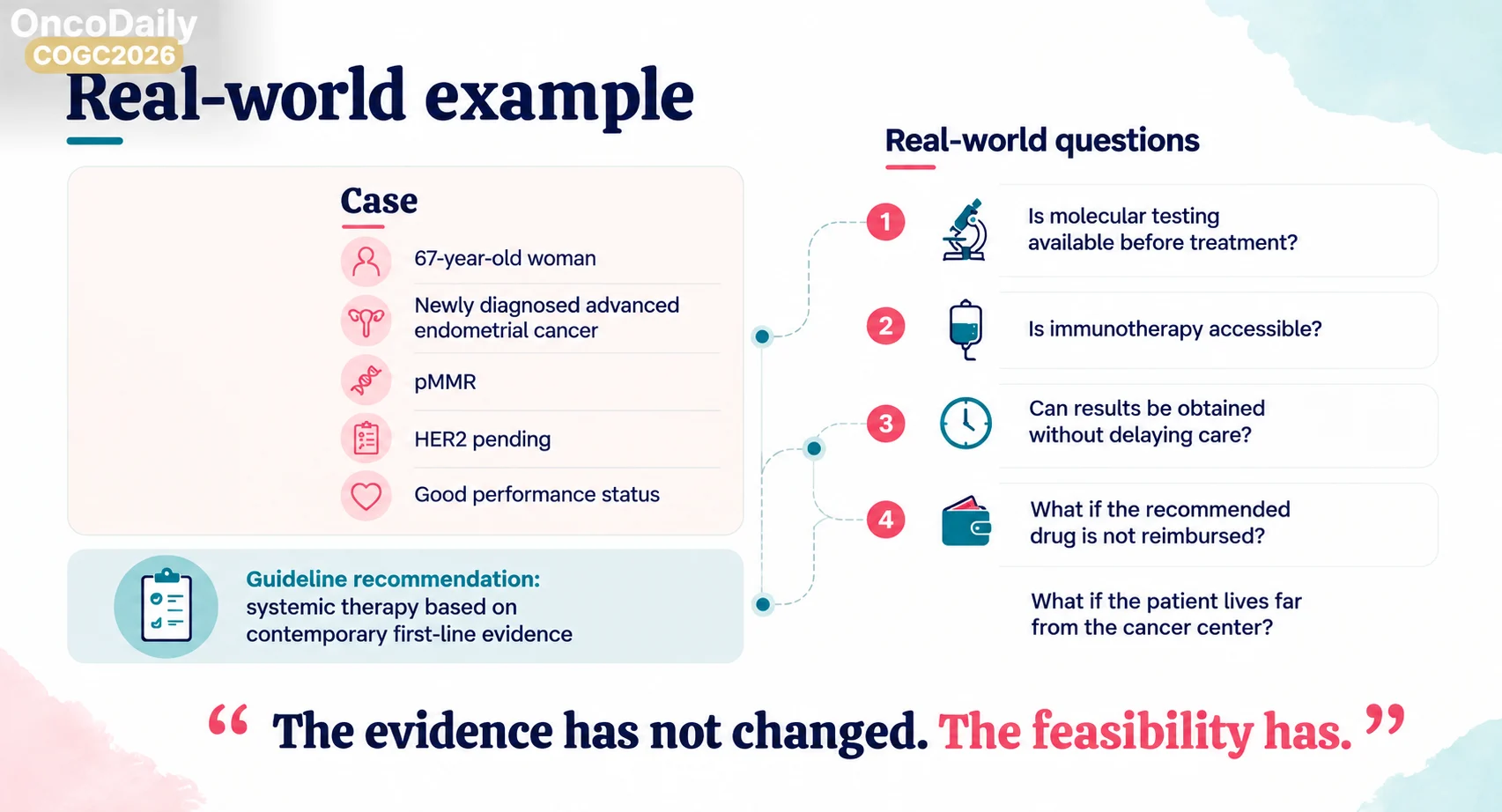
She has good performance status, she is pMMR, and her HER2 testing is still pending.
On paper, the guideline recommendation may look relatively straightforward.
But then the real-world questions begin.
- Is molecular testing available before treatment?
- Is immunotherapy accessible?
- Can we obtain the results without delaying care?
- What happens if the recommended drug is not reimbursed?
- And what if the patient lives several hours away from the cancer center?
The evidence has not changed. The feasibility has.
And that difference may completely change how care is delivered.
This also raises a provocative question: is deviation from a guideline always a marker of poor-quality care?
I would argue that the answer is no.
Sometimes deviation is clinically appropriate because of frailty, comorbidities, or patient preferences. Sometimes it reflects limitations in drug availability, molecular testing, or referral pathways. And sometimes new evidence has emerged before the guideline itself has been updated.
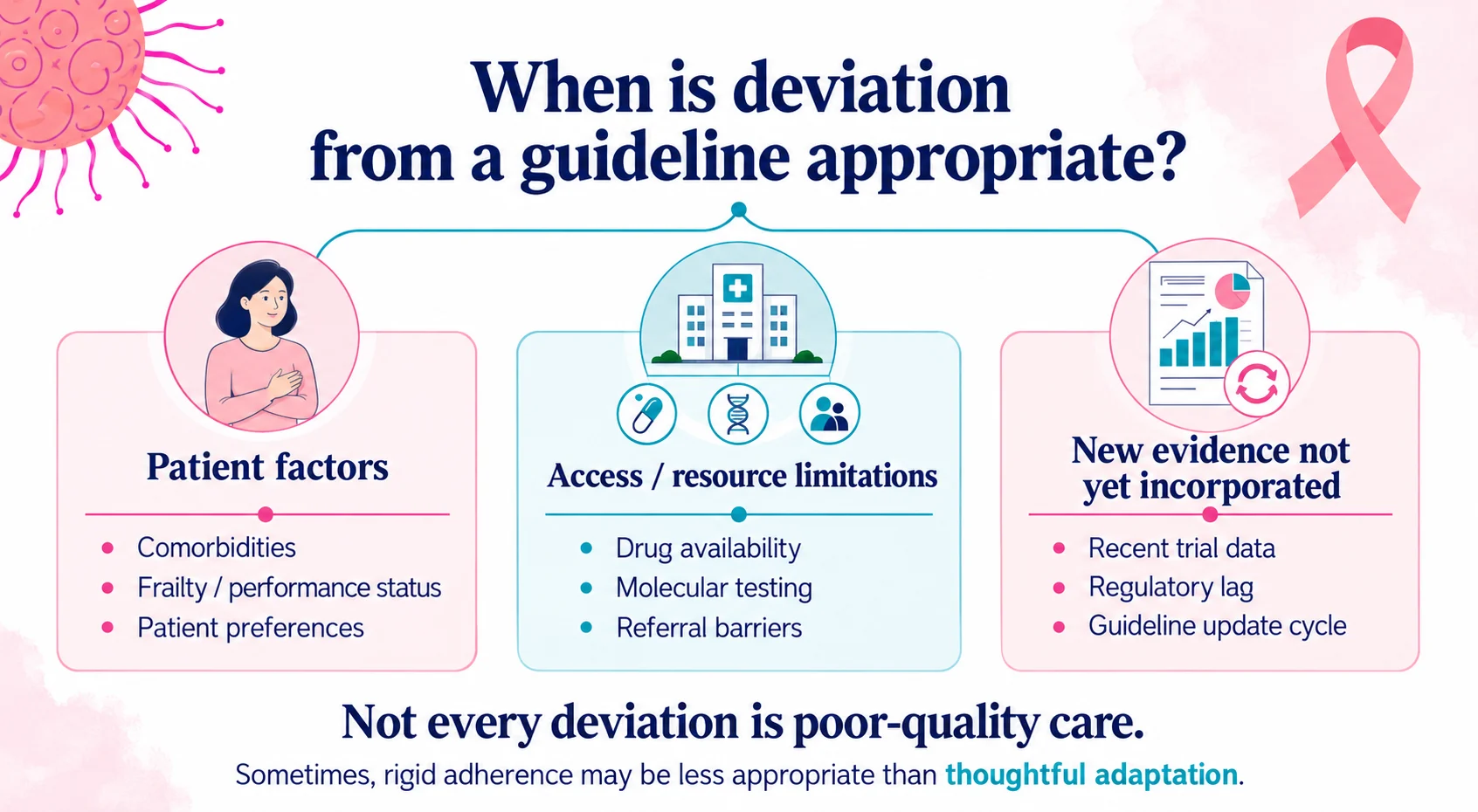
So rigid adherence is not always synonymous with good medicine. Sometimes thoughtful adaptation is more appropriate.
The important question is whether we are still preserving the quality and intent of evidence-based care.
Evidence moves faster than guidelines, and guidelines frequently move faster than healthcare systems.
A new trial may be presented today. Regulatory approval may follow. The guideline changes. But reimbursement, molecular testing, infrastructure, and local access may take considerably longer.
Some implementation gaps are simply the result of science moving faster than the system can adapt.
Even when the evidence, recommendations, and technology are available, patients may still miss appropriate biomarker testing because of workflow, insurance, geography, organization, or equity barriers.
This can happen in highly resourced healthcare systems as well, which is why implementation science matters everywhere.”
Same Evidence, Very Different Access
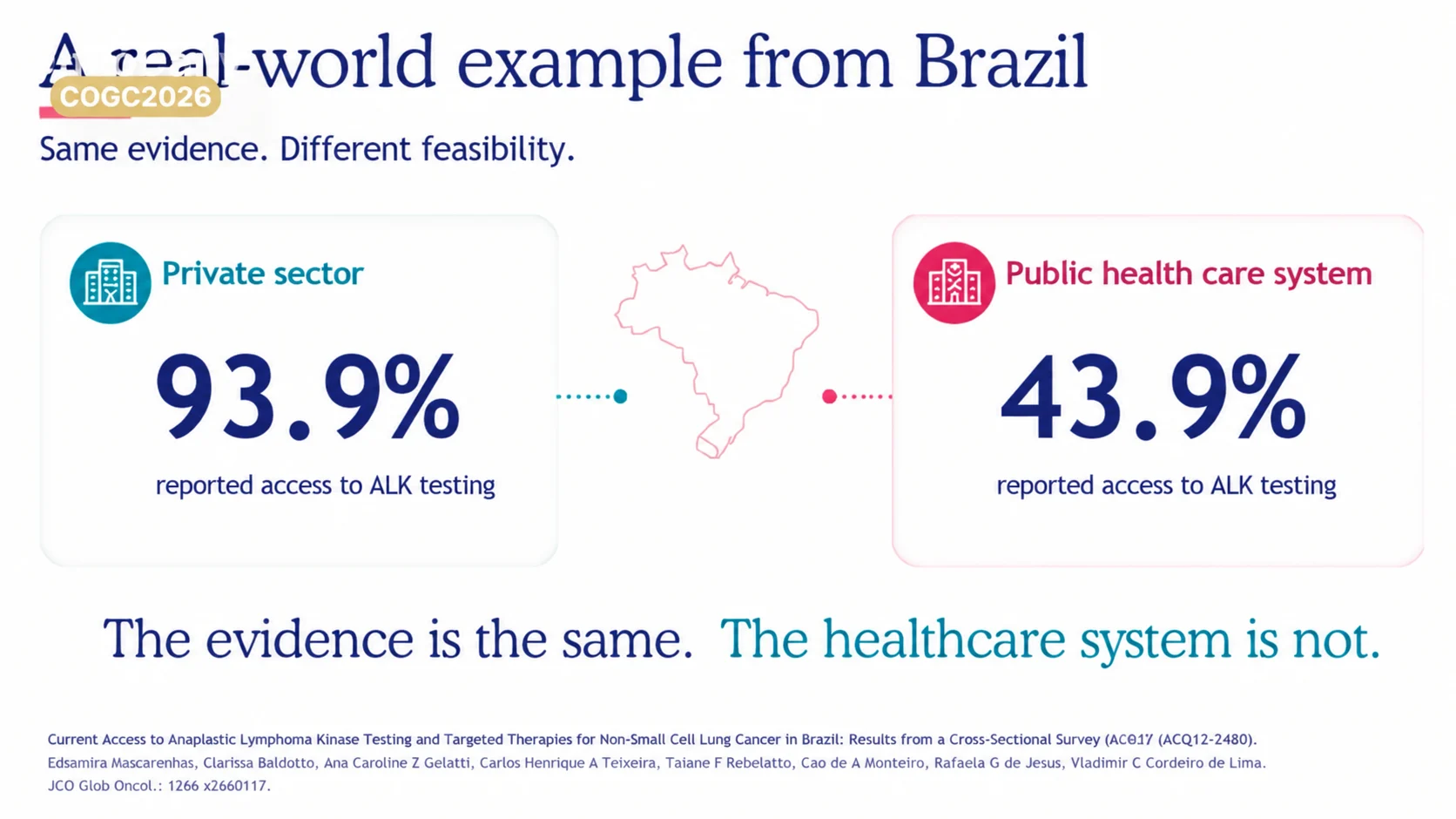
“Let me show you what this can look like in my own country.
A recent Brazilian study evaluated access to ALK testing and targeted therapies. In the private sector, approximately 94% of physicians reported access to ALK testing, compared with only about 44% in the public healthcare system.
Think about what that means.
Same cancer. Same biomarker. Same evidence. Same guideline. But a completely different ability to implement that guideline.
For me, this is one of the clearest examples of the evidence-to-practice gap.
The evidence is the same, the healthcare system is not.”
Getting Guidelines Off the Page
“If implementation cannot depend only on the individual oncologist, then institutions also have a responsibility.
We can:
- Create standardized clinical pathways,
- Strengthen multidisciplinary tumor boards,
- Improve access to molecular diagnostics,
- Invest in continuous medical education,
- Measure quality indicators,
- Audit our own practice.
We can also create referral networks for complex cases and clinical trials.
High-quality community oncology does not mean doing everything locally. It means knowing what should be done locally and when the patient should be referred.
After all of this, one principle becomes very clear: the best guideline is only as good as our ability to implement it.
Good implementation needs to balance three things. It needs to be evidence-based, patient-centered, and context-aware.
A scientifically perfect recommendation that cannot reach the patient is still an incomplete form of care.
So I would finish with one sentence:
Evidence becomes care only when we make it possible.
Publishing a guideline is not the end of evidence-based medicine. Implementation is part of evidence-based medicine.
Bridging the gap between evidence and practice requires us to think not only about what the best treatment is, but also about how we make that treatment accessible, timely, and realistic for the patient in front of us.”
Written by Eliz Baloyan, MD, Features Writer and Editor at OncoDaily and CancerWorld