






At LeukO 2026: Global Virtual Congress on Leukemias, organized by OncoDaily, Naveen Pemmaraju, Professor in the Department of Leukemia and Director of the Blastic Plasmacytoid Dendritic Cell Neoplasm (BPDCN) Program at The University of Texas MD Anderson Cancer Center, discussed advances in treating one of the rarest and most aggressive hematologic malignancies.
His presentation examined how improved understanding of the disease’s biology has led to two FDA-approved CD123-targeted therapies, expanded treatment possibilities for older patients, and renewed interest in combination strategies designed to prevent relapse.
For much of its history, blastic plasmacytoid dendritic cell neoplasm (BPDCN) was difficult to recognize and even harder to treat. Patients frequently presented with unusual skin lesions, conventional chemotherapy produced limited long-term disease control, and historical median overall survival was often approximately eight months to one year.
Over nearly two decades of research, Pemmaraju and his colleagues have helped move the field toward molecularly informed diagnosis and targeted treatment. Yet as he explained, important challenges remain, particularly in managing treatment-related toxicity, central nervous system involvement, and relapse after an initial response.
Recognizing BPDCN: A Rare Cancer With an Unusual Presentation
BPDCN is an aggressive malignancy derived from plasmacytoid dendritic cells. Unlike many other blood cancers, it frequently becomes visible through its involvement of the skin.
Patients may develop purplish or violaceous lesions that range from small patches to more extensive plaques and nodules. The disease can also involve the bone marrow, peripheral blood, lymph nodes, and central nervous system (CNS).
This combination of cutaneous and hematologic manifestations creates diagnostic challenges. In some patients, BPDCN may resemble acute myeloid leukemia (AML), leukemia cutis, or other hematologic malignancies.
Pemmaraju described a familiar diagnostic combination:
CD123, CD4, and CD56.
CD123, the alpha subunit of the interleukin-3 receptor, is strongly expressed in BPDCN and represents a particularly important diagnostic and therapeutic marker.
However, the classic three-marker profile is not sufficient to establish the diagnosis in every case.
Additional testing, including immunohistochemistry and flow cytometry for markers such as TCL1, TCF4, and CD303, can help distinguish BPDCN from other malignancies.
The molecular characteristics of BPDCN provide further insight into its biology.
TET2 is among the most frequently mutated genes, followed by alterations involving ASXL1, RAS-family genes, and splicing factors such as ZRSR2.
Pemmaraju discussed research suggesting that the type of TET2 alteration may influence prognosis, with truncating mutations associated with poorer outcomes in some cohorts.
He also referenced a 2023 study published in Nature, which investigated the relationship between ultraviolet radiation and BPDCN development.
The researchers found that loss of TET2 function could protect plasmacytoid dendritic cells from ultraviolet-induced cell death, potentially contributing to malignant transformation in the skin.
These findings offer a possible biological explanation for the relationship between cutaneous involvement, ultraviolet exposure, and certain molecular alterations, although BPDCN development remains complex.
Not Every Patient Fits the Classic Profile
BPDCN has historically been associated with older men presenting with skin lesions.
However, Pemmaraju emphasized that this clinical pattern does not describe every patient.
He presented examples of patients whose disease developed without characteristic skin involvement.
- One was a young woman with CNS disease and no skin lesions who received tagraxofusp-based treatment and subsequently underwent stem cell transplantation.
- Another patient presented primarily with pancytopenia and lymph node involvement rather than the more recognizable cutaneous manifestations.
These cases illustrate why clinicians must consider BPDCN even when its traditional features are absent.
Accurate diagnosis requires integrating the clinical presentation with pathology, immunophenotyping, and molecular findings.
For patients with this rare malignancy, recognizing the disease correctly can determine whether they receive an appropriate targeted therapy.
CD123: From Diagnostic Marker to Therapeutic Target
The identification of CD123 as a therapeutic target represented a major turning point in BPDCN research.
Historically, treatment relied on chemotherapy regimens borrowed from other hematologic malignancies, including acute lymphoblastic leukemia (ALL), AML, and lymphoma.
Although some patients achieved remission, relapse was common, and long-term outcomes remained poor.
The discovery that BPDCN cells consistently express high levels of CD123 provided an opportunity to develop treatments specifically directed against the malignant population.
Pemmaraju credited early work by Dr. Arthur Frankel and colleagues, who investigated whether the interleukin-3 receptor could be used to deliver a cytotoxic agent directly to cancer cells.
That approach eventually led to the development of tagraxofusp.
Numerous other CD123-targeted strategies have been explored, including monoclonal antibodies, antibody-drug conjugates, bispecific antibodies, and cellular therapies.
However, Pemmaraju noted that only two CD123-targeted agents had received FDA approval for BPDCN by the time of his presentation: tagraxofusp and pivekimab sunirine.
Their development has helped establish BPDCN as an important example of how understanding a rare malignancy’s biology can lead to clinically meaningful therapeutic advances.
Tagraxofusp: The First Approved Targeted Therapy for BPDCN
The first major breakthrough was tagraxofusp, also known as TAG or SL-401.
Tagraxofusp is a fusion protein consisting of recombinant interleukin-3 linked to a modified diphtheria toxin.
The interleukin-3 component binds CD123-expressing cells, allowing the toxin to enter the malignant population and inhibit protein synthesis.
In December 2018, tagraxofusp became the first FDA-approved treatment specifically indicated for BPDCN, including adults and children aged two years and older.
Pemmaraju reviewed the early clinical experience that supported its approval.
In the original pivotal study, 29 previously untreated patients were evaluated, with an overall response rate of approximately 90% and a complete remission or clinical complete remission rate of 72%.
These results were particularly encouraging given the historically limited effectiveness of conventional chemotherapy.
Longer-term follow-up subsequently included 65 treatment-naive patients who received tagraxofusp.
In that larger cohort, median overall survival was 15.8 months, and some patients achieved prolonged remission, particularly those who proceeded to stem cell transplantation.
The distinction between the initial and longer-term analyses is important because the studies evaluated different patient populations and follow-up periods.
Pemmaraju also described individual cases in which treatment produced substantial improvement in skin disease, bone marrow involvement, and general clinical condition.
One patient, a 71-year-old woman with extensive BPDCN, experienced a significant reduction in disease burden following tagraxofusp and subsequently became eligible for allogeneic transplantation.
For some patients, this improvement in performance status creates an opportunity for curative-intent treatment that may not have been feasible at diagnosis.
Managing Capillary Leak Syndrome
Although tagraxofusp demonstrated substantial clinical activity, its development also identified a potentially life-threatening toxicity: capillary leak syndrome (CLS).
CLS occurs when fluid and proteins leak from the vascular compartment into surrounding tissues, potentially causing edema, hypotension, respiratory complications, and organ dysfunction.
The risk led to an FDA boxed warning and the development of specific monitoring and management strategies.
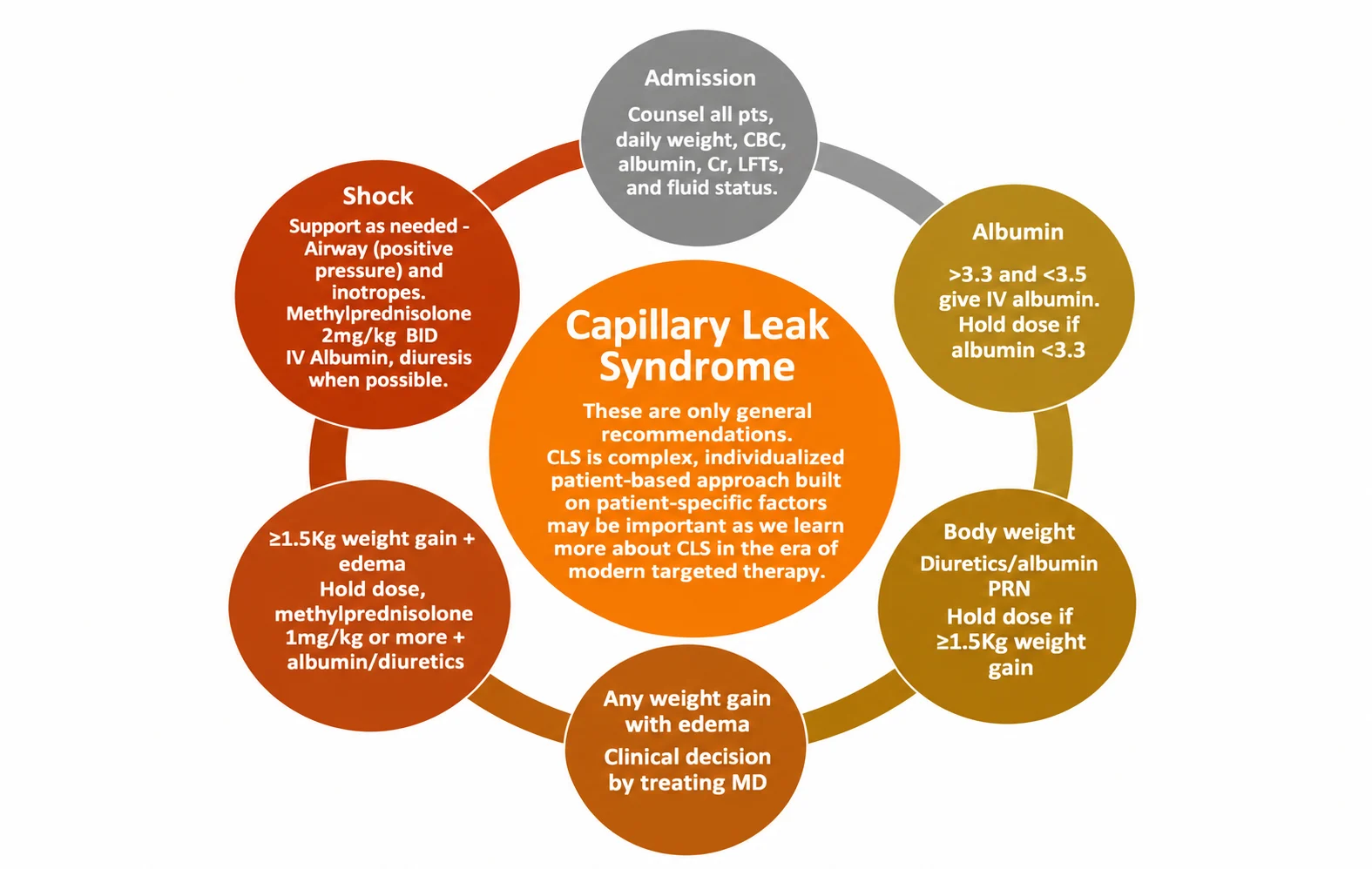
Pemmaraju emphasized the importance of assessing serum albumin, monitoring body weight, and recognizing early changes in fluid balance.
A weight increase of approximately 1.5 kilograms or more above pretreatment weight is one of the clinically important warning thresholds incorporated into treatment guidance.
Management may include temporary interruption of tagraxofusp, corticosteroids, albumin support when indicated, and careful fluid management.
Severe cases may require intensive care.
Pemmaraju described a 31-year-old patient who developed significant capillary leak syndrome during treatment, including respiratory complications.
With aggressive supportive care, the patient recovered, later resumed therapy, and proceeded to allogeneic transplantation.
He reported that the patient remained alive several years after transplantation.
The case illustrated that successful management of treatment toxicity can preserve the opportunity for further therapy.
However, rechallenge after CLS requires careful individual assessment, adherence to prescribing guidance, and appropriate specialist monitoring.
Pivekimab Sunirine: A Second CD123-Targeted Treatment
The second major development discussed by Pemmaraju was pivekimab sunirine, also known as PVEK.
Unlike tagraxofusp, which delivers a modified bacterial toxin, pivekimab sunirine is an antibody-drug conjugate.
It uses an anti-CD123 antibody to deliver an indolinobenzodiazepine cytotoxic payload to malignant cells, causing DNA damage and cell death.
In May 2026, the FDA approved pivekimab sunirine-pvzy, marketed as Decnupaz, for adults with BPDCN.
The approval followed findings from the phase I/II CADENZA trial, which evaluated pivekimab sunirine in previously untreated and relapsed/refractory disease.
Pemmaraju discussed results from 84 patients, including 33 treated in the frontline setting and 51 with relapsed/refractory BPDCN.
Among the 33 previously untreated patients, the study reported:
- An 85% overall response rate.
- A 70% complete remission or clinical complete remission rate.
- A median overall survival of 16.6 months.
The frontline population had a median age of approximately 73 years, demonstrating the feasibility of delivering this treatment to an older group of patients.
Importantly, 13 of the 33 frontline patients proceeded to stem cell transplantation.
Results in the relapsed/refractory cohort were more modest.
Among 51 patients, the overall response rate was approximately 35%, while the complete remission or clinical complete remission rate was approximately 14-16%, depending on the analysis.
Median overall survival in this population was 5.8 months.
Some patients had previously received tagraxofusp, and the observation of subsequent responses to pivekimab sunirine suggests that sequential CD123-directed treatment may be possible in selected cases.
However, this does not establish that pivekimab can reliably overcome resistance to tagraxofusp.
The median overall survival figures reported for tagraxofusp and pivekimab sunirine come from separate studies. They should not be interpreted as evidence that one drug is superior to the other.
A Different Toxicity Profile
Pivekimab sunirine introduces a different set of clinical considerations.
Pemmaraju described hematologic toxicities, including anemia, neutropenia, and thrombocytopenia, alongside peripheral edema and infusion-related reactions.
Edema may emerge after several treatment cycles, making continued monitoring important even when the initial treatment period is well tolerated.
The most serious safety concern is hepatotoxicity, including hepatic veno-occlusive disease (VOD).
VOD can cause severe liver injury and may become life-threatening, particularly in patients who subsequently undergo stem cell transplantation.
The FDA-approved prescribing information therefore includes a boxed warning for hepatotoxicity, including VOD.
Pemmaraju noted that careful evaluation of underlying liver disease, monitoring of hepatic function, and coordination with the transplantation team are particularly important.
The arrival of pivekimab sunirine expands the number of approved BPDCN therapies, but treatment selection still requires balancing response potential with patient characteristics, safety, and the overall treatment plan.
When BPDCN Occurs Alongside Another Blood Cancer
Another important area of Pemmaraju’s research concerns patients with prior or concomitant hematologic malignancies (PCHM).
BPDCN may develop in individuals who already have another blood cancer, particularly myelodysplastic syndromes (MDS), chronic myelomonocytic leukemia (CMML), or myeloproliferative neoplasms.
This association is especially relevant because overlapping mutations, including TET2, suggest that the diseases may sometimes arise through divergent evolution from an earlier abnormal hematopoietic clone.
In the expanded frontline tagraxofusp cohort, eight of 65 patients had a prior or concomitant hematologic malignancy.
These patients could respond to BPDCN-directed treatment, but the presence of another malignancy complicated the assessment of disease control and long-term prognosis.
For example, eliminating BPDCN cells may not adequately treat an underlying MDS or CMML clone.
Consequently, clinicians must determine whether treatment is controlling one malignancy, both malignancies, or only a particular component of the disease.
Pemmaraju emphasized that these cases require careful evaluation of bone marrow findings, molecular results, and transplantation options.
They also illustrate why BPDCN should be understood within the broader context of clonal hematopoiesis and related myeloid disorders.
Central Nervous System Involvement: A Frequently Overlooked Risk
One of Pemmaraju’s strongest clinical recommendations concerned CNS evaluation.
BPDCN has a substantially higher frequency of CNS involvement than might be suspected from its visible skin manifestations.
Studies have reported CNS involvement in approximately 20-30% of patients, including individuals without neurological symptoms.
Pemmaraju stressed that the absence of headaches, neurological deficits, or other obvious signs does not exclude disease in the cerebrospinal fluid.
His approach to comprehensive BPDCN assessment includes four major components:
- Skin examination and biopsy,
- Appropriate imaging,
- Bone marrow evaluation,
- Lumbar puncture with cerebrospinal fluid analysis.
For skin disease, clinical photography and standardized assessment methods such as the modified Severity-Weighted Assessment Tool (mSWAT) can help document treatment response.
Imaging, including CT or PET-CT when appropriate, may identify lymph node or other extramedullary involvement.
Bone marrow examination remains essential for detecting marrow disease and assessing hematologic response.
However, lumbar puncture is particularly important because CNS involvement may otherwise remain undetected.
Pemmaraju advocates baseline CNS evaluation and intrathecal chemotherapy as part of BPDCN management.
His group’s approach commonly incorporates at least eight intrathecal treatments, alternating cytarabine and methotrexate, with the number and intensity adjusted according to clinical findings and risk.
This is an expert and institutional treatment strategy rather than a universal requirement established for every patient in every clinical setting.
The concern is particularly relevant to targeted therapies because agents such as tagraxofusp and pivekimab sunirine have not been shown to reliably control disease within the CNS.
Therefore, a patient may experience substantial improvement in skin and bone marrow disease while still requiring separate CNS-directed treatment.
For Pemmaraju, recognizing this risk early is essential to avoiding a potentially preventable site of relapse.
Beyond CD123: Venetoclax and Combination Treatment
Despite the progress achieved with CD123-targeted therapies, relapse remains a substantial problem.
Pemmaraju explained that his group has increasingly investigated combinations designed to improve remission durability and address mechanisms of resistance.
One important observation is that BPDCN cells appear highly dependent on BCL-2, an anti-apoptotic protein that supports malignant cell survival.
This provided a rationale for investigating venetoclax, a selective BCL-2 inhibitor already used in AML treatment.
Early clinical reports demonstrated that venetoclax could produce responses in heavily pretreated BPDCN, but these responses were often transient.
Investigators subsequently evaluated venetoclax combined with hypomethylating agents such as azacitidine or decitabine.
Small studies suggested that these regimens were feasible, particularly for older or medically unfit patients.
In some cases, treatment improved performance status sufficiently for patients to proceed to transplantation.
However, Pemmaraju cautioned that venetoclax-based lower-intensity treatment should not be regarded as an established curative approach for BPDCN when used without transplantation.
Its value may lie in disease control, symptom improvement, or providing a bridge to further treatment.
Combining Targeted Therapy With Intensive Chemotherapy
Pemmaraju also presented his group’s experience combining tagraxofusp, venetoclax, and hyper-CVAD, an intensive chemotherapy regimen traditionally used in acute lymphoblastic leukemia.
Hyper-CVAD-based treatment has attracted interest in BPDCN partly because its CNS-directed components may help address a major site of disease involvement.
In a phase II experience discussed at the congress, 16 previously untreated patients received this combination.
Approximately 94% responded, and 10 of the 16 patients proceeded to stem cell transplantation.
Median overall survival was reported at approximately 14.6 months, with a two-year overall survival rate of 45%.
Although several patients experienced prolonged remission, the overall survival results also reflected the difficulty of treating an older and medically complex population.
Pemmaraju noted that early deaths occurred, including complications related to infections and the treatment period overlapping with the COVID-19 pandemic.
The findings indicate that intensive combination strategies may be effective for selected patients, but their toxicity and resource requirements limit their suitability for others.
Tagraxofusp, Azacitidine, and Venetoclax: A Promising Triplet
A second approach combines tagraxofusp with azacitidine and venetoclax, offering a potentially less intensive treatment strategy.
This combination is supported by the biological rationale for targeting CD123 and BCL-2 simultaneously, while using azacitidine to influence additional leukemia survival and resistance mechanisms.
Pemmaraju discussed phase II results involving 16 previously untreated patients receiving the triplet.
The regimen produced high response rates, and 10 patients, or 63%, proceeded to allogeneic stem cell transplantation.
Capillary leak syndrome occurred in approximately 15% of patients across the study population, emphasizing the continued need for safety monitoring even with modified treatment schedules.
A 2026 publication reported a composite complete remission rate of 88% in the frontline cohort, with median overall survival not yet reached and a two-year overall survival rate of 65%.
The relapsed/refractory cohort also demonstrated activity, although outcomes remained less favorable than those observed in newly diagnosed patients.
These results are encouraging, especially given the older age and comorbidity burden commonly seen in BPDCN.
However, the study included a small number of patients and was not a randomized comparison against tagraxofusp or pivekimab sunirine alone.
The triplet therefore remains an investigational approach, and further studies are needed to clarify its role in routine clinical practice.
Stem Cell Transplantation and the Search for Long-Term Survival
Across the different treatment strategies, Pemmaraju repeatedly returned to the importance of stem cell transplantation.
Although targeted therapies can produce substantial responses, allogeneic hematopoietic stem cell transplantation remains the principal established treatment with curative potential for eligible patients with BPDCN.
The most favorable outcomes have generally been reported when transplantation is performed during the first complete remission.
Pemmaraju encouraged clinicians to reassess transplant eligibility after successful treatment, particularly when a patient’s initial poor performance status was related to extensive disease burden.
A patient who is not suitable for transplantation at diagnosis may become eligible after achieving substantial disease control.
Autologous transplantation has also been used in selected patients, although its precise role remains less established.
Pemmaraju shared a particularly meaningful observation from his group’s long-term clinical experience.
Among more than 100 patients followed over the years, four had reached approximately ten years of survival.
Some had received conventional intensive chemotherapy followed by transplantation, while others participated in the original tagraxofusp study and subsequently underwent transplantation.
These individual experiences demonstrate that long-term survival is possible, but they do not establish a ten-year survival rate for the broader BPDCN population.
For Pemmaraju, the challenge is increasing the number of patients who achieve similarly durable outcomes.
Achieving an initial response is important, but preventing relapse and preserving the possibility of transplantation remain central treatment goals.
The Future of BPDCN Treatment
BPDCN has undergone a significant change in clinical practice over the past decade.
Improved diagnostic markers have made the disease easier to recognize, while CD123-directed therapies have introduced treatment options specifically developed for its biology.
Tagraxofusp, approved in 2018, established the first targeted treatment pathway. The approval of pivekimab sunirine in 2026 added a second mechanism for delivering cytotoxic therapy through CD123.
At the same time, research into BCL-2 inhibition, hypomethylating agents, and combination regimens is expanding the therapeutic landscape.
Yet Pemmaraju emphasized that patients continue to experience relapse, treatment-related toxicity, and limited long-term survival.
Future studies must determine how best to sequence CD123-targeted agents, identify and overcome resistance, integrate CNS-directed treatment, and improve remission durability.
The most promising combinations will also need to demonstrate that their benefits extend beyond early response rates and translate into meaningful improvements in survival.
The direction of BPDCN research increasingly involves using several complementary approaches to achieve deeper and more durable disease control.
The development of two approved CD123-targeted therapies has substantially expanded treatment options for BPDCN. The next priority is to make those responses last longer, reduce relapse, and help more patients reach potentially curative transplantation or achieve sustained remission.
Written by Eliz Baloyan, MD, Features Writer and Editor at OncoDaily and CancerWorld
Watch the full video on YouTube.