Key takeaways
- CML treatment has entered a new era, where the goal extends beyond long-term survival to improving quality of life and helping eligible patients achieve treatment-free remission.
- Treatment-free remission is an achievable goal for carefully selected patients, offering the possibility of maintaining molecular disease control without continuous TKI therapy.
- Deeper and more sustained molecular responses improve the chances of successful treatment discontinuation, making treatment selection and molecular monitoring essential from the beginning.
- Asciminib is creating new opportunities in CML management, with clinical trials demonstrating deeper molecular responses and favorable tolerability, although its impact on treatment-free remission still requires confirmation.
- The future of CML care lies in individualized treatment strategies, balancing disease control, treatment-related toxicity, patient preferences, and the possibility of a treatment-free life.
At LeukO 2026: Global Virtual Congress on Leukemias, organized by OncoDaily, Natalia Baran, Leading Attending and Assistant Professor in the Department of Hematology and Hematological Central Laboratory at the University of Bern, Switzerland, presented an evidence update on treatment-free remission (TFR) in chronic myeloid leukemia (CML), examining which patients can safely discontinue therapy, how to identify the optimal time to stop, and how emerging treatments and molecular tools could expand future opportunities.
The treatment of CML has undergone one of the most remarkable transformations in hematology. With modern tyrosine kinase inhibitors (TKIs), many patients now achieve long-term survival approaching that of the general population.
But this success has introduced a new clinical ambition: helping eligible patients maintain remission without continuous treatment.
Drawing on updated European LeukemiaNet recommendations, clinical trial findings, and emerging molecular research, Baran explored how treatment-free remission is becoming an increasingly important part of personalized CML management.
From Long-Term Survival to Life Without Daily Treatment
The introduction of imatinib revolutionized CML treatment, replacing older therapeutic approaches with targeted inhibition of the BCR::ABL1 oncoprotein.
Subsequent generations of TKIs improved molecular responses, expanded treatment options for resistant disease, and made long-term disease control possible for many patients.
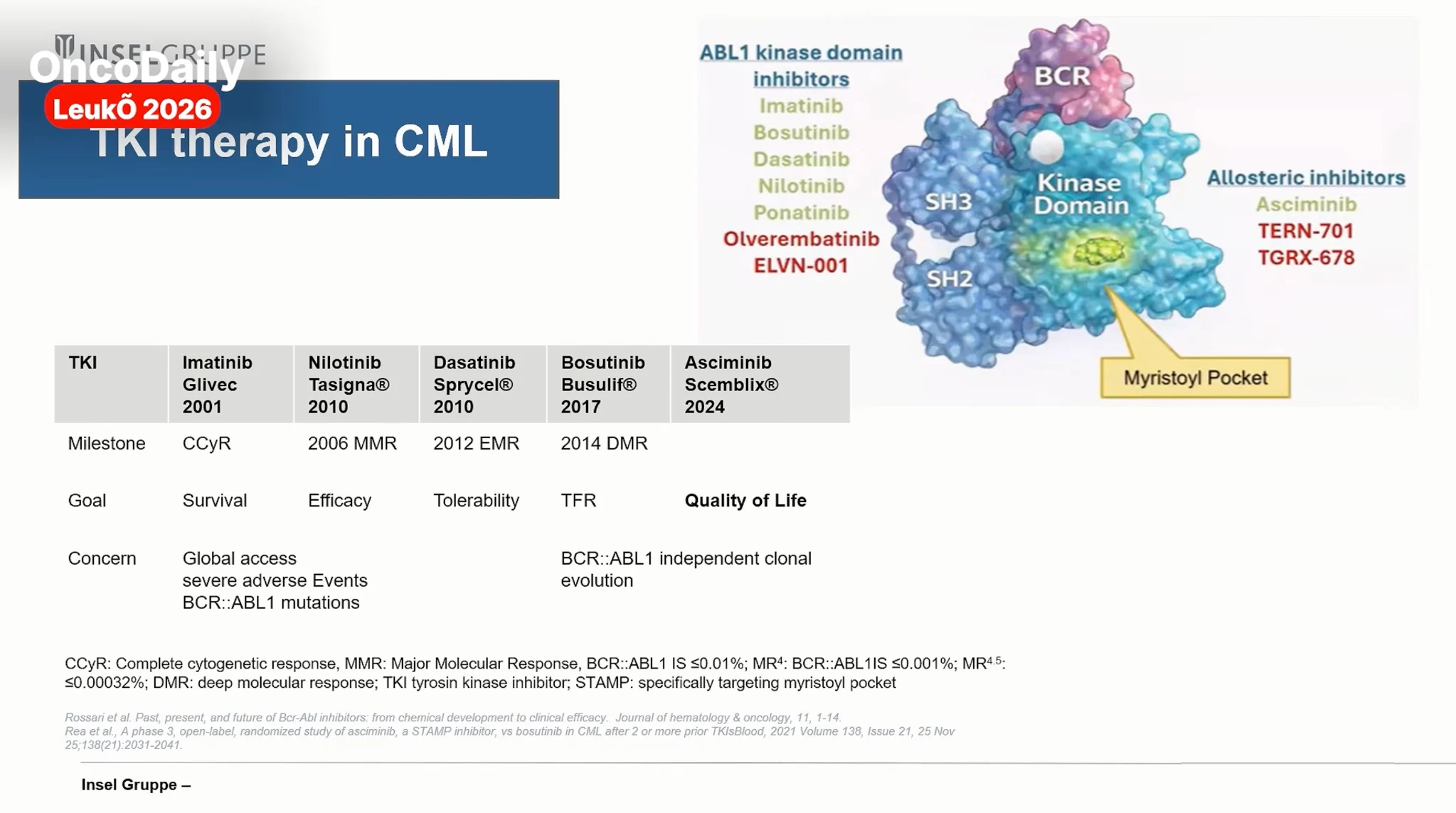
Today, five-year survival in contemporary CML populations can approach 95%, shifting attention toward the long-term experience of living with the disease.
Although TKIs are highly effective, continuous treatment can involve chronic adverse effects, drug interactions, financial burdens, and the psychological weight of taking medication indefinitely.
Treatment-free remission offers a different possibility: stopping TKI therapy while maintaining molecular disease control through continued surveillance.
Baran described this evolution as a shift in treatment priorities, from survival to efficacy and now toward quality of life and treatment-free remission.
The available evidence is encouraging.
Meta-analyses of TKI discontinuation studies suggest that approximately 50-60% of carefully selected patients maintain treatment-free remission at one year, although results vary between studies and patient populations.
For Baran, these findings make TFR a realistic treatment objective, but one that needs to be considered from the beginning of a patient’s therapeutic journey.
“The selection of frontline therapy is the first step in the TFR journey.”
That perspective is particularly important as newer treatments become available.
Imatinib remains an established and valuable option, particularly when long-term disease control and tolerability are the main considerations. However, second-generation TKIs and newer agents such as asciminib can achieve deeper molecular responses more rapidly, potentially influencing how soon patients become candidates for treatment discontinuation.
The challenge is determining which patients are most likely to benefit from that opportunity.
Who Is Ready to Stop Treatment?
Treatment-free remission requires considerably more than a favorable response to therapy.
Patients must demonstrate sustained molecular disease control, have an appropriate treatment history, and be willing and able to undergo frequent monitoring after discontinuation.
Baran highlighted the importance of the 2025 European LeukemiaNet (ELN) recommendations, which provide a structured framework for selecting patients and managing TFR attempts.
The central requirement is a sustained deep molecular response (DMR), meaning that BCR::ABL1 transcript levels have fallen to very low levels.
Molecular response is measured using the International Scale:
- MMR (MR3): BCR::ABL1 ≤0.1%
- MR4: BCR::ABL1 ≤0.01%
- MR4.5: BCR::ABL1 ≤0.0032%
- MR5: BCR::ABL1 ≤0.001%
For patients considering TFR, major molecular response alone is generally insufficient. A sustained response of at least MR4 is required, with deeper and longer-lasting responses generally associated with more favorable outcomes.
The 2025 ELN recommendations specify minimal criteria that include chronic-phase disease, an adequate duration of TKI treatment, and more than two years of sustained MR4 or deeper response. The recommended treatment duration is generally more than five years, or more than four years for second-generation TKIs.
Optimal candidates have maintained even longer or deeper responses, although eligibility must always be individualized.
Baran repeatedly returned to a straightforward principle:
“I think the deeper the better.”
She highlighted data suggesting that patients who reach MR5 may have particularly favorable TFR outcomes, with approximately 75% maintaining remission at one year in the selected population illustrated in her presentation.
These findings do not mean that MR5 is required for every TFR attempt. Rather, they reinforce the importance of molecular response depth when estimating the likelihood of remaining off treatment.
Duration matters as well. Patients who have received TKIs for longer periods and maintained deep responses over time generally have better chances of sustaining remission after discontinuation.
Just as importantly, patients need access to reliable BCR::ABL1 molecular testing and must understand that stopping treatment does not mean stopping follow-up.
The First Months After Discontinuation Matter Most
For patients who successfully discontinue TKIs, the initial months require particularly close attention.
Most molecular recurrences occur early, making frequent BCR::ABL1 monitoring essential.
Baran emphasized intensive PCR surveillance during the first six months, when the risk of losing molecular response is greatest.
Current ELN guidance recommends molecular monitoring approximately every six to eight weeks during the first six months, every two months during months six to twelve, and every three to six months thereafter. Some discontinuation protocols use monthly testing initially.
The objective is to detect molecular recurrence before clinical progression occurs.
In most established TFR protocols, loss of major molecular response, defined as BCR::ABL1 rising above 0.1% on the International Scale, is the trigger for restarting treatment.
One of the most reassuring findings from discontinuation research is that molecular recurrence is usually manageable.
“If a patient relapses, I don’t think we have reason to panic.”
Baran highlighted data showing that approximately 90-95% of patients who lose molecular response regain their previous deep response after restarting TKI therapy.
In the findings she presented, approximately 93% regained deep molecular response, typically within several months.
The same previously effective TKI can often be reintroduced, followed by intensified molecular monitoring until the response is restored.
This is an important distinction for both physicians and patients.
An unsuccessful TFR attempt does not necessarily indicate resistance or irreversible disease progression. Most patients can regain control after restarting treatment, although uncommon serious outcomes reinforce the importance of careful selection and surveillance.
For selected patients who regain a stable deep molecular response, a second attempt at treatment-free remission may also be considered.
The decision requires individualized assessment, as outcomes after a second discontinuation attempt can differ from those observed after the first.
Could Asciminib Bring Treatment-Free Remission Closer?
One of the most promising developments discussed by Baran was the expanding role of asciminib, a first-in-class STAMP inhibitor that targets BCR::ABL1 through its myristoyl pocket rather than the ATP-binding site targeted by conventional TKIs.
The distinction in mechanism has introduced another option for achieving molecular disease control, including in newly diagnosed CML.
Baran highlighted updated findings from the Phase III ASC4FIRST trial, which compared asciminib with investigator-selected standard TKIs in patients with newly diagnosed chronic-phase CML.
The longer-term results demonstrated continued improvements in molecular response.
At 144 weeks, 56% of patients receiving asciminib achieved MR4, compared with 36% receiving the combined comparator TKIs.
In the comparison with imatinib, MR4 rates reached 58% with asciminib versus 33% with imatinib.
Asciminib also produced higher rates of MR4.5, with 42% of patients achieving that response compared with 25% in the overall comparator group.
These differences are especially relevant to treatment-free remission because achieving and maintaining deep molecular responses is an essential prerequisite for safely attempting discontinuation.
The results also showed favorable tolerability, an important consideration for patients who may require treatment over many years.
Baran discussed the Phase IIIb ASC4START trial, which directly compared asciminib with nilotinib in newly diagnosed chronic-phase CML.
The study met its primary endpoint, demonstrating a lower risk of treatment discontinuation due to adverse events with asciminib.
Adverse-event-related discontinuation occurred in 5.6% of patients receiving asciminib, compared with 12.1% receiving nilotinib, with a hazard ratio of 0.45 for the primary time-to-discontinuation endpoint.
For patients whose ultimate goal may be treatment-free remission, combining effective molecular disease control with favorable tolerability could be particularly valuable.
However, Baran acknowledged an important remaining question.
Although asciminib has demonstrated higher and deeper molecular response rates, whether these improvements will translate into higher rates of successful treatment-free remission has not yet been established.
Direct discontinuation data and longer-term follow-up will be necessary to answer that question.
Asciminib’s role also extends beyond frontline therapy.
Baran referenced the ASCEMBL trial, which demonstrated sustained efficacy and favorable treatment retention with asciminib compared with bosutinib in previously treated CML.
She also discussed its activity in selected patients with the T315I mutation, highlighting how newer treatment options may help patients maintain disease control after resistance to earlier TKIs.
Together, these developments are expanding the range of therapeutic strategies available throughout the course of CML treatment.
Can Molecular Testing Predict Who Will Remain in Remission?
Even among patients meeting established TFR criteria, outcomes vary considerably.
Some maintain molecular remission for years after stopping treatment, while others experience recurrence within months.
This raises an important question: can clinicians predict the likelihood of successful treatment-free remission before discontinuation?
Baran highlighted the growing role of digital polymerase chain reaction (dPCR), which offers highly sensitive detection and quantification of low levels of BCR::ABL1 transcripts.
A 2024 individual-participant-data meta-analysis examined whether dPCR results could help predict molecular recurrence after TKI discontinuation.
The investigators developed a composite risk model incorporating dPCR findings, total TKI treatment duration, and BCR::ABL1 transcript type.
The resulting model separated patients into three risk categories, with estimated molecular recurrence probabilities at 24 months of approximately:
- 25% in the low-risk group
- 45% in the intermediate-risk group
- 68% in the high-risk group
These findings suggest that combining molecular measurements with clinical characteristics could provide more personalized estimates of TFR success.
Baran also discussed differences associated with BCR::ABL1 transcript type.
Patients expressing the e14a2 transcript have shown more favorable TFR outcomes in several analyses than those expressing e13a2.
The significance of this association remains an area of investigation, but it could contribute to more individualized counseling.
Another emerging direction involves genomic and immunological biomarkers.
Baran referred to research from the DESTINY trial, including analyses investigating whether somatic variants associated with clonal hematopoiesis influence the likelihood of maintaining TFR.
Exploratory findings have implicated variants in genes such as EZH2, GATA2, and DNMT3A, suggesting that biological factors beyond BCR::ABL1 transcript depth may influence outcomes.
However, these genomic associations require further validation and are not yet established criteria for deciding whether patients should discontinue treatment.
Immune mechanisms may also contribute to sustained remission, with natural killer cell function and other immune characteristics being investigated as potential predictors.
The longer-term ambition is to combine clinical history, molecular response, genomic characteristics, and immune biomarkers into more accurate tools for patient selection.
Rather than offering TFR based on a small number of fixed criteria, clinicians may eventually be able to estimate individual risks and choose the most appropriate time to stop treatment.
A More Personalized Path to Treatment-Free Remission
Treatment-free remission can have different meanings for patients at different stages of life.
For younger adults, it may represent an opportunity to reduce the long-term burden of medication or plan for pregnancy under specialist supervision.
For older patients, discontinuation may help reduce polypharmacy, persistent adverse effects, and the complexity of managing multiple chronic conditions.
Baran also emphasized the importance of considering the needs of pediatric patients, where growth, development, and long-term treatment exposure require particular attention. Evidence for TFR and newer TKIs in children remains more limited than in adults, making specialist oversight essential.
The possibility of treatment discontinuation also raises questions about how best to prepare patients.
One strategy discussed was gradual dose reduction before complete cessation.
The DESTINY trial investigated this approach by reducing TKI doses before discontinuation in selected patients.
Its findings suggested that dose de-escalation may provide a feasible pathway toward TFR, although it is not a universal requirement and the most appropriate strategy depends on the individual patient.
For patients who have already attempted discontinuation unsuccessfully, newer therapies and improved molecular monitoring may eventually provide additional ways to optimize treatment before another attempt.
Baran’s broader message was that TFR should be considered as part of a long-term, individualized treatment strategy rather than an isolated decision made after years of therapy.
It begins with choosing an appropriate TKI, continues through molecular response monitoring and risk assessment, and requires careful follow-up when treatment is stopped.
“TFR is achievable for the right patients.”
The expanding evidence base is helping clinicians understand who those patients are, when discontinuation may be appropriate, and how to manage molecular recurrence safely.
As newer treatments, digital PCR, and emerging biomarkers continue to develop, treatment-free remission may become an option for a broader group of patients with CML.
The next major advance may not simply be a treatment that controls leukemia more effectively, but a more precise way to identify when patients can safely live without continuous treatment.
Written by Eliz Baloyan, MD, Features Writer and Editor at OncoDaily and CancerWorld