
Key takeaways
- Venetoclax has transformed AML treatment, establishing BCL-2 inhibition as an important therapeutic strategy and opening new possibilities for patients previously considered ineligible for intensive chemotherapy.
- The PARADIGM trial could reshape frontline AML treatment, demonstrating improved event-free survival with azacitidine–venetoclax compared with intensive chemotherapy in selected chemotherapy-fit patients.
- AML genetics play a critical role in treatment response, with mutations involving FLT3, RAS, and TP53 influencing sensitivity to venetoclax and the development of resistance.
- RAS mutations are revealing new opportunities to overcome venetoclax resistance, with preclinical research supporting combinations that target alternative survival pathways such as MCL-1.
- The future of AML treatment is increasingly genotype-driven, with emerging combinations aiming to deliver more durable remissions while minimizing treatment-related toxicity.
At LeukO 2026: Global Virtual Congress on Leukemias, organized by OncoDaily, Marina Konopleva, Director of the Leukemia Program and Co-Director of the Translational Blood Cancer Institute at Montefiore Einstein Comprehensive Cancer Center, explored how BCL-2 inhibition has transformed the treatment of acute myeloid leukemia (AML), what scientists have learned about resistance to venetoclax, and how emerging combination strategies could improve outcomes across different molecular subtypes.
The introduction of venetoclax marked a major advance for patients with AML who could not tolerate intensive chemotherapy. Yet its success also revealed the biological complexity of the disease. Some patients achieve durable remissions, while others respond briefly or develop resistance despite treatment.
For Konopleva, whose research contributed to establishing BCL-2 as a therapeutic target in AML, understanding these differences has become central to developing the next generation of treatment strategies.
The Drug That Changed AML Treatment Almost Didn’t Get There
BCL-2 is an anti-apoptotic protein that helps cells survive by preventing programmed cell death. In AML, many leukemic cells express increased levels of BCL-2, allowing them to evade the normal mechanisms that eliminate damaged or abnormal cells.
Early laboratory research, including work from Konopleva’s group, demonstrated that inhibiting BCL-2 could eliminate AML cells and leukemia stem cells while showing relative selectivity over normal hematopoietic stem cells.
These findings provided the biological rationale for investigating venetoclax, a selective BCL-2 inhibitor designed to restore the apoptotic machinery in malignant cells.
But the transition from laboratory research to clinical treatment was not straightforward.
In an early study involving approximately 30 patients with relapsed or refractory AML, venetoclax monotherapy produced an objective response rate of only 19%.
“I have to say that our expectations were not met.”
Although approximately half of the patients experienced reductions in leukemic blasts, the responses were generally short-lived. The median time on study was approximately two months.
The investigators also noticed something important: patients with certain molecular alterations, particularly IDH1 and IDH2 mutations, appeared more likely to respond.
That observation suggested that the effectiveness of BCL-2 inhibition might depend heavily on leukemia biology.
The next step was combining venetoclax with other treatments.
Clinical development shifted toward patients who were older or ineligible for intensive chemotherapy, using venetoclax alongside hypomethylating agents such as azacitidine or decitabine.
The pivotal Phase III VIALE-A trial demonstrated the impact of this approach.
Patients receiving azacitidine plus venetoclax achieved a median overall survival of 14.7 months, compared with 9.6 months among those receiving azacitidine alone.
The combination also substantially improved remission rates.
Venetoclax combinations initially received accelerated FDA approval for eligible patients with newly diagnosed AML in 2018, followed by regular approval in 2020 after confirmatory trial results.
For a patient population with limited effective treatment options, this represented a major change in clinical practice.
But the development story was far from over.
PARADIGM: Could Venetoclax Challenge Intensive Chemotherapy?
For years, the use of azacitidine plus venetoclax has been established primarily in patients considered ineligible for intensive induction chemotherapy.
But what if the same approach could benefit patients who are fit enough to receive intensive treatment?
Konopleva highlighted findings from the PARADIGM trial, a randomized Phase II study published in the New England Journal of Medicine in September 2026.
The trial compared azacitidine plus venetoclax with conventional intensive induction chemotherapy in 172 previously untreated adults with AML who were considered eligible for intensive treatment.
Importantly, the study focused on a selected population. Patients with core-binding-factor AML, FLT3 mutations, and certain NPM1-mutated cases were excluded because established treatment approaches may be particularly effective in those subgroups.
Most participants had adverse-risk disease.
The results challenged expectations.
Median event-free survival reached 14.5 months with azacitidine plus venetoclax, compared with 6.2 months with intensive chemotherapy.
The venetoclax combination also produced higher overall response rates and fewer severe infections and hemorrhagic complications.
Another notable finding was the proportion of patients who proceeded to hematopoietic stem cell transplantation: approximately 60% in the azacitidine-venetoclax arm versus 40% in the intensive chemotherapy arm.
This suggested that a less-intensive approach could potentially help more patients reach transplantation without experiencing the same burden of induction-related toxicity.
However, the study did not establish an overall survival advantage. Median overall survival was approximately 21.5 months with azacitidine-venetoclax and 18 months with intensive chemotherapy, without a demonstrated significant difference.
Konopleva viewed the findings as potentially practice-changing, particularly for selected patients whose disease biology predicts less favorable outcomes with conventional intensive treatment.
At the same time, PARADIGM was a Phase II trial with specific eligibility criteria, and the results do not establish azacitidine-venetoclax as a universal replacement for intensive chemotherapy.
What they do suggest is that the traditional distinction between chemotherapy-fit and chemotherapy-unfit patients may not be sufficient to determine the optimal treatment for every patient with AML.
Molecular characteristics, expected treatment toxicity, and the possibility of proceeding to transplantation are increasingly important parts of that decision.
Why Some Leukemias Escape BCL-2 Inhibition
Despite the success of venetoclax-based therapy, resistance remains a major obstacle.
Konopleva explained that AML cells can survive BCL-2 inhibition by relying on other anti-apoptotic proteins, particularly MCL-1 and BCL-XL.
Venetoclax works by selectively binding BCL-2, allowing pro-apoptotic proteins to activate the cellular death machinery.
However, when proteins such as MCL-1 become overexpressed, they can compensate for the loss of BCL-2 activity and prevent apoptosis.
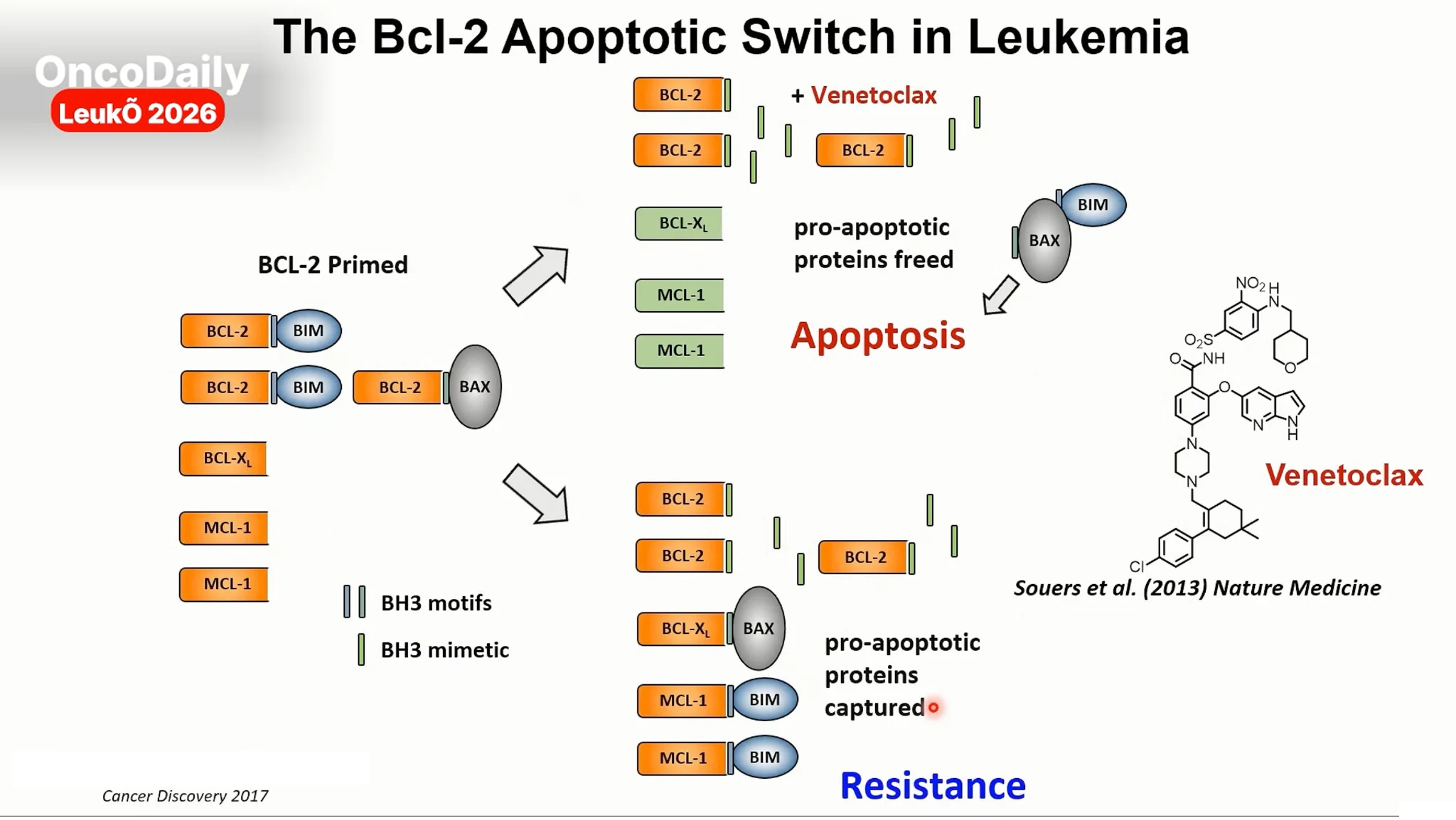
The drug may still bind its intended target, but the leukemic cell finds another way to survive.
These alternative survival mechanisms are particularly relevant in AML driven by certain signaling mutations.
Konopleva discussed the molecular prognostic risk signature (mPRS) developed from studies of venetoclax-based treatment.
The model identifies distinct groups based on mutations in a small number of genes:
- TP53-mutated AML: Generally associated with the poorest outcomes.
- FLT3-ITD- or NRAS/KRAS-mutated AML: Associated with intermediate benefit and an increased risk of resistance.
- AML without these alterations: Generally associated with more favorable outcomes, including subgroups enriched for NPM1 and IDH1/2 mutations.
The importance of this classification extends beyond predicting survival.
It also helps researchers understand which biological pathways should be targeted to improve treatment.
For example, FLT3 and RAS signaling can promote the expression of anti-apoptotic proteins such as MCL-1, reducing dependence on BCL-2.
Other resistance mechanisms involve changes to the apoptotic machinery itself, including alterations affecting BAX, a protein essential for executing programmed cell death.
TP53 dysfunction represents another particularly difficult mechanism because it can interfere with the cellular response to treatment at multiple levels.
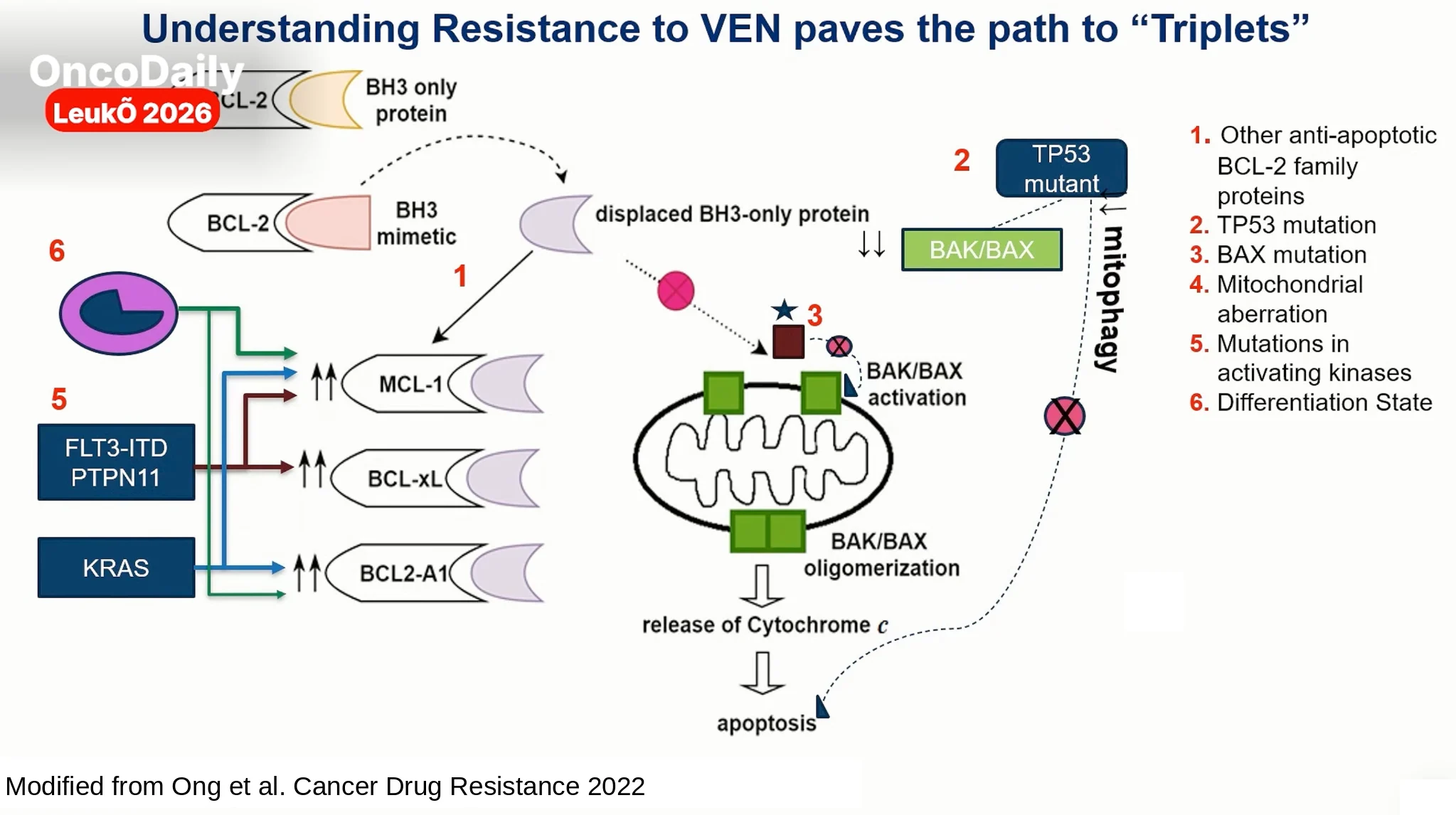
The emerging picture is that AML is not uniformly dependent on BCL-2, even when BCL-2 is highly expressed.
The molecular characteristics of the leukemia help determine which survival pathways remain active when BCL-2 is inhibited.
And that knowledge is now informing the design of new treatment combinations.
FLT3-Mutated AML: Why Two Drugs May Not Be Enough
Patients with FLT3-mutated AML have been a particular focus of efforts to overcome venetoclax resistance.
Although FLT3 inhibitors have improved treatment outcomes, FLT3-driven signaling can support alternative anti-apoptotic pathways that limit the effectiveness of BCL-2 inhibition.
Konopleva reviewed earlier efforts to improve outcomes using FLT3-targeted treatment.
The Phase III LACEWING trial, for example, evaluated azacitidine plus gilteritinib in patients with newly diagnosed FLT3-mutated AML who were ineligible for intensive chemotherapy.
Although the combination improved response rates, it did not demonstrate a significant overall survival advantage over azacitidine alone.
Subgroup analyses of VIALE-A also showed that patients with FLT3-ITD mutations had less favorable outcomes with azacitidine-venetoclax than several other molecular subgroups.
These limitations led researchers to investigate a different strategy: combining a hypomethylating agent, venetoclax, and a FLT3 inhibitor.
The rationale was to attack the leukemia through complementary mechanisms, potentially preventing FLT3-driven signaling from sustaining malignant cells after BCL-2 inhibition.
Early studies of azacitidine, venetoclax, and gilteritinib, including work from MD Anderson Cancer Center, produced encouraging remission rates and evidence of deeper molecular responses.
However, the combination introduced another major challenge: myelosuppression.
Prolonged cytopenias and infectious complications made treatment scheduling especially important.
Konopleva described how investigators adapted dosing strategies, shortening venetoclax exposure and adjusting FLT3 inhibitor treatment according to bone marrow response and blood count recovery.
In some clinical protocols, venetoclax exposure was reduced from the conventional 28-day schedule to approximately 14 days during initial therapy, with further reductions considered in subsequent cycles.
These modifications were intended to preserve antileukemic activity while allowing patients to recover between treatments.
She also highlighted the importance of measurable residual disease (MRD) monitoring.
In early triplet studies, some patients required multiple cycles before achieving MRD negativity, suggesting that the depth of response could continue to improve with treatment.
Further evidence has emerged from the VICEROY study, which evaluated different venetoclax dose levels in combination with azacitidine and gilteritinib.
The early findings demonstrated high response rates, but longer follow-up and comparative studies are needed to determine whether the approach improves survival sufficiently to justify its toxicity.
Konopleva also discussed ongoing research, including the myeloMATCH program and the QUIZZICAL trial, which is investigating a lower-intensity venetoclax-based triplet containing quizartinib against intensive chemotherapy-based treatment in selected patients with FLT3-mutated AML.
These studies may help determine whether targeted triplets can provide an effective alternative to intensive chemotherapy for particular patient populations.
For now, the results remain encouraging but investigational.
The central challenge is no longer simply whether adding another targeted agent increases activity. It is how to combine effective drugs without exposing patients to excessive treatment-related toxicity.
RAS Mutations Reveal a Different Kind of Resistance
Another important focus of Konopleva’s presentation was the relationship between RAS mutations, monocytic differentiation, and resistance to venetoclax.
Historically, AML with monocytic features has sometimes been considered less sensitive to BCL-2 inhibition.
But Konopleva emphasized that the relationship is more complex.
Research from Irene Papapetrou’s group, published in Nature, demonstrated that NRAS and KRAS mutations can promote the development of leukemia stem cells with monocytic characteristics while independently contributing to resistance to venetoclax.
The findings suggested that RAS mutations, rather than monocytic differentiation alone, can be a major driver of treatment resistance.
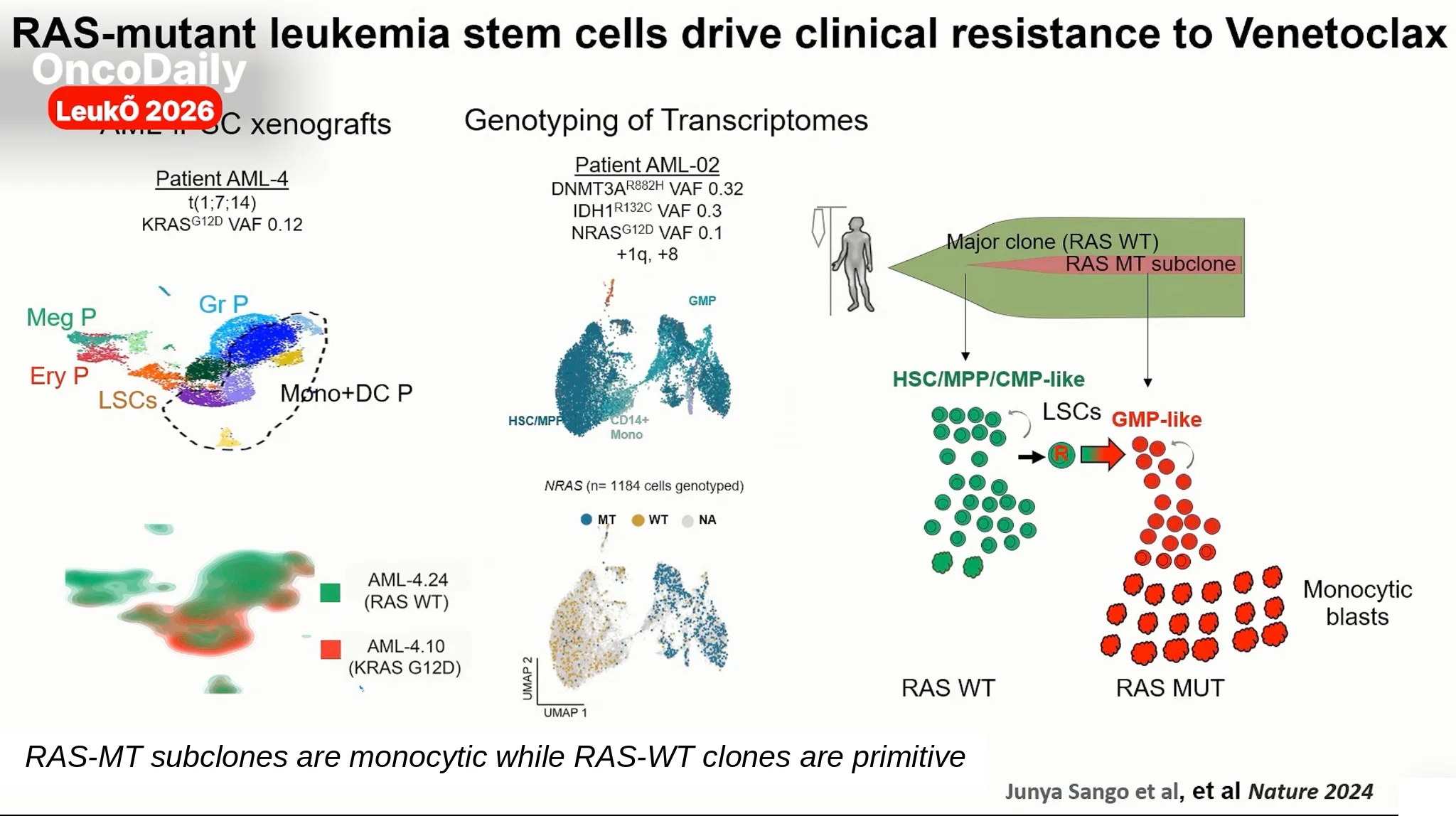
This distinction has important clinical implications.
Konopleva described analyses in which the overall outcomes of patients with monocytic AML were not necessarily worse than those with non-monocytic disease.
However, when researchers examined patients harboring KRAS or NRAS mutations, the prognosis was markedly different.
In a subset analysis of VIALE-A, patients with both RAS-mutated and monocytic AML had a median overall survival of approximately 3.4 months.
By contrast, patients with monocytic AML harboring NPM1 mutations could experience outcomes comparable to patients without monocytic differentiation.
“It’s not necessarily that all monocytic leukemias will be refractory to venetoclax.”
The underlying biology helps explain why.
RAS mutations activate the MAP kinase signaling pathway, which can increase MCL-1 expression and reduce the leukemia cell’s dependence on BCL-2.
This creates a potential therapeutic opportunity.
Preclinical studies have demonstrated that inhibition of RAS signaling can restore sensitivity to venetoclax in selected resistant AML models.
Konopleva highlighted the emerging interest in combining venetoclax-based treatment with inhibitors targeting RAS-dependent pathways.
The development of pan-RAS inhibitors, including agents being investigated in other cancers, has strengthened interest in bringing these approaches into AML clinical trials.
However, RAS inhibitor combinations with venetoclax remain investigational in AML, and laboratory evidence of restored sensitivity has not yet established clinical benefit.
For Konopleva, the importance of this research lies in moving beyond broad morphological categories toward identifying the molecular mechanisms that make an individual leukemia resistant.
TP53-Mutated AML: Could Less-Intensive Treatment Work Differently?
Among the most difficult forms of AML to treat is disease harboring TP53 mutations, particularly when both copies of the gene are affected.
TP53-mutated AML is frequently associated with complex cytogenetic abnormalities, resistance to conventional treatment, and poor long-term survival.
Even with hypomethylating agents combined with venetoclax, outcomes remain unfavorable, with median overall survival often around five to six months in high-risk populations.
Konopleva discussed an alternative approach developed at Montefiore Einstein that challenges conventional treatment scheduling.
Led by Dr. Mendel Goldfinger and colleagues, the strategy involves metronomic administration of decitabine and venetoclax, using both drugs once weekly rather than conventional prolonged treatment schedules.
The rationale is to provide sustained therapeutic activity through lower-intensity exposure while potentially avoiding some of the prolonged cytopenias associated with conventional dosing.
The regimen was initially developed to reduce hospital visits and treatment burden during the COVID-19 pandemic, with subsequent research exploring its activity in high-risk myeloid malignancies.
Konopleva presented findings from a study published in Haematologica involving 40 patients with TP53-mutated disease, including 14 with AML and 26 with high-risk myelodysplastic syndromes (MDS).
Most patients had particularly unfavorable disease biology, including a high prevalence of biallelic TP53 mutations and complex cytogenetic abnormalities.
Despite these challenges, the results were encouraging.
The overall response rate reached 70% in patients with AML and 57% in those with high-risk MDS, using disease-specific response criteria.
Among patients who were transfusion-dependent at baseline, 58% achieved transfusion independence.
Median overall survival was 11.3 months across the entire cohort, including 11.6 months for AML and 9.9 months for MDS.
These results compared favorably with historical outcomes in TP53-mutated myeloid malignancies, but the study was small and did not include a randomized control group.
It therefore cannot establish that the metronomic regimen is superior to standard treatment.
“We find this encouraging, but clearly it’s not curative.”
That qualification was important.
Despite improvements in response, TP53-mutated AML remains a major unmet clinical need, and durable disease control continues to be difficult.
Konopleva explained that patients at her center are actively evaluated for allogeneic stem cell transplantation whenever appropriate, given its potential to provide long-term disease control.
Meanwhile, investigators continue to explore additional combinations, including agents directed against alternative anti-apoptotic proteins such as BCL-XL.
The metronomic approach also offers a different perspective on treatment optimization: rather than automatically intensifying therapy, carefully adjusting the schedule and biological effects of treatment may offer benefits for selected patients.
Whether this approach can improve long-term outcomes will require further clinical investigation.
The Next Chapter of BCL-2 Inhibition
Venetoclax has already transformed the treatment landscape for patients with AML who are unable to undergo intensive chemotherapy.
The PARADIGM findings now suggest that its role could expand into selected patients eligible for intensive treatment, while research into resistance is opening new opportunities for genotype-directed combinations.
For FLT3-mutated AML, investigators are evaluating whether targeted triplets can produce deeper and more durable responses. In RAS-mutated disease, laboratory research is identifying ways to overcome alternative survival mechanisms. For TP53-mutated AML, modified treatment schedules and new therapeutic combinations are being explored in populations that have historically experienced particularly poor outcomes.
Other approaches involving IDH inhibitors, menin inhibitors, and additional apoptosis-targeting agents are also under investigation.
Across these efforts, the scientific question is becoming increasingly specific.
The challenge now is to determine which of these promising approaches can deliver lasting benefits in larger clinical trials, particularly for patients with the most treatment-resistant forms of AML.
Konopleva’s presentation showed how far BCL-2 inhibition has progressed, from early laboratory experiments and disappointing monotherapy results to an established component of AML treatment.
The next advances may come from recognizing that no single mechanism can explain every patient’s response.
For a disease as genetically diverse as AML, the future of venetoclax may depend on understanding not only why it works, but also exactly why it stops working, and what can be done about it.
Written by Eliz Baloyan, MD, Features Writer and Editor at OncoDaily and CancerWorld